
Apostles of Golden Love
Were the Surrealists the First Freudo-Marxists?
Kevin Duong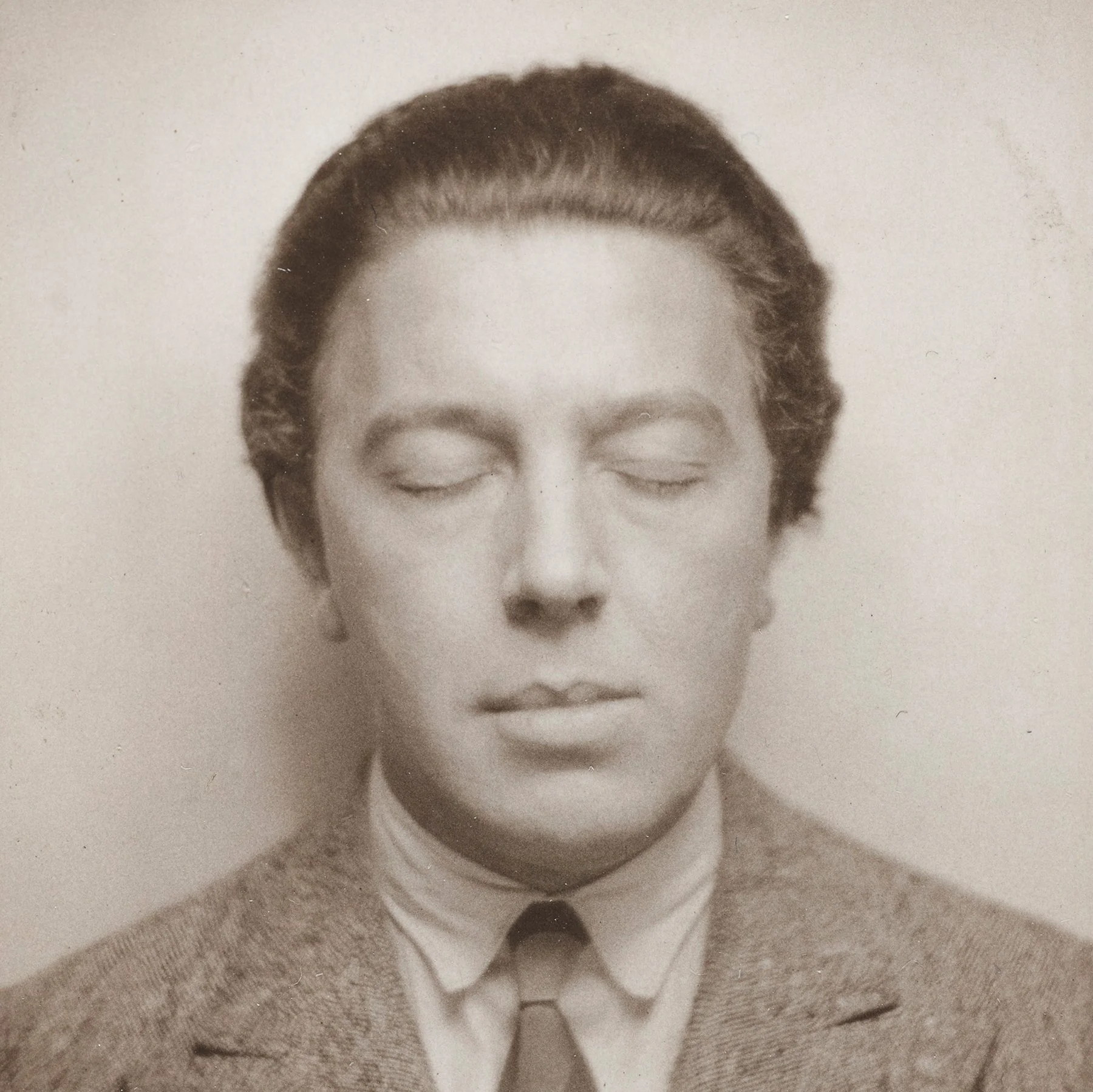
André Breton, Self-Portrait, 1929
For the full archival accompaniment to this essay, including translated letters of between Breton and Freud, please see the print version of Parapraxis Issue 07: Romance.
Strange poets of stranger power, the Surrealists were Freud’s most enthusiastic readers in interwar France. André Breton’s 1924 Manifeste du surréalisme praised the psychoanalyst as a scientist of the highest order who, by rediscovering the unconscious, restored the imagination to its throne. Surrealist essays put Freud’s name on the map in a country where his works were slow to be translated and slower to be accepted. German speaker that he was, Freud was often judged antithetical to the nationalist rationalism of French neuropsychiatry and philosophy. The Parisian Surrealists liked that about him.
The respect was asymmetric. Freud’s letters make it clear he thought these poets were sloppy thinkers. In 1932, after a testy exchange with Breton, he admitted, “I am not able to clarify for myself what Surrealism is and what it wants. Perhaps I am not destined to understand it, I who am so distant from art.” There was one small exception. To Stefan Zweig in July 1938, Freud confided that he considered the Surrealists “as absolute (let us say 95 percent, like alcohol) cranks.” He added, however, that a young Spaniard painter with “fanatical eyes” was making him reconsider. He meant Salvador Dalí.
Surrealism was a rebellion against aesthetic and poetic conformity, an activity rather than a doctrine, a collective wrestling with the social role of the bohemian classes. It can be classified with the historical avant-garde like Futurism, Cubism, or Dada, though its political thought far surpassed these other tendencies. Surrealism internationalized beyond Paris and Zurich to become a lingua franca of global anticolonialism during and after the 1940s, most famously in the Caribbean.
The movement is best known through its most famous painters: Giorgio de Chirico, René Magritte, Leonora Carrington, and especially Dalí. Pictures of melting clocks, monstrous sunflowers battling half-asleep girls, vacant monumental plazas—these are the dreamscapes for which Surrealists have been immortalized in museums, galleries, and art history seminars. Their canonization in painting is ironic, since the first Surrealists understood themselves as waging a war on the written word. Linguistic saboteurs, it was in the realm of poetry, not painting, that they first sought to liberate humankind from its mental fetters.
André Breton was Surrealism’s prime mover. Born in Normandy in 1896 as the only son to a family of doting women, the young man first encountered psychoanalysis while mobilized as a wartime doctor in 1916. Breton was twenty years old and in training, treating the Great War’s wounded soldiers at a psychiatric center in Saint-Dizier. There he read about Freud in texts like Emmanuel Régis and Angélo Hesnard’s La Psychoanalyse des névroses et des psychoses. Freud’s ideas struck him as earth-shattering.
The first meeting of the two doctors came in Vienna in 1921. The occasion caused Breton no small amount of anxiety and, inevitably, the meeting disappointed him. He repaid Freud’s hospitality with some snarky remarks after the fact. “I’m rather glad to say that the greatest psychologist of our times lives in a thoroughly unremarkable house in a forgotten corner of Vienna,” he reported in Littérature. He later blamed these remarks on youthfulness—“a regrettable sacrifice to the Dada spirit.” Freud didn’t take any of it too seriously.
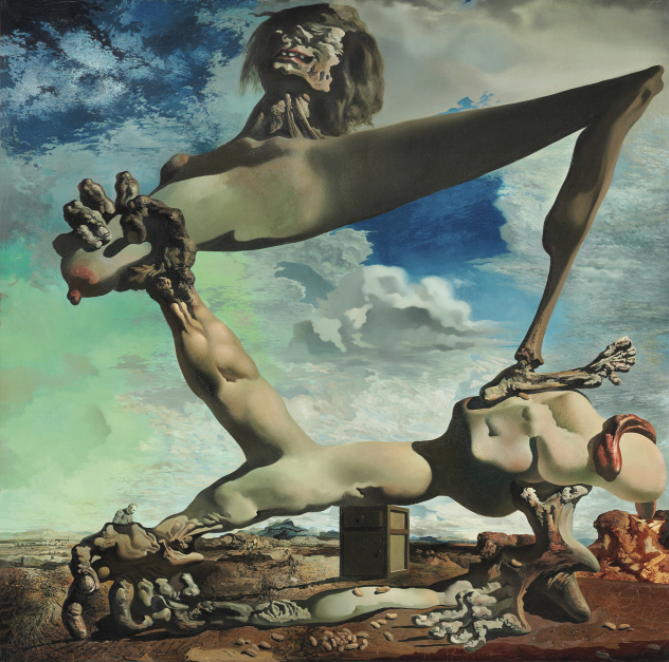
Salvador Dalí, Soft Construction with Boiled Beans (Premonition of Civil War). 1936. Oil on canvas. Philadelphia Museum of Art: The Louise and Walter Arensberg Collection, 1950-134-41 © 2025 Salvador Dali, Fundació Gala-Salvador Dalí / Artists Rights Society (ARS), New York
Their conversations continued: a postcard here, a letter of thanks there. Freud sent copies of his books to Breton with short messages tucked inside on cards. The latter reciprocated in kind. “A humble thanks,” Freud wrote in receipt of the 1924 Manifeste du surréalisme. They kept up the communication until close to Freud’s death. Breton also made sure excerpts and summaries of Freud’s writings were reproduced in avant-garde magazines like the Belgian Variétés and their own La Révolution surréaliste, and later, in exile in the United States, in the wild pages of VVV. He would constellate Freud’s ideas with others over the next thirty years, everyone from Hegel and Lenin to Flora Tristan and Charles Fourier, but “my enthusiastic admiration for Freud,” Breton insisted, “never left me.”
*
Freud was right that the Surrealists were not always careful readers of psychoanalysis. Breton’s annotations of The Interpretation of Dreams indicated a systematic engagement. Consulting his “Giraffe Notebook” reveals the attention he paid to dream’s relationship with madness. But a January 15, 1921, letter to his employer, Jacques Doucet, makes it evident that Breton was sometimes fishing for what was useful to him as a poet, artist, and social critic. That’s probably why the Surrealists don’t appear in histories of psychoanalysis except as dumb poets misusing a science they barely grasp. They’re a colorful output of a clinical practice, never an input.
That hardly mattered to the Surrealists, and it should hardly matter to us. Though some did try to write contributions to psychoanalysis and psychiatric method—Breton’s Communicating Vessels (1932) and Dalí’s Conquest of the Irrational (1935) come to mind—their concern was to put psychoanalysis to political work. An urgent task lay at hand, one that was coming to dominate all others: the fight against fascism.
This point has to be underscored. Surrealism’s antifascism is the reason its political thought should matter to us today. Mussolini seized power in between the 1920 publication of Breton and Philippe Soupault’s Les Champs magnétiques (The Magnetic Fields) and the 1924 Manifeste du surréalisme. Autobiographical accounts from these years make it evident how many young people in France embraced Mussolini and adopted explicit pro-Fascist positions. The most politicized of the Surrealists came to see their experimental activity as a method for neutralizing this explosion of authoritarian desire, even unleashing a flood of counter-desire. Their experimental activity ran parallel to the investigations of their contemporaries like Wilhelm Reich, Simone Weil, François Tosquelles, and Walter Benjamin. The Martinican Surrealist Pierre Yoyotte’s “Réflexions conduisant à préciser la signification antifasciste du surréalisme,” which appeared in June 1934, was the strongest of these interventions, but not the only one. Aimé Césaire’s claim in the 1950 Discourse on Colonialism that Hitlerism was colonialism boomeranged home is much celebrated, but it did not come out of nowhere. It crowned a twenty-five-year effort by Surrealists to theorize the psychodynamics of fascist imperialism.
If there was something that distinguished Surrealism from adjacent antifascist programs, it was probably the pride of place they gave to love. Love: a gate to the marvelous, a moment when chance becomes fate, a blinding feeling which increases our capacity for elemental perception. “What kind of hope do you place in love?” La Révolution surréaliste asked its readers in a 1929 survey. “Would you accept not becoming the person you might have been if this were the price you had to pay for fully enjoying the certainty of loving?” Years later, in a radio interview with André Parinaud, Breton was at pains to remind listeners that for all of its automatic poetry, its flamboyant sculptures, its penchant for street provocation, “Surrealism has had an enormous capacity for love, and [. . .] what it violently condemned were precisely the things that impaired love.”
These poets and artists were apostles of golden love and its black sun, lust. They were convinced love was both a cause and effect of human emancipation, at once key to the social revolution’s ignition, yet realizable in full only on the other side. “The extermination of love and the confinement of dream,” the Martinican poets of Légitime défense proclaimed, is “generally known under the name of Western civilization.” Love had to be exterminated because, in Louis Aragon’s words in “Une vague de rêves,” it was linked to “the edge of the night and crime,” to subversion. Love had nothing to do with the bourgeois family’s functionalism, its organization around reproduction and wage labor.
Love was an alchemical reagent that transformed pessimism into revolutionary action, Georges Bataille concluded in a 1938 essay, “L’Apprenti sorcier”: you can’t start a revolution without it. Love was a treasure from childhood, René Menil wrote three years later in “Introduction au merveilleux.” It is “the most valuable of all, the cause and effect of all desires,” and that which made “the intolerable limits of everyday life” fall away like lace.
“If there was something that distinguished Surrealism from adjacent antifascist programs, it was probably the pride of place they gave to love.”
Readers are likely familiar with Freud’s view of love as a destabilizing power, too. In Civilization and its Discontents, the psychoanalyst observed love’s tendency to destroy the boundary between things which were supposed to be bounded—to enact something like surreality. Outside of psychopathology, Freud wrote, love was the state where the ego lost its way. “Against all the evidence of his senses, a man who is in love declares that ‘I’ and ‘you’ are one, and is prepared to behave as if it were a fact.” The latter half of this sentence deserves our emphasis. Love, Freud thought, was an enabling and capacitating delusion.
Of course, declaring “I and You are One” and behaving as if that unity were a fact does not make it a fact. Being in love establishes a unique relation to another, but it neither describes nor explains that relation. Yet the public world is a strange thing. Surrealists and their fellow travelers appreciated, better than most, how much our common world is shaped by our acting as if: as if we are self-sufficient rational individuals, as if market exchanges unfolded between equivalent values, as if sex is binary, as if states have a right to exist, as if nature were an infinite resource, as if yesterday and today will predict tomorrow and the day after.
Thus these lovers of games would play one of the century’s greatest games. If love could be made lord, if we could only fall in love with love—inside a web of polycules, perhaps?—couldn’t we unleash, like a sorcerer’s apprentice, a world that was in fact more whole? Wouldn’t this, Bataille wondered, be real magic?
*
There is a story about love that is repeated in North American university lecture halls year after year, like a priest’s benediction. The plot has stayed roughly the same for three-quarters of a century. Overseeing its transmission are teachers of Political Theory 101, of which I happen to be one. It is a story all the more beloved for how anachronistic it is.
In Plato’s Symposium, we dutifully point out, Aristophanes explains that love is the result of Zeus slicing an ancient species of androgynous human in half, “the way people cut sorb apples before they dry them.” Sundered in two, the weakened rumps need each other. “This, then, is the source of our desire to love each other. Love is born into every human being: It calls back the halves of our original nature together; it tries to make one out of two and heal the wound of nature.”
This picture of reparative love sounds cozy. But the search to “make one out of two,” to connect, is a principle of disorder. It offers a precise image of what happens when power accumulates from below to people who have no power. “Consider Jesus Christ in the Sermon on the Mount,” the political theorist continues. “Whatever else it may be, the New Testament is a systematic critique of vengeance, the idea of justice as an eye for an eye or a tooth for a tooth. Christ offers listeners an alternative vision of justice as unconditional love, unbound by rank and allegiance. The bonds of universal love lead him to proscribe private property like a proto-communist. Love makes him into an enemy of established authority.” Here, one invites objections and then dispatches them.
Lectures may follow on Emma Goldman’s critique of possessive love; on Leo Tolstoy’s arguments for the supremacy of love over violence; on Hannah Arendt’s worry that love is antipolitical, irreconcilable to the spheres of speech and action. There is a smidgen of wiggle room here in this second act, but the finale is settled. One squeaks on the chalkboard, from Martin Luther King Jr.’s “Letter from a Birmingham Jail,” “Will we be extremists for hate or for love?” One underlines King’s exalting invocations of Socrates and Christ to bring the semester full circle; the tip of the chalk snaps.
If it feels clichéd that Surrealists treated love like Promethean fire, that’s because it was. How many of them understood that they participated in a long history of revolutionary love? French-speaking or otherwise, their formation tended to be philosophical and poetic rather than political. Many of them were fed a diet of Romantics, like Gérard de Nerval and Blake; philosophers like Descartes and Hegel; and modern poets like Baudelaire, Rimbaud, and Comte de Lautréamont. It was an atypical formation, but not a rare one. Aimé Césaire taught the same curriculum to Frantz Fanon at lycée, too; Breton and Surrealism were now added.
Breton, for his part, admitted he hadn’t understood the concept of revolution until the mid1920s. He vaguely associated it with the Jacobins or the Paris Commune, but did not think of it as something people did methodically. This belated political education may explain why Surrealist faith in revolutionary love feels fresh, despite being trite. It wasn’t knowing or practiced. As with first love, naïveté endowed some of their corny fixations—like Musidora (Jeanne Roques) in the 1915 seven-hour hit film Les Vampires—with an earnestness that bordered on the imperious.
These radicals disagreed on what love meant. Friends and critics alike laughed at Breton for worshipping amour courtois, “courtly love.” Simone de Beauvoir would later castigate him, rightly, for making women into Woman, pure symbol. And, unlike most of his friends, Breton disliked promiscuity and homosexuality. Lust, he said, lacked the element of sublimation. Love was supposed to be ennobling and fateful, like a full moon. Beginning in the late 1920s, Bataille forwarded his “base materialism” to challenge both Stalinism and Breton’s courtly love. Feces, sadism, the pain of pleasure: these, Bataille believed, contained more subversive potential than either socialist realism or sweet nothings on a summer night. The subsequent conflict between the two men is infamous. In his Second manifeste du surréalisme (1930), Breton denounced his former friend’s “obnoxious return to old anti-dialectical materialism, which this time is trying to force its way gratuitously through Freud.”
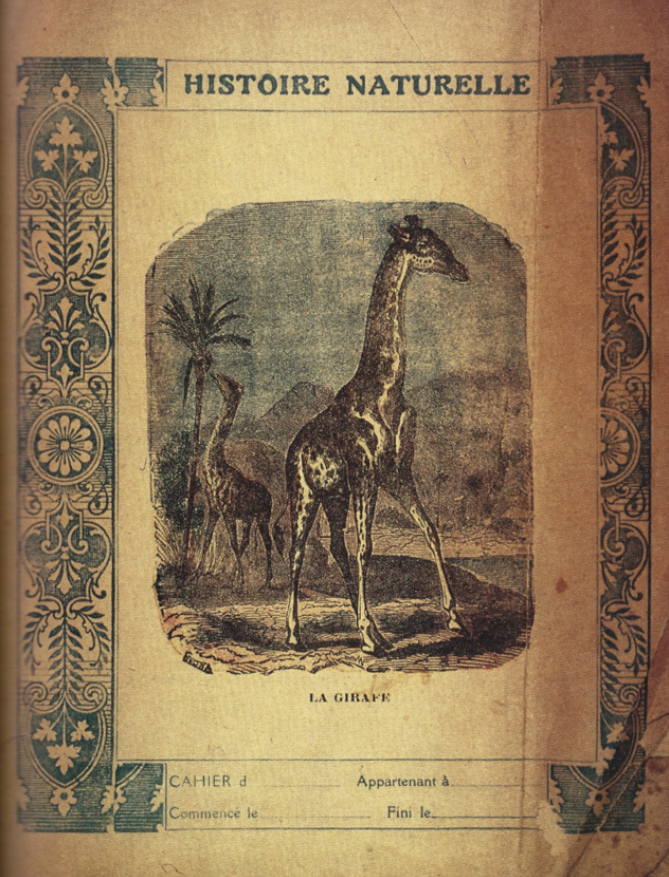
André Breton, “Cahier à la girafe” (1927–1931). Bibliothèque littéraire Jacques Doucet, Paris. © 2025 Artists Rights Society (ARS), New York / ADAGP, Paris
In fact, when it came to love, Surrealism’s pope and its apostate shared conspicuous similarities. Those similarities are what strike us today, for Bataille and Breton both treated love as a solution to the problem of revolutionary action. In his landmark “L’Apprenti sorcier,” Bataille was emphatic that star-crossed lovers held more power between them to transform reality than the most dedicated socialist parliamentarians of the French Third Republic. Unlike realistic politicians, lovers actually believe. They are in love. The hermetic world enclosing them is a fiction, but they are prepared to act as if this fiction is fact. That is why they act against the reality principle, why they alone defy it. Family disapproval or financial ruin be damned: we will be together.
That love is delusional in its conviction is its strength, for conviction, which love makes possible, is also a necessary condition for being an antifascist. There is an extraordinary statement by the German socialist Hans Fittko to this effect. In 1940 and 1941, Hans and his partner Lisa smuggled persecuted intellectuals, including Walter Benjamin, out of Nazi-occupied France. Hans was once misunderstood to be doing this illegal work for profit. Insulted, he replied, “Do you actually know what an anti-Fascist is? Do you understand the word Überzeugung, convictions?”
The tight connection between love and conviction is the subject of Breton’s great novel on love, Nadja:
[O]ne evening, when I was driving a car along the road from Versailles to Paris, the woman sitting next to me (who was Nadja, but who might have been anyone else, after all, or even someone else) pressed her foot down on mine on the accelerator, tried to cover my eyes with her hands in the oblivion of an interminable kiss, desiring to extinguish us, doubtless forever, save to each other, so that we should collide at full speed with the splendid trees along the road. What a test of life, indeed! Unnecessary to add that I did not yield to this desire . . . I am no less grateful to her for revealing to me, in such an overpowering way, what a common recognition of love would have committed us to at that moment.
It is a difficult thing, Nadja shows, to put your life on the line for convictions. Love is “a test of life.” But that is precisely why, as when we act out, love forgets reality’s rules and leads one to defy it and so change it. “Love, the freest, the most powerful moulder of human destiny,” Emma Goldman once wrote in “Marriage and Love.” In a world of realists and compromisers, this kind of conviction does not come easily. Once encountered, it leaves its mark. Of Nadja’s provocation, Breton’s narrator admits, “I feel less and less capable of resisting such a temptation in every case. I can do no less than offer thanks in this last recollection, to the woman who had made me understand its virtual necessity.”
“Unlike realistic politicians, lovers actually believe. They are in love. The hermetic world enclosing them is a fiction, but they are prepared to act as if this fiction is fact.”
This is mundane stuff, but sometimes mundane stuff is the least understood. Conviction was singularly lacking in Breton’s generation: the liberal politicians who appeased Nazis in the name of realistic statesmanship; the party communists who got so turned around in their labyrinthine excuses for Stalin that they forgot why communism won their hearts in the first place; and some Surrealists, too, like Dalí, who later ditched his friends for Francoism when wealth and contrarianism seemed more interesting. No less than Emile Durkheim, the most famous French sociologist of Breton’s youth, spent his life arguing that moral conviction was an enigmatic phenomenon—so strange and rare, indeed, that he, even more than Freud, compared it to religious experience. True conviction is anything but mundane. It is the highest mental achievement of collective human existence.
*
Over the years, love helped Breton figure out his relationship to Marx. In the summer of 1925, about one year after the publication of the Manifeste du surréalisme, the French army joined Spain in its repression of the rebelling Riffian tribes in the Moroccan protectorate. Leading the repression was none other than Philippe Pétain, Vichy’s future head of state. Horror and revulsion at this imperialist aggression led the Parisian Surrealists to throw their public support behind the leader of the Riffians, Abd el-Krim, then president of the short-lived Republic of the Rif. So it was that Surrealists fell into a decades-long war against colonialism, which to this day remains underappreciated. The Haitian revolt against the dictator Élie Lescot, the Algerian revolution, the Vietnamese independence struggle—these would become some of their most important causes. “Wherever Western civilisation is dominant,” they proclaimed with their Marxist friends, “all human contact has disappeared.”
The move into anticolonialism brought Parisian Surrealists into contact with communist politics. Breton reviewed Trotsky’s biography of Lenin in La Révolution surréaliste and found himself swept away. A genuine, and doomed, effort followed from the Surrealists to integrate themselves into the French Communist Party. This effort fatally split the Parisian group. The Czech Surrealists had better luck, enjoying for a time official sanction from their national party. A few of them even joined Tito’s government. And there was occasional sympathy from the other side, however limited. Georges Politzer and Henri Lefebvre appreciated what Breton and his friends were trying to do.
But how to square Marx and Freud? Can this be done? The official position was that psychoanalysis had something to learn from Marxism, but not the other way around. When a committee of the French Communist Party interviewed Breton for party membership, they asked him why he needed to be a Surrealist if he was a Marxist. Posed with utter contempt, it was nevertheless a genuine question. Aragon and Michel Leiris were among those who, at different times, admitted they had no good answer.
In a forthcoming article, “Claude Cahun, Freudo-Marxism and Poetry’s Political Action,” Jackqueline Frost suggests we can divide Freudo-Marxism into amalgamating and aggregating types. The distinction is an important point of departure. An amalgamating strand is familiar through critics like Wilhelm Reich, Herbert Marcuse, and the Lafargue Clinic’s Hilde Mosse and Fredric Wertham. These thinkers believed that a synthetic account was both possible and necessary. If there was going to be something like Freudo-Marxism, it would have to take the shape of an integrated social theory whose power was measured by its comprehensiveness and cohesion. Consider the following thesis which offers an example of amalgamation: fascist imperialism is propelled by the unmet emotional needs of a defensive middle class. They lack the wealth to satisfy those needs through consumption, Pierre Yoyoette suggests, but are insulated from the debilitating poverty that would make material needs override their emotional ones.
What Frost calls the aggregating strand includes most Surrealists. Juxtapose Marx and Freud side by side, like a collage, and watch the sparks fly. This strand includes later critics like Stuart Hall, who measured the power of Freudo-Marxism by its willingness to let the tensions stand. “That is the problem,” Hall explained in 1987. We need to “speak both these languages together in some way [. . . .] But all the forms of correspondence or relationship between them which we have of them are inadequate.” Here the aim is not unification of explanation but multiplication of perspectives. Consider two more theses which we might aggregate: colonial expansion is caused by finance capital’s search for new markets in an era of monopoly capitalism (says Lenin); colonial expansion is spurred by a “Nero complex,” an oppressor’s futile attempt to legitimate, in their own minds, their stolen authority by oppressing victims so much they seem to deserve their domination (says Albert Memmi). Both are probably right, but not for the same reason.
Sometimes Surrealists were honest about their tendency toward aggregation. In a brilliant June 1942 essay in VVV, the playwright and critic Lionel Abel explained to readers in no uncertain terms,
We intend to “hold the step gained.” Since our goal in everything is freedom, we reject the lie of an “open universe” in which anything is possible, and we support those doctrines which indicate how man’s acts are circumscribed. Thus we support Historical Materialism in the social field, and Freudian analysis in psychology.
The problem, the whole drama, is that we are at once creatures of biology and subjects of history. We have reproductive organs, but we also have sexuality. We have to procure our subsistence, but we procure through modes of production. By virtue of this conjunction, we are vulnerable to being shackled twice over. In a 1942 essay in Tropiques, Suzanne Césaire named one controversial example: “pseudomorphosis,” the collective absorption by a colony’s middle class of a colonist’s way of life, such that their bodies, hysterically, no longer know they are unconsciously imitating an illness.
The nature of Breton’s Freudo-Marxism shifted as the crises of the era mounted and transformed. In 1924 he firmly believed in the unconditioned rights of the imagination. He wasn’t that far from Tolstoy who, fifteen years earlier, wrote “only one thing is necessary” for love to triumph: “men should believe in the law of love in the same way that they now believe in the inevitability of violence.” His engagement with the French Communist Party over the next decade made Breton abandon his philosophical idealism. In truth, he conceded, imagination was feeble without organized, militant action. Hence the “primacy of matter over mind,” as the saying went. Texts from these years show Breton modifying Freud with Marx in an effort to make the former more dialectical and less dualist. Well before World War II, however, this concession collapsed in turn. Rigid party discipline meant violating the very reason Surrealists had joined the fight against fascism: to increase mental freedom.
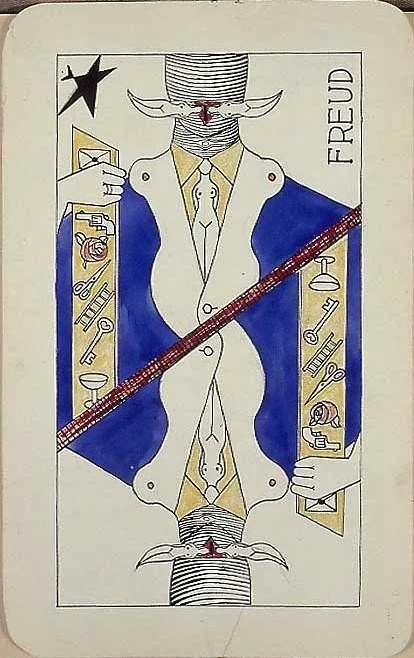
Oscar Dominguez, Le Jeu de Marseille, 1940. Musée Cantini, Marseille and Association Atelier André Breton. © ADAGP, Paris.
Thus did Breton arrive at his own idiosyncratic path that was neither agglomerative nor aggregative but dialectical. Breton would fight for the social revolution on behalf of love. He would support the communist revolution not for its own sake, but to create a future world in which an honest experience of love might be possible.
Criticizing Freud via Friedrich Engels, Breton’s Communicating Vessels already put the matter clearly. “[O]nly a radical social change whose effect would be to suppress, along with capitalistic production, the very conditions of ownership special to it could cause reciprocal love to triumph on the level of real life.” At present, he wrote, love “trips up miserably” because of “economic considerations,” but that is precisely what made social revolution so urgent. “Human love must be rebuilt, like the rest: I mean that it can, that it must be reestablished upon its true bases.” Someday, Breton hoped, men and women might give themselves to each other not because of money or obligation or power, but because they are free.
Michael Löwy was right to call Surrealism “that supreme mental location where the libertarian trajectory meets revolutionary Marxism”—a “libertarian Marxism.” The contradiction, long embraced by anarchists, may not be contradictory someday. Surrealists wrote poetry where, as Breton wrote, “words make love.” They placed words next to each other in defiance of grammar so that their lovemaking might produce a beautiful shock that never should have been. They pasted together conflicting images in collages so that, sometimes, an unexpected illumination could break out in defiance of logic. They brought together people who common sense said could not be allies “to make,” as Aristophanes said of love, “one out of two and heal the wound of nature.” One reads in “Freedom is a Vietnamese Word,” their 1947 denunciation of French colonialism in Indochina, “Surrealists, whose great objective as always is the liberation of mankind, can hardly remain silent at such senseless and revolting criminality [. . .] Surrealism therefore vigorously protests this imperialist aggression and addresses its fraternal salute to those who incarnate, at this very moment, the becoming of freedom.”
“Someday, Breton hoped, men and women might give themselves to each other not because of money or obligation or power, but because they are free.”
Surrealists despised logic, Breton said, because they wanted to destroy a false reason on behalf of a “true reason” that grasped that I and You are One, empire and class and race and sexual difference and all the rest, ad infinitum, be damned. We are meant to be together.
As World War II wound down, Breton discovered the utopian socialists. The Vichy regime had judged his works the purest negation of French fascism. Breton fled into exile, first to Martinique, where he met Suzanne and Aimé Césaire, and then to the United States, where he traveled around Nevada, New Mexico, and Arizona. There he met Pueblo Indians (the Hopi and the Zuni) whose dignity and creative genius stole his heart. He also composed the stunning Ode to Charles Fourier. In the natural environment surrounding him, in the people who welcomed him, and in Fourier’s political theory, he found a concern for collaborative life, a defense of women’s emancipation, and proof that the dualism of ruler and ruled is not inevitable.
Fourier standing out clearly against the greyness of ideas and
aspirations today your light
[. . .] the real lever remains nonetheless the unreasoned belief in the
movement toward an edenic future and after all that is
also the only leaven of the generations of your youth
This late ode to utopian socialism at last reconnected Surrealism to its own history of revolutionary love. When Breton proclaimed in the 1924 manifesto that a point existed at which the contradictions of waking and dream life fell “into an absolute reality, a super-reality” called surreality, he was dreaming as Fourier dreamed more than a century earlier. Fourier had imagined that socialist reform would usher in climactic changes so extreme that oceans would taste of “aigre de cèdre,” citrus julep. Likewise, when Breton claimed that surrealism’s supreme aim lay in uniting our interior and exterior life, he wished the same wish that drove Fourier to design intentional communities not around the management of conflicting egotistical interests, but the complementarity between erotic and gastronomical pleasures.
Or, better yet, Breton and the Surrealists wished for the same thing that Flora Tristan, Breton’s other favorite utopian socialist, wished: for a union of all working-class men and women. Is there a more surreal wish than that? All working people of all sexes will unionize, Tristan predicted, because their collective international power will secure them the most important thing in the world: the material power to guarantee their mental freedom. Tristan imagined universal unionization would allow workers to develop their psychic lives in proletarian “palaces” they would fund and build themselves. “Men, women, and children will all work” in these palaces, Tristan explained in her 1843 The Workers’ Union. But “since they will not have to worry about their material existence, they can choose to try whatever they want without hesitating.” It is as if every revolutionary of love in this vast history is trying to remember in their own way, desperately, what Freud refused to remember in Civilization and its Discontents: oceanic feeling, a feeling so destabilizing that it permits things to connect which are not supposed to connect. To make one out of two.
The Surrealists’ revolution of the mind expressed an “unreasoned belief in the movement toward an edenic future” that, I’m tempted to say, is idealist in the final instance. What is pathetic about our world is how capitalism has damned it to materialism. It has damned it to be determined in the final instance by material forces. But for these Freudo-Marxists, it should be ideas, it should be imagination, it should be love that set the color and rhythm of collective life. Yes, the Surrealists conceded, the Marxists of their day were right. Matter is supreme over mind. But they did not want communists to forget that the point of being a materialist was to create a situation where the reverse might be true someday, where mind is liberated from matter. This is the dialectical dream at the heart of Surrealism. “The poet to come,” Breton wrote in Communicating Vessels, “will surmount the depressing idea of the irreparable divorce between action and dream. He will hold out the magnificent fruit of the tree with those entwined roots and will know how to persuade those who taste of it that it has nothing bitter about it.”
Tolstoy and King might have been right that one has to become an extremist for love to surmount the world as it is. Nadja might have been right that love teaches us what it means to put one’s life on the line, to command the reality principle to bend the knee. Revolutionary love is, as Christ insisted, a threat to the established order. To rebuild love in the future, it might be necessary to save love now. Somewhere in this wild spiral where effects become causes and illogicality yields true insight, moral conviction takes root.
Devil knows that’s in short supply today.