
Bride at the Refugee Camp
Notes on Martyrdom and the Palestinian Wedding-Funeral
Laura al-tibi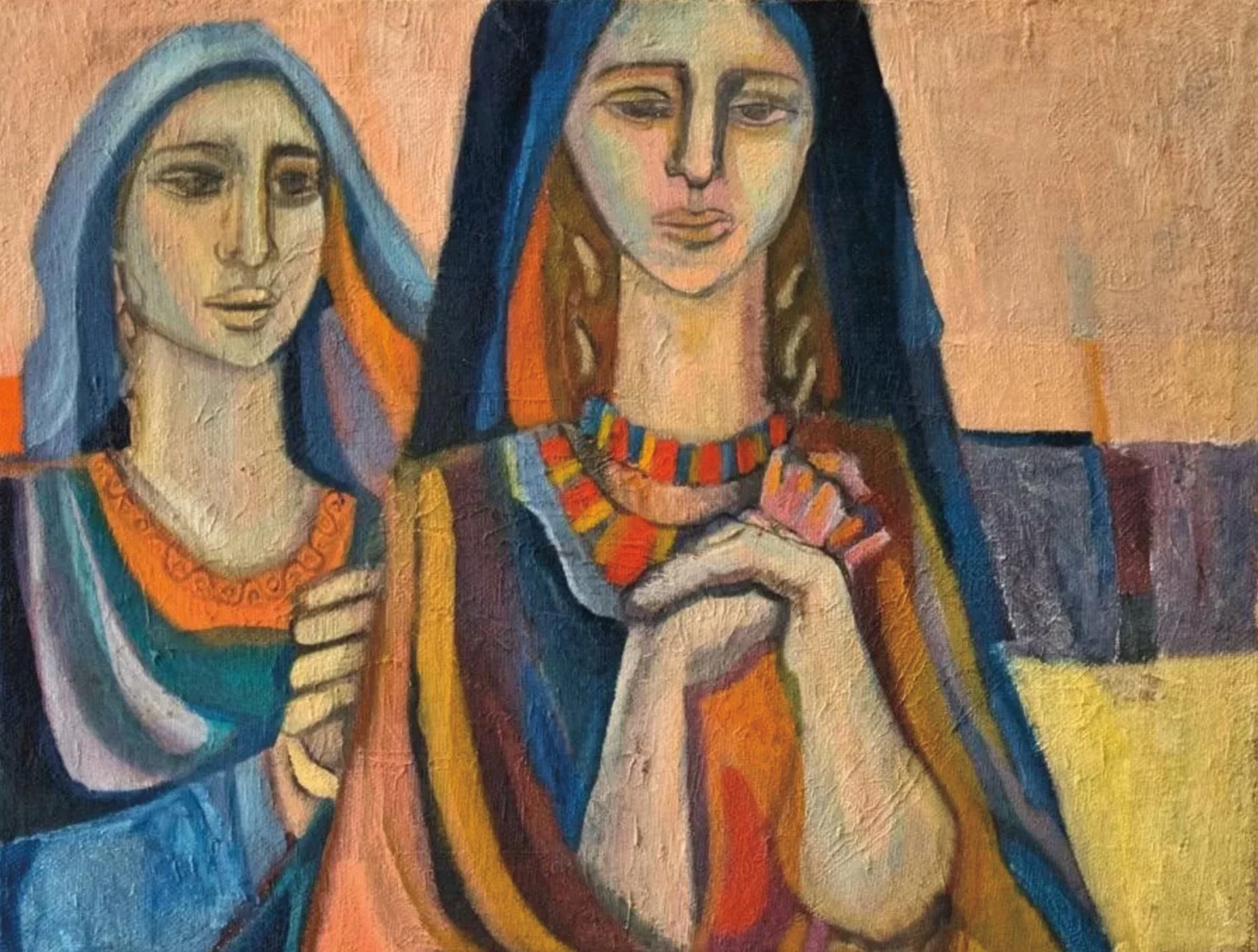
Abed Abdi, Bride at the Refugee Camp, 1979, gesso and oil on canvas, 60 x 75 cm. Collection of Barjeel Art Foundation, Sharjah
And he walked toward the mint of the home,
Planting narcissus atop his helmet,
When the camp reverberated with its bleeding dabke,
Distant Sara, solitary Sara, all the faces of the young girls were Sara
And the evening was grey,
The golden expanse a vessel for Sara’s blossoms
He gathered her limbs from the songs of fugitives
In the rings of the camp,
Muhammad was singing to the mint of the home in wakefulness,
That binds the spring to the sand
And blood to jasmine
All the houses sealed the dirge of the wound,
Shaping a dream toward wheat,
A day toward the morning . . .– Muhammad Al-Qaisi, from A Vessel for Sara’s Flowers, Thyme for Her Orphans, 1979 [1]
Against a flattened horizon, finery and a flower on the cusp of bloom animate an otherwise still and doleful bride. She possesses a solemn frontality, resembling a relief sculpture whose features sink in heavily carved furrows. A downcast gaze stems the swell of tears, while a tautly rendered throat betrays a lump in tawny yellow and white. Her monumental presence and elongated neck evoke classical images of indigeneity within the Palestinian artistic canon. Yet the romantic archetype of the stocky, rooted peasant woman blissfully tending abundant orchards is here inverted into a wilted figure, set against a backdrop of low-lying structures—possibly tents or the makeshift shelters of corrugated zinc and concrete. The painting’s title further confirms the setting, cohering the slate blue forms under the loaded signifier of the refugee camp.
Palestinian artist Abed Abdi (b. Haifa, 1942) painted Bride at the Refugee Camp in 1979, the same year Palestinian poet Muhammad al-Qaisi (b. Kufr ʿAana, 1944–2003) published his book-length poem, A Vessel for Sara’s Flowers, Thyme for Her Orphans. Both works adopt a simultaneously celebratory and elegiac register, invoking the visual, semantic, and ceremonial forms of weddings and funerals. They also fall squarely within the spatial and historical parameters of the Palestinian refugee camp, appearing three years after the massacre at Tal al-Zaʿtar refugee camp in Beirut, which al-Qaisi’s poem directly laments. Their twin births and thematic overlaps compel a composite reading, leading me to append selections of al-Qaisi’s poem to Abdi’s painting. I do so while consciously mirroring the trajectory of Abdi’s artistic practice, which developed alongside text—from his role as a graphic designer at al-Ittihad newspaper to his manifold illustrations accompanying the literature and poetry of Samih al-Qasim, Mahmoud Darwish, and Emile Habibi, to name a few.[2] Taking narrative cues from select stanzas and stitching various sources and critiques on top of al-Qaisi’s poetry, I craft and guide my own interpretation of Bride at the Refugee Camp: The bride, I propose, mourns the martyrdom of her beloved, a freedom fighter killed on his wedding day.
The collation of Abdi’s painting and al-Qaisi’s poem further provides fertile aesthetic and historical ground from which to read Palestinian weddings and funerals—or, as this essay tenders, the Palestinian wedding as funeral. This ceremonial collision is both metaphoric and concrete; the legibility of the metaphor calls for a material grasp of colonial violence, squared with anticolonial political sacrifice or martyrdom and its attendant commemoration. Palestinian martyrdom is understood as a physical and transcendental reunion with the land, popularly expressed and officiated in matrimonial terms. Al-Qaisi’s poem, which narrates the martyrdom of a young man named Muhammad, doubles down on the metaphor and rehearses the ceremonial rites of this (re)union: The martyr-groom is delivered to his beloved homeland in a mass procession activated by cathartic chants and ululations, at once woeful and celebratory. The feminization of the land and its representation as a usurped and violated bride is a recurring and powerful metaphor in the Palestinian national tradition (as in many anticolonial nationalisms), spanning literature, poetry, and national chants and charters.[3] Sara, the poem’s reclusive bride, does not register as any specific woman but, in accordance with the burgeoning national canon, represents an allegorical embodiment of the homeland awaiting her lover’s return. Abdi’s painting, however, compels a reconsideration of this familiar trope, shifting focus to the real, non-allegorical bride, whose forlorn expression and conspicuously absent groom signal his martyrdom. Still, the image perilously hovers over iconicity as infinite Saras converge in Abdi’s nameless bride, mourning over a century of martyrs.
Rallying CallsWorthy of this evening wedding,
This final culmination,
Between flame and spark
Worthy that all homes and sparrows,
Begin their crimson chorale
And Sara emerges from the bosom and grave,
Drinking his pure tear
Let the horizon blaze at his wedding,
He now spreads his ribs and swathes the wasteland
Welcome, oh welcome, greetings
“His blood cloaked the earth in crimson
And thickened the breeze with the fragrance of youth”
Welcome, oh welcome, greetings
The Chorus: Welcome, oh welcome, greetings! [4]
Martyrdom, a term whose very enunciation in Arabic is etymologically bound to witnessing, is understood as a sacrificial devotion to cause and testimony to truth. The symbolic realm of language, however, struggles to encapsulate the somatic impetus of revolutionary action. “For is there anything more eloquent and articulate than the act of the martyr?” mused Basel al-Araj, who, despite studying and ruminating on the wills of Palestine’s martyrs, only came to this realization on the brink of his own martyrdom, as though his brush with truth necessitated ascension.[5]
The martyr’s will/act manifests as a sacred covenant with the land, formalized by funerary rites that merge with wedding rituals. This formal blurring is not just a metaphor, however potent; rather, it is a negotiation of the form and forum of two ceremonial events which structure themselves around the collective. Their legibility is incumbent on an anticolonial framework consecrated through communal practices that escape the liberal seclusion of the personal from the political.
Palestinian weddings and funerals affirm peoplehood through shared joy and grief, while often constituting sites of contestation. It is not solely the form of the Palestinian wedding-funeral that generates its revolutionary currents, but the social relations therein. The collectivity summoned by their forms gives way to an embodied political consciousness that consolidates speech with practice. This materializes across generational lines as children, youth, adults, and elders all partake in these ceremonies.[6] The very proximities they bear to martyrs and revolutionary actors, which remain emphatically classed, place the wedding-funeral as a site of political mobilization. During the freedom fighter’s funeral, the domain of armed resistance, often tucked in labyrinthine circuits, spills onto the streets en masse as guerillas—fathers, sons, brothers, and uncles—flash their firearms, marching shoulder to shoulder with their kin. Their presence shatters the liberal ideological compartmentalization of armed struggle, which mechanically assimilates all Palestinian men and boys into the juridical category of “terror,” siphoning them off from their communities and rendering them legitimate targets.[7] Whatever mystique might have shrouded the martyrs and distanced the arms-bearing youth is, in the funeral, laid bare. Here, the collective assembles around the word/act of the martyr, whose testimonial ignites the rallying calls of the camp and illuminates its path to liberation.
“Precisely because they mark a joyous occasion, many Palestinian weddings are always already charged with revolutionary will and burdened with past and potential grief.”
The Palestinian wedding similarly solidifies anticolonial consciousness and imparts revolutionary history across entire communities in a form that evades colonial repression. I am not suggesting that joy provides cover for the gravitas of revolutionary politics—on the contrary, the two are inseparable. This is evident in the songs and ballads ceremonially enacted at weddings, which typically open with sentiments of love before smoothly transitioning into an account of life under colonial oppression. Love, in this context, is imbricated with the land, both as an object of melancholic longing and as a direction toward revolutionary action whose path is paved by the sacrifice of its martyrs. The thematic shift in such songs occurs under the same melody and tonal register, so seamless that it escapes the notice of outsiders. Ruanne Abou-Rahme has described this practice as a form of coding, where messages of resistance are safely communicated between confessions of love and the quotidian banality of colonial subjugation.[8] We might also read the slippages as a collapse between the “hard” category of militancy and the “soft” category of intimacy, itself an imposed binary operating under the assumption that love is apolitical and external to resistance. Precisely because they mark a joyous occasion, many Palestinian weddings are always already charged with revolutionary will and burdened with past and potential grief. As Mahmoud Darwish famously put it, “Never will lover reach lover / Except as martyr or fugitive.”[9] His verse is not merely romantic elegy but, like Abdi’s painting, registers as material fact, so commonplace that the inevitability of martyrdom and fugitivity has hardened.
The mother’s chantThe burdened body presses on, driven to islands
No shores to contain them, no windowed home
No songs
Here the cages penetrate the innermost folds,
And the eyes bound by chains and primitive death
Swimming in Arab blood,
The time for flight is neither here,
Nor does the beginning end
The trees told him something
And the horizon roared,
With blood and neighing
His hands were waving and sketching
Shapes on the city gates
Inscribing his emblem
And the Prelude to entry in Arab green,
Did he read his coming day and understand
What the prairie’s steeds foretold!
(Arab silence) [10]
“They shot Ibrahim,” declared Huda Jarrar during the funeral of her son, Ibrahim al-Nabulsi. “On the contrary, there are one-hundred Ibrahims . . . You are all my sons . . . You are all Ibrahim.” The chorus of mourners thickened, resounding their prayers and chants: “Mother of the martyr, lucky one / I wish my mother were in your place.”[11]
It is difficult to grasp the almost mythological stoicism of Palestine’s bereaved mothers. However, reducing their conviction to national iconography depersonalizes loss and sublates the spiritual rites of mourning into secular performance. It also burdens the bereft mother with the expectation of defiance. This is not to exclude fathers and grandfathers from public mourning; the bereavement of Jamal al-Durra, Wael al-Dahdouh, and Khaled Nabhan—all of whom are from Gaza, where paternal grief is forcibly externalized—come to mind. Although beyond the scope of this essay, it is worthwhile noting that the grief of the martyr’s father is not as canonized as that of the mother, who appears more as iconic than as individual, her defiance easily absorbed into allegory.
In his 2004 novel Amnah’s Weddings, Ibrahim Nasrallah addresses the numbing expectation of maternal resilience through the voice of an exasperated mother: “Must we ululate all the time? Why? Because our sons are martyrs? But they are still our sons.”[12] Funerary ululations play several roles: from convening masses and directing processions to filling the void of ineffable sorrow (not all mothers are able to broadcast elegies and national slogans during their slain child’s funeral). Most significantly, they demonstrate defiance in the face of the occupier. “Those who force us to ululate at the funerals of our martyrs are their killers,” continues the mother, “We ululate so they do not, even for a moment, feel they have defeated us.”[13] The very ululations enacted to grieve martyrs are also performed to celebrate marriages. Defiance alone, however, does not explain the fluidity with which ceremonies of mourning and matrimony transpose with one another, or why the rites of joy mediate grief. What is it about the Palestinian wedding that makes it superimposable onto the funeral?
The wedding-as-funeral unfolds in an anachronistic progression in which the child’s chronology devastatingly supersedes that of the parent, buckling two rites of passage under the weight of premature death. Mothers invoke the symbolic and ritual forms of wedding ceremonies when mourning their martyred sons to grieve lives denied fruition and dreams abrogated before their realization. Their ritualization enacts stolen rites of passage, insisting that the wedding take place while simultaneously mourning the fact that it never can. The ceremonial form is not only an assertion of the rites of life in defiance of colonial death, but also an indictment of those who enact and enable such oppression. The ululations and speeches of the martyr’s mother are, on the one hand, directed at the occupier and, on the other, articulated as a grievance against Arab leaders.[14] Al-Qaisi’s stanza crystallizes the bereaved mother’s grievance, her remarkably lucid address and charge met with “Arab silence.” His parenthetical statement is both indictment and lament of Arab impotence, rhetorically positioned in response (or the absence thereof) to the cries of Palestine’s mothers. More troubling than this lingering critique is the genocidal apologia it has renewed.
Despite drawing on popular signs and referents, grief cannot be contained or predetermined. Naturally, the martyr’s mother does not always readily display defiance or raise grievances. The choked lullabies of bereaved mothers in Gaza singing the wedding-turned-mourning song “Sabbal ʿUyūnuh” to their martyred children do not feign fortitude or level a charge.[15] This is a far more vulnerable, inward grief, forcibly stripped and digitally circulated in anonymity. Such secular and technological mediations of death have come to violently outpace and supersede the sacred duration of mourning, distilling martyrdom into digital streams and data devoid of spiritual valence.[16] The bride in Abdi’s painting displays a similar interiority made public. However, compared to the split-second shutter speed of the camera, its medium imposes a slower, more contemplative temporality as its historicity draws us back into the longue durée of the Nakba. The painting’s content, moreover, resists the desecrating overexposure of the dead; the martyr implicitly resides in the bride’s rueful expression, his death mediated spiritually through his beloved’s mourning.
By contrast, the overexposure to death and destruction in Gaza has produced a deficient and indistinct image of the martyr in excess, which we ought to resist. This is not to rehash the drawn-out Sontagian critique of insurmountable distance and difference between the Othered subject and the Othering spectator, but to emphasize the stakes in terminating the rites of mourning, which include splintering the relation and obligation we bear to the martyred. Abdaljawad Omar has recently redressed the question of Palestinian mourning, resuscitating it from the Western academy’s theoretical chokehold and orienting the spinning needles of Judith Butler’s “compass of mourning” back to Palestine.[17] His essay highlights the colonial disruption and preclusion of mourning, arguing that Palestinian resistance in all its forms has always been embroiled in a struggle for unimpeded mourning and the “chronal refuge” it provides.[18] The fight for chronal refuge folds into the broader Palestinian struggle, which emanates from and organizes itself around the land; to deny the chronos of mourning is also to deny the physical and spiritual space to grieve and bury the dead. The corresponding communal fracture is both consequential and circular: impeded mourning denies collectivity, and the diminished collective in turn denies the martyr’s rite of passage. As delayed funerary rites are then expedited, if not completely abrogated, the bond and passage between the living and the dead is likewise disrupted.[19] Without spiritual rites to mediate this passage, martyrs risk being entrapped in a non-place, their memory degraded, and with it, their descendants’ cause.[20]
“The fight for chronal refuge folds into the broader Palestinian struggle, which emanates from and organizes itself around the land; to deny the chronos of mourning is also to deny the physical and spiritual space to grieve and bury the dead. The corresponding communal fracture is both consequential and circular: impeded mourning denies collectivity and the diminished collective in turn denies the martyr’s rite of passage.”
Unlike the martyr’s mother, whose loss is interpellated into national sacrifice and elevated to saintly, iconic status, the bride’s grief for her deceased beloved registers as a personalized loss. While the mother’s grief is often publicly displayed as a rallying point for the collective cause, the bride occupies a different space, one of quiet mourning, removed from public rituals and processions. Abdi complicates this structure by centering the bride, preserving her bond with the martyr-groom, and situating her grief in public space—both within the representational plane of the camp and the material plane of the canvas. He monumentalizes the widowed bride’s quiet mourning while preserving her privacy, even as the process of painting renders her iconic. The painting’s durée, the course of its creation and its lifecycle, also provides the necessary time for mourning, escaping the peril of the non-place and allowing grief to take shape and settle into the historical record. Through his beloved’s grief, the martyr is inscribed, his rite of passage fulfilled, his memory preserved in an enduring visual record, and the essential passageway between the living and the dead safeguarded.
sara's chantThe adornments are for my beloved
And the arches woven with red poppies
And yellow ones to welcome my beloved
And the wind whistling in the valley reeds
Rejoicing for the arrival of my beloved
And my beloved comes from the direction of the sea with my dowry
Five lilies in his palms
Six on his chest
At the bend of the street, they ambushed my beloved
But my beloved continued in my steps
Here is my beloved’s carriage
Dignified and bathed in the twilight emanating from his raised cheek
Adorned with green and red,
Adorned with white and red
O my sisters,
The sea ebbs from his face
And all recognize him, but none understand him
And he is my beloved
Sealed with a bleeding ballad was my beloved
He came to the wedding sad and estranged,
Like the wave and the shore
So come out to me, all of you, my sisters
And let my quiet wedding begin [21]
To fully grasp the figure of the widowed bride, it is necessary to consider not only the martyr-groom as a metaphor but the martyred groom as an unfolding and contingent fact. The assassination of Farouq Salameh on the eve of his wedding exemplifies this reality, laying bare the precarious threshold between joy and mourning. On November 3, 2022, Israeli occupation forces ambushed and executed the Jenin Brigades commander in an abattoir, where he was finalizing preparations for a wedding feast he intended to host in honor of Palestine’s martyrs.[22] The feast still took place the next day, with Farouq now counted among the martyrs to whom it was dedicated.
The formal cohesion between the Palestinian wedding and funeral is itself an effect of the tenuous boundary between life and death and the semantic slippages this engenders. Rather than his bride, Farouq married the homeland, physically returning to the earth and spiritually ascending to its Maker. We can wax poetic, but the cause and reference remain tethered to the material violence of colonization. Farouq’s martyrdom exceeds metaphor; his funeral calendrically merged with his wedding, not merely transforming one into the other, but colliding to fulfill a double passage: both the funeral and the denied rite of marriage. This is neither coincidental nor exceptional. His murder was premeditated and the timing and method were intended as a kind of collective punishment, deepening the pain of his family and fiancée. As his brother Fadi noted, “[the Occupation] could have arrested or even injured him, but intentionally chose to kill him.”[23]
The celebratory register of weddings took an especially literal form in Farouq’s case. His wedding had been planned as a grand, camp-wide affair, with the banquet set to take place at the Jenin Youth Club, a venue for countless weddings and even more funerals.[24] In a striking display, Farouq’s wedding suit and combat fatigues were mounted side by side on an exterior wall of the youth club. While the former marks the stolen rite of marriage and the joy of which the groom, his bride, and their families were robbed, the latter honors his role and legacy as a camp protector. The relationship between the two is far more coherent and symbiotic than it is contradictory: each is necessary for the other to fulfill its purpose and neither can be dislodged from the struggle for liberation. In other words, the guerilla’s firearm is oriented toward securing a future in which lovers may wed and families may grow, unencumbered by colonial violence.
The sartorial memorial to Farouq’s martyrdom, indeed the whole ceremonial assemblage of mourning, matrimony, and militancy, is not merely unpalatable but entirely illegible to the Western gaze, whose indignation over political violence is only ever leveraged against the colonized. Palestine, and specifically Gaza in the aftermath of Al-Aqsa Flood, has unraveled and cohered any presumed contradictions within the Western liberal left, exposing an intelligentsia unable to reckon with its own moral and intellectual foundations. Their mental acrobatics and ethical ping-ponging read as anxious attempts to reconcile whatever sympathy they have mustered for the Palestinian victim with their unequivocal contempt for the Palestinian guerrilla. The decolonization they tout is to remain locked in their ivory towers, debated and dissected in the past tense, perhaps even safely celebrated within the parameters of history. But there is no room for materializing theory or for the contemporary revolutionary subject. On the contrary, discussions of Palestinian armed resistance are met with theatrical moral outrage and politically paralyzing denunciations that bar us from discussing reality, let alone changing it. However negligible, the irrationalized violence of the native always already presents an affront to the colonizer, whose spectacular violence is framed as a necessary, if reluctant, sacrifice for the greater civilizational good.[25]
“I do not invoke love as a universal unit of analysis or a private, hyper-commodified emotion emptied of history, but a revolutionary commitment to the land and its liberation.”
Liberalism’s refusal to accommodate anticolonial violence or rationalize the merging of matrimony and militancy also stems from its inability to understand the collective form and forum of Palestinian weddings and funerals as sites of resistance. Its individualistic logic views loss from colonial violence as personal tragedy, rather than the basis of a shared political commitment.[26] The combination of Farouq’s suit and guerrilla gear, however, articulates collective commitments: one to a beloved/the land, the other to the people/the cause. By refusing to separate the act of marrying from the act of resisting, the display collapses the forged boundary between the personal and the political, situating the wedding within the broader struggle for liberation. One key thread between the two is love. I do not invoke love as a universal unit of analysis or a private, hyper-commodified emotion emptied of history, but a revolutionary commitment to the land and its liberation. Similarly, Farouq’s wedding was more than a personal milestone; it remains inseparable from a collective will to resist. Of course, this is not to imply that Palestinian love is inherently revolutionary—indeed, it can be entirely antithetical to liberation—or that Palestinian weddings are ontologically resistant—there is nothing resistant about the weddings of the comprador elite, for instance. Rather, those lovers whose unions are only ever fulfilled in martyrdom or fugitivity (i.e., those most exposed to colonial violence) are often those most devoted to liberation. Indeed, it is because of Farouq’s revolutionary commitment, his love for the land and obligation to future generations, that his earthly union was impeded.
As the wedding-funeral fulfills the martyred groom’s denied rites of passage, encoding his sacrifice as a marriage to the homeland, the bride is robbed of her own rites and left to grieve their unattainable union. She figures as a silent referent in these rituals. Abdi’s painting and al-Qaisi’s poem, however, hone in on the widowed bride, reinstating her as a grieving protagonist. In Abdi’s painting, she is removed from any funerary or wedding procession, possibly pictured after receiving word of her beloved’s martyrdom. She is withdrawn, situated in an open, somewhat remote space indicated by the distanced geometry of the camp (spatial depth is articulated via diminution rather than linear perspective), but not entirely isolated. Another woman—perhaps a relative or a neighbor—stands close by, her demeanor calm yet protective. She gently rests her hand on the bride’s arm in a consoling gesture, her lips slightly parting as if to say: “معلش شهيد”[Do not grieve; celebrate, for he is a martyr].
While the bride in Abdi’s painting quietly mourns, the bride in al-Qaisi’s poem, Sara, delivers an elegy for her beloved. Overlaying the chant and image on top of one another animates the figure of the widowed bride as she grieves her beloved. The wind carries her chant, as if to relay the message of her beloved’s martyrdom to the land so that it may prepare to receive him. Red poppies and yellow buds festoon the streets and passageways to welcome the martyred groom, the former symbolizing the blood of Palestine’s martyrs and the latter a new generation stemming from the soil that merged with it. Wrapped in the Palestinian flag and adorned with lilies, the martyred groom returns to his bride/homeland from the direction of the sea (exile), having paid her dowry (the cost of love/liberation) with his own life.
“All recognize him, but none understand him,” laments Sara. Her statement recalls Faisal Darraj’s philosophical meditation on martyrdom in his essay “Where Do the Martyrs Go?” He writes, “There was, in the martyr, a spontaneity and simplicity that was incommensurate with the mechanical rigidity of a machine manufacturing posters and elegiac rhetoric, incapable of recognizing innocence.”[27] The martyr is known, his image recognizable, his iconography generally legible; yet its automated ephemerality detracts, entrapping him within the flattened pictorial plane of “revolution.” He is rendered iconic, but the elevation and proliferation of his image is deceptive—it produces reflexive consumption and risks obscuring the martyr’s will and sacrifice. Darraj’s essay served as the opening to his 1996 book, The Poverty of Culture in the Palestinian Institution, a collection of essays advancing a searing critique of the Palestinian revolution-turned-authoritative institution. In it, he begins to craft his indictment of a detached Palestinian leadership whose decaying power and political program, he argues, are fueled by harnessing the sacrifice of the dispossessed. An institutionalized revolution supplants liberation, churning out martyrs as commodified emblems of nationalism, their mechanically mediated testimonies left to weather and fade in increasingly alienated streets.
“Martyrs do not excel at returning, nor in gathering their scattered remains from various graves and pockets,” states Darraj, briefly alluding to Algerian writer Al-Tahir Wattar’s novel The Martyrs Return This Week, “and bloated pockets favor the martyr who departs skillfully and knows no return.”[28] In other words, the political elite appropriate and exploit martyrs for institutional gain, extracting their symbolic value while stifling the material revolutionary effects of their sacrifice. Martyrs do not excel at returning precisely because they remain ensnared in a symbolic realm, “sad and estranged,” their cause unfulfilled and the truth of their testimony suppressed. “The martyr remains in his unknown location,” he continues, “yearned for by a bereaved mother, a child of limited speech, and a shell that once tore him in half. He might be remembered by a burnt tent, a childhood friend now blessed with many children, and a girl who loved him before he returned to the homeland, and never returned.”[29] The memories and testimonies of martyrs, Darraj tells us, are not preserved in institutions; their aura cannot be mechanically captured or distilled in the hollow rhetoric of demagogues. Rather, they reside amid the intimate constellations of home and kin: a grieving mother who calls out to her martyred son, assuring him his suit is ironed and shoes are polished in time for his wedding; an incinerated camp, stubbornly rebuilt; its progeny and protectors; a communal feast shared in mourning as in celebration; and a lover who dreams of a celestial reunion.[30] It is from here that we may begin to understand the martyr, sharpen the image, heed the testimony, and fulfill the spiritual and physical reunion with the land.
an ode to the women of tal al-za’tar:Thus, from Sara’s ribs
Emerges a choir of the slain,
And the flowers of gardens
Thus, in Sara’s window
Vases of fire sprout
This is how Sara’s weddings begin
Bloodied anthems and gallows [31]
It is no coincidence that Salameh, the martyr-groom of Jenin, hails from its refugee camp; no more than the fact al-Qaisi’s poem looks to Tal al-Za’tar or that the bride in Abdi’s painting is in a camp. The camp is, after all, the signpost of dispossession and the cradle of the Palestinian liberation struggle. While the Palestinian camp became a central aesthetic and political concern, Darraj looked askance at its institutionalized “revolutionary” representations. Writing in the aftermath of the Oslo Accords, he argued that Palestinian political leadership “found comfort in the ‘camp’s masses,’ where cheap ‘labor’ and impoverished consciousness compounded the misery of life.”[32] Such immiseration, as he bluntly put it, conditioned “the ‘revolution’ to view the camp as a storehouse of freedom fighters, martyrs, and mothers who produce young men only to be consumed on the road of return to the homeland.”[33] Darraj penned his critique at a time when the Palestine Liberation Organization had retrograded into a bureaucratic authority, betraying the camps and ceding the right of return. Desperate to legitimate their authority, native political elites continued to exploit the Palestinian camp, hijacking and commodifying its steadfast resistance as an emblem for their decadent “revolution.” Darraj consolidates his criticism by explaining how a devolved political leadership “approaches the simultaneously militant and sorrowful camp, stirring and preserving its alienated consciousness in order to mask its own alienation from the camp.”[34] The relevance of Darraj’s text endures, though the “revolutionary” facade is thinned, hardly cladding the Palestinian Authority’s estrangement from the camp; on the contrary, their violent obstruction of Palestinian resistance and utter deviation from the cause are vulgarly laid bare.[35]
The chasm between the comprador class and the people of the camp is littered with actionless slogans and icons piling up atop the graves of restless martyrs. Darraj’s critical assault compels us to reckon with place and proximity, with where we exist in relation to the cause and its revolutionary actors—the widowed bride, the martyred groom, his mother—whose iconicity precludes singularity. “Who knows the names of those who lived in the Tal al-Za’tar camp and were buried there, or whose bodies decomposed because they found no one to bury them? Who knows the nightmares of those who awaited slow death in Sabra and Shatila?”[36] Darraj’s questions raise another: What do the names Tal al-Za’tar and Sabra and Shatila evoke beyond massacre? As an aftereffect of Zionism’s eliminatory colonial campaign, the camp seems to presage massacre as it marks its history. The lives and memories it sheltered are collapsed and distilled into the event of slaughter, where nameless martyrs accrue, their identities subsumed into geographies of massacre.
Darraj’s questions both command commemoration and critique its exploitative tenors. He is concerned, on the one hand, with the sites and subjects of resistance and massacre, and on the other, with a politics of recognition and obligation that exceeds nomenclature. It merits circling back to Amnah’s Weddings and Nasrallah’s literary recognition of martyrs. By carefully inserting a fictive plot and cast into a very real besieged and bombarded Gaza, Nasrallah merges those martyred in the narrative passages with those martyred in real life (he mentions, for instance, Samir ‘Elewah from Gaza City and Mohammad Abu Jazar from Tal al-Sultan camp in Rafah, shot dead by Israeli occupation forces in 2000 and 2001, respectively).[37] In one of the novel’s many distressing turns, several women, including Amnah, the now-widowed protagonist, flock to the hospital morgue to claim the charred and fragmented remains of an unidentifiable martyr, each believing he is her husband, brother, father, or lover. The throng of women proceed to mourn by his grave for weeks, dividing the sorrow of a single unknown loss among themselves. Nasrallah shields the martyr—and, by extension, the grieving women—from the horror of unrecognizable death as he assumes the names and inhabits the stories of all the women and their children. The point is not necessarily a nominal identification of the martyr, but a collective recognition of him through a web of intimacies that catalyze personal loss. This is, of course, a reflection of the surfeit of colonial violence in Gaza, where the ubiquity of unburied and unmourned death, displacement, imprisonment, and fugitivity has yielded multiple claimants and attributions to a single grave, if any. Beyond statistical probability, Nasrallah sustains the memories of those missing and martyred through embodied relations; their names surpass folkloric heroism and reside in the realm of the living. This is emphasized through another principal character who swaps places with her martyred identical twin sister, taking her name before her death is announced. The surviving sister continues to invoke her twin’s name interchangeably with hers, inhabiting both at once. Her double appellation, however, transcends preservation and memorialization, to the extent that she herself no longer differentiates between the living and the martyred. The reader is left frustratingly confused by the dialogue—until discerning the author’s ingenuity in articulating the martyred as living.
Nasrallah’s narrative inverts the iconicity Darraj cautions against, recognizing martyrs through their relations and proximities. Significantly, Abdi’s painting, al-Qaisi’s poem, and Nasrallah’s novel all convene around women: from widowed brides and bereaved mothers to their consoling sisterly companions. Though the women are set apart, they are not isolated from the camp or its sons, but quite the reverse: they cannot be extracted from such entanglements. Rather than perceiving them through a masculine referent, the reading I propose insists on the communal whole.
“Though the women are set apart, they are not isolated from the camp or its sons, but quite the reverse: they cannot be extracted from such entanglements. Rather than perceiving them through a masculine referent, the reading I propose insists on the communal whole.”
Abdi’s painting, as I see it, calls into relation. We can choose to assimilate it into allegory or even petrify it into icon, but the scene it depicts and the ceremonies and relations it implicates are all too real. The task at hand is not to close the unbridgeable gap between the painted subject and its institutional display, but to enter representation and metaphor through the material histories and realities upon which they draw. Moreover, the institutional impulse and philanthropic incentive to preserve and memorialize Palestinian art ought to be eclipsed by the relation and obligation we bear to the place and people it depicts. The loss Abdi mirrors in mourning folds us into the painterly plane and its stretched-out time of grief. Yet it also demands we exit the static voyeurism of “bearing witness” and merge into the wedding-funeral procession that culminates in protest and confrontation. Only once the representational plane of the bride transcends its institutional prison of icons and metaphors and enters the orbit of reality can we secure the painting’s legibility.
Author’s note: I am grateful to Kaleem Hawa and Lama Suleiman for the intellectual generosity and care they brought to engaging with this essay.
[1] Muhammad al-Qaisi, Ināʾ li-azhār Sārā, zaʿtar li-aytāmihā (Beirut: Dār Ibn Rushd, 1979), 21-22. Selections from the poem, originally written in Arabic, are included throughout the essay and translated by the author. All translations are approximate rather than literal.
[2] PalREAD—Country of Words, episode 6, “Abed Abdi,” interviewed by Rand Khdeir, July 10, 2023, Kerning Cultures, https://www.geschkult.fu-berlin.de/en/e/palread/Podcast/AbedAbdi.html.
[3] For a more in-depth study, see Joseph Massad’s 1995 essay, “Conceiving the Masculine: Gender and Palestinian Nationalism,” in The Persistence of the Palestinian Question: Essays on Zionism and the Palestinians (London: Routledge, 2006), 41-54. From a psychoanalytic lens, Massad has written about mourning and melancholia in Palestine, specifically about the Palestinians’ refusal to publicly and collectively grieve the colonial theft of Palestine, and therefore concede to the finality of their loss. See his “The Cultural Work of Recovering Palestine,” boundary 2 42, no. 4 (2015): 187-219, https://doi.org/10.1215/01903659-3154182.
[4] Al-Qaisi, 23-24.
[5] Basel al-Araj, “Waṣiyyat al-Shahīd Bāsel al-Aʿraj [The Will of the Martyr Basel al-Araj],” Al-Manar, March 6, 2017, https://almanar.com.lb/1643068.
[6] A similar communal rejoicing occurs during the homecoming of Palestinian prisoners.
[7] Meanwhile, the liberal feminist constituency harps on the machismo of (Palestinian) militancy, some appalled by the absence of Arab and Muslim women in arms. The historical reasons for this are conveniently excluded. As are the historical actors who should otherwise satisfy the demand—Nariman Khurshid, Fatima Bernawi, Sana Mheidaly, Leila Khalid, Teresa Halaseh, and Dalal Mughrabi, to name a few. Truthfully, liberalism’s disdain for the revolutionary Palestinian subject and Islamophobic commitment to (a Protestantized) secularism can never accommodate Huda Jarrar’s insistence on wielding her martyred son’s firearm, enacting his very will—“Do not forsake the firearm!”—during his funeral procession, nor should we desire for it to.
[8] Based on conversations with the artist around her ongoing multipart project with Basel Abbas, May amnesia never kiss us on the mouth, 2021-, https://mayamnesia.diaart.org/part-ii.
[9] Mahmoud Darwish, “Ṭūbā li shayʾ lam yaṣal! [Blessed be that which has not come!],” in The Palestinian Wedding: A Bilingual Anthology of Contemporary Palestinian Resistance Poetry, ed. A. M. Elmessiri (Washington D.C.: Three Continents Press, 1982), 196-205.
[10] Al-Qaisi, 24-25.
[11] “Touching and unexpected words from the mother of the martyr Ibrahim al-Nabulsi following his martyrdom,” Alghad TV, August 9, 2022, video, 1:50, https://www.youtube.com/watch?v=E9F3f4m2K9c.
[12] Ibrahim Nasrallah, Aʿrās Āmnah [Amnah’s Weddings] (Beirut: Arab Scientific Publishers, 2013), 98. See also Abdaljawad Omar’s reference to Nasrallah’s quote in his essay “Can the Palestinian Mourn?” Rusted Radishes, November 27, 2023, https://www.rustedradishes.com/can-the-palestinian-mourn/.
[13] Nasrallah, 98.
[14] Omar, “Can the Palestinian Mourn?” 2023.
[15] The song’s famous opening line translates to: “He lowered his eyes and stretched out his hands for them to adorn with henna.”
[16] A similar analysis is put forth by Patricia Hayes in the context of southern Africa. See her introduction, “Photographs and Ghosts in the War for Namibia,” in Bush of Ghosts: Life and War in Namibia, 1986–90, eds. John Liebenberg and Patricia Hayes (Cape Town: Umuzi, 2010), 22.
[17] Omar, “Can the Palestinian Mourn?” 2023; and Judith Butler, “The Compass of Mourning: Judith Butler writes about violence and the condemnation of violence,” London Review of Books 45, no. 20 (2023), https://www.lrb.co.uk/the-paper/v45/n20/judith-butler/the-compass-of-mourning.
[18] Omar, 2023.
[19] Alia Al-Sabi and Amany Khalifa, “Passage: Rehearsals in linguistic returns,” Journal for the Anthropology of North America 27, no. 2 (2024): 38, https://doi.org/10.1002/nad.12190.
[20] Faisal Darraj, “Ilā ayna yadhhab al-shuhadāʾ? [Where do the Martyrs go?]” in Buʾs al-thaqāfa fī al-muʾassasa al-filasṭīniyya [The Poverty of Culture in the Palestinian Institution] (Beirut: Dār al-Ādāb, 1996), 7-11.
[21] Al-Qaisi, 25-27.
[22] Fatimah Ibrahim, “fī mukhayyam Jinīn…ḥaḍara ‘al-maʿāzīm’ wa ghāba ‘al-ʿarīs’” [In the Jenin camp… The ‘guests’ were present but the groom was ‘absent’”], Wafa, November 4, 2022, https://www.wafa.ps/pages/details/58644.
[23] Ibid. Farouq’s older brother, Ihab, was also arrested despite being released from occupation prisons only a few days prior, where he had faced a fourteen-month sentence for providing shelter to Ayham Kamamji and Munadil Naf'at, two of the six Palestinian prisoners who had dug their way out of Gilboa Prison in the Freedom Tunnel operation of September 2021.
[24] The club provides a respite from the urban density of the camp, functioning as its communal hearth and offering gathering space for events. It has also consistently become a site for condolence gatherings, hosting public mourning spaces for the families of martyrs. During the January 2023 invasion of Jenin, Israeli forces bulldozed the club’s courtyard precisely because it hosted the communal commemoration of the camp’s martyrs. The building was also completely destroyed by occupation forces during the 2002 Jenin Massacre, before being rebuilt in its current form. Fatimah Mahmoud, “Taʿarraḍa li-ʾiʿtidāʾāt isrāʾīliyya mutakarrira…nādī mukhayyam Jinīn mutanaffas al-ahālī wa maqarr ʿazāʾ al-shuhadāʾ [Subjected to repeated Israeli attacks...Jenin Camp Club is a respite for families and a site for mourning martyrs],” Al Jazeera, February 15, 2023, https://aja.me/50xg2x.
[25] Frantz Fanon, The Wretched of the Earth, trans. Richard Philcox (New York: Grove Press, 2004); and Nasser Abourahme, “In tune with their time,” Radical Philosophy 2.16 (2024): 13-20, https://www.radicalphilosophy.com/article/in-tune-with-their-time.
[26] Beyond this, the impetus to singularize our death is yoked to the reproductive threat of the Palestinian family and the colonial demographic anxieties and genocidal actions it stirs.
[27] Faisal Darraj, “Ilā ayna yadhhab al-shuhadāʾ? [Where do the Martyrs go?]” in Buʾs al-thaqāfa fī al-muʾassasa al-filasṭīniyya [The Poverty of Culture in the Palestinian Institution] (Beirut: Dār al-Ādāb, 1996), 7.
[28] Ibid.
[29] Ibid, 7-8.
[30] This is in reference to Farouq Salameh’s mother, Hanniyeh, who, in a state of overwhelming grief and shock, called out to her martyred son. “Mother of the martyr Farouq Salameh: Tomorrow is your henna, dear…I’ve Ironed your suit and prepared the sweets,” Fajer TV, November 3, 2022, https://www.youtube.com/watch?v=f48Te4JWHeY.
[31] Al-Qaisi. 27.
[32] Darraj, “Al-siyāsa al-thaqāfiyya fī siyāsa bilā thaqāfa [Cultural Politics in a Politics Without Culture”] in Buʾs al-thaqāfa (Beirut: Dār al-Ādāb, 1996), 17.
[33] Ibid. See also Nasser Abourahme, “Revolution after Revolution: The Commune as Line of Flight in Palestinian Anticolonialism,” Critical Times 4, no. 3 (2021): 459, https://doi.org/10.1215/26410478-9355217.
[34] Darraj, 17; Abourahme, 459.
[35] The Palestinian Authority has not only remained idle throughout Israel’s genocidal war on Gaza but has unleashed its own U.S.-funded and trained security forces onto Jenin, besieging its camp and killing eight of its people at the behest of Israel.
[36] Darraj, 9.
[37] The context in which Sameer ‘Elewah was killed is not to be overlooked: “He left to distribute wedding invitations for his brother Muhammad’s wedding, only to return to his family a martyr.” Nasrallah, 50.