Between Injury and Collective Struggle
Wendy Lotterman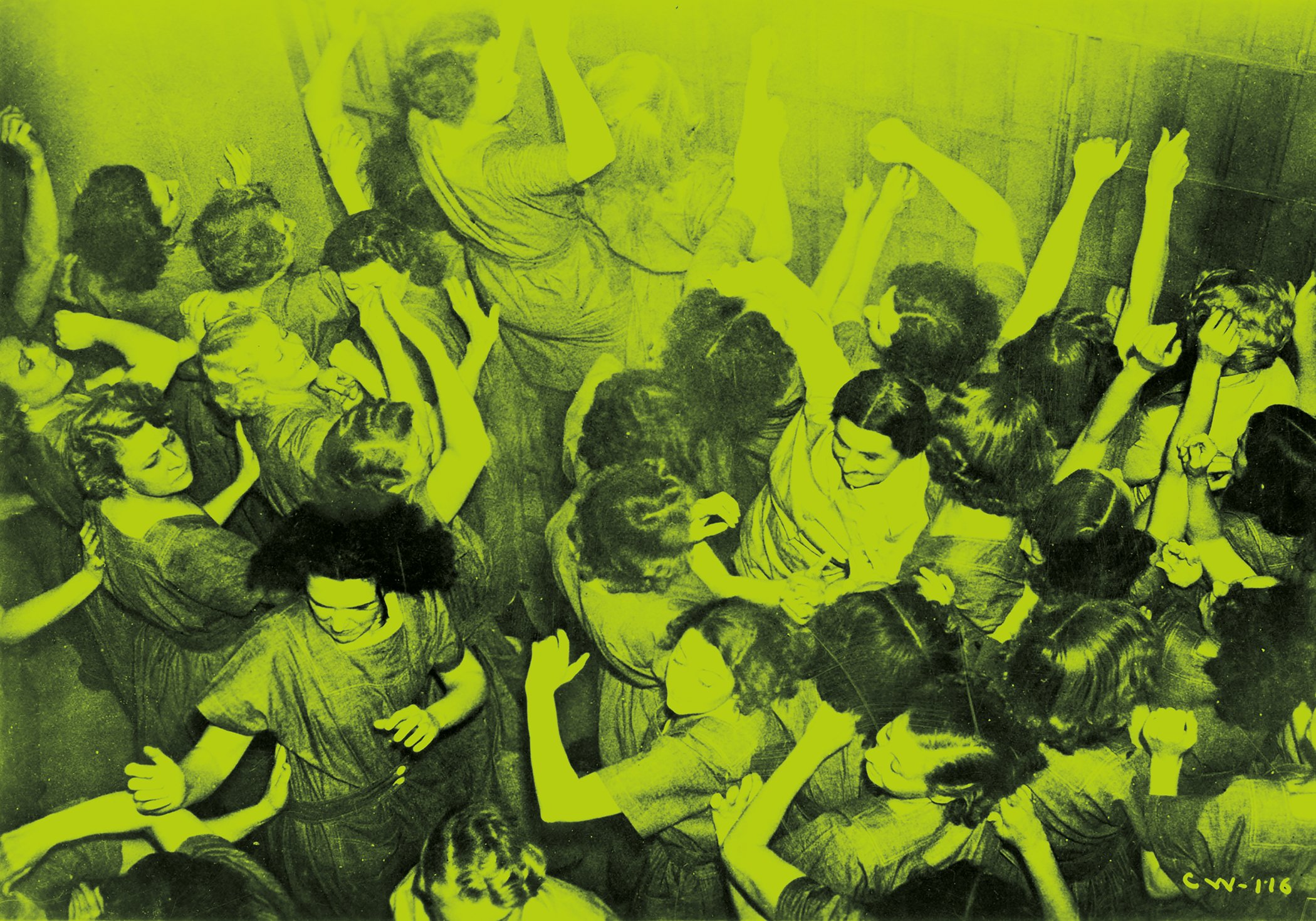
Still from Condemned Women, 1938
“The consequences of the law’s focus on individuals rather than groups are anything but academic.” — Bostock v. Clayton County, Georgia (2022)
I’m on an A train beneath banner ads for a new social media platform on which users follow the portfolios of successful investors. Warren Buffet, of course, but also Nancy Pelosi. Beside stock charts zigzagging north in electric green is another ad for Harris, Keenan & Goldfarb, a personal injury law firm reachable at “1-800-Pain-Law.” Their pitch is two incomplete sentences with full stops for emphasis: “Injury Compensation. The Real Pain Killer.” This ad has no graph but implies a similar financial ascendancy, a golden ticket out of the amorphous no-fault crime of licit immiseration, for which the only liable party would be an economic program that reproduces widespread dispossession and rewards an increasingly rarefied few. There is indeed real pain on the subway, a solid client base. People are visibly suffering. Those without quick fixes for abolishing capitalism might be reasonably seduced by the offer: You are hurt, and that hurt could be converted into overnight wealth you could never dream of making in wages.
But that hurt must stem from a personal injury for which you are promised a personal solution, a personal gain. The law knows how to recognize this kind of pain. It is also a pain whose recognition reaffirms the law by yielding the kinds of subjects it likes to reproduce—responsibilized private parties and individuated claimants. It also affirms the law’s capacity to repair.
Personal injury changes the way we think about the subject of pain and its repair. People understand that there is a solution for being hurt in a particular kind of way and make claims commensurate with that form. These rewards—recognition, damages, individual rights—distract necessarily from the aims, ambitions, and rewards of collective struggle, which can never be met by institutions whose solutions reinforce a basic hostility to the group. Like the most conservative strains of psychoanalysis, the law participates in producing individuals by imposing limits on its capacity for recognition. While the left generally understands the importance of acting and desiring as a mass, psychoanalysis must actively disinherit a strain of thinking about group psychology that warns against deindividuation as a threat to freedom, rather than one of its conditions.
*
In 1989, a group of inmates in a California men’s prison formed an association, or artificial personhood, to sue for their right to smoke cigarettes. Although motivated by a desire to reinstate their right to vice and pleasure, the case that ultimately became known as Rowland v. California Men’s Colony achieved landmark importance for the group’s recourse to a procedural measure that allows litigants to appear in forma pauperis, or to have legal fees waived due to indigence. They were, in other words, seeking to appear first as a group, then as poor. After getting passed back and forth through appeals, the Supreme Court ruled in 1993 that only “natural” persons, i.e., not artificial persons, or groups that appear before the court as a person, could be poor. Justice David Souter’s opinion relies on a definition from Webster’s New International Dictionary, stipulating that poverty denotes “[w]anting in material riches or goods; lacking in the comforts of life; needy.” Souter, suddenly summoning Lacan in Washington, argues that it is precisely “lack” that draws a line between natural and artificial persons. An association may well be insolvent, but only natural life can lack. Poverty, per the court, is a person’s problem, not a group’s.
After several centuries of organized dispossession, America’s highest court appears to lack a concept of collective economic impoverishment, or class. The justices are right to perform ignorance: The court is designed to redress only exceptional breaches of legal homeostasis, departures from the abstract neutrality of US citizenship. Each recognition of personal injury affirms the idea of a baseline equality under US law. Alleging a deviation from this norm also affirms that the norm exists, that legal doctrine hews to justice, and that violence is traceable to errors that can be fixed by the court. The massively distributed systemic injustice of the United States is not eligible for recognition, but lapses in its application are. If the court were to take seriously how institutions of power unevenly allocate life chances, it would have to abolish itself.
Seventeen years after the prisoners’ suit was dismissed, the Supreme Court delivered its ruling in Citizens United v. Federal Election Committee, a case of such varied consequence that it is difficult to assign a single landmark. While it is mainly remembered as a successful campaign to protect unrestricted spending as a form of free speech, it also recognized Citizens United, a conservative political advocacy group and 501(c)(4), as an artificial person—what’s commonly referred to as “corporate personhood.” One could argue that Citizens United sought to appear as a person, whereas the inmates maintained their status as a group. But there are also significant differences in the profiles of their claimants. Where the inmates sought to regain a right to pleasure in prison, Citizens United sought to expand private influence on public elections. Where the men asked to assemble in poverty, Citizens United sought to speak through capital. The men never got to make their collective case for individual smoking; Citizens United was heard by the Court and won.
The majority opinion, authored by Reagan-appointed Associate Justice Anthony Kennedy, superficially emphasized the right of protest while empowering corporations to influence elections: “If the First Amendment has any force, it prohibits Congress from fining or jailing citizens, or associations of citizens, for simply engaging in political speech.” He goes on to argue that this freedom must be extended irrespective of the speaker’s identity:
The identity of the speaker is not decisive in determining whether speech is protected. Corporations and other associations, like individuals, contribute to the “discussion, debate, and the dissemination of information and ideas” that the First Amendment seeks to foster.... The Court has thus rejected the argument that political speech of corporations or other associations should be treated differently under the First Amendment simply because such associations are not “natural persons.”
Further repurposing the language of struggle, the court adds, “By taking the right to speak from some and giving it to others, the Government deprives the disadvantaged person or class of the right to use speech to strive to establish worth, standing, and respect for the speaker’s voice.” There’s class, but not class struggle, and there’s respect for the disadvantaged speaker’s voice, but the speaker is a corporation. Plus, “speech” specifically denotes the unrestricted flow of capital, not the plaintive claims of an oppressed population. The hallmarks of left struggle are picked up for their rhetorical force but emptied of their political content. “Identity” slips from its typical application to “natural persons”—or, more specifically, a form of private property that is vulnerable to theft—and is instrumentalized to defend the corporation’s conservative bias. On the surface, this case seems to indicate the Court’s capacity to recognize a speaking subject beyond the limits of natural personhood. Yet Citizens United does not radically break from or transform the legal apparatus. The group makes its claim in the form of an individual in order to remain a group.
“If the court were to take seriously how institutions of power unevenly allocate life chances, it would have to abolish itself.”
The illegibility of the group as a group is partly due to the fact that the subject of the law is the subject of capital. This phenomenon is called the “legal form” by Evgeny Pashukanis, a Soviet Marxist who demonstrated that the invention of the commodity exchange historically coincided with the emergence of legal personhood. Basically, for commodities to be freely exchanged, their owners or guardians must be seen, per Marx, as “persons whose will resides in those objects,” and thus recognize each other as private proprietors. Each owner must be mutually recognized as formally equal; in the event of a dispute, this baseline abstract equality allows the law to regulate between the formal categories it recognizes, e.g., personhood and property. The legal form, then, manages the relationships between subjects and the state under capitalism; it does not, however, provide solutions to the problems that capital introduces.
*
Both artificial personhood and appearing in forma pauperis are part of the procedural basis for the men’s claim of entitlement to cigarettes in prison, which was never officially heard. The form in which they made the claim ultimately thwarted their ability to appear in court. Legal cases often fall prey to a procedural hitch that draws the focus of adjudication away from the initial plot point. The so-called merits of the case become subordinate to this peripheral commanding detail, a strangely common evocation of the fourth wall in the theater of law. Because these cases revise a piece of procedural infrastructure, they tend to be remembered—a perplexing combination of a gutter ball and a strike. This is another way to think about legal form, if not necessarily the legal form. Successful claims are allowed to advance precisely because they obey the formal demands of the recognizing authority. But these formal concessions are not merely formal; they substantively change the very nature of an appeal and the way we conceive of the subject who makes it.
There is a strong incentive to make such obedient claims. Civil suits cut through the murky unquantifiability of pain and say: Here is a financial equivalent to your grief. They also pay out hugely, making them a regular American pastime. Nearly everyone in my family has been touched by such cases—suddenly losing or gaining by transformative degrees. There are several stories I could share about disputes between a family member and someone else, insurance battles backed by fabulations that threaten one’s grip on reality, an invested settlement that changed everything. And then there is one story, a devastating story, that I can’t share, about one family member suing another for an astronomical sum, backlit by untimely death and phenomenal grief. This incident shaped my life, but because the misguided attempt to funnel pain into a claim for so many millions hinged on a bogus charge of libel, the specter of further libel casts too great a shadow to name it explicitly.
In addition to quick fixes on the consumer side, the law is also a powerful machine for naturalizing ideology. Jacques Derrida, after Montaigne, calls this its “mystical foundation,” a bottomless cascade of ethics and force that is mirrored in the infinite recession of justice, a distant light toward which the legal process allegedly tends. Legal institutions create false bottoms in the absence of solid ground, never acknowledging the contingency of the authority they invoke. All this indeterminacy leaves an open door for ideas to enter as if already established principles. Although all common law cases participate in the transubstantiation of opinion into fact, some of the most egregious instances are found in decisions from early US land disputes. The majority opinion in Johnson v. M’Intosh (1823), for instance, licenses the dispossession of an Indigenous group by proving that occupancy “held in common” is incompatible with “every theory of property,” adding that individual ownership is the only legally defensible relation to land. A footnote cites Locke’s Second Treatise on Government. Someone in the UK had an idea about private property, and then an entire apparatus of justice converted its whimsical propositions into truth.
In her essay “Anthropomorphism in Lyric and Law,” Barbara Johnson proposes that “personhood” is one such “powerful, presupposable unacknowledgment.” The contingent definition of “man,” she argues, is never as stable as when it is being given to what it is not. She begins by carefully parsing Paul de Man’s skeptical reading of Charles Baudelaire and his frequent use of the word comme—variously translated as “like” and “as”—in his poem “Correspondances,” as if the adverb could seamlessly transfer the properties of a human onto the rest of the world. Its use as both simile and enumeration produces a conflict. Johnson is less concerned with what happens to objects once endowed with humanity than with what happens to the category of “human” once its meaning is rhetorically fixed. In his writing on tropes, which Johnson quotes, Nietzsche argues that anthropomorphism is “the taking of something for something else that can then be assumed to be given.” By assuming the essential solidity of the first entity, anthropomorphism “freezes the infinite chain of tropological transformations and propositions into one single assertion or essence which, as such, excludes all others. It is no longer a proposition but a proper name.” In other words, anthropomorphism is a way of stabilizing the category of “man.” In promiscuously shipping out its meaning, the original word is no longer a proposition, but a consolidated proper name, equal only to itself. Johnson adds that “proper names are not subjects of definition: They are what they are. If ‘man’ is taken as a given, then, it can only be because it is out of the loop of qualification. It is presupposed, not defined.”
This does not clarify which propositions or subjects are allowed to claim tautological self-evidence—why, for instance, Citizens United could be seen as a disadvantaged speaker, but the prisoners could not be a poor person. The question is also raised inadvertently by the majority opinion in Rowland v. California Men’s Colony, Johnson says, when the court reads Congress as a subject with intentions while refusing to grant the men the same status:
The word natural, which is precisely at issue here—since the Court is, after all, trying to find out whether the statute applies only to natural persons—is here applied to an artificial person, Congress, which is personified as having natural intentionality.... There is a personification of an artificial entity, Congress, embedded in the very project of interpreting how far the law will allow for artificial entities to be considered persons.... Congress is endowed with “natural” intentionality in order to sweep away the abyss of reference.
In an instance of gameplay so clearly fixed for the house to win, the law’s ace plays high and the prisoner’s ace low. An artificial person (Congress) assembles without qualification to disqualify another artificial person (the prisoners). Or: Congress sweeps away the abyss of reference, and the inmates are swept away with it.
“Citizens United could be seen as a disadvantaged speaker, but the prisoners could not be a poor person.”
Clarence Thomas authored a dissenting opinion in Rowland v. California Men’s Colony that raises the existence of these silent coefficients—the buried, but no less signifying, factors of race and class as they attach to the universal subject of law. In defending the prisoners’ right to appear in forma pauperis, Thomas’s argument that there is “no basis for concluding that an association is not entitled” to do so cites the pervasive use of “poor” to describe “so-called ‘developing’ countries.” Further challenging the refusal to apply social and economic qualifiers to artificial persons, he revises the majority’s reading of Wilson v. Omaha Tribe (1979), a fascinating case of riparian law in which the migrating course of the Missouri River, which forms the political border between Iowa and Nebraska, later yielded differently-sized deposits of land to residents on either side of the water. For the purposes of that opinion, which ruled in favor of private landowners in Iowa over an Indigenous tribe in Nebraska, the category of “white person” was applied to a group of landowners. In both Rowland and Wilson, the term “person” is inflected by the content of its modifier. The differential outcomes of the two cases suggest that a group may be a person insofar as it is a white person, but a group of poor prisoners will never be permitted to assemble into a legible single entity. If an association’s status matches the suppressed particulars of the ostensibly universal subject (i.e. , white, propertied, male) then there is no issue commuting its meaning to an artificial entity. Thomas argues that if the court “was correct in holding that the statutory term ‘white person’ includes a corporation (because the ‘context’ does not ‘indicate otherwise’)—the conclusion that an association is a ‘person’ for in forma pauperis purposes is inescapable.” Of course, the court conspicuously omits any mention of how much these qualifying details matter, but by ruling inconsistently across cases with racial and economic components, the subject of law effectively becomes white and propertied, even in its ostensible universality.
*
The US invented the modern “class action.” Unsurprisingly, the form has primarily become a vehicle for mass consumer complaint. Contrary to corporate personhood, in which the group must perform as a person, the class action pluralizes individual claimants. Its only traceable antecedent is “group litigation,” a thirteenth-century form once common in Britain. A compelling hypothesis argues that this was not the immanent shape of an insurrectionary struggle, but a form of management by a medieval state that lacked the capacity to handle cases on an individual basis. Between 1400–1700, a period that roughly maps onto the period of primitive accumulation and Britain’s transformation into a capitalist economy, group litigation progressively lost favor until it disappeared in the mid-nineteenth century and was replaced by individual litigation. By the time anything resembling the form would reappear, twentieth-century US jurisprudence was already deeply steeped in liberal values imported from UK theorists of personhood and property.
The modern class action was codified in 1966, during a period that witnessed major agitation for liberation by dispossessed and disenfranchised groups under the auspices of the Civil Rights Movement. While the class action became popular in subsequent decades as a strategy for activist groups, its solutions were always in service of preserving and purifying the institution responsible for the very problems it was asked to recognize and reward. Brown v. Board of Education (1954) is one such example. The rare win for affirmative action was, as Derrick Bell argues, only achievable insofar as it converged with ulterior US interests, including a concerted effort to quell the dissent of Black soldiers protesting conscription into a racist military and the exportation of US liberalism as beacon of progress amid ongoing Cold War antagonism. While incidentally effective in getting a favorable decision for integration, the class action form did not radically challenge racial hegemony; rather, it was used as leverage for US imperialism. Bell adds that the impact of Brown included the closure of Black schools “by the hundreds” and the firings of Black teachers and administrators “by the thousands.” It also allowed white parents to “hide their children in white schools . . . that court orders could not reach.” With a bit of smoke and mirrors, the state successfully deflected negative international attention while abrogating justice for the litigant class.
“The US invented the modern ‘class action.’ Unsurprisingly, the form has primarily become a vehicle for mass consumer complaint.”
At a structural level, class action litigation binds individual grievances but does not actually recognize a mass. Individual members are bound by their claims being comme, like, those of other claimants. And since all law, as Pashukanis tells us, is bourgeois law, the underclass will only ever be recognized when it consents to make its claims as a person. But the form was not simply abandoned at will for its structural conservatism; by the 1980s, judicial interpretations of the class action mechanism had begun to make class certification in civil rights cases substantially more difficult. The class action form is thus no longer a popular vehicle for left social movements. Instead, most class actions gather a broad swath of consumers with sufficiently similar complaints about the same commodity. In this sense, the class action is more like an escalation of a customer service call or a harsh word with the manager at a restaurant. A recent scroll through the list of open class actions on openclassactions.com found “Mid America Pet Food $5.5M Class Action Settlement,” “$4M TreeHouse Foods Waffle Recall Class Action Settlement,” “Sealy 1250 Thread Count Bedding $750K Class Action Settlement,” “AARP Facebook Video Privacy $12.5M Class Action Settlement.” One is instructed to join an open class by submitting a claim form.
It is no surprise that the incidence of civil suits and personal injury claims is so high in a place like the US, where subjects find few opportunities to push back against often incomprehensible structures of violence that squeeze and strain and gradually diminish life. The inoperable feeling that something is dynamically wrong gets funneled through an available channel of consumer complaint, making one’s feelings of acute pain addressable while distracting from the actual problem and its scope. These minuscule adjudications of consumer grievance are pacifying substitutes for something like justice, for which they are not, in the slightest, a rehearsal.
As a common law state, the United States is one of the few nations that absorbs each legal challenge into its body of doctrine. American courts rely equally on “case law,” a vast archive of precedent, and interpretations of the Constitution, to make their determinations. An individual’s petition thus stands not only to be recognized but enfolded into future jurisprudence. In addition to the monetary reward, this presents another potential incentive for civil litigation: Your name might become shorthand for a major historical event or its reversal. The law is, of course, amenable to such narcissistic ambition; it further compels subjects to appear before it as individuals.
*
In 1895, the reactionary French polymath Gustave Le Bon published a pioneering account of mass psychology, The Crowd: A Study of the Popular Mind. Le Bon proposed that the crowd is much more than an assembly of parts; it is an organism with its own mind, its own unconscious desires. Beholden to the magnetic sway of a crowd, subjects undergo a process of deindividuation that weakens their own reason and loosens the superegoic truss. He likens the individual in a crowd to a grain of sand whose movements are at the mercy of the wind. In other words, for Le Bon, the subject of the crowd ceases to be a self. This dissolution is achieved through three key psychological processes: anonymity, contagion, and suggestibility. Anonymity erodes personal responsibility. Things happen in a crowd that are not reducible to any single actor. When no one is to blame, Le Bon argues, the crowd becomes empowered, capable of piercing through social norms and conventions that individuals would otherwise heed. “[B]y the mere fact that he forms part of an organized crowd, a man descends several rungs in the ladder of civilization. Isolated, he may be a cultivated individual; in a crowd, he is a barbarian—that is, a creature acting by instinct.” A man of many capacities, Le Bon was also a race biologist and anthropologist who believed Europeans to be of objective superior rank. It is no wonder that his analysis of the crowd argues for the preservation of personhood, a seventeenth-century Western subject form commensurate with whiteness and capital that emerged amid a pervasive fear of the masses, documented in the literature of that period.
Freud’s Group Psychology and Analysis of the Ego (1921) addressed a perceived gap in Le Bon’s account: why crowds happen. Unconvinced that there existed a primordial herd instinct, Freud wondered what drew people to groups and held them together, however impulsive and shortlived an association may be. For Freud, the answer was a libidinal drive strong enough to overcome the individual’s narcissism. This drive expresses itself as mutual identification over a shared love object, represented in the figure of the leader. For Le Bon, the leader merely commands the group’s immanent energy; for Freud, the leader is its cause. Rather than avowing an original sociality, Freud argues that horizontal equality is essentially the resigned solidarity of rivals who remain bonded through stalled competition for the favor of an authority figure. In the postscript, Freud returns to the myth of the primal horde, positing an account of how the individual emerges as a triumph over the masses. The poet— who, for Freud, creates the ego ideal—is the first to recognize that the door to the prison of conformity was always open and the first to model freedom by leaving. His liberation is gained through his departure from the group.
“This account of an excluding mass that owes its cohesion to the shared love of a powerful individual was a better analysis of fascist Europe than it was a blueprint for a communist future.”
Freud struggled to imagine a leaderless group—a lateral herd before the primal horde. The group was always a mass in relation to a singularity, a subordinated many vying for the coveted love of the one. Freedom from this thrall, which begins in the mythic competition for the father but returns in authoritarianism, is won through dissent and separation. This account of an excluding mass that owes its cohesion to the shared love of a powerful individual was a better analysis of fascist Europe than it was a blueprint for a communist future. What Freud’s text does not address is that the crowd is a repressed primordial form, a social substrate out of which the individual is forged as a kind of reaction formation within a period of bourgeois transformation in the West. Le Bon’s “barbarian” is not the product of a devolved society, but a differently socialized subject, one that has not been conscripted into the process of individuation. The individual, like the commodity or value, is a form invented to make subjects amenable to capitalism. Or, to put it in more psychoanalytic terms, the “I” is a fiction of separation, enabled by devices of representation (the mirror, language) and incentivized by institutions of modern social life (law, capitalism) which make it very difficult to thrive as anything else.
The question of the mass does not only apply to subject formation; it is also a question of clinical practice. Against the backdrop of political crisis, Freud imagined various strategies for disseminating the treatment he’d spend a lifetime rewriting, including free clinics for the suffering masses during World War I. What eventually became the dyadic frame was the result of a concession to economic exigencies and the needs of his immediate population—bourgeois individuals with bourgeois problems. This is not, however, what psychoanalysis has remained, or the limit of what it can become. Like common law, psychoanalysis is transformed by each individual case, each instance of its encounter with the subjects it seeks to recognize and reward. Freud’s case studies were not proof of a perfect treatment, but integral to refining his theory of the subject. Like common law, analysis is often defensive about anything that seems to threaten its authority. Twentieth-century experiments in the clinic, like Frantz Fanon’s, teach us that the material and social conditions of a patient’s life are not incidental to the patient’s psychic liberation, even if, as sources of suffering, they are not reducible to a single psyche.
Consider the strange internal tension of “indivisible, with liberty, and justice for all,” the final clause of a rehearsal for patriotism that even its juvenile ventriloquists utter with measured reverence. “Indivisible” designates the people as a collective that, like a quark or a prime number, cannot be further split. Then “liberty” overthrows that principle, reducing freedom to the protection of an individual’s right to property. “With liberty” means with division, with separation—with a program of accumulation and dispossession that naturalizes theft through law. Perhaps “indivisible, with liberty” is a painfully accurate expression of the paradox that organizes social life in the United States, where attempts to make claims in the form of a group or to live according to the indivisibility of the social are rigorously and strategically and persistently subordinated to the value of the individual, which any subject must first be like in order to be free.