
Curing the Group
On Healing Institutions
Tobias Jenkins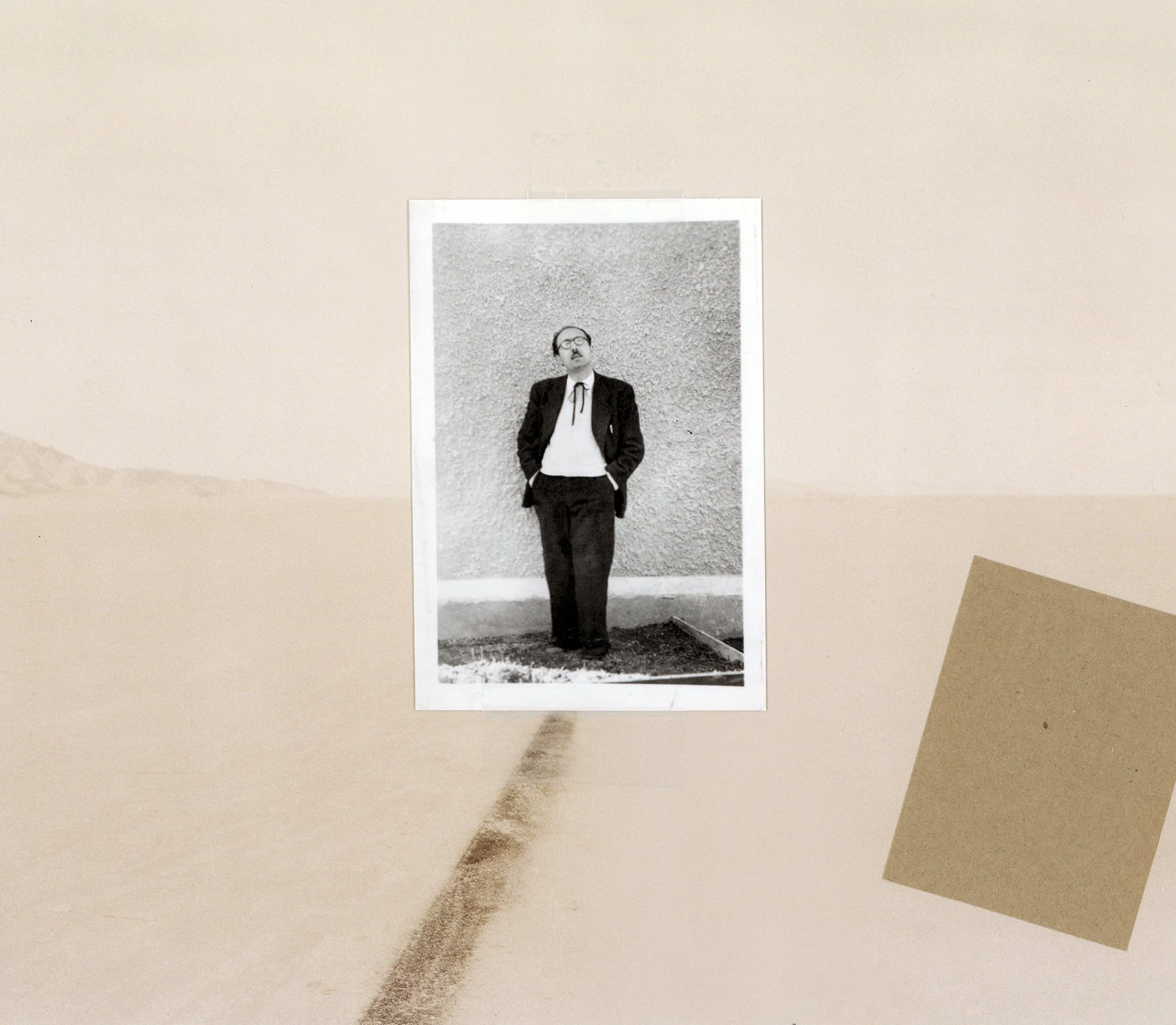
The most famous photograph of Francesc Tosquelles shows him balanced barefoot on the corrugated metal roof of the administrative building of the psychiatric hospital of Saint-Alban-sur-Limagnole in the South of France, of which he was the director from 1953 to 1962. He holds above his head a sculpture of a ship constructed from found pieces of metal, cloth, and wood by the French outsider artist, Auguste Forestier, a long-term resident of the same institution. Tosquelles’s bent arms and knees suggest the need for constant readjustment, as if he is shifting his center of balance back and forth to in order to support the weight of the sculpture and keep it aloft. Looking more closely, one can see the ship’s crew arranged along the gunwale. Faced out toward the world, they turn to meet the camera, whilst Tosquelles’s attention remains, unwavering, on the vessel under his command.
Tosquelles considered the institution at once the greatest obstacle to psychiatric care and most important enabling condition for it. He pioneered an approach termed “institutional psychotherapy,” which required the institution constantly to be rethought and reoriented in response to pressures both inside and out. For Tosquelles, it was the institution itself that was ill and most in need of treatment. It was only by healing the hospital that rigid forms of institutionalization could be resisted, and the conditions for a new, non-authoritarian psychiatry be produced.
Born in Reus, in Catalonia, in 1912, Tosquelles first encountered psychoanalysis through his maternal uncle, Francesc Llauradó, an early reader of Freud, who noted in an 1899 review of The Interpretation of Dreams the impact that Freud’s ideas might go on to make in psychiatric hospitals. Consequently, “[f]rom age ten, I already knew what I wanted to do,” explained Tosquelles in a 1984 interview: “bring Freud to the asylum and bring psychoanalysis to the patients.” Following this ambition, he entered medical school at the University of Barcelona in 1928, where he specialized in psychiatry. He became involved in the work of the Institut Pere Mata, the Catalan hospital where new approaches to psychiatry were already being introduced, as a student and joined the staff officially after he qualified. Tosquelles later described Barcelona in the first half of the 1930s as “Little Vienna” because of the presence of many Jewish psychoanalysts who had come there from Germany and Central Europe as refugees. His mentor, Doctor Emili Mira, had introduced him to many of the classic texts from the psychoanalytic canon.
Politics was the other powerful force in Tosquelles’s formation. In 1931, he presented a lecture entitled “The Structuring of Society and Madness” to an audience of anarchist and socialist students at the Ateneu Enciclopèdic Popular, a working-class cultural and educational center that hosted courses during Barcelona’s general strike, allowing students and teachers to honor the university picket line. The following year, he served as the secretary for Emili Mira’s seminar on Freud and Marx at the Ateneu Enciclopèdic. Freud and Marx would remain the two most important points of reference for Tosquelles throughout his career. For the Catalan, social alienation, as much as the mental form, was the concern of the psychiatrist, and therefore his practice had to be politically engaged.
The extreme polarization and instability of Spanish politics in the 1930s made such commitments inescapable. Moreover, it provided a context in which ideas could become transformed into action. Following the proclamation of the Republic in 1931 and the restoration of Catalonian autonomy in 1932, for example, the left-wing government in Barcelona embarked on a widespread reform of the healthcare and social systems, moving toward a form of provision that was more local and responsive to economic and social need. Tosquelles’s own efforts were concentrated in the anarcho-communist Bloc Obrer i Camperol (BOC), or Workers’ and Peasants’ Group, and the Partido Obrero d'Unificación Marxista (POUM), or Workers’ Party of Marxist Unification, of which he was a founding member. Following Franco’s military coup and the outbreak of civil war in 1936, he offered his services as a psychiatrist to the Republican cause. He was deployed to the Aragón front in 1937, where he was tasked with organizing the evacuation of patients from the fascist-held psychiatric hospital in Osca, and then given the command of a hospital in Almodóvar del Campo, where he established a therapeutic community for patients described as “war mutes and schizophrenics,” staffed in part by sex workers whose brothels had been forced to close. In 1938, he was appointed head of Psychiatric Services of the Army of Estremadura and, in 1939, of the Army of Extremadura, a post that he held until the defeat of the Republican forces later that year.
Crucially, Tosquelles’s participation in the anti-Stalinist POUM put him in opposition to the official communism of Moscow and the Communist International, which contributed to the party being made illegal in 1937. In contrast to Stalinist centralism, Tosquelles espoused a more libertarian communism, arguing against the hierarchization and centralization of power. In a letter to Stalin, he asserted that socialist government needed to be responsive to the local people and culture and that the communist slogan of “all power to the Soviets” could only make sense in Catalonia if it were translated as “all power to the debate groups” that met to talk politics and socialize in the region’s bistros and cafés. In this way, Tosquelles demonstrated not only his commitment to anti-fascism, but his resistance to authoritarianism in all forms.
“For Tosquelles, it was the institution itself that was ill and most in need of treatment.”
The Spanish Civil War provided both a challenge and an opportunity for Tosquelles, and it was here that many of the central principles of institutional psychotherapy were first put into practice. For Tosquelles, war brought into focus important relations between madness, marginalization, and the end of the world. Later in his life, he would provocatively state that “[i]f it were not, unfortunately, that war produces corpses, you should organize at least one or two wars for every generation; in that situation, one understands things one wouldn’t otherwise.” The necessities of wartime required constant innovation. Tosquelles practiced psychiatry in requisitioned farm buildings and recruited untrained personnel from local communities to staff his therapeutic communities. He produced new protocols for personnel selection and opposed attempts to centralize psychiatric services, arguing instead for local clinics and frontline support services, such as psychiatric ambulances, that could treat men without having to separate them from their units. In this way, Tosquelles arrived at a psychiatry embedded in the social group. Lessons learned in the conflict would accompany him into the practice of peacetime psychiatry.
Tosquelles fled Francoism in late 1939, one of over half a million refugees that escaped across the Pyrenees to France. He famously carried with him copies of Hermann Simon’s 1929 text Aktivere Krankenbehandlung in der Irrenanstalt [A More Active Medical Treatment in the Mental Hospital] and Lacan’s 1932 doctoral thesis. Tosquelles described Simon’s book as a “proposal to do psychiatry that’s not just active but as active as possible.” From Simon, Tosquelles took the notion that patients could only be cured if the hospital was too. The German psychiatrist sought to encourage self-reliance and a greater sense of autonomy in his patients. He advocated for the establishment of workshops and libraries in psychiatric hospitals, as well as the unlocking of closed wards, providing an important model for Tosquelles’s own subsequent experiments in institutional care. However, Simon’s approach to occupational therapy conflicted with his increasing espousal of social Darwinist and Nazi ideas. Initially identified as a source of personal freedom, Simon started to understand work as a method for discriminating between patients who could contribute to the workforce and those who could not. By contrast, Tosquelles insisted on occupational therapy in which labour was always “personal and personalized” and never imposed; only “self-motivated activity…that originates and is rooted in the active subject and is capable of opening up in a social context” could achieve its therapeutic aim, the Catalan claimed.
Lacan’s contributions to the problem of psychosis also provided an important theoretical framework for Tosquelles. Tosquelles read Lacan’s thesis at Mira’s instigation soon after its publication in 1932 and almost immediately adopted it as teaching material for a six-month course that he led for doctors at the Institut Pere Mata. Tosquelles described his encounter with Lacan as “extraordinarily transformative.” Lacan’s thesis provided him with a powerful means to think about the importance of identification in psychosis and its relation to the structure of the personality. Moreover, it provided a platform for him to introduce more psychoanalytic ideas to his senior colleagues at the hospital. In a 1987 interview, Tosquelles ironizes his course on Lacan as a “ploy to interest some aging classical psychiatrists in problems of the complexity of personhood, of the personality, with a kind of mélange of poetry and politics, from a Freudian orientation.” Put more bluntly, he describes how
the utility of Lacan…was the subversive effect, the psychoanalytic introduction of an opening, of saying, “Gallant psychiatrists, if you close the house to every psychoanalytic problem you’re screwed.”
Tosquelles only met and made a personal friendship with Lacan after the Second World War, when he was regularly travelling to Paris to earn his baccalaureate, a necessity for his promotion in the French psychiatric system. However, he never presented himself as Lacan’s pupil or became a member of the famous psychoanalyst’s school. In contrast to the next generation of institutional psychotherapists, such as Jean Oury and Félix Guattari, Lacan remained only an important interlocutor rather than a fundamental influence on Tosquelles’s work. He shared with the French Freud an emphasis on the importance of speech in psychoanalysis and the recognition that it is “always mediated, indeed barred,” and regularly cited the psychoanalyst’s theories with approval. However, as with Simon, Tosquelles’s use of Lacan was personal and pragmatic. “People are a bit surprised, especially when the talk is centered around my reading of, my acquaintance or my work with Lacan,” he explained, ‘[b]ecause when you come down to it, I’ve had very few direct relations with Lacan. The first was almost imaginary.”
On his arrival in France in September 1939, Tosquelles was interned at a refugee camp in Septfonds. Here he resumed his work as a psychiatrist, receiving permission to set up a psychiatric service based on therapeutic principles that he had established during the Spanish Civil War, putting on activities such as concerts and theater productions in addition to running more traditional group therapies. Tosquelles’s experiments at Septfonds brought him to the attention of French psychiatry, where it was decided that he could make a useful contribution. In 1940, he received authorization to leave Septfonds and take up a post at Saint-Alban, the psychiatric hospital in the South of France with which in time his name would become indissociable.
Tosquelles recalled arriving at Saint-Alban to find a “mess of a hospital,” partially in ruins and still with solitary cells for its 600 patients. Together with Paul Balvet, then the hospital’s director, he began the work of treating the institution. First, the architecture of Saint-Alban had to be transformed. The walls separating the hospital from the surrounding area were demolished and new spaces provided for patients to meet and encounter each other outside of their wards. Uniforms were dispensed with and regular meetings and social activities organized to encourage new relations between doctors, nurses, and patients.
To conceptualize and reflect on their work, the hospital’s doctors formed the Société du Gévaudan, a debate group “open to heterogenous contributions,” in which ideas could be exchanged and members’ collective experience drawn upon. Tosquelles also promoted self-management amongst the patients. In 1942, the Club Paul Balvet was founded as a vehicle for patients to organize hospital social activities. Tosquelles described the Club Paul Balvet as “largely the self-expression of the hospital.” The center of Saint-Alban’s collective life, the patient-run cooperative not only fostered new forms of social relation between residents and made them active participants in their own care, but also provided spaces in which conflicts and institutional tensions could come to the fore and be made available for therapeutic work.
In addition to numerous other forms of occupational therapy practiced at the hospital, Saint-Alban also started to produce a number of publications, such as the internal newspaper Trait d’union. Trait d'union, the French word for “hyphen,” translates more literally as the “line of union.” Tosquelles argued in a 1952 issue that one of the most important aims of institutional psychotherapy was to bring patients out of their isolation by “[h]elping each of them discover the existence of the others [and learning] to comprehend and respond to their calls.” Through the Trait d'union, to which both staff and patients contributed, patients' words were put back into circulation in the social group, with the paper providing a site where thoughts and ideas could be exchanged, with some safety and privacy; the masthead read “Ce journal ne doit pas sortir de l’hopital [This journal must not leave the hospital].”
Presenting his work to fellow professionals in 1969, Tosquelles described institutional psychotherapy as “the internal contestation of the psychiatric establishment and what they support.” “What is necessary, first of all, is action,” he contended, “activities that break the rigidity of the classical establishment.” In his work at Saint-Alban, Tosquelles attempted to create new transferential constellations through which patients’ conflicts could be articulated and resolved. Turning attention to the institution, he claimed, it could become the most powerful therapeutic tool at the staff and patients’ disposal.
In the context of European fascism, Tosquelles’s humanizing approach to madness was inherently political. In 1987, the psychiatrist Max Lafont described the “soft extermination” of the mentally ill in Nazi-occupied France, in which an estimated 40,000 patients in the nation’s psychiatric hospitals were allowed to die of cold, starvation, and other forms of neglect. In response to food and fuel shortages, Saint-Alban’s patients were encouraged to work local farms to produce their own meat and vegetables and engage in informal economies with the surrounding community to ensure that the hospital remained supplied. In addition, Saint-Alban provided shelter for many Jews and political refugees. “During that time, the hospital became peopled with crazies and strangers,” Tosquelles said in 1987, having opened its doors to a range of people in need of protection from the Pétainist regime.
“In the context of European fascism, Tosquelles’s humanizing approach to madness was inherently political.”
Saint-Alban’s relative isolation also made it an important refuge for members of the French Resistance. In particular, it provided a base of operations for the psychiatrist Lucien Bonnafé, who was involved in the formation of the Resistance’s clandestine health service. It was through Bonnafé that a number of prominent members of the intellectual and artistic avant-garde who were engaged in the Resistance came to spend time at Saint-Alban. Tosquelles’s hospital provided shelter to the Surrealist poet Paul Éluard and his wife Nusch from 1943 to 1944, where he wrote the collections Les Sept Poemes d’amour en guerre [Seven Poems of Love at War] and Lingères légères [Light Laundresses], in part inspired by the collective life of the institution. Likewise, the philosopher of science Georges Canguilhem spent time at the hospital in 1944, participating in debate groups and meeting with patients, experiences that would inform his account of madness as a socially determined construct in his 1966 book Le normal et le pathologique [The Normal and the Pathological], an expansion of his doctoral thesis and a key influence on Michel Foucault and other French philosophers of madness.
Saint-Alban also housed its own important artistic community. Patients, such as the sculptor Forestier and the textile artist Marguerite Sirvins, produced artworks that came to public attention through their collection by the painter and sculptor Jean Dubuffet. Dubuffet’s appropriation of these patient productions and their presentation in his establishment of the art brut movement have more recently come under criticism from art historians who argue that they were shorn of their context and “forced into a cultural economy of collection.” However, brought back into the history of hospital, the works demonstrate the profound, if sometimes painful, creativity that the institution was able to sustain. Interested in this relationship between artistic production and madness, Tosquelles chose the poet Gérard de Nerval as the subject of his doctoral thesis, defended at the Faculty of Medicine in Paris in 1948. In Essai sur le senses du vécu en psychopathologie: le témoignage de Gérard de Nerval [Essay on the Meaning of Lived Experience in Psychopathology: The Testimony of Gérard de Nerval], he relates the poet’s work to the words and experience of the mentally ill, having received assistance and encouragement in his research from Paul Éluard.
Tosquelles’s innovations not only transformed Saint-Alban but shaped the field of radical psychiatry. During his time as director, he acted as mentor to a number of important figures in the field. The Lacanian psychoanalyst and psychiatrist Jean Oury was a resident at Saint-Alban from 1947 to 1949, where he learned the principles of institutional psychotherapy that he went on to implement at La Borde with his colleague, the anti-Oedipean Félix Guattari. The Martinique psychiatrist and activist Frantz Fanon also worked at the hospital from 1952-1953, shortly before he departed for Algeria, where he brought Tosquelles’s methods to the Blida-Joinville Psychiatric Hospital: daily meetings, occupational therapy, and a club adapted to the context of Muslim social life, where patients could meet, play cards, listen to traditional storytellers, and celebrate religious festivals. Through Fanon and other students, Tosquelles’s innovative institutional psychotherapy spread throughout France and abroad. In 1967, he himself returned to the Insitut Pere Mata in Reus to find out if institutional psychotherapy could provide a site of resistance to Franco’s regime, still in power there. He served as the director of the hospital until his death in Granges-sur-Lot, France in 1994, leaving behind him a constellation of hospitals and clinical experiments in which psychiatric care continued to be reimagined.
*
The translation of Joana Masó’s Francesc Tosquelles: Healing Institutions (Semiotext(e), 2026) by Robert Hurley and Mara Faye Letham represents the first significant, book-length attempt to represent the psychiatrist’s life and work to an English-speaking audience. The ground has been well-prepared for the appearance of Masó’s anthology by Camille Robcis’s recent history of institutional psychotherapy, Disalienation: Politics, Philosophy, and Radical Psychiatry in Postwar France (University of Chicago Press, 2021) and the English translation of Florent Gabarron-Garcia’s A People’s History of Psychoanalysis (Pluto Press, 2025), each introducing the ideas of the Catalan psychiatrist and situating them in their historical context. (Gabarron-Garcia’s book will be reviewed in Parapraxis in 2026.) This rise in interest is also reflected in the recent trickle of translations of Tosquelles that have appeared, for example, in Psychotherapy and Materialism: Essays by François Tosquelles and Jean Oury (ICI Berlin Press, 2024) and in Parapraxis (2024). For English readers, Masó’s book promises the first opportunity to follow Tosquelles’s ideas throughout the different parts of his career.
Published originally in Catalan in 2022, Francesc Tosquelles: Healing Institutions is the culmination of the five-year long research project “The Forgotten Legacy of Francesc Tosquelles,” led by Masó, a professor of French literature at the University of Barcelona, which has also produced an touring exhibition Francesc Tosquelles: Like a Sewing Machine in a Wheat Field (2021-2024), curated by Masó and the artist and critic Carles Guerra, which was shown in Toulouse, Barcelona, Madrid, and New York.[1] In addition, Masó co-wrote the experimental documentary film The Potential History of Francesc Tosquelles, Catalonia and Fear (2021) with director Mireia Sallarès, marking an intervention into cinema, a form in which Tosquelles himself expressed a considerable interest.
Masó draws on her immersion in Tosquelles’s life and work to produce an anthology that brings together a range of the psychiatrist’s texts and interviews, in addition to photographs, posters, and a range of other archival sources. Generously illustrated throughout, the result is a text that brings to mind the wall newspapers used to disseminate information by the Republicans in the Spanish Civil War and later produced by patients and pasted up in the common room at Saint-Alban. Masó’s multimedia approach also interrupts the linear reading experience; one’s attention is drawn back and forth between pictures and text and across the page to the shorter excerpts from Tosquelles and other authors that Masó includes to pluralize the perspective offered by the main body of the text. In this way, the book continually establishes new connections between its sources, remaining in constant process and resistant to an authoritative form.
“Generously illustrated throughout, the result is a text that brings to mind the wall newspapers used to disseminate information by the Republicans in the Spanish Civil War and later produced by patients and pasted up in the common room at Saint-Alban.”
The texts collected in Tosquelles: Healing Institutions are organized into four sections, each documenting a different time and place in the psychiatrist’s career. Each section opens with an extended essay by Masó, in which she situates the texts historically and provides a commentary on them. The breadth of the historical overviews offered by these introductions is impressive, given the importance of so many different social, intellectual, and political contexts for Tosquelles’s work, each of which demands specific expertise. Encountering Masó’s attempt to reconstruct these contexts, the reader is reminded of what Tosquelles called his “wall paintings,” in which he attempted to map out his intellectual influences in the form of tangled diagrams (they appear in the final section of the book), and recognizes the difficulty of the unraveling that Masó has achieved.
Masó produces an appropriately institutional history of Tosquelles’s work. This is particularly the case in the opening section of Healing Institutions, in which Reus and Barcelona are represented as dense networks of different political and clinical organizations through which the psychiatrist moved, from the Ateneus Barcelonès and Enciclopèdic Popular to the Instituts d’Observacio Psicologica and Pere Mata. In this way, Tosquelles’s words are never removed from the contexts that formed them. Healing Institutions therefore functions as a history of a certain era in Catalan intellectual life and French psychiatry as much as an outline of a single author’s contributions.
Healing Institutions includes texts written for both political and clinical purposes. For example, a militant 1937 text on POUM’s slogans is presented alongside more traditional texts, such as a 1969 journal article on institutional psychotherapy. Encountering Tosquelles in both modes reaffirms the fundamental interrelatedness of the political and clinical in his work. Masó’s strongest editorial decision is to include numerous excerpts from interviews conducted with Tosquelles in the later part of his life. These not only complement her introductory essays by retracing the same periods in Tosquelles’s own words, but also provide the reader with a more direct impression of Tosquelles’s character, making it possible to imagine his manner as a clinician at Saint-Alban. In the interviews, Tosquelles comes across as an earthy and unpretentious practitioner. For example, when he translates the Lacanian concept of paternal function into blunt and humorous conversational terms:
There are always several fathers. Any guy who comes by and talks to the mother is a father, even if it’s a woman. I mention that because there are women who are much more paternal than any father. Just as people say: What a woman! But it’s not about whether they have a penis or not, it’s because they talk to the mother instead of just saying “waah-waah”. Pissing, shitting, and waah-waahing is enough to be able to relate to the mother. Well, on a basic level…
Tosquelles consistently resists theoretical language, preferring instead to express himself in “ordinary words.” For this reason, his ideas prove surprisingly accessible, particularly to readers who may come to Healing Institutions having encountered institutional psychotherapy only through the work of its inheritors, such as Guattari. In contrast to many of his contemporaries, Tosquelles’s texts never depart into abstract territory removed from material life. In this respect, Masó’s collection fulfills an important function in restoring to Tosquelles’s work the practical context that gave rise to his ideas. Likewise, it rescues Tosquelles from misrepresentations of his work that present him as primarily indebted to Lacan. Instead, Tosquelles is presented as a participant in a plural psychoanalytic culture, hence, for example, his profound appreciation for Melanie Klein.
Even if Tosquelles remains at its center, Healing Institutions nonetheless insists on the important place of his many colleagues and collaborators in the history of institutional psychotherapy. Masó comments that the “big names and their cultural output,” such as Oury, Fanon and Guattari, “have overshadowed many others’ contributions,” and her collection is revisionist in its attempt to bring more of this collective history back to light. In particular, Masó’s recenters a number of the women who participated in the history of Saint-Alban. For example, Agnès Masson, one of his predecessors at Saint-Alban, who introduced the idea of geopsychiatry; the psychiatrist and homeopath Germaine Balvet; and Nusch Éluard, who coordinated theatrical productions at the hospital. In this context, it is a shame that more of the patients themselves are not represented in the text directly, a limitation that more probably reflects the limitations of the archive than editorial oversight.
Healing Institutions opens with a complete chronology of “The Lives of Francesc Tosquelles” and concludes with an authoritative bibliography and filmography of the psychiatrist’s work. Masó positions her anthology as a complement to the current effort, edited and overseen by his son Jacques, to publish Tosquelles’s complete worksin French for Éditions d’une. The long list of publications at the back of her book demonstrates how much more material remains untouched for future translators who might continue Hurley and Letham’s work and, in this, holds the promise of many further insights into and from Tosquelles’s life and practice still to come.
[1] The exhibition takes its title from Tosquelles’s appropriation of Andre Breton’s maxim, adopted from the nineteenth-century writer Isidore-Lucien Ducasse, about “the chance encounter of a sewing machine and an umbrella on a dissecting table” to describe the new current in Catalan psychiatry in the 1930s. In New York, it was exhibited under the title Francesc Tosquelles: Avant-Garde Psychiatry and the Birth of Art Brut.