
Debts to the Dead
Idris Robinson’s Political Theology
Juliana Spahr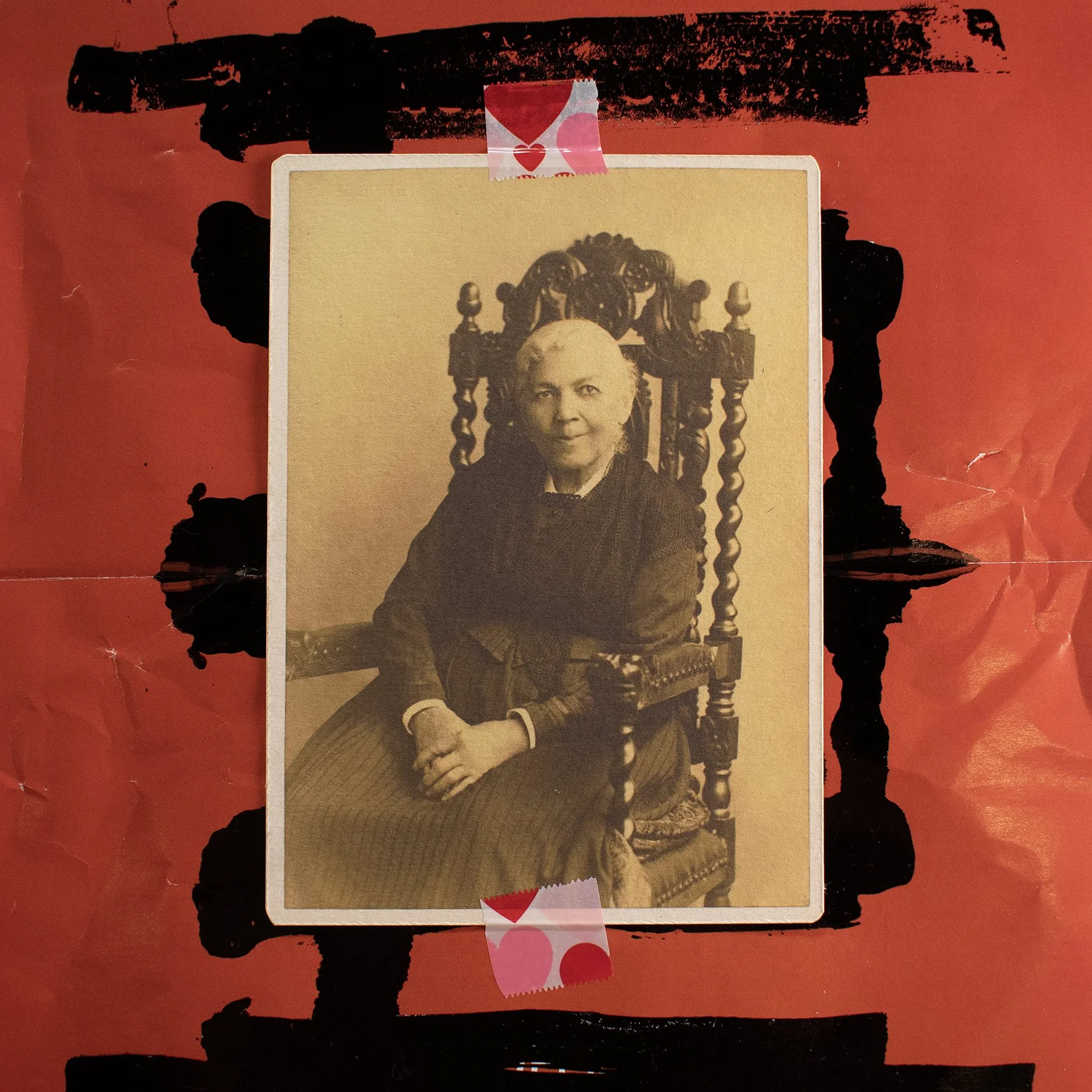
Hours after John Brown was executed for his failed raid on Harpers Ferry in 1859, Thoreau called him “an angel of light.” Louis Ransom (in 1860) and Thomas Hovenden (around 1884) painted images of him stooping to kiss a Black infant held up to him by its mother, depicting a possibly apocryphal encounter described by a New York newspaper three days after Brown's death. Currier and Ives in 1863 produced a lithograph based on Ransom’s painting showing the moment right before the kiss, the mother waiting on the steps, baby on her lap. Thomas Satterwhite Noble painted Brown, this time blessing the baby, in 1867. Not everyone at the time thought him an angel, but many did. However, in the early twentieth century, he became more of a monster. Robert Penn Warren said he had the instincts of a patriarchal despot. James C. Malin called him a thief and a murderer with little interest in eradicating slavery. Bruce Catton called him a brutal murderer. Charles Joyner called him incompetent. And a version of those verdicts has held. When Kara Walker revisits the scene of Brown and the baby in 1997, her etching shows Brown half-naked, infirm, kissing the penis of a naked child held up to him by the mother. I am not entirely sure what she wants to say about Brown, but I feel confident that it is not that he is an angel of light.
Those intent on making Brown monstrous often mention the 1856 Pottawatomie massacre where he preemptively killed five pro-slavery settlers. To Brown, the settlers' presence in Kansas Territory and their willingness to exist within and benefit from a slave society, even though they did not own slaves, made them part of the machinery of slavery and thus guilty. It is this Brown that interests Idris Robinson in The Revolt Eclipses Whatever the World Has to Offer (Semiotexte, 2025). As he puts it, “he drew a line that elevated truth and justice above life itself. It demonstrated that all life will remain senseless and barren, so long as there are those reduced to abject servitude.”
“What if we asked what psychoanalysis might learn from the insurrectionary (rather than how psychoanalysis can explain insurrection)?”
Robinson pursues this sort of question in the book: “If John Brown were alive today, what would he be like? How would he behave?” He articulates an answer across heterogeneous forms of writing that function as artifacts of lived, embedded practice that allow him to imagine what Brown would be and do today. The Revolt Eclipses Whatever the World Has to Offer is a collection of speeches, transcripts of conversations, polemics, a letter to a dead man, autobiographical vignettes, philosophical arguments, and report-backs from “militant research” in Seattle, New York, and Palestine. The book is also genuinely funny. There is a wizard and a judo throw. Donald Rumsfeld's grandson does push-ups next to Robinson in a holding cell while Cornel West leads a guided meditation. The book’s structure enacts something about where political thinking actually happens: on the streets, at the encampments, during the riots, in the jail cells. Within these various forms, Robinson repeatedly charges at a series of liberal conventions. As he puts it: “Identity politics, intersectionality, and social-privilege discourse: all are modalities of the police.” He wants us to realize that the protests of 2020 were not peaceful and nonviolent; that property destruction is a useful form of protest; that Black Lives Matter was, despite claims made by Black leadership, a leaderless and multiethnic uprising; that voting cannot fix what ails; that institutional diversity, white privilege discourse, and naming your positionality are regulatory and counterrevolutionary; that the break-up of the US union might be the best path forward; that civil wars have a possible liberatory potential.
This critique of liberalism and defense of militancy will be unsurprising to anyone who has spent time with insurrectionary anarchists. When I was reading this book, a friend asked if it was yet another series of position papers in the style of the anarchist collective Crimethinc. The answer is no. The Revolt Eclipses Whatever the World Has to Offer is more heady, more philosophical, more willing to be difficult. Much of this more can be located in Robinson’s attention to what he calls “the morbid and terrifying libidinal politics that undergirds race in this country.” Because he is writing in a tradition that tends to treat psychoanalysis as an individualist, bourgeois practice and a detour from collective action, his attention to the libidinal is provocative, even surprising.
Robinson uses James Baldwin's “Going to Meet the Man” to explain these morbid and terrifying drives. In Baldwin's story, a white man who has spent the day torturing Black protestors lies in bed with his white wife, unable to get an erection. When he recalls a lynching he attended as a child—the corpse mutilated, its genitalia cut off and handed around—he finally becomes aroused. The story ends with him reaching for his wife, telling her he is “going to do you like a nigger.” Baldwin wrote the story in third person limited to force the reader inside the consciousness of a man who beats protesters by day and cannot perform sexually by night.
The story seems to be asking for a psychoanalytic reading, but this is not Robinson's interest. Baldwin never lets the man gain insight and does not suggest he could be fixed or cured. What Baldwin describes is not deviance. It is the current social order. Robinson insists that we cannot keep avoiding what Baldwin had already named in 1965:
This is deep stuff. No one likes talking about it. But this is the core of racism that we need to reach. What’s more, I think no one wants to touch this part of the race problem because we are all implicated in it. It is obvious that white liberals get off on videos of Black murder. It is even more obvious that there are Black liberals who are more than happy to sell these videos of Black death for their own careerist goals. So long as we fail to take into account these libidinal drives within racism, we will not be able to explain how and why Ahmaud Arbery was killed.
It is not just that this libidinal structure helps us understand what motivated Travis McMichael, Gregory McMichael, and William Bryan to murder Arbery as he went for a jog. It also explains why liberals, who understand to some extent that everything is fucked up, are so concerned with maintaining social order, with peaceful protests and intact windows, in the face of it.
“The couch in this formulation is downstream of the plantation. Without freedom, and without a couch and an analyst, Jacobs nonetheless worked out the structures of desire, surveillance, and power that Freud would later elaborate from the comfort of Vienna.”
Another dimension of Robinson's argument sits alongside the libidinal analysis. It is, if anything, more stark. Slavery, he says, was so irredeemable that it places an obligation on the living that has not yet been discharged. He is direct about this: “We owe the revolution to the millions of slaves who never knew a second of freedom. What the long list of martyrs who have fallen during this uprising deserve from us is nothing other than the completion of the revolution.” Revolution is an obligation to the dead and, as he puts it, “the only way we can put our own souls at ease.” This obligation is not discharged by mourning, by commemoration, by diversity training, by the naming of buildings, or by any of the rituals through which American culture manages its relationship to slavery. It requires the completion of what figures like Brown, Gabriel Prosser, Denmark Vesey, and Nat Turner died attempting. This doctrine—that we must attend to the martyrs to save our souls—is Robinson's political theology, and it is what separates him most sharply from the insurrectionary anarchist tradition he otherwise inhabits.
Once we explain the motivations of Arbery’s murderers, once we realize that we have an obligation to continue the work of Brown, Prosser, Vesey, and Turner, how, as Robinson phrases it, “might should be done”? One answer the book proposes is to act like Michael Reinoehl, the antifascist who shot a far-right agitator during the 2020 uprising. Or like Anthony Huber and Joseph Rosenbaum, who lost their lives attempting to disarm Kyle Rittenhouse in Kenosha that same summer. Or like Natalie White, who set fire to the Wendy's where her partner Rayshard Brooks was killed. Or like Rachel Corrie, who was murdered by an Israeli bulldozer while trying to protect a Palestinian home. In one of the book's most provocative gestures, Robinson extends this lineage not just to Luigi Mangione but to the Zizians, the vegan anarchist collective whose strange story he tells with characteristic deadpan in a chapter entitled "The Poor Man's Luigi." Robinson understands these figures—from Prosser to Mangione—as thoughtful and cognizant of their decisions. He unites them by their willingness to break what he defines, in a letter addressed to Reinoehl, as whiteness itself:
[M]uch of the academic debate about race, which has now become everyday parlance, is actually beside the point. Neither biological nor social, whiteness is to be measured by the degree to which a person clings to the last vestiges of this dying and doomed country. It is to maintain a faith in the same constitutional protections that your summary execution again proved empty. It is to nurse feelings for that one racist family member who still manages to elicit affection and love. It is to believe that a job is actually deserved at a firm where the darker employees can only clean up. In short, it is the extent to which a person embodies life, liberty, and the pursuit of happiness.
There are, of course, moments where I want to quibble, and this list is one of them. The many figures of resistance who float through this book are not the same. Some responded to the material conditions of slavery and ongoing racial violence; some reacted in self-defense; some were assassinated defending others. Some acted on political commitments; some killed people for reasons that remain genuinely disturbing and unclear. And across all of this: some moved voluntarily toward these actions, others were pushed there by circumstance. Grouping these actors together as a single category papers over enormous differences in context, intention, political meaning, and moral weight. The Zizians, for instance, have not yet been fully adjudicated by history or by law, but Robinson still reads them as belonging to this same constellation, implying that what unifies these actors is the willingness to disrupt, not the analysis animating that disruption.
What if we asked what psychoanalysis might learn from the insurrectionary (rather than how psychoanalysis can explain insurrection)? Robinson's almost passing observation that the disorder of rebellion can “be quite therapeutic and soothing” points toward something worth taking seriously. Psychoanalysis has sophisticated tools for thinking about why people invest libidinally in structures that damage them, why the oppressed might desire their own oppression, how the past refuses to stay past. But even in the most socially oriented versions of the tradition, the street, the uprising, and the moment of collective rupture remain more metaphors or case studies, less forms of therapy. What it might mean for psychoanalysis to theorize moments of genuine social rupture as therapeutic remains an open question, although one posed by Fanon. But that is not the only thing an insurrectionary psychoanalysis might do. It could address why these ruptures so regularly fail to produce lasting change. When uprisings happen, and the morbid libidinal structure is interrupted, there is an opening. As Robinson writes, “We saw how to end racism in the streets the first weeks after George Floyd was murdered.” Yet somehow the conditions that produce the pathology repeatedly return eventually. Why? Revolutionary theory addresses this question over and over, usually musing about institutional failure or strategic error. An insurrectionary psychoanalysis might make this question hit sharper and stranger.
According to Robinson, Hortense Spillers claims that Harriet Jacobs, in Incidents in the Life of a Slave Girl, “invented psychoanalysis thirty years before Freud did.” His reading is a fair assessment of Spillers’s argument. She is a little less direct, but she does call Jacobs’s narrative “one of the richest displays of the psychoanalytic dimensions of culture before the science of European psychoanalysis takes hold.” The couch in this formulation is downstream of the plantation. Without freedom, and without a couch and an analyst, Jacobs nonetheless worked out the structures of desire, surveillance, and power that Freud would later elaborate from the comfort of Vienna. A psychoanalysis with Jacobs at its center would have no choice but to think about destruction as therapeutic. It would make no sense to treat the social order as a given, within which the enslaved should learn to function better. Robinson's book extends that refusal outward. For him, compliance makes no sense for anyone. The social order producing clear pathologies is everyone’s to make total destroy, and the debt owed to the dead has not been assigned to any single community to repay.