
A Conversation with Alexis Kyle Mitchell
Leora Fridman
I first met the artist Alexis Kyle Mitchell as a facilitator of movement. Mitchell led the morning session of “Simone White Calls This Gym Class,” a daylong event at Giorno Poetry Systems in New York last year. It took her thirty seconds to fix my deadlift, which, it turns out, I’d been doing wrong for ten years. I immediately needed to know who this person was, this artist leading other artists and writers in weightlifting. In our brief first conversation, Mitchell mentioned her 2024 film The Treasury of Human Inheritance, and I knew that I needed to see it, without knowing why, as if there were something about this film calling to me.
When I did see the film, I was overwhelmed by its capacious approach to health, embodiment and inheritance, subjects I had also been addressing in my work for some time while absenting many personal aspects of my own family history with disability. I felt both called out and called in by the work, as if it knew that I had been hiding something and simultaneously welcomed these experiences and realities to come forth, encouraging me to presence the realities of disability and careful analytic work alongside one another instead of segmenting them as I had.
The Treasury of Human Inheritance is an hour-long experimental, poetic documentary that explores myotonic dystrophy, a genetic disease that runs through Mitchell’s maternal line. It works with personal and archival footage as well as critical and poetic text to explore what it means to inherit and pass on, and how the patterns of family life, medical research, and ritual attempt to explain the unexplainable.
Mitchell’s film was a therapeutic experience for me in that it offered me something that years of therapy had mostly failed to provide: an ability to integrate multiple life experiences in the present moment instead of perceiving them as irresolvably separate. When I saw that Mitchell’s solo show was going up at JOAN in Los Angeles, I leapt at the opportunity to talk with her more about The Treasury of Human Inheritance and the larger body of work presented under the umbrella of the exhibition The Goal of Our Health.
Our conversation touched on many aspects of the psychoanalytic as they enter, and are amplified in, Mitchell’s practice. We begin with fascist aesthetics of embodiment and ability and move through considerations of how repetition operates to reify vs. transform idealized bodies. When does a repeated image convince us of its truth, and when does it cause us to question it? At what moment in a repetition can we find an entry point into something new? What role does the accidental play in understanding ourselves and our family histories, and how might we build meaning around an accident while avoiding eugenicist and ableist ideas of fault? In considering the partial overlap in our family histories, we also looked toward how experimental artmaking might provide possibilities for integration without the violence or force of resolution.

Alexis Kyle Mitchell, Plates, Peer Gallery (credit Andy Keate)
Mitchell often works collaboratively—primarily in moving image—and prior work combines considerations of empire and the regimentation of relationship and embodiment. As we discussed, Mitchell’s years of practice as a multi-media artist and scholar are also currently supported by her work as a personal trainer. Her considerations of the body are wide-ranging and combinative: she both refers to herself as a “jock” and examines this term from all angles, including the historical. Our conversation touched on the drive to “refine” or “build” one’s body, and how these kinds of practices participate in a binary of strength and weakness. How might we unsettle this binary, particularly when it excludes some bodies from conversation or when it erases trauma, as in the project of Muskeljudentum (Muscular Judaism) developed to construct Zionism? We discussed how Jewishness and its relationship to Zionism show up in the film, as well as how the film considers other spiritual practices, like meditation and Tarot, and the sense of structural or narrative support that these might provide.
While much of our conversation focused on The Treasury, we also situated the film as centerpiece of the body of other, newer work gathered in The Goal of Our Health at JOAN. One enters the exhibition through a draped curtain, on which is printed one of Mitchell’s photographs reformulating Eadweard Muybridge’s 19th-century photographs of disabled bodies in motion, juxtaposed with an image from the naturalist German gymnast Dora Menzler’s series of “idealized” body movements.
Once one passes through this curtain, The Treasury is centered in the space. To one side of it are five walls along the window featuring Plates, small, brief black-and-white, hand-processed films of bodies in repetitive choreographed motion in which people hold, and attempt to strike, the Menzler poses.
“At what moment in a repetition can we find an entry point into something new?”
On the opposite side of the space are two pieces. On a cube monitor on the floor is Plate 555,a hand-processed 16mm animation of a Muybridge image of “man with muscular atrophy walking.” On the wall next to it hangs Description of Pedigree Plates, two pagesreproduced from the journal The Treasury of Human Inheritance, both taken from Vol. 4 (1948)—one titled “Nervous Diseases and Muscular Dystrophies,” and the other, “Dystrophia Myotonica and Allied Diseases.” These pages demonstrate the eugenicist medical language used to describe muscular dystrophy as well as the spookily beautiful family-tree-like formations of medical classification–which Mitchell also employs in The Treasury to inspire its sonic score.
This persistently intergenre approach—a restless movement between text and image, sound and motion, the personal and historical—permeates and expands the small space at JOAN. It also conveys—or, to use the genetic language of Mitchell’s research— propagates the relational spaciousness of her thinking and practice.
LSF
Borrowing themes of inheritance and relation in your work, I want to start by asking you how these works came to belong to one another: how one built on the next, and how you chose to put them together in this show at JOAN.
AKM
I made The Treasury of Human Inheritance in 2024 in the epicenter of a grief state (which will become an important context later on). Since finishing the film, I have been sitting with the sometimes obscure connections and slippages between genetics and eugenics, and this has resulted in the rest of the body of work presented at JOAN.
Before I even started working on The Treasury, I had been obsessed with an image from a series by Eadweard Muybridge, often thought of as the "father of cinema," in that he created the famous successive photographs of a horse in motion. He also made a series of almost 800 images of humans and other animals in motion. Within this series, there is a small section of [images of] people with disabilities. Because I am a filmmaker, I have been with these Muybridge images for a long time, but specifically one of Naked Man with Muscular Atrophy Walking, because of the genetic disease my family has.
This image is repeated throughout the exhibition. You see it first as part of that repeated image on the big blue curtain that lines the exhibition’s entrance, where it lives alongside that Menzler backbend image. Menzler was part of a German naturalist movement which, through its idealized images of the body, has stark resonances with a Nazi aesthetic and desire to think about “health” through the body’s relationship to nature.
I have this book of photographs of Menzler’s postures, which features groups of people, all white and slim, holding poses either by themselves or in groups in nature. I recreated these photographs as short, silent films in which groups of friends hold these postures for the duration of a manual crank of the camera (approximately 30 seconds). These are displayed as Plates on tiny, almost phone-sized monitors at JOAN. From afar, they look like photographs or postcards, and then you approach them and see these people struggling to hold these awkward poses.
The Muybridge animation and the Menzler poses are all shot on black and white 16mm film and developed in coffee using a natural-developing process, linking these images and their contexts to questions of colonial extraction and the laboring body. This method extends to The Treasury as well. Much of the film is shot on black and white 16mm film, and then developed using my urine, mixed with blood and other genetic materials.
The last set of objects in the exhibition space feature the plates from the first journal to study this group of genetic diseases linked under the umbrella of “muscular dystrophies.” At the bottom of every page of that journal, it says “Issued by Galton Laboratory”—Francis Galton being the person who coined the idea of eugenics. This question of eugenics therefore looms large in the background, asking why the study of how the body moves necessitates a process of ranking certain kinds of humans or movements over others.
LSF
Yes, what does it mean to rank, why is ranking useful vs. damaging, and what does ranking do to organize or disorganize families, groups of people, “nature.”
Those two plates are what we would call primary source material. For me, they are gesturing towards your role as a researcher and your engagement with what it means to research in a potentially anti-hierarchical way, which is impossible but interesting! In The Treasury there is also a ranking of different types of selfhood, different aspects of self operating, and many layers of research. You also have this first line in the film in which someone speaks the words, “drop from the thinking self to the feeling self. Tune into the language of the body.” What are the languages of the body? Are they exclusive from the languages of the mind? What kinds of binaries and compartmentalizations are operating there?
AKM
When I first decided to make a film about this disease my family has, I did it very naively, in that I wanted to make something that could be somehow “useful” to my family, and others with similar experiences.
Subsequently, my mom died very suddenly, and I really couldn’t figure out how to make that film. I think what became The Treasury started to come out by accident while I was attending to my own grief. The voiceover that starts the film is a somatic meditation, a recording voiced to me by a therapist, because I couldn't figure out how to meditate without listening to someone walk me through it. I didn’t know how to be in my body.
In another part of the film, I am working with my sister who also has this disease. We were doing workouts online together as a practical way of dealing with a degenerative neuromuscular disease during the pandemic when she was stuck inside. At the same time, I was taking a training course online to become a personal trainer—also as a way of solving some practical issues—I had just finished my PhD when the pandemic began, and I didn’t have a job. I guess what I’m trying to say is that my impetus was to go toward rationalist, academic research, but I think grief wouldn't let me do that, and the body just took over.
Early in the film, you get set up in a tarot reading. Before you get to any scientific information or rational thought, you are situated in the body and a spiritual introduction. In a way, it reorders the dominant idea of how we come to know anything.
LSF
And one can enter this film at multiple points. It has many layers of access. Seeing your film opened up a lot for me personally—though I had thought (and felt) about disability and chronic illness in my own work, I had left out the presence of disability in my own family, in my own sibling, and I was energized by the grace you brought to navigating that here.
The film is extremely rigorous, poetic, and lyrical, but also multiply accessible. In my own journeys with academic work and critical theory, I have often been in struggle with the binary of rigor and refinement versus care and generosity. Your work presents as layered and intricate but allows entry for people with various knowledge sets and fluencies.
AKM
Growing up around disability was so normalized to me that I almost didn't think it worthy of reflecting on. At the same time, maybe I felt I didn't have the right to explore that experience, as it's not something I live with in my own body (in this same way as other people in my family do). Early on in trying to make this film, I had a conversation with a disabled artist and thinker whom I really admire, and they said something to me along the lines of, "Disability affects all of us in relation." I think I needed to hear that to remember that I am connected to this experience, and also to realize that my access points were relevant too.
I guess the idea of ‘access’ in the film comes through multiple means—you have the rational, spiritual, sensorial…but you also have access to different perspectives and ways of understanding complex material. You hear me rewatching edits of the film with my sister while she’s reflecting on what she’s seeing and hearing. I am creating this thing which to her is quite obtuse, esoteric, and weird, but then you have her voice in dialogue which sits alongside my way of understanding and experiencing.
LSF
It is ultimately crucial to the project that it is not the straight-ahead, science-informative film you set out to make. In its “stuttering,” stopping and starting, its repetitions, and its invitations of the unconscious, it gestures to a different concept of understanding where many intelligences coexist. We’ve spoken in the past about our shared critiques that when disability studies requires a PhD then it is not inclusive of all disabled people. In the film, the spiritual also presents an alternate way of entering or integrating information. You spoke about that meditation being a tool you were using in your own grief process—can you say more about the tarot or other gestures at Kabbalah in the film and how those present other forms of narration and understanding?
“In grief I became a much more embodied individual than I had ever been. The difficulty was unnamable; there was no language for it.”
AKM
The tarot really entered the film as a cinematic ode rather than a spiritual one! I am remaking the opening scene of the Agnes Varda film Cléo from 5 to 7, where the protagonist visits a tarot reader who foreshadows fears about her health. But my addition was doing a reading in the shape of the Kabbalist tree of life—because this idea of the tree was recurring in the images I was collecting—from the pedigree plates, to the oldest living tree, to the representation of “eugenics” as a tree (an image that appears early in the film). Once we did this tarot reading though, I started to understand how all the threads related: the meditation, the workouts with my sister, the archival footage of the family Seder, the footage of the oldest known Yew tree in Scotland, the coffin roads I was walking, the Salmon run…. I saw the dilapidated buildings I was shooting on B&W 16mm and developing in my own urine as stand-ins for the body, the shape of the table for the family Seder that allows you to draw out the nodes of the Kabbalistic tree of life, etc. So I think I just decided at some point to “let the spirits take the wheel!”
I am not as “woo” as the film makes me seem, but it is there. In grief I became a much more embodied individual than I had ever been. The difficulty was unnamable; there was no language for it.
The spiritual also came in repetition. At the center of the film, you finally hear a geneticist describing the disease as one in which the problem is repetition: a piece of the coding of the DNA repeats too many times. It was described to me by geneticists as a record that skips or a stutter. As those repetitions get passed down generationally, they expand and the disease gets worse. In a three-generational family, you see children being born with the disease already in a super advanced stage. My sister and cousin were born with the disease in this state. My mom and her siblings didn't start to see symptoms until their 40s, and my grandmother and her brother not until the end of their lives.
As we learn about the disease, you see a salmon trying to jump over a barrier, repeating and repeating, meditative loops. The sound of the film is also repetitive. I worked with experimental filmmaker and musician Luke Fowler and musician Richy Carey. Luke played the genetic family trees as scores on a modular synthesizer, which looks very similar to the genetic family trees and sounds like popping, hissing, beeping, droning…meditative loops that shift ever so slightly.
The film holds this tension between repetition as a problem and repetition as creation. I think for Freud, repetition becomes a problem, the idea that you are stuck inside something. But for Deleuze and also within a lineage of Black music and techno specifically, repetition is the thing that creates something new—slowly, but surely. That tension is where the spiritual lives for me because, in a materialist sense regarding this disease, repetition brings us closer to death, but it also is the thing that creates aliveness. In the film, this is expressed through the techno-soundtrack towards the end of the film, as you hear the voiceover connecting the images, which have become starker, to the inclusion of MDMA in urine—an additive I learned might have this effect when doing my “research.”
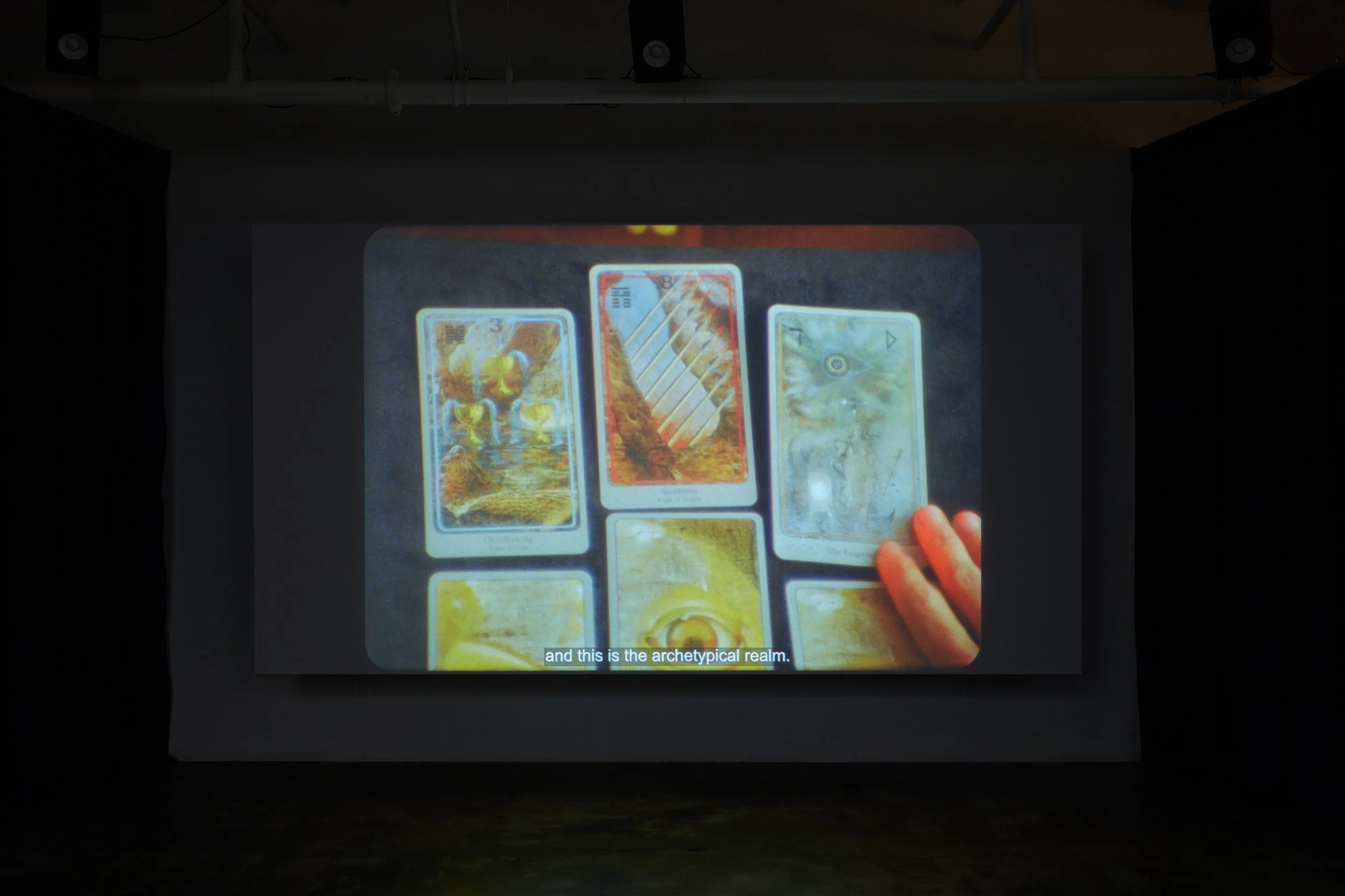
Alexis Kyle Mitchell, The Treasury, JOAN (credit Evan Walsh)
LSF
Yes, for Freud repetition is a problem, a sign of stuckness, but also whenever something is repeated, it is significant. In this context of Parapraxis: though something seems like a slippage, it is never an accident.
The slippages and cuts-between in The Treasury not only bring in multiple forms of reality or understanding, they convey that these forms of reality and understanding can all be available at the same time. Not forever, and not continuously, but for the moments we are in encounter with this work and the way it manages reality.
I’m thinking of this through a Freudian read, in which if all forms of reality are available at the same time, then an individual is likely to manage this by being either neurotic (the ego maintaining a relationship to the outside world while managing other realities internally) or psychotic (breaking from reality, “disavowing” what is unbearable or irresolvable in reality).
For me, The Treasury (and the context of experimental essay films in which I place it) works analytically in the sense that we are offered a temporary space in which to integrate realities, to allow them to live alongside one another for a short period, or perhaps for as long as is tolerable within the (mediated, contained, even, I would say, accompanied) space of the film. I myself found it tolerable for the period of this film to be with multiple realities that I have long struggled to figure out how to integrate: in my case, my early lived experience growing up with an intellectually disabled sibling, the way that shaped my personality and personas, my career in highly intellectualized and academic contexts, my interests in the spiritual, and the conflicting senses of abstraction and meaning that each of these contexts has offered me.
You mentioned to me in a previous conversation that The Treasury tends to operate as a “magnet” for people who have disabled people in their families, bringing people “out of the woodwork” toward you who share related experience. I think the film magnetizes in this way because it provides this kind of space that is not exactly therapeutic, but permissive, definitely. In its cuts, in its fusions or amalgamations. To me, it communicates that these experiences or modalities of being can coexist without resolution. The resolution is absolutely not the point. That’s what magnetized me. I’ve been in therapy about these things, but any work toward resolution never really did it for me!
AKM
Yes, and that is also how repetition can become this kind of spiritual zone. Because it emphasizes the between, the dichotomy between or the tension between. It stays there.
LSF
Staying in that tension also feels also informed by the experience of living with, being formed by, or being close to someone who is disabled. Earlier, you described parts of the film in which you talk with your sister about the film. This is part of the process of making it. Your sister’s form of meaning-making becomes one of many that leads to this film operating in the way that it does. The conversation with your sister is no aside or accident, in that sense. It becomes a part of how meaning is built.
As I offer that, though, I’m reminded too of the problematics of a spiritualist belief that nothing is an accident, that everything presents an opportunity for meaning. I’m wondering how you think about that. In a disability context, to say "Of course this was supposed to happen in this way," can easily lean into self-blame or blaming people without social context. How do we continue to offer care for suffering while accepting said suffering? I mean without erasing the sufferer’s reality in service of solving or healing.
Your work invites many interrogations of solutions for a body that suffers or has undergone trauma. A moment ago, you said: "In grief, I became a much more embodied individual than I had ever been." Given the Jewish content, the family Passover Seder, and the Hebrew references in the film, I want to think about that also in terms of Zionism, which I know is something you are also thinking about. How a body is “solved” by being slotted into a nationalist identity. Zionism also was a form of turning grief into an embodied individual by presenting a strong, muscled Jewish figure to relieve or counter the forced enfeeblement of the camps and the Nazi Holocaust. How is Zionism rippling in the film or the other work in the show?
AKM
When you mentioned the psychoanalytic idea that nothing happens by accident, I was thinking about this Passover scene. That scene also entered the film by “accident.” Because my mom died very suddenly, I searched for images of her moving to somehow process the loss. I went through all my hard drives, and the only thing I found was this footage I shot in 2008 from a family Seder. The film became a very Jewish film because of the accidental entry of the Kabbalah and this Passover scene.
So my parents sent me to a Hebrew day school as a child, but I’ve always felt out of place in this enforced Zionism (this became a more active and conscious politic somewhere in my 20s but perhaps was always an embodied refusal). The hatred and fear of the weak or failing body is masterfully utilized by capitalism and colonialism. You can think of the Nazi Holocaust as Germany's response to its own weakened “body” post-World War I. This idea also fits neatly into the post-Holocaust figure of the Muskeljuden in Max Nordau's ideology—this new, muscular Jew that rises above and becomes a strong, colonial figure, rather than a weakened, debilitated one. This is the material implementation of the colonialist project of Zionism and its ongoing genocide of the Palestinian people: to obsessively regenerate an idea of Jewish identity and community in opposition to ideas of weakness.
“The hatred and fear of the weak or failing body is masterfully utilized by capitalism and colonialism.”
That is the kind of repetition that gets stuck. It doesn't move. The Passover story that stops at Jewish pain gets regenerated and doesn't expand. This straight line between the weak and the strong, and the hierarchy in that, is always a eugenicist project. I continue to think about the fact that every policy we live with—at least in the imperial core—that has to do with health and the proliferation of a capitalist system is still a eugenicist project. The goal of this work is to expand our understanding of eugenics beyond thinking about Nazi Germany and understand how this binary obsession with strength and weakness is operating more broadly—even at the level of aesthetics (which is often subconscious).
LSF
Your work insists upon a willingness to turn the gaze toward the so-called weak. It looks at things that are often termed undesirable, considered weak, or uncomfortable inside the family. To bring another Freudian sense to that, there is also a real turn towards looking at the mother's body. There are intimate descriptions of the mother's head, neck, and vertebrae. What does it mean for the mother to be disappearing and reappearing through the held-open frame of this film? The mother appears in that Seder scene, but she also gets linked to a mother in the tarot and other memories the narrator shares with her mother.
AKM
In that Seder scene, my uncle is this sort of boastful patriarch running through the Seder ceremony. In screening the film, a lot of people have laughed in recognition of their own experiences with family tradition, but it is also in opposition to the idea of the mother as weak or meek—these are the stories that get told over the scene. I do think that attending to the different kinds of embodied and spiritual knowledge gets at the strength of the maternal in a way that is often forgotten.
You hear in the film about my mom dragging me to Weight Watchers with her which was her own way of dealing with her failing body. It became a normalized obsession with weight gain and loss that was passed on to me, even though I didn't inherit the genetic disease. That was her way of dealing with her perceived weakness: trying to take control of her body in a way that aligns with the capitalist patriarchy's obsession with a masculinist ideal.
LSF
In my experience of disabled spaces, there is often an extreme over-attention to fitness. I wonder if this is because disabled people present as less able to follow the social command of thinness. They can be disobedient subjects in that way. In your film, Weight Watchers serves as an attempt to become an obedient body as the body is becoming disobedient through aging and disease. Is this a form of agency, even as it serves a masculinist ideal?
You became a personal trainer at the same time as working on The Treasury. Back to that idea that grief turned you into a more embodied person. What does it do to this exhibition and this body of work and thinking that you also “work” in the field of “health” now?
AKM
At an early showing of this film, someone in the audience (whom I have known since I was young) asked, “Do you think your obsession with working out has anything to do with the fact that you grew up in a family where people's bodies were becoming exponentially weaker?” I couldn’t answer the question at the time because it seemed like the most obvious thing. The most subconscious and the most obvious.
“Health” as a concept is very vague, and yet, there is often a fascistic obsession embedded in the imperative to “work out” as it relates to projected relationship between health and fitness. At the same time, moving my body, with others, has changed me from a compartmentalized, intellectually driven person, to relating to people at the level of their bodies, and I find that a much richer, more nuanced, and less fascistic (!) relational practice.
LSF
In a way you have opened yourself or your own embodiment as an axis for people to enter. Your personhood operates on levels that people don't necessarily usually connect, and you connect them. It is like what happens when we read tarot—using symbols to make meaning of our lives, connecting images as power. I think your capacity or willingness to connect disparate worlds allows people to come into those worlds too. I experience that as a form of generosity.
AKM
Well, to dispel that sense of generosity, it's important to me to disagree with your perception of fearlessness of looking at the weak or disabled body. I wouldn't say that is something I approach with confidence. I feel troubled by it. I think it's why I watched my mother move in that Seder footage for so long.
I also felt an aversion to showing these Muybridge images. Knowing the history of that image and Muybridge's relationship with Leland Stanford, to the building of Palo Alto, (and contemporary techno-feudalism basically), and how that image is situated in a hierarchy of moving bodies, I felt we shouldn’t look at them. But as I was working with this image, I started to question my own looking away. Remaking that image as an animation allowed me to become more intimate with the person posing for that image: they could be a family member. It brought it into much more intimacy. My sister had her own self-conscious desire around how she wanted her image to be seen. She was interested initially in completely invisibilizing herself, but looking at these images together shifted something in both of us (her desire is now for everyone to see her in the film). I guess I’m saying that this “generosity,” as you put it, is shared collectively when we look at disparate and difficult things together. I don't exactly know what it is doing to represent or not shy away yet, but I feel committed to being in process with that difficulty.
LSF
Any kind of disabled-looking or looking-with-disability that feels ethical has to be constantly refusing itself, right? It must refuse to be seen and also desire to be seen—an anti-binary gesture. It is very much an in-process, which is important to how much of the work in this show is literally moving. These are not still photographs; they are in process. The curtain moves.
AKM
They are not stagnant. They don't repeat with no end. They repeat for creation. But they are always shapeshifting.
Alexis Kyle Mitchell’s exhibition ‘The Goal of Our Health’ will be at Site Gallery, Sheffield, from 16 October 2026—21 March 2027.