
Eluded Subjects
Phyllis Grosskurth’s Melanie Klein for the Present
David K. Seitz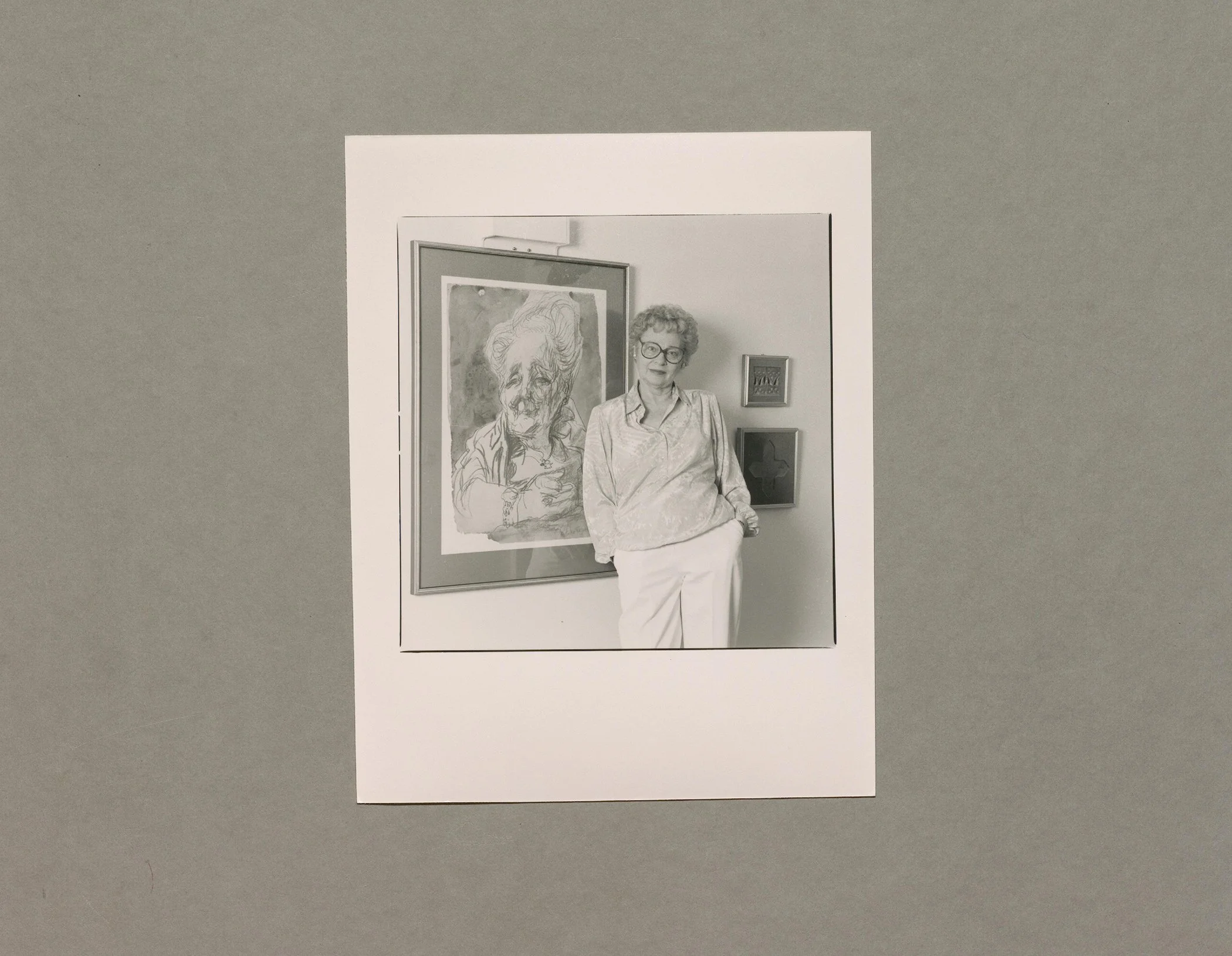
Roger Yip, Phyllis Grosskurth with an original portrait drawing of Melanie Klein by Feliks Topolski. Courtesy of the Thomas Fisher Rare Book Library, used with permission of the Grosskurth literary estate.
September 2026 marks the centenary of Melanie Klein’s move to London, a city whose psychoanalytic community she would take by storm, even amidst the city’s later literal bombardment. This year is also the eightieth anniversary of both the formal resolution of the Controversial Discussions between supporters of Klein and Anna Freud in the British Psychoanalytical Society and, fittingly, of the paper that introduced Klein’s concept of the paranoid-schizoid position. Finally, it is the fortieth birthday of the book that remains Klein’s most comprehensive biography, Canadian literary scholar Phyllis Grosskurth’s Melanie Klein: Her World and Her Work (henceforth MK).
Numerous intellectual biographies of Klein preceded and followed this 500-page tome, which Grosskurth, who also chronicled the lives of John Addington Symonds, Havelock Ellis, Margaret Mead, and Lord Byron to acclaim and uproar, considered her magnum opus. Yet none have sought to replicate the encompassing ambition of Grosskurth’s research, which drew on oral history interviews with dozens of Klein’s peers, loved ones, and patients conducted in the early 1980s alongside a thorough review of her publications, correspondence, case notes, and autobiography. In MK’s foreword, Grosskurth observed that “Few professional women have been subjected to as much distilled malice and rumor accepted as fact as Klein endured both during her lifetime and since her death.” With the book, she set out to correct unduly negative perceptions of Klein without the overcorrection of hagiography. “I hope,” Grosskurth offered, “I have in some measure presented a more balanced evaluation.”
Whether Grosskurth achieved her aim remains in contention to this day. MK challenged core aspects of the autobiographical notes that Klein left to her eponymous trust, weighing them against interviews and correspondence. Klein’s childhood, Grosskurth contended, had been more economically rocky, her level of formal education somewhat less advanced than she had suggested. Klein’s mother, Libussa Deutsch Reizes, far from the saint depicted by Klein in her later years, emerged in Grosskurth’s interpretation as domineering and manipulative—a pattern Grosskurth suggested Klein repeated with her own children and professional mentees. MK also confirmed for the first time for a broad audience that Klein’s earliest studies of young children had been based on the analyses of her own offspring, something disclosed in early German-language editions of Klein’s work but concealed in translations and largely confined to rumor in Anglophone worlds.
This is not to say that MK lacked admiration for its subject. “Captivated by the concept of the unconscious,” Grosskurth recounted, Klein pursued it “into speculative depths from which even Freud had retreated,” antedating libido and aggression from childhood to infancy. Audaciously, Klein theorized envy, “traditionally…regarded as a female weakness” that “a predominantly male group was reluctant to accept…[as] an inherent element in themselves,” as a general feature of the psyche. Grosskurth writes that it was “for daring to branch out on her own paths of investigation” that Klein “was branded, vilified, and mocked.” Although Klein’s ideas were clinically derived, Grosskurth held they also took inspiration from difficult, “deep personal experience”: the untimely deaths of two of her siblings and her eldest son, the attenuation of educational and professional opportunities in her young adulthood, an unsatisfying marriage followed by an intense but ephemeral romance, and endless professional controversies. That Klein “managed to survive”—much less leave such rich, creative contributions to human ideas—for Grosskurth was an achievement “of resilience and self-understanding.”
MK was generally well-received, with its reconstruction of the Controversial Discussions between the followers of Klein and Anna Freud often singled out for praise. Gillian Wilce lauded Grosskurth for “re-animat[ing] a world of feeling, thinking people,” and as “sympathetic to her subject” but not working “only in primary colors.” For Sherry Turkle, MK upended “simple myths” about Klein, both “forcing us to ask once again if the status of psychoanalytic theory is challenged by the vulnerability of psychoanalysts” and “provid[ing] rich new materials for thinking through this problem.” Grosskurth’s book was a key text in an international Klein renaissance in the 1980s and 1990s that included a new edition of Klein’s selected writings, works of Kleinian social and cultural theory, and even an acclaimed stage play dramatizing Klein’s life. Although Klein had long been influential in clinical analysis in the UK, Europe, and South America, MK helped Klein’s ideas find wider audiences, particularly in the US and Canada, where post-Freudian ego psychology had been hegemonic for much of the postwar period.
But the book’s detractors were not few. For some, Grosskurth’s sympathy for Klein came at the expense of evenhanded attention to the ideas of Klein’s critical interlocutors, particularly Anna Freud. The harshest criticisms, however, came from within the Kleinian fold. For some leading Kleinians, particularly in the UK, Grosskurth’s interpretive method partially or even completely undercut her years of diligent research. As Hanna Segal put it in the Sunday Times, Grosskurth’s “research is impressive, but for me the book is marred by her attempts to ‘psychoanalyse’ Klein and others. She tends to make suppositions and attributes motives on evidence which is very flimsy and sometimes nonexistent.” Strenuous critiques in scholarly journals followed. “Unfortunately,” Edna O’Shaughnessy observed, Grosskurth “is often possessed—seemingly unawares—by hostile animus against her subject.” Adrift in Grosskurth’s speculation, she concluded, “Melanie Klein eludes the book.”
In her 1999 autobiography, Elusive Subject: A Biographer’s Life (hereafter ES)—the title almost certainly a retort to O’Shaughnessy—Grosskurth recounted the precipitous descent from her initially warm reception as an “honorary Kleinian” to “feral and formidable” coordinated public criticism by the same group after her book’s publication, describing it as “among the worst experiences I can recall.” The fallout even compelled her to write another book, The Secret Ring: Freud’s Inner Circle and the Politics of Psychoanalysis (1991), which was more widely received as a concerted attack on psychoanalysis than MK. Grosskurth came to regard her estrangement from the Kleinians as a case study in “the dynamics of group behavior, how people who share the same ideological beliefs can indulge in punitive actions collectively while assuming no responsibility for their actions individually.”
In revisiting these scenes of talionic rancor, this essay’s aim is not to settle scores over Grosskurth’s book. Like many who came to psychoanalysis through queer theory, I first encountered Klein through Eve Sedgwick’s retooling of the paranoid-schizoid and depressive positions into paranoid and reparative reading practices, respectively. And although my own personal Klein is, in Julia Kristeva’s terms, less “reparative fairy” than “wizard of disquietude,” my undertaking here could, for better and for worse, be called “reparative.”
O’Shaughnessy countered Grosskurth’s “psychospeculation” with calls for speculation about Klein of a different sort: “[H]ow did her mind work?....How did she write? What did she read? Each day she set aside time of reading and writing. And how did her ideas come?” I have to confess I love these questions, unanswerable and hagiographic though they may in some ways be, and I love the works that pursue them. But I also appreciate much about Grosskurth’s Klein, warts and all.
Perhaps today, when thinking on and with Klein has become ampler and more variegated than it was 40 years ago, it is not too greedy or too epistemophilic to think with both of these Kleins. From our own paranoid-schizoid historical conjuncture, what more might we learn from Klein and from MK by revisiting Grosskurth’s own “world and work,” which has only occasionally been considered in assessments of the book?
Grosskurth came to regard her estrangement from the Kleinians as a case study in “the dynamics of group behavior, how people who share the same ideological beliefs can indulge in punitive actions collectively while assuming no responsibility for their actions individually.”
Although her biographical works brought her international renown and controversy in her own lifetime, Grosskurth, who died in 2015, is now little known beyond Canada. Her autobiography, published by a now-defunct Canadian press, was, much to her chagrin, not promoted in the UK or the US, as previous books had been. Yet with a biographer’s sense of posterity, she left a vast amount of material—some 214 boxes, dozens of them containing material on Klein—to the University of Toronto’s Fisher Rare Book Library.
If Northrop Frye, Grosskurth’s erstwhile U. of T. English department colleague, reportedly quipped that Toronto, with its frosty Protestant colonial history, “is an excellent town to mind one’s own business in,” then Grosskurth, a daughter of Toronto, refused Frye’s prescription. “If the person has been a public figure,” she told Joan Givner in a 1989 interview, “and the figure is dead then the biographer has every right to be as intrusive as possible.”
“And you don’t see this as Peeping Tomism?” Givner asked.
“Of course, of course it is,” Grosskurth replied. “Biographers are very nosy people.”
Both Grosskurth’s autobiography and the remarkable self-exposure effected by her archived papers now permit us to follow her lead.
A detour with Grosskurth affords us both a recuperation of what might be called the proto-psychosocial dimensions of MK and new perspectives on Klein for the present. As Carolyn Laubender observes, although the Freud Wars of the 1980s—in which Adam Phillips derided Grosskurth for “Freud-bashing”—could sometimes assume a polemical tone, these debates also prompted scholars to better “document the sociocultural context and use of [Freud’s] most significant theories,” putting psychoanalysis in a more “nuanced dialogue with its wider ideological and material environment.” The approaches modeled by Laubender and others enable us to reread Klein, Grosskurth, and their critics otherwise. If Grosskurth’s subtitle, which put Klein’s “world” before her “work,” somewhat audaciously purported to foreground the unconscious internal object-world of Melanie Klein herself, the book’s empirical findings, contextualizations—and yes, speculations—together continue to enable novel, timely, and even urgent readings of Klein.
*
The eldest of four children, Phyllis Marguerite Langstaff was born in Toronto on March 16, 1924 to Milton Langstaff and Winnifred Owen Langstaff. Although Phyllis spent part of her childhood in Toronto’s flush Rosedale neighborhood, the Great Depression caught up even with the comfortable. Milton, once an insurance executive, lost control of company he had founded and was eventually laid off. Life for the Langstaffs then became a continuous series of displacements across Canada and across the Caribbean—Barbados, Trinidad, and Jamaica, then British colonies—as Milton worked a series of short-lived sales jobs. When the family finally returned to Toronto, undergraduate studies in English literature at U. of T. offered Phyllis a world of intellectual stimulation, as well as a reprieve from her mother’s harsh criticism and physical abuse and her brother’s increasingly erratic behavior.
Phyllis’s first marriage, at 22, to Bob Grosskurth, a fellow U. of T. student who became an officer in the Canadian Navy, got her out from under the roof of her increasingly fractious family. But it also meant she was frequently on the move again, first across Canada and then to England. Although compelled to defer a career until her three children were older, Grosskurth embraced the position of oddball within the navy wife social scenes through which she moved, completing a master’s on William Faulkner at the University of Ottawa and then a doctorate at the University of London. Her first book, a biography of the poet and critic John Addington Symonds, won the 1964 Governor General’s Award, Canada’s highest literary honor, as well as commendation from gay activists for a then-rare non-phobic treatment of Symonds’ homosexuality.
Grosskurth joined the faculty at the University of Toronto in 1965, part of a cohort of three women who were the first to teach English literature at University College in tenure-track positions. She chafed against a good old boys’ network that underpaid and trivialized female faculty, and it was only by threatening to resign that she was granted tenure in 1968. Grosskurth came to relish the stereotype of “Difficult Woman” and did not shy from confrontation when she felt junior colleagues had been unjustly denied tenure.
After a second biography, on the sexologist Havelock Ellis, Grosskurth came to Klein somewhat by accident. She had originally set out to write a biography of Marie Bonaparte, the psychoanalyst and patron of the psychoanalytic movement who helped Sigmund, Martha, and Anna Freud escape Nazi Austria. Grosskurth even secured an advance from Knopf, which she combined with modest fellowship money to support a leave from teaching to begin a Bonaparte book in London. Both Kurt Eissler and Anna Freud took meetings with her about the project, but neither mentioned that Bonaparte’s papers, which are housed within the Freud Archives at the US Library of Congress, would remain sealed until well into the 21st century—nor that another biographer, Célia Bertin, had been granted access. When she finally learned from Ronald Clark about the access restrictions, Grosskurth panicked. Having spent a year and Knopf’s advance working on a now-unviable book, she had to begin again from scratch, in literary debt and under considerable time pressure.
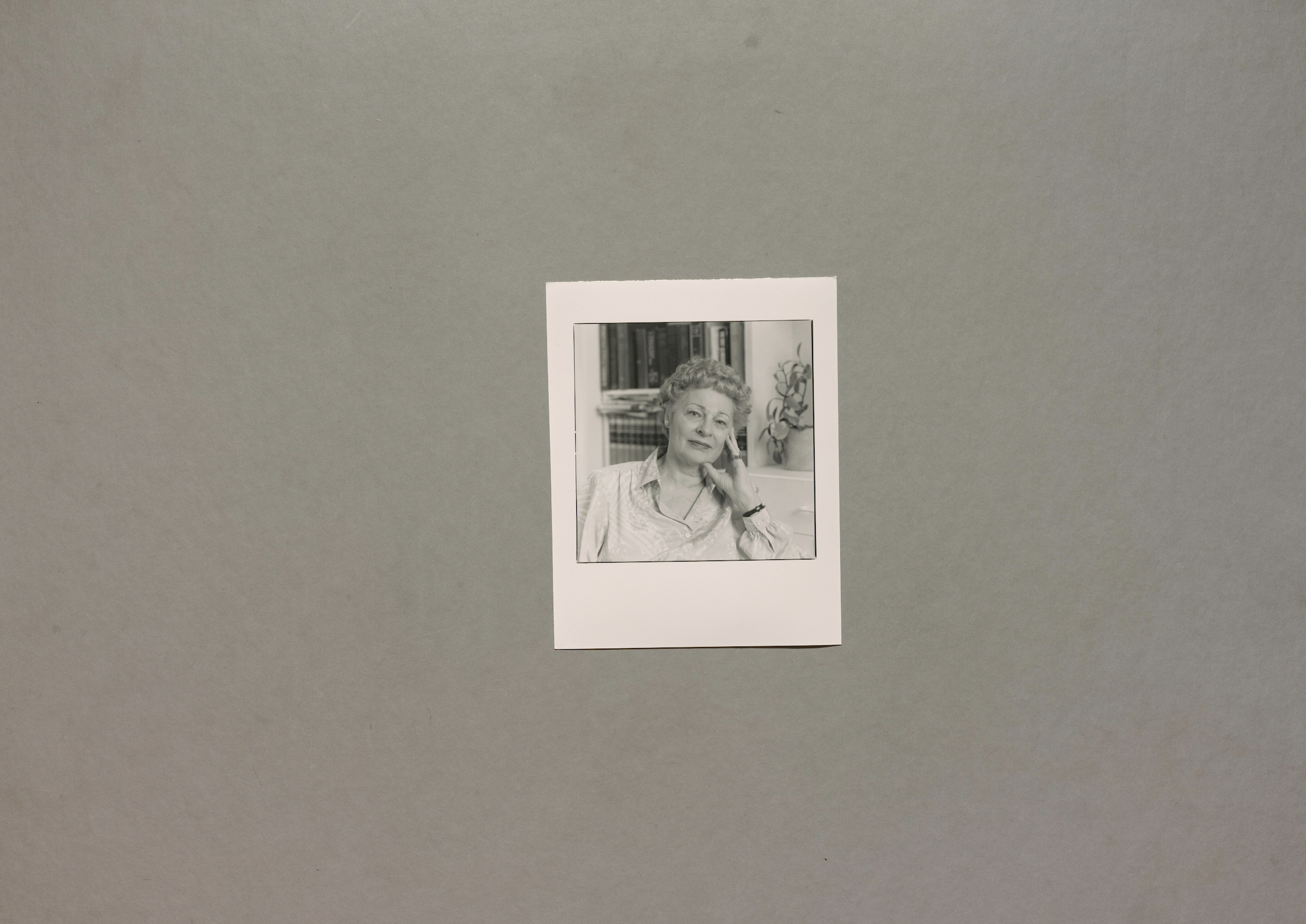
Roger Yip, Phyllis Grosskurth at her home in Cabbagetown, Toronto. Courtesy of the Thomas Fisher Rare Book Library, used with permission of the Grosskurth literary estate.
The idea of a Klein biography came to Grosskurth from her son. Brian Grosskurth, then a graduate student at McGill University, had written a term paper comparing the views of the Oedipus complex in Freud, Lacan, and Klein. Up to that point, Phyllis knew next to nothing about Klein, “beyond the fact that she was a controversial figure whom people sometimes mentioned ominously at London dinner parties.” But to her surprise, she soon obtained a guarantee of open access to Klein’s material from Hanna Segal and the Melanie Klein Trust and the support of Klein’s son, Eric (who had changed his name from Erich Klein to Eric Clyne to avoid British antisemitism). Granted interviews by an astonishingly wide range of analysts in the British Society—Kleinians, Freudians, Independents—she was refused cooperation only by Anna Freud, Klein’s principal rival, as well as Paula Heimann, Klein’s former protégé, with whom she had a permanent break in 1955, and Melitta Schmideberg, Klein’s estranged daughter and a psychiatrist who began attacking her mother professionally in 1933 and remained unreconciled with her at Klein’s death in 1960.
Klein was for Grosskurth a revelation. Although wary of overidentifying with a biographical subject, the parallels between the two women’s lives were uncanny and myriad. Both were one of four children, and both were subject to frequent social and geographical dislocation through early adulthood. Both deferred their professional careers to raise children. Both were mothers to two sons and one daughter. After rough divorces, both retained their married surnames for professional purposes (including, for Grosskurth, through two subsequent marriages). Despite being intellectually underestimated upon arriving in London—Klein by some in the psychoanalytic community, Grosskurth by her graduate advisor—both first flourished professionally in that city. And both remained “dogged by controversy and male chauvinism” throughout their careers.
But it was Kleinian theory that had “had an extraordinarily personal resonance” for Grosskurth. A breast cancer survivor who counted an envious resentment of her mother’s breastfeeding her sister and an antipathy to her own breasts as among her earliest memories, Grosskurth found Klein’s attention to female sexuality refreshing, even exhilarating, vis-à-vis Freud’s lacunae on the subject. Encountering Klein’s vision of unconscious reparation to the internal parents as the basis of gratitude and love, Grosskurth intimated, became “lodged deep in my heart, and […] marked the real beginning of my reconciliation with my mother, who still, even in death, was part of my inner life.” Above all, in Klein, Grosskurth found a complex, almost endlessly surprising mind. “I have never written a book which afforded me so much intellectual enrichment. Every morning I would rush to my desk, not knowing how the story would unfold that day.” Grosskurth even dreamt of Melanie Klein.
After MK’s completion, she experienced withdrawal symptoms, “something dreadful. Because it’s very exciting…to go around carrying a whole world in one’s head, balancing this whole world and then suddenly it’s gone. And one has to get on with one’s own rather mundane life.” The feeling is familiar to any writer who must relinquish a major project to publication. As Lauren Berlant put it, “Books are never finished: one just stops writing them.” For Grosskurth, intellectual postpartum depression was not the only trouble coming.
*
What is remarkable, in retrospect, about the reception of MK is the degree to which it repeated the very split dynamics that Klein discerned in the infantile unconscious, and that characterized the reception of Klein’s ideas in her own lifetime. Grosskurth’s Klein was, by any reading, a mixed bag: a sometimes unpleasant, always formidable person with brilliantly creative ideas. What kind of whole object these parts integrated into was up to the reader. But as Segal’s review made clear, for some Kleinians the book was itself split: admirable in its comprehensive empirical foundation, but far too speculative and theoretically naive.
All parties, including Grosskurth herself, agreed on the presence of factual errors in MK, the most serious of which concerned the suicide of one of Klein’s former patients. But far more ire has been directed at Grosskurth’s interpretations. There is no shortage of speculation in MK: about the unconscious roots of analytic politics (“Anna Freud and Melanie Klein were both aware that they were unwanted children, whose fathers preferred their older sisters; and this affected them, in different ways, all their lives”); about the autobiographical dimensions of Klein’s theories, well beyond the early analyses of her own children (“In the envy paper Klein may well [have been] discussing herself”); and about the effects of the dense web of training analyses on contentious psychoanalytic scholarship (“Was Heimann in some way telling Klein something about the unsatisfactory nature of her own analysis?”).
For Grosskurth, such conjectures were the product of a psychobiographical method, “a psychoanalytic reading of a character” which, although “dangerous,” is “justified particularly in cases where there’s a wide disparity between the public image and the private person. The biographer then asks why this disparity.” But for many, including many of the book’s admirers, such interpretations smacked of wild analysis. “Grosskurth,” by Turkle’s reading, “succumbs to the temptation to use Klein’s theory to analyze Klein.”
What proves most revealing, however, are the terms on which Grosskurth’s Kleinian critics rejected her method. Here’s O’Shaughnessy:
If [psychobiography] is to be a valid genre, some appraisal is needed of the difference between a psychobiography and a psychoanalysis. Otherwise, as here, too much will become what can only be termed psychospeculation. Even with the privileged access to his internal world which a patient allows to an analyst, unravelling infantile sources of current attitudes is complex and difficult, and a biographer, lacking analytic access, necessarily works from different, more external sources. Phyllis Grosskurth’s intrusions into psyches, in my view, hinder her throughout the book from using the findings of psychoanalysis in a more valid writer’s way to augment imaginative insight into her subject.
For O’Shaughnessy, there was validity and then there was validity. Psychoanalytic validity—available only to psychoanalysts in the space of the consulting room—belongs to the order of proper, scientific knowledge. The best Grosskurth could hope for, as a non-analyst, was the more restrained use of “the findings of psychoanalysis in a more valid writer’s way.” This way remains somewhat nebulous. Where would it leave the Freud who analyzed Daniel Paul Schreber via Schreber’s memoirs, to say nothing of O’Shaughnessy’s own diagnosis of Grosskurth’s unconscious hostility to Klein via MK? But the implication of the scientific/writerly distinction is clear: as non-scientists, non-analysts like Grosskurth should stay in their lane.
Whatever its merits, such a critique ironically repeats the very scientism that characterized initial objections to Klein’s own work. Revisiting the Controversial Discussions, Jacqueline Rose observes that early cases for Klein as “inheritor of the Freudian ‘truth’” embraced her radicality in pursuing it beyond “an order of scientifically verifiable human knowledge,” which “the limits of Freud’s own scientific training made him unable to fully pursue.”[1] Rose returns us to the charge leveraged by Marjorie Brierly, who framed the inferential character of Kleinian theory as a threat to psychoanalysis’ scientific authority on ugly civilizational terms: “[I]f we persist in equating mental functions with our subjective interpretations of them, we forfeit our claim to be scientists and revert to the primitive state of the Chinese peasant who interprets an eclipse as the sun being swallowed by a dragon.” Heimann, then among Klein’s allies, replied that “[t]he science of psychology is not to be equated with the science of astronomy,” that the analytic task is to understand how “the knowledge that the sun is not swallowed by a dragon develop[s] in the minds of peasants and philosophers.” “For Heimann,” Rose adds approvingly, “psychoanalysis makes no distinction between peasants and philosophers.”
Alongside the pairing of the peasant and the philosopher as equally worthy subjects of inquiry, the debate on MK compels us to consider an additional figure: the housekeeper. In taking Grosskurth to task for the serious factual error noted above, critics repeatedly impugned her source: an interview with Kathleen Cutler, a domestic worker employed in Klein’s Bracknell Gardens home. Thus Segal: “Grosskurth herself relied on a very old housekeeper’s gossip rather than checking the easily ascertainable facts.” O’Shaughnessy: “The author believed Melanie Klein’s old housekeeper whose memory was failing.” And independent analyst William Gillespie: “Clearly it is unwise to accept uncritically the gossip of a housekeeper.”
Grosskurth’s Klein was, by any reading, a mixed bag: a sometimes unpleasant, always formidable person with brilliantly creative ideas. What kind of whole object these parts integrated into was up to the reader.
The necessity of triangulating one’s sources and double-checking one’s facts is not in dispute. But the readiness and pervasiveness with which such critiques put the disparaged, gendered, classed, figure of the elderly housekeeper to rhetorical work seems overdetermined, in excess of even the grave seriousness of the factual error in question. Might disparaging Grosskurth’s turn to Cutler as a worthy interview subject have also expressed anxieties about her more general attention in MK to the question of class? (Think of the proverb, later revised by Hegel and Goethe, that “no man is a hero to his valet.”) MK was not a robust social history of Kleinian analysis, but it did raise questions of class antagonism: the professional hurdles Melanie’s father Moriz Reizes experienced in antisemitic Vienna, the middle-class discomfort about the sex work stroll near Klein’s Notting Hill home, the exploitative political economy of patient referrals for analysts in training, and even the class inflection of Klein’s view of Melitta’s marriage to the wealthy Walter Schmideberg.
For Segal, Grosskurth’s “psychologising results in attributing usually the lowest motives,” and “There is no evidence of Klein having ever been motivated by money or social prestige.” I can’t help but wonder: so what if there were? Plenty has come to light about the money woes faced by Sigmund and Martha Freud, parents of six children, and about Jacques Lacan’s exquisite art collection, and their ideas have proven no less incisive in interrogating capitalist desire for it.
Grosskurth’s autobiography is even more candid about her own financial troubles: her family’s Depression-era fall from affluence; the gender gap in faculty pay at the University of Toronto; the debt to Knopf that hovered over the production of MK; her sometimes drastic efforts to reduce her living costs in London; and the nightmare of an unexpected tax audit during a Revenue Canada campaign targeting artists and writers.
ES is equally frank about the need to fight inequality with political action. In 1972, Grosskurth resigned in protest from a body advising the Canadian province of Ontario on university affairs, making headlines with her claim that the Progressive Conservative government was using the body as a rubber stamp for austerity. In prescient critiques of the emerging idioms of a neoliberal age, Grosskurth shredded the language—decentralization, means-testing, behavioral incentives, even diversity—through which the province sought to walk back the promise of universal access to higher education. “Who,” she asked in a Globe and Mail editorial with Garry Clarke, “are the least employable of our youth? How do we know who will be affected by excluding 46,000 qualified students from full-time study? What is the social cost (as distinct from the financial cost) of such a departure from the present ‘open door’ admission policy?” These do not seem like the words of a woman who would consider the experience and knowledge of a retired domestic worker disqualified from contributing to the history of psychoanalysis.
In 1989, Grosskurth joined a coalition that battled with the U. of T. administration over their censure of faculty who supported a two-week teaching assistant strike. In 2001, she co-led a class action lawsuit against U. of T. over the meager pensions of retired women faculty in her generation, many of whom started their careers after marrying and raising children, thus reaching the university’s mandatory retirement age before their prime earning years and before a long-awaited gender pay gap audit.
Reflecting on MK, E. Ann Kaplan worries, with good reason, that the substantive ideas of women intellectuals are too often reduced to their emotional roots. But if Grosskurth’s psychobiograpical method purported, however bluntly, to put the biographer in a position akin to that of the analyst, Grosskurth, unlike Klein, believed in something like the countertransference. Asked whether “all biography is really autobiography,” Grosskurth answered in the affirmative, reflecting that when she taught biography, her students became as interested in the authors as in their subjects. Crucially, countertransference in psychobiography was ineluctably social as well as personal. Grosskurth’s strong identification with Klein and Kleinian theory was not merely personal, but suffused with social questions of gender, migration, and class, questions that shaped the book that resulted. To close, let’s consider an example of the affordances of both MK and Klein for thinking our own ghastly contemporary moment.
*
In keeping with its author’s inveterate nosiness, it was MK that first publicly identified the man whom Eric Clyne considered the great love of his mother’s life, a man with whom Klein engaged in a brief affair after the end of her marriage, followed by a prolonged, amicable correspondence. Klein met Cheskel Zwi “Hans” Kloetzel in a dancing class in Berlin in spring 1925 as she prepared a series of lectures for the British Society that summer. Nearly “nine years younger than Klein,” Grosskurth recounted, Kloetzel “was married and had a daughter. He was also a confirmed Lothario.” A Berliner Tageblatt travel journalist and children’s book author, among his best-known works was Moses Pipenbrink’s Adventures (1920), described by one German literary scholar as“one of the first novels with Zionist tendencies written for Jewish children in the German-speaking world.”
By June 1925, the Klein-Kloetzel affair was clearly doomed, with Klein headed to London and Kloetzel on assignment in South Africa, then a part of the British empire. The next month, Kloetzel, “already involved in a shipboard romance” with another woman, broke things off with Klein by a letter sent from a stop in the Canary Islands. In a draft response, omitted from her final letter but included in MK, Klein concludes by wishing Kloetzel a stimulating sojourn in Africa as a kind of recompense for the sorrow he had expressed over the breakup: “I hope this trip will be to your satisfaction. The interesting new things, which will take all your attention, will surely form a counterbalance for you against any pain, however strong.”
Excised, Klein’s expression of hope did not make its way to Kloetzel. But it resurfaced in her writing over a decade later. Postcolonial critics have long interrogated Klein’s strangely colonial choice of metaphor in “Love, Guilt, and Reparation,” which compares the epistemophilic, greedy baby’s guilty phantasy of making repair to its aggressed mother to the figure of the colonial explorer. The explorer, Klein wrote, “gives expression to both aggression and the drive to reparation” through the process of “discovering a new country.” In “former times,” reparation for “ruthless cruelty against native populations” had taken concrete form through “repopulating the country with people of [the explorer’s] own nationality.” But “through the interest in exploring (whether or not aggression is openly shown) various impulses and emotions—aggression, feelings of guilt, love and the drive to reparation—can be transferred to another sphere, far away from the original person,” including “any kind of scientific discovery.”
If Clyne was right about the enduring significance of Kloetzel in Klein’s inner world, and if Grosskurth was right about the place of the personal in Klein’s theories, to what extent was the figure of the colonial explorer in “Love, Guilt, and Reparation” modeled on Kloetzel himself? It is perhaps not insignificant that Kloetzel’s archived papers include an (apparently unpublished) manuscript of his admiring biography of Christopher Columbus. If, in Klein’s thinking, Kloetzel repaired his guilt about transgressing his marriage—or breaking up with Klein—by repopulating his life with a new lover shipboard or accumulating knowledge of “new” places, what kind of reparation was this?
Many critiques of “Love, Guilt, and Reparation” assume that its account of reparation, bedecked as it is in colonial metaphor, is normative—that it naturalizes what David Eng calls “bad-faith liberal white guilt” in the face of settler-colonial conquest and genocide. But Amy Allen has recently argued that this passage is in fact an implicitly critical description of what Klein called “manic reparation” or the “manic defense.”
In “A Contribution to the Psychogenesis of Manic Depressive States,” Klein explained that manic defenses stave off the depressive anxieties of dependence on an object through the “disparagement of the object’s importance” and unconscious phantasies of omnipotent control that can lead to the denial of “a great deal of external reality.” Klein’s work on this essay began in summer 1934, as she began to work through her son Hans’s death in a climbing accident that spring. But Grosskurth noted that Klein entered analysis for depression months before her son’s death, timing that “would suggest that Klein’s deep depression was triggered by the departure of Kloetzel for Palestine in late 1933,” only to be infinitely compounded by the loss of her son. It surely did not help that Kloetzel’s nickname was Hans.
Consider, too, a key Kleinian figure of manic denial: “the typical Don Juan,” the promiscuous (presumed heterosexual) man who denies his mother’s indispensability as “he can always find another woman to whom he has passionate but shallow feelings.” Although this account is certainly pathologizing, Grosskurth surmised it was shaped by Klein’s experience with the men closest to her, Kloetzel very much included.
If Kloetzel was, for Klein, a figure of manic reparation in both his travel writing and his intimate conduct, might her intuition also have extended to his Zionist politics? Kloetzel, who died in 1951, spent the rest of his life in Palestine, becoming features editor of the PalestinePost, which in 1950 became the Jerusalem Post. Founded in 1932 by Gershon Harry Agron (né Agronsky), a journalist and politician who took seriously “the political imperative to present the Yishuv’s case both to Jews and non-Jews abroad,” the Post was an expression of Gershon’s lifelong mission, as he described it, of writing with “a spirit of constructive optimism, predisposing the reader to see that in Palestine there is a state of ‘normalcy,’ where Zionist reconstruction can be taken for granted.” Kloetzel’s wide-ranging contributions included coverage of new settlements, developments in rail and air technologies and infrastructures, Jewish communities in Africa and Asia, and trends in literature and the arts. In one especially remarkable column, he drew directly on a 1946 psychoanalytic paper on “neurotic group behavior” to pathologize what he saw as the belatedness of British support for a Jewish state, decrying “neurotic denials…of the undeniable situation” that “Zionism is the only answer to the Jewish problem, and Palestine the only country where the homeless and unwanted Jews can go.”
As Klein herself insisted, there are plenty of persecutory anxieties to go around, and their mere presence need not reflect external, material reality.
Klein’s 1959 autobiographical notes, by contrast, waxed far more ambivalent on the question of Zion. Despite a “strong feeling for the Jewish race,” she had never been a Zionist herself, as “even in my young days I had no desire to be segregate.” Although she felt “a certain sympathy with the people who struggle to establish Israel and [had] some admiration for their endurance and the strength of their principles”—her old Berlin colleague and friend Max Eitington emigrated to Palestine around the same time as Kloetzel—she personally “should have hated” to live there. Taking “England as my second motherland,” Klein tied her “attitude of sympathy with Israel” with “a feeling which, though it may have originated in the state of persecution of the Jews, extends to all minorities and to all people persecuted by stronger forces.”
Perhaps we can hear echoes of Klein’s distance from Zionism and readiness to connect Jewish persecution with that of “all people persecuted by stronger forces” in the contemporary insistence voiced by groups like Jewish Voice for Peace that never again means never again – for anyone. We might even place Klein alongside Hannah Arendt, who Judith Butler argues offered a “critique of the nation-state and of Zionism in particular [that] provided a pivotal conjunction between the dispossession of the Jews from Europe and the justice of the demands of all those who were coercively dispossessed of home, land, and rights of political self-determination, including Palestinians.”
But Klein was not Arendt. Her remarks on Zionism were incipient, not fully articulated. On its own, a capacity to link experiences of persecution could just as easily slide into an equivocal, liberal Zionism that sanitizes the occupation of Palestine with paeans to queer and other minority rights. As Klein herself insisted, there are plenty of persecutory anxieties to go around, and their mere presence need not reflect external, material reality.
Klein’s most salient contributions to political theorizing were more indirect, rooted in her astute discernment of the most elusive and unsettling of human motives. Thus in “Mourning and its Relation to Manic-Depressive States” (1940), she emphasized “the importance of triumph, closely bound up with contempt and omnipotence, as an element of the manic position.” Triumph impeded the work of mourning, to say nothing of “true harmony and peace,” setting in motion a vicious phantasmatic circle wherein “the subject’s triumph over his objects necessarily implies to him their wish to triumph over him, and therefore leads to distrust and feelings of persecution.” It is here that Klein came closest to Arendt, who, as Rose reminds us, warned that behind the “spurious optimism” of Herzlian, us-against-the-world Zionism “lurks a despair of everything and a genuine readiness for suicide.”
Noura Erakat, drawing on the work of Aimé Césaire, writes of a “boomerang effect,” whereby U.S. support for the genocide in Palestine at the periphery of its empire has compounded authoritarianism at home. Klein’s account of triumph in the manic position locates a kind of microboomerang at the intrasubjective scale, whereby phantasies of ultimate triumph perversely amplify the persecutory fears they seek to eliminate once and for all. What the Post saluted in its founding father’s “positive work style and building ethos”—and what Kloetzel praised in Columbus’s spirit of “Venture and Triumph”—Klein equipped us to understand as enactments of manic reparation at the scale of a collective colonial project.
*
Both MK’s empirical findings and its speculations about what lay beneath Klein’s theories thus continue to make new, urgent readings of Klein possible. Grosskurth was no flawless paragon of Left politics. Her own sense of persecution by British critics as a “colonial granny” from the empire’s periphery, and of Canada’s innocence on the world stage, betrayed attenuated analyses of race and settler colonialism.[2] But if, as Laubender argues, even the adamantly apolitical Klein responded to the political questions of her day by bringing the language of war and reparation into the clinic, Grosskurth in her own way effected something similar, bringing the social conditions that gave rise to her identifications with Klein into even MK’s wildest analyses.
In 1986, Grosskurth predicted that it would take another generation for MK to be more universally appreciated. I’m not sure whether Grosskurth will ever be vindicated in any final or triumphant way. But as Berlant advised, a book’s “exempla are beginnings, not hermetic seals.” Whatever MK’s limits, it is laudable that Grosskurth found it “impossible to write about pallid, safe, subjects” and refused to “sidestep incendiary material.” Something similar could no doubt be said of Klein. As the imperial boomerang rebounds in draconian, neo-McCarthyist restrictions on speech in many of the countries of the imperial core—about Palestine, race, gender, climate—there remains much to learn from thinking with as well as against the exempla left by these Difficult Women.
[1] The word “truth,” Rose points out, is Joan Riviere’s.
[2] Grosskurth’s 1989 reproach of a history of Freud’s friendship with Carl Jung for including an interview with Freud’s housekeeper as an “extraneous detail” also tragically reiterated the very classist aggression that she herself had endured over MK. Phyllis Grosskurth, “Great Minds Didn’t Think Alike,” Toronto Star, March 11, 1989, M18.