
Inviting the Enemy
The Iranian Diaspora’s New Politics of Belonging
Séamus Malekafzali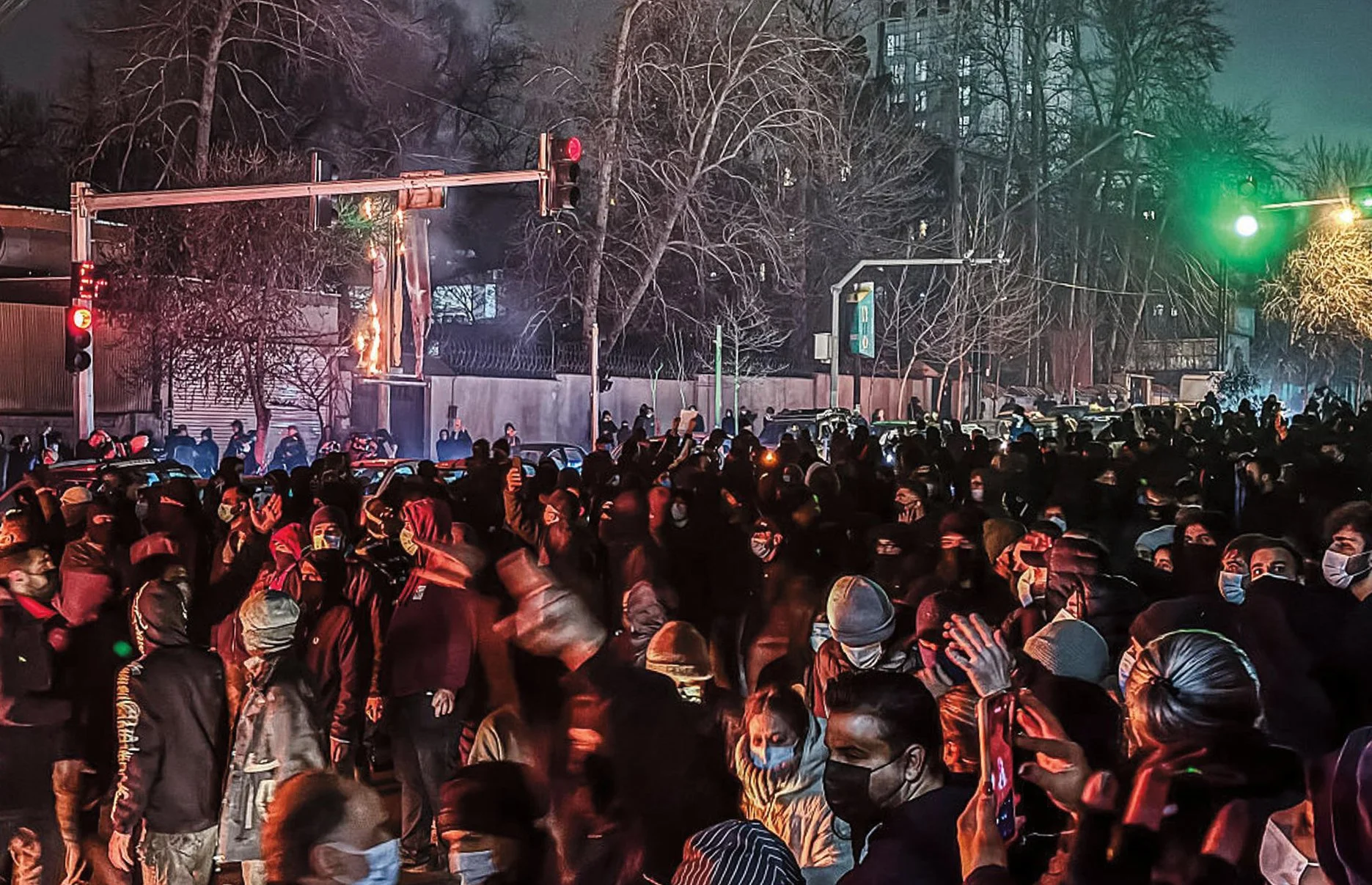
In September 1980, Reza Pahlavi, having been deposed as crown prince only a year earlier, wrote a letter on the royal stationery of a dynasty that no longer existed. It was not addressed to his supporters, nor to any foreign government, but to the new government of his home country, the Islamic Republic. In the letter, Pahlavi pledged to demonstrate his patriotism “by offering [his] blood” and asked to be given the opportunity to express his “devotion to the sanctity of this border and homeland.” Pahlavi was not simply speaking as an aggrieved and angered Iranian, mortified at the invasion of his country only a few days earlier by Saddam Hussein and the forces of the Republic of Iraq, but as a potential strategic asset. Pahlavi had been training as a pilot in Texas as a cadet in the Iranian Air Force before the Revolution forced his travels elsewhere.
In the message, he offered to “fulfill [his] national and patriotic duties as an officer, and like every Iranian soldier, act accordingly.” Even though his own father had been overthrown by those who now ruled Iran, Pahlavi saw it as an imperative to defend the country regardless. “I hope, that as an Iranian and as a young pilot filled with a profound love for his homeland, who has no goal other than the greatness, the progress, and the dignity of Iran, that together with my fellow soldiers, I will sacrifice my life in defense of the water and land of Iran.”
There was no reply.
In March 2026, Pahlavi stood on the stage at the Conservative Political Action Conference (CPAC) in Grapevine, TX. His country had been at war for nearly a month. Some 124 children had been massacred in strikes in Minab and Lamerd on the first day of the war. Nearly fifteen hundred civilians had been killed in American and Israeli airstrikes; hundreds more still were killed after the convention had finished. Hospitals, apartment blocks, stadiums, libraries, nuclear reactors, universities, museums—anything and everything relating to the fabric of Iranian society had been deemed a target by an enemy that had, years before, threatened to destroy Iran’s cultural sites as retribution, and would, only days after Pahlavi spoke, threaten to destroy Iranian civilization itself.
Pahlavi did not acknowledge on stage, at any point, civilian casualties from the war waged against Iran or the threats to invade Iranian territory and seize places like Kharg Island, where thousands of Iranians live. He instead thanked, “on behalf of millions of Iranians,” the “resolve” of President Trump and the “courage of American troops.” In an uncomfortable echo of statements from American politicians referring to Gaza at the start of that war in 2023, Pahlavi linked Iranian protesters and American soldiers in his call to “finish the job.”
The Reza Pahlavi of the 1980s, the twenty-something American-trained fighter pilot who offered his services to the Islamic Republic’s Air Force in order to fight the Iraqi invasion, was now dead and buried. The Reza Pahlavi of the 2020s is willing to invite anyone in. “President Trump is making America great again,” he said. “I intend to make Iran great again.”
This story is not solely about Reza Pahlavi, however. On the CPAC stage, Pahlavi did not stand alone, playing only to those close to the White House from whom he so desperately sought attention. Pahlavi was rapturously and continuously applauded inside the convention center by his own gang of sycophants, members of the Iranian diaspora who constantly chanted his name, declaring “Long Live the Shah” and “King Reza Pahlavi.” Both he and the crowd still devoted time to showing fealty to the man high above all of them: Donald Trump. At one point, attendees, some of them clad in shirts with the royal emblem, others draped in royalist flags, cried out “Thank you, Trump” in unison.
During the war against Gaza, there were no public protests by groups of Palestinians, for example, waving Israeli flags and demanding that the Israel Defense Forces go further. In Iran’s case, there are countless examples of demonstrators in American and European cities waving the US, Israeli, and royalist Iranian flags together and, in some cases, even waving the flags of the IDF and the Savak, the Shah’s secret police. The emergence of a strong, incredibly vocal, and deeply pro-war faction of the Iranian diaspora has left many who stridently oppose the war against Iran in a state of deep bewilderment.
Popular support for the war among the Iranian American population has tumbled as the war has ground on, but a poll from late March still showed it at 32.7%, down from a nearly fifty-fifty split at the beginning of the war. At least in the abstract, virtually half of the Iranian American population was in favor of a war against their cultural and familial homeland. At the beginning of the conflict, the White House justified its war through videos of members of the Iranian diaspora celebrating that it posted to its social media page, some set to the Village People’s “YMCA,” a favorite of Trump’s.
Opposition to wars that America and Israel undertake abroad has usually relied on the support of the people being attacked—the diasporas of those countries mortified at the horrifying situations. The scenes of Iranians holding up signs thanking Trump and the IDF for their work, insulting those who protest against the war, and telling reporters that the massacres at Minab were “worth it” if they overthrow the government, have had the anti-war left searching for an angle that is difficult to triangulate. Keyvan Golsorkhi wrote in The Nation in mid-April that war against Iran is no longer seen as a “catastrophe” by much of the diaspora,
but as part of the necessary precondition for freedom. This position does more than justify violence; it redefines its meaning, collapsing the distinction between foreign intervention and democratic mobilization and recasting external force as a vehicle for liberation. In this framing, a war is not a tragedy to be resisted but a condition to be embraced.
As Golsorkhi notes, it was not always like this, but the seeds of this were planted long ago.
The Iranian Revolution, known as the Islamic Revolution by those who wish to acknowledge the system that came after it, produced a novel form of government in an incredibly short amount of time, with the main wave of protests beginning in late 1978, the Shah leaving in January 1979, and the referendum to create the Islamic Republic coming in March of that year. For the secular, the liberal, and, most vocally, the upper class, the sudden insertion of Islamic values into public life, something supported by an overwhelming majority of the national population, left them bewildered and anguished, feeling as though they had experienced a national trauma, unable to recognize the country in which they were born and raised, and unable to foresee the path the nation would soon be going down.
Some who had supported the revolution, especially those from leftist cadres, feminist organizations, and other secular groups, became regretful. Shirin Ebadi, who was a judge before the revolution saw her removed from her post, wrote in The Washington Post in 2020 that she regretted taking part in the revolution and wished that she had instead backed a constitutional monarchy: “[W]ith the benefit of hindsight, most of us can agree that 1979 was not the time for a revolution. What we needed most was reform, not the total destruction of the system.” In 2026, Ebadi pledged to build a future justice system to prosecute Islamic Republic officials when Pahlavi comes to power in Iran, a move condemned by more than three hundred Iranian academics and other members of civil society in a letter in March. Earlier this year, Ebadi, a Nobel Peace Prize laureate, advocated for the assassination of Islamic Republic officials, seeing a model in Israel’s assassination of Hamas political bureau leader Ismail Haniyeh in Tehran in 2024. After the American bombing of the elementary school in Minab that killed at least 150 students, Ebadi decried the Islamic Republic for having built a school so close to a military base and appeared to imply that the killed girls had been used in a manner akin to child soldiers.
Many in the West have had diaspora narratives in literature color their perceptions of the revolution and its aftermath. Perhaps chief among those examples is Reading Lolita in Tehran by Azar Nafisi, released in 2003. Nafisi, whose father was the mayor of Tehran in the early 1960s and whose mother was a Royalist member of Parliament, describes her experience and that of others around her in the revolution and its aftermath in terms of feeling like “aliens in their homeland”: not understanding the strange customs, simultaneously new and ancient, that had come to the fore and perceiving its leaders as representatives of a different people and a different land than her own. She and her students at Allameh Tabataba’i University found comfort through the ’70s and ’80s in the books of Western authors and thinkers who helped them process their own predicament.
In 2006, the Iranian academic Hamid Dabashi decried Reading Lolita in Tehran as emblematic of America’s “comprador intellectuals” and claimed that Nafisi was helping lay the groundwork in the public’s imagination for a future war with Iran “by way of justifying the imperial designs of the US as liberating these nations from the evil of their own designs.” In 2024, a film adaptation of Reading Lolita in Tehran premiered, directed by Israeli filmmaker Eran Riklis. Nafisi, for her part, has opposed the war insofar as it has killed civilians and bombed critical infrastructure, but wrote in The Guardian in late March that she hoped “that the conflict could liberate my people” and celebrated that the Islamic Republic has been unable to destroy “Iranian culture,” which will remain after the war ends and the regime goes.
A pervasive conviction has emerged over the past decade among the Iranian monarchist opposition, one wrapped up in the militant belief that Western intervention and war are necessary, that Iran is not just ruled by Islamists who seek to crush freedoms and curtail human rights, but that the country is occupied by non-Iranians, that its society, its customs, and even its language have been invaded and taken over by foreigners, and that, as the Islamic Republic has entrenched itself, the only solution is for another foreign force, one much more in line with the customs and beliefs of ancient Iranian civilization, to excise this government from the face of the nation.
Reza Pahlavi has attempted to forge these connections between Iran and Western cultures in much more formal fashion, making visits to Israel on the basis that Iran and the Jewish people hold an ancient, thousand-year-old alliance going back to Cyrus the Great, and that Israel, the state of the Jewish people and the natural heir to that history, can help Iran rebuild into a major power with its financing and technology. A future Iran under his helm would sign his proposed “Cyrus Accords,” a version of the Abraham Accords just for the Iranians, a signifier of the importance of their relationship.
Mohammad Reza Pahlavi, the last Shah, took the title Aryamehr, which means “Light of the Aryans,” during his reign. That title continues to be invoked by supporters of the late Shah and his son, alongside other traditional titles. One notable figure who regularly calls the late Shah “Aryamehr” has been Kamal Penhasi, the IDF’s Farsi spokesman, an ardent monarchist who announced expulsion orders for neighborhoods in Tehran on the Israeli military’s behalf during the war.
What it meant to be Aryan in the Iranian context was distinct from its later usage by the Nazis; the term referred to how Iranians themselves were defined in the pre-Islamic era, but the connotations with authentic nationhood and, more crudely, racial purity, remain. Diaspora protests have featured chants desperately insisting that Iranians are not Arabs, with one event in Berlin seeing crowds of demonstrators chanting, “We are Aryans, we do not worship Arabs.” One chant that occasionally recirculates on monarchist social media, accompanied by a rash of pro-Pahlavi hashtags, stems from a chant from a protest in 2016: “Everything that is bad is from the Arabs.”
Those advocating Iran’s disengagement from its arming of Palestinian and Lebanese armed groups and its own military intervention in the Syrian Civil War coalesced around broadly nationalistic slogans like “Neither Gaza nor Lebanon, my life for Iran,” but how this sentiment has manifested in later years among monarchists is much more blunt. Embedded with the IDF, Babak Eshaghi, the Israel correspondent of the monarchist news network Iran International, reported in October 2024 from the Netzarim Corridor in the Gaza Strip, attesting that not even “billions of dollars,” presumably from Iranian coffers, could bring Gaza back to where it was before Israel began to lay waste to it in its attacks following October 7. While he was on assignment, Eshaghi approached a wall of a destroyed home in an ethnically cleansed area of the Strip and wrote on the debris with a marker, “Woman, Life, Freedom,” echoing the slogan of the Iranian protest movement that emerged after a Kurdish woman, Jina (Mahsa) Amini, died in Iranian police custody after being beaten for not wearing hijab properly. “I think this is the best souvenir from the Iranian nation,” Eshaghi remarked after writing the phrase.
Monarchism used to be a relatively fringe movement within the Iranian diaspora, and particularly the Iranian opposition at large. Throughout the 1990s and 2000s, even into the mid-2010s, many were enamored with reformism, even as it ran into myriad disappointments during the presidency of Mohammad Khatami, the failure of the 2009 Green Movement, and the compromises of moderate politics as they ascended with President Hassan Rouhani. Policies of economic privatization, common across administrations reformist and conservative alike, would cause malaise and spur right-wing nationalism under any administration. With crippling Western sanctions strangling the country and making austerity one of few viable options, it was a death blow to the aspirations of millions to have any sort of livelihood. With a feeling that there was little room to maneuver politically inside the country, along with the immense weight of imposed economic warfare, desperation from within and without to change the situation was seized upon by the one of the few movements that had any sort of coherent structure.
A systematic dismantling of liberal opposition movements under the late Shah, coupled with the dismantling of leftist opposition under Khomeini, left Reza Pahlavi able to maneuver with few organized rivals left inside and outside the country. As Saudi money poured into growing monarchist media empires, satellite television channels like Iran International and Manoto chief among them, a ferocious media sphere quickly began to spin up, foisting itself upon the Iranian population as the Iran nuclear deal fell apart and the economy was forced from abroad into catastrophic circumstances.
Those supporting Pahlavi began to offer up a vision of their own police state, constantly speaking about pro-regime agents operating from within the people (many of whom were also stridently anti-Islamic Republic), policing any and all engagement with the Islamic Republic as the government of the land they were all ostensibly from, and demanding fealty to Pahlavi in seemingly all forms of public expression. In 2023, after an attempt at building an opposition coalition abroad faltered, supporters of Pahlavi harangued Hamed Esmaeilion, a former ally whose wife and daughter had been killed in a plane crash caused by an errant Iranian Revolutionary Guard Corps missile strike, as he spoke to a crowd of supporters in London, demanding that he acknowledge that “the Prince of the Blood Imperial is your master.” Some chants heard in European streets even tied being Iranian itself to wanting the restoration of the monarchy: “Our leader is Pahlavi, whoever doesn’t say that is a foreigner.”
The feeling of being “aliens in their homeland,” as Nafisi articulates it, hangs over all of this discourse like a pendulum. Even among those outwardly desiring war, like those who advocate for Iran to be given “chemotherapy,” there is a professed affection for Iranian cityscapes, Iranian music, Iranian history, Iranian religions, and Iranian culture. There is a deep-seated belief that they can go back to living in what Ernst Bloch describes as “prehistory”: “still in the stage prior to the just and true creation of the world.” Bloch was convinced that the only way to actually achieve a homeland was through a radical, working-class understanding of the situation, what he deemed the real “root of history.” To those who saw the Iranian working class of the 1970s as invaders from another planet, this understanding is all but impossible. To connect with the true nature of this homeland and history would be to engage with the influences of other systems, its minorities, and the indelible mark of Islam and Arab history on its language and its customs. To those who do not regard a literal threat to destroy Iranian civilization as a true danger but instead follow with rapturous attention unfounded rumors of Arab fighters being released into Tehran’s streets, this is not an option. The only path forward is to attack the homeland they so desperately desire, to unify it not through a process of reconciliation, but one of domination, turning the living, ever-shifting homeland into a static image of their own desires and, by extension, destroying the possibility of a homeland itself.
Activists have begun offering up anything and everything as this war has ground on in exchange for the regime’s collapse. Figures on television and social media claim they would be willing to give up Iran’s oil, to see mosques to bombed into oblivion and mausoleums taken as personal fiefdoms for Trump, anything from Iran’s natural resources or cultural heritage, as long as Trump gives them what they have longed for, what they believe will be the key to their ultimate destiny. One Iranian from Tehran who spoke to the BBC had his response hurriedly sanitized after publication, when readers reacted with shock to the twenty-something remarking, “About them hitting energy infrastructure, using an atomic bomb, or leveling Iran. My honest reaction is that I’m OK with all of these. Or anything else they might have in mind.”
What must not be ignored is that these opinions are not just present in the Iranian diaspora. What were long deemed only the views of those firmly placed outside the state, in places like Los Angeles or London, have now, driven by the internet and satellite television channels, cross-pollinated with the opposition inside Iran, appealing to many young Iranians who came of age as the nuclear deal collapsed and political horizons disintegrated. During the last spate of protests in January, monarchists mobilized in large numbers, in many different cities, for the first time since 1979. Many chanted explicitly for the return of the Shah and held up portraits of Reza Pahlavi and his mother Farah, the former Empress, the Shahbanu. What followed in the wake was, even by the government’s own minimum numbers, the deadliest crackdown in the Islamic Republic’s history, with thousands of protesters killed, along with hundreds of police officers. Not only were banks, radio stations, and marketplaces targeted for arson attacks by protesters, but mosques, places rarely targeted during protests, were attacked in spades over the course of several nights.
As the academic semester began, several days before the war was to arrive on Iranian shores, student protesters descended on campuses with monarchist flags, chanting right-wing slogans that had previously only been heard on the streets of European capitals. Universities that had previously seen protests against both “Shah and Supreme Leader” now were awash in chants for “Death to the Three Corrupt Ones: The Mullah, the Leftist, and the Mojahed,” the latter a reference to the Mojahedin-e-Khalq, the Islamic-Marxist political cult based in Albania, and for Trump to receive the Nobel Peace Prize. Hypothetical logos circulated among monarchist students for a future in which their universities were returned to the names they had had before the Revolution, as when Sharif University was named Aryamehr University. On April 6, Sharif University was directly attacked by a US-Israeli airstrike, joining other universities that had seen protests and then been attacked with airstrikes, such as Shahid Beheshti University, the Isfahan University of Technology, and Amirkabir University of Technology.
As this war has continued, many of those who initially celebrated have since expressed their shock and dismay that the overthrow of the Islamic Republic has not gone as quickly or as cleanly as they had hoped. A woman in Tehran interviewed by the Financial Times in early March expressed her bewilderment: “[W]e weren’t supposed to be bombed. Our city, our country, this wasn’t supposed to happen. How is it that Venezuela . . . saw clean, bloodless regime change, but not here?” Even major backers of military intervention, such as CNN contributor Masih Alinejad, began pleading with the Trump administration not to destroy Iranian civilization, instead begging him to attack only the government: “Don’t do their job for them in one night. For forty-seven years, the Islamic Republic has tried, and failed, to destroy Iran’s civilization. . . . Don’t take Iran back to the Stone Age. Target the Stone Age mindset.” At the outset of the temporary ceasefire, even Reza Pahlavi attempted to distance himself from what he had helped bring about, telling the French television station LCI that “we have never sought military intervention in our country” and that it was only because of the regime that Iran had to “suffer attacks from Israelis and Americans in this conflict.”
For all the attempts to become Aryan in the eyes of the West, to be seen as a civilizational bulwark against Arab and Muslim hordes, the open racial animus of those in the Trump administration and of those in the Israeli state who have taken to calling Iranians “Amalek” (the Biblical enemy of Israel), just as they did with Gaza, has made such quests all but impossible. In the end, Iranians will remain vulnerable to bombardment, massacre, and the destruction of cities, with little protest until those in the countries launching the bombs, or at least helping them onto the planes, begin to feel the effects in their wallets. Iranians, regardless of what they believe, still remain among the wretched of the earth. What is left to be realized is that in that label there is no dishonor.