
Mass Hysteries of the Young Girl
Laila riazi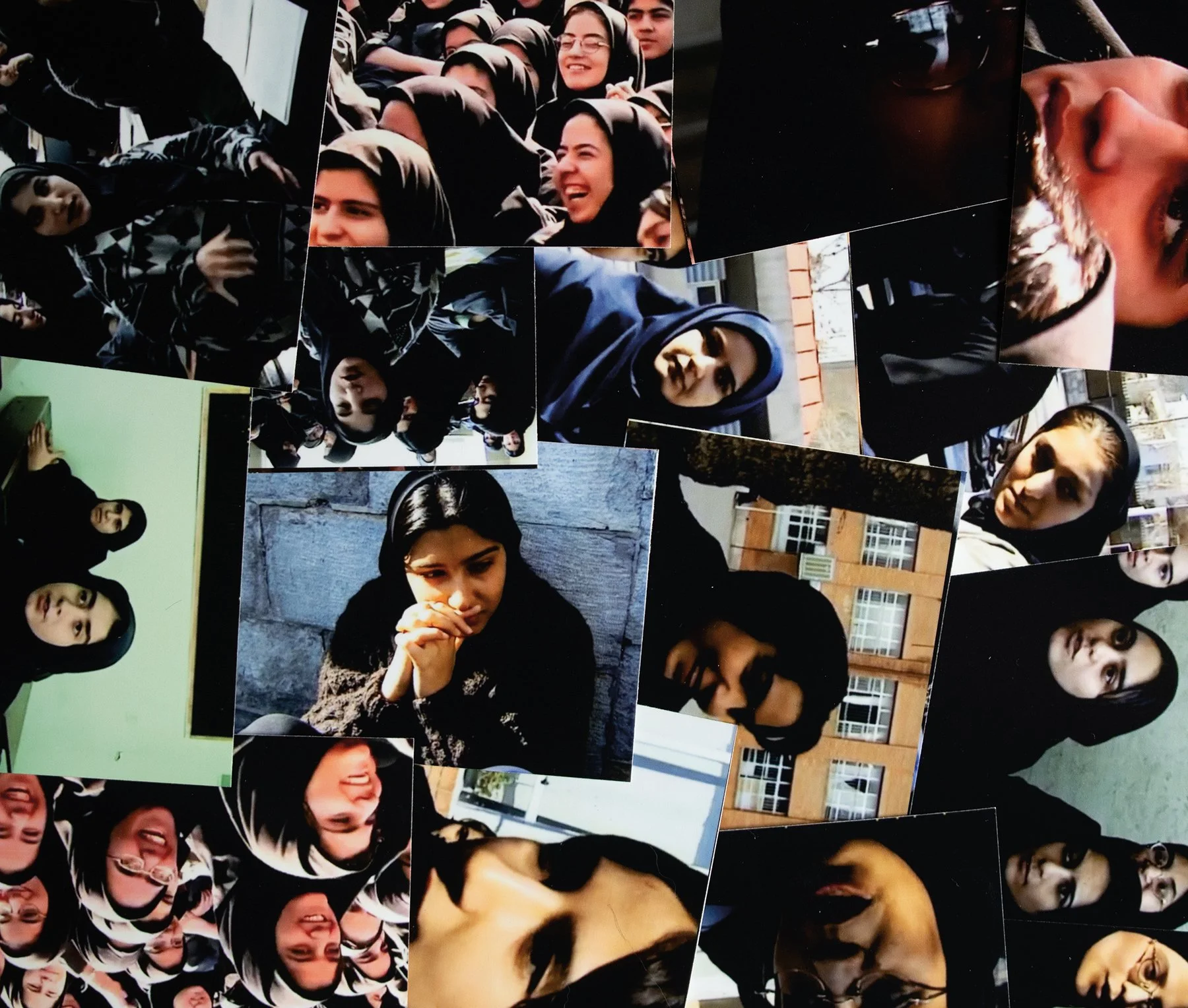
[Nature’s] common theme is death of fathers. . . . — Claudius, Act I, Scene ii of Hamlet
On May 19, 2024, Iranian President Ebrahim Raisi died in a helicopter crash near the country’s border with Azerbaijan. With the parting of the fog came the discovery of his remains. Upon confirmation of the President’s death, Supreme Leader Ali Khamenei declared five days of official mourning. Thousands poured into Tehran’s Vali-e-Asr square just to glimpse the hearse. Disbelieving men pressed their hands to Raisi’s coffin, their faces streaked with tears.
From behind closed doors, others called this mysterious torsion of fate poetic justice. “We dance freely on your filthy grave and celebrate,” wrote a feminist activist. “Life in Iran has taught us that sometimes it is possible to be happy about the death of people,” a second testified. “It is painful, but I am happy.”
These flickers of mirth registered collective relief: Raisi was responsible for the fervent crackdowns on women’s dress linked to the murder of a Kurdish-Iranian woman, Jina Mahsa Amini, at the hands of the morality police in September 2022 for failure to observe the hijab, or Islamic veil—“in its widest sense,” Joan Copjec writes, “the entire ‘system of modesty’ that conceals the very shape of women.” Decades earlier, in the 1980s, Raisi had gained notoriety as a member of the Islamic Republic’s death committee, presiding over the mass executions of political dissidents. Throughout the uprisings sparked by Amini’s death, protestors retorted Marg Bar Diktator! (Death to the Dictator!) as the president ordered them beaten, imprisoned, and killed. If celebrations of Raisi’s actual death were enjoyed in the name of retribution, they also marked the traffic in violent impulses—the circulation of a wish for the leader’s death turned back on itself by its fulfillment.
The death wish against Raisi traces its referent to the very founding of the Islamic Republic, its originary wound Reza Shah’s spectacular dethronement in 1979. Once addressed to the Pahlavi King, the slogan Marg Bar Shah! (Death to the King!) is testament to the uncanny resemblances between monarchical and republican regimes. The slogan’s echo across discrete periods of historical time bears witness to the Islamic Republic’s inheritance of an arcane, authoritarian tendency. For as the monarch was being ousted, a Supreme Leader took his place, his authority built upon the systematic slaughter of any opponents.
The Islamic Republic has witnessed at least three waves of mass protest aimed at toppling its governing bodies since the turn of the century. In 2009’s Green Movement, embittered protesters accused President Mahmoud Ahmadinejad of election fraud. In late 2017, thousands registered their grievances over economic mismanagement. Gathering under a slogan borrowed from the Kurdish Women’s Freedom Movement—Jin, Jayan, Azadi (Woman, Life, Freedom)—the most recent uprisings were overtly feminist in character. Driven by women and girls, they were first to take specific aim at the Islamic Republic’s gendered prohibitions, most visible among them the hijab.
Throughout the months-long demonstrations, the compulsory Islamic veil was shown to be most vociferously protested by children. In spite of the government’s near-total internet shutdown, images and videos circulated of young schoolgirls swarming their streets and schools. Chanting and singing, they emphasized their apparently indestructible unity: “Natarsid natarsid, mah hameh bah ham hasteem (Don’t be afraid, don’t be afraid, we are all in this together).” They filmed themselves desecrating images of the Supreme Leader by burning them along with their headscarves in large, funereal pyres, or stamping on them in a sequential choreography resembling the playground game of hopscotch. “Agar yekee nasheem yekee yekee tamam meesheem (If we don’t become one, we will be destroyed one-by-one),” they cried.
Freud called this observable “contagion of feelings and ideas in an identical direction” the “group mind.” “[A] mere collection of people is not a group,” he stated in 1921’s Group Psychology, highlighting the unconscious links between individuals in groups both “fleeting” and “lasting”—in crowds and herds, as well as churches, armies, and schools. The priority given to the unconscious made the group mind akin to the mental life of children and primitives, Freud would argue. Impulsive, irritable, and prone to contradiction, all three were led by the unconscious. This explained the propensity of groups towards illicit acts and unconsidered violence. After all, the unconscious was the seat of our ineradicable, “instinctual endowment,” Freud elsewhere wrote. It contained our most base and aggressive impulses. It was and is everyone’s “inner child.”
In scenes of play and protest, young girls in Iran evidenced the group mind’s childlike qualities as the unlikely foundations upon which they made claims of political consequence against a repressive reality. In physical confrontations with the law, and in simulated encounters with their Supreme Leader, these girls furnished an emergent, revolutionary movement with a novel myth, staging a sorority’s struggle against a symbolic, Oedipalizing father.
*
Veiling and Unveiling Desire
Before the veil was recognized as a symbol of the Islamist regime’s oppression of women, it had been banned by Reza Shah Pahlavi in 1936, as part of a sweeping modernization campaign. In her historiography of the Irano-Islamic hijab, Afsaneh Najmabadi describes how the prohibition imperiled women’s and girls’ “public togetherness”:
Girls were withdrawn from schools and kept at home. Women teachers who did not want to unveil resigned from their jobs or were dismissed . . . Girls’ schools that had been sites of women’s public togetherness, with women acting not only as students and teachers but also as citizens, actively shaping “gender and patriotic sisterhood,” now became sites of division.
The ban amounted to a near-total upheaval in the lives of women and girls for whom veiling was a centuries-old religious and cultural practice, as “sisters-in-religion,” those women in observance of the veil, fled the schools that had constituted the very foundations of their civic engagement. Only by disappearing from the public eye did veiled women succeed in evading the state’s enforcement of its new dress code.
Based upon an interpretation of the Quran’s Surah An-Nur, the Islamic Republic’s hijab mandate partakes in a more comprehensive dress code that largely prohibits appearing non-Muslim. Limiting women’s self-exposure, the hijab protects its wearer from the eyes of men to whom she is unrelated. “Men may look at all men,” writes Najmabadi, and “Women need not practice rules of hijab under the eyes of other women or mahram men (blood relatives).” In this way, the hijab mandate was initially conceived as a path towards women’s “moral cleansing.” But there is already a slippage detectable here between women’s dress and women’s desire. According to Najmabadi, such a regulation “repeatedly implies that women and men desire each other.”
The Islamic veil casts its long shadow over Nahid Rezaei’s 2003 documentary Dream of Silk. Rezaei revisits the all-girls high school she attended just prior to the establishment of the Islamic Republic, her task to archive the desires and ambitions of its current student body. “What do you want most out of life?” the filmmaker asks her subjects. One schoolgirl divulges a contentious wish:
[Y]ou asked me to talk today. I have a lot of issues. I’m different . . . I tend to put myself around boys, I don’t let anyone insult them, even though we fight. They don’t let me go out, because they know that if I see a girl being beaten up, I won’t intervene. “Good, keep hitting her,” I’ll say. . . .
We quarrel a lot over my going out. I’ve even been beaten. There was a time when the boys didn’t let me go out. They actually bought me a veil and forced it upon me. I wore it reluctantly. They treated me harshly and asked why I wanted to be a boy. I even cut my hair short, like a boy. I went to a men’s hair salon and asked for a haircut. My family will tell you that from my birth, as soon as I understood that boys and girls were different, I wanted to be a boy.
My father used to cry. He’d say he wanted to have a girl, to give her everything she wanted . . . Whenever there was an activity for boys, my father mocked me for going. This being-a-girl—I hate it. In fact I despise everything about being a girl. Even now, in class, when I think about it, I get angry.
Writing on the young girl’s Oedipalization, Freud will often refer to the girl who wants to have her father. But what of the father who wants to have a girl? In Persian, the word for girl (dokhtar) and daughter (dokhtar) are one. Thus, the father’s desire necessarily intervenes within the girl’s articulation of her own desires. “He’d say he wanted to have a girl/daughter, to give her everything she wanted . . . ,” the speaker recalls of her disappointed progenitor. In the father’s account of what he wants, the hypothetical girl/daughter’s desire is derivative of his own. The speaker offers an impossible addendum to her father’s imagination of what a girl/daughter could want. “My family will tell you that from my birth, as soon as I understood that boys and girls were different, I wanted to be a boy,” she confesses. Her response to the filmmaker’s question, “What do you want most of life?,” now appears addressed to her father.
Yet it is surprisingly the group of boys in the speaker’s account who are most fierce in their role as gatekeepers of a prohibitive, paternal function. They beat the speaker, buy her a veil, and force her to wear it. As the lawful marker of female sexuality, the veil works to neutralize the speaker’s professed identification with other boys, which is paradoxically there from “birth” and the result of her learnt realization that “boys and girls were different.”
As the speaker continues on, she ponders the relative privileges of being a boy, which include, in addition to dominating and beating girls, loving them: “I wanted to marry a girl who was my classmate, Fakhri Manouchehri . . . I kept thinking, if only I was a boy, I’d marry this girl. I was possessed by my love.” Alluding to the Islamic Republic’s prohibitions on same-sex marriage, the speaker laments her thwarted romance, but staunchly defends her preferences: “When my family learned about it, they made us cut ties. This is my condition, I like things this way.”
*
mass hysteries
Within the early history of psychoanalysis, women’s and girls’ desire is shrouded by a figurative veil. “[The erotic life of women]—partly owing to the stunting effect of civilized conditions and partly owing to their conventional secrecy and insincerity—is still veiled [emphasis added] in an impenetrable obscurity,” the father of psychoanalysis wrote in 1905, in his Three Essays on the Theory of Sexuality. Over two decades later, in 1926, Freud confessed to having made little headway: “We know less about the sexual life of little girls than of boys. But we need not feel ashamed of this distinction; after all, the sexual life of adult women is a ‘dark continent’ for psychology.” Freud’s ocular metaphors are admissions of epistemological uncertainty. But not knowing is often an occasion for projection: the psychoanalytic veil over female sexuality translates Freud’s desire for women and girls who desire men. When, in Group Psychology, Freud imagines a “troop” of women and girls, “all of them [are] in love in an enthusiastically sentimental way . . . [with] a [male] singer or pianist.” The beloved male singer functions within this example of group structure as what Freud calls its “leader,” linking sexual and sociopolitical domains:
It would certainly be easy for each of them to be jealous of the rest; but, in face of their numbers and the consequent impossibility of their reaching the aim of their love, they renounce it, and, instead of pulling out one another’s hair, they act as a united group, do homage to the hero of the occasion with their common actions, and would probably be glad to have a share of his flowing locks.
Threatening cohesion, jealousy is a selfish bid for the scarce resource that is the leader’s love. When the jealous rivals, realizing that none will be the favorite, come together, it is because they have “succeeded in identifying themselves with one another by means of a similar love for the same object.” Freud’s example stages the collective’s triumph over narcissism. “Love for oneself knows only one barrier—love for others, love for objects,” Freud quips later on. And yet, the women and girls are united through their identically unrequited love for the male leader, not their love for each other.
In late 2022, footage circulated of an all-girls high school in the southern Iranian city of Shiraz. The tide of young girls swells and recedes around a single basiji, a paramilitary representative tasked with enforcing Islamic law. Amid rampant unveiling, the basiji has been asked to restore order on the school grounds. Fists balled, the girls whip the air with their headscarves, flooding the schoolyard with their song:
Basiji boro gom shoh!
Basiji boro gom shoh!
Basiji boro gom shoh!
Basiji get lost!
The scene heralds an irreparable, generational rupture. In shared violation of the hijab mandate, the leaderless female herd enacts its emancipation from a symbolic, lawgiving father. The girls force the basiji to look upon their hair, thus forcing him to participate within their collective, civil disobedience. They end by chasing the basiji off school grounds.
For Freud, the realization of a death wish for the father first occurs at the hands of his children. In Totem and Taboo: Resemblances between the Mental Lives of Savages and Neurotics (1913), Freud borrows from the conjectural archive of colonial anthropology to describe an act of killing he claims prefigures the Oedipus complex. Once upon a time, in an unnamed, aboriginal tribe, a “violent, jealous father . . . [kept] all the females for himself and [drove] away the growing sons.” Retaliating against their exclusion, the “. . . expelled brothers joined forces, slew and ate their father. . . .”
Yet the murder of the primal father by his growing sons is not so straightforward in its results, for what it reveals is the self-replicating structure of patriarchal authority in the form of its return. Sated by the father’s corpse, the brothers are overtaken by their unexpended, “tender impulses” for him. Guilt ensues, and they set out to symbolically reverse their act. First, they renounce their claims to the father’s women by establishing an incest taboo. Second, they designate a sacred totem animal identified with the father’s blood and body, whose killing is taboo except for the occasion of the annual totem feast. In other words, “What had up to then been prevented by [the father’s] actual existence was thenceforward prohibited by the sons themselves,” Freud remarks. Far from abolishing his function, the loss of the flesh-and-bone father is the grounds for his birth in a social-symbolic order: in forms of social organization, religious rituals, and moral prohibitions. “The dead [father] now became stronger than the living had been,” writes Freud of the sons’ irretractable inheritance.
Freud’s primal horde anticipates his later treatise on group psychology. For the growing sons are especially emboldened by their belonging to a group. “Together they dared and accomplished what would have remained impossible for them singly,” Freud says, of their mutinous impulse. But for the evolutionary-minded Freud, this early parable of group psychology also expresses a psychoanalytic maxim, that “ontogeny recapitulates phylogeny.” The growing sons stand for the growing pains of human history, and the symbolic father for the historical achievement of repression. Thus “Freud not only maintains that human history can be understood only as a neurosis,” writes Norman O. Brown of Totem and Taboo, “but also that the neuroses of individuals can be understood only in the context of human history as a whole.” As Freud himself grew up and braved each sequential tumult of his century, Brown argues, history—growing up—appeared less and less like a process of becoming wiser, and increasingly as one of becoming sicker.
Two months into the Jin, Jayan, Azadi uprisings, eighteen schoolgirls in the central Iranian city of Qom fell prey to a mysterious illness. As word spread of the hospitalizations, more cases of ill schoolgirls were reported in the northwestern city of Ardebil and in the western province of Lorestan. In each, the ill manifested strikingly similar symptoms, including nausea, headaches, sweating, and excessive salivation. They reported the smell of rotting fish, arousing suspicion of deliberate chemical attacks by the state or unaffiliated fundamentalist groups. Responding to the accusations, the deputy health minister cited attackers who, in the wake of the uprisings, hoped to prevent girls from going to school. As illness spread, parents forbade their daughters from leaving the house. Schools were again being emptied of girls over the veil.
In the weeks that followed, only a fraction of toxicological reports from various schools indicated traces of noxious gas. Met by a lack of conclusive evidence, social scientists noted similar, hysterical symptoms among schoolgirls in Afghanistan in 2009 and the West Bank in 1983. In either case, the shared illness was traced not to the presence of organic toxins lodged in girls’ bodies, but to the distressing conditions of their everyday lives, which had made available the collective imagination of poisoning by toxic agents. As thousands checked into hospitals, they quantified the force of mental contagion: the transmissibility of affect among strangers afflicted by an identical fantasy, one capable of pulling their uprising to a screeching halt. Asked to specify the nature of their ailments, many a schoolgirl described not being able to stand up.