
Non-Closure Island
In the Furrow of Genre
kaleem hawa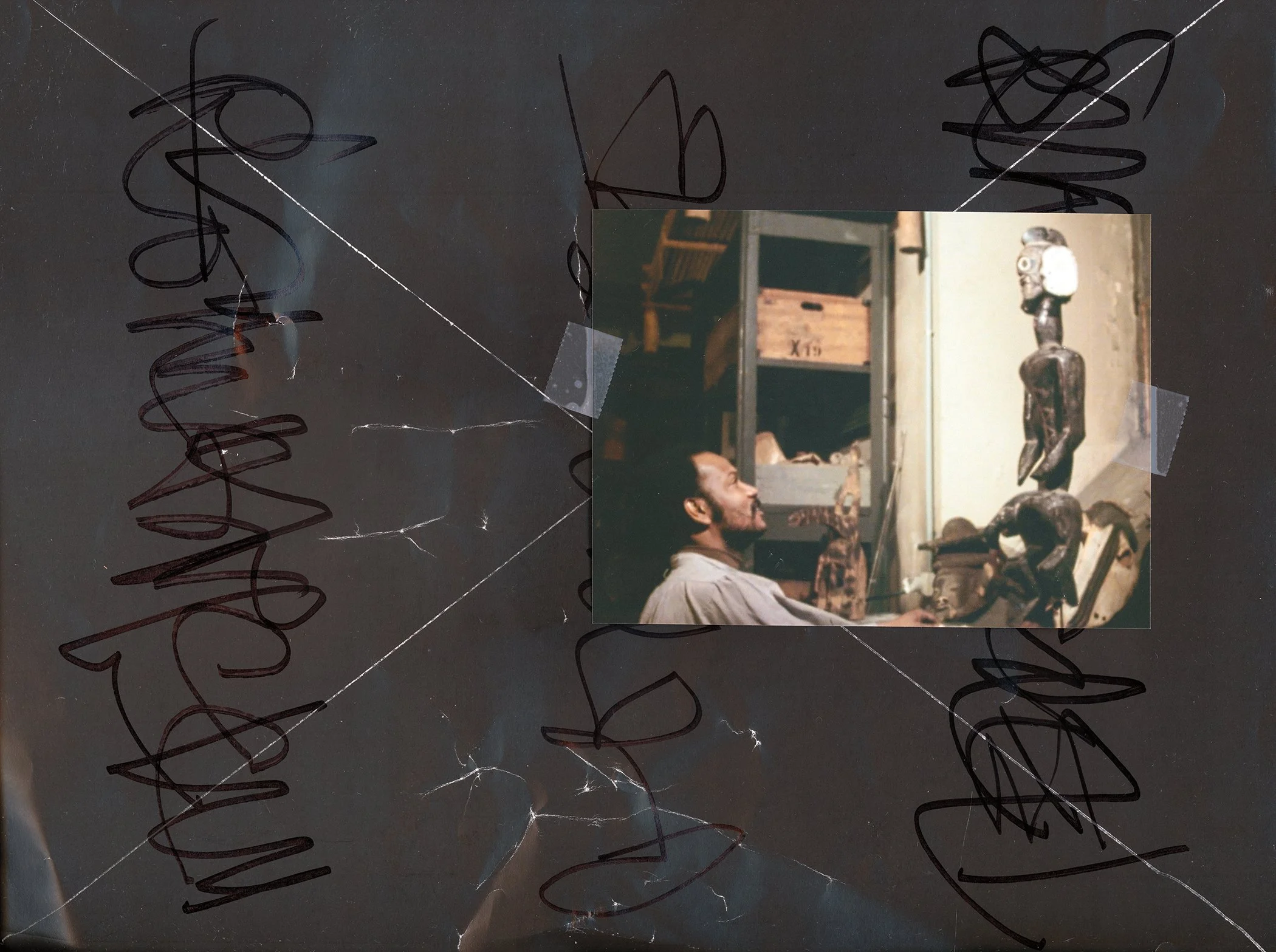
Still from Et les chiens se taisaient (And the Dogs Were Silent) Dir. Sarah Maldoror, 1978 [1]
With the women it was the same. When Chevalier, a black chief, hesitated at the sight of the scaffold, his wife shamed him. “You do not know how sweet it is to die for liberty!” And refusing to allow herself to be hanged by the executioner, she took the rope and hanged herself. — C.L.R. James, The Black Jacobins (1938)[2]
The Caribbean, you see, very gentle islands, very gentle…real mild…sweetie islands, you see. — Aimé Césaire, ......And the Dogs Were Silent (1943)[3]
i.In 1943, the Martinican writer Aimé Césaire sent a completed manuscript of his historical play ......And the Dogs Were Silent to his recent friend, the French Surrealist André Breton, for publication. A few months later, Césaire embarked on his first visit to the island of Haiti, which loomed large in the work. His time there inspired some level of personal crisis and, in a series of letters Césaire wrote to Breton, he began to disaffiliate from his original drafts. In 1946, the text was eventually published within the larger book Les armes miraculeuses (The Miraculous Weapons). Among other prodigious edits, many of the references to Haiti and revolutionary violence had been excised, leading Kora Véron, one of Césaire’s contemporary biographers, as well as the text’s translator, Alex Gil, to observe that the work had changed from a dramatic history, in the form of an oratorio, to a tragedy.[4]
In 1938, C.L.R. James published The Black Jacobins, his canonical treatment of the same revolution that had inspired Césaire. In 1958, James, too, visited the Caribbean, in this case Trinidad, for the first time since his youth and at the invitation of Eric Williams’s People’s National Movement (PNM). Following a period of involvement in the PNM, James would eventually break from the party, leaving with some level of disenchantment with its political project.[5] Less than five years after his return to Trinidad, the second, revised edition of the work would be released; appended to it were seven new paragraphs at the outset of the last chapter, as well as an appendix from James. The Jamaican literary theorist David Scott has argued that this effectively altered the generic character of the work from an anticolonial romance to a tragedy.
It is notable that two high-profile treatments of Haiti and Toussaint L’Ouverture from two of the most well-known Black communist writers of midcentury would both be post facto alleged by contemporary critics to have amended their generic representation of the world-historic revolution in Haiti, each toward tragedy. In Conscripts of Modernity (2004), his major work on the subject, Scott describes the romantic mode of James’s earlier work as bearing an inclination to “privilege the historic role of the heroic personality,” with history to be read “not as the collective agency of ‘the people’ transforming their world, nor as the consequence of impersonal forces determining the course of events, but as a catalogue of the actions of great men.”[6] Between the two editions, James allegedly confronted “the irreconcilable dissonance between Toussaint’s expectations for freedom and the conditions in which he sought to realize them, between the utopia of his desire and the finitude of his concrete circumstances.” This is framed as a product of a putative tension between anticolonial revolution’s negative project—that is, to overcome chattel slavery and domination—and the constructive project of actualizing human freedom. Scott perceives this to have produced a transition in James’s figuration of the enslaved actant in a mode of confrontation with colonialism toward a sager rumination on the possibilities of collective, socialist emancipation in the face of the political and economic forces of the colonial situation—one best able to be represented through the genre of tragedy.
For his part, Gil, the translator of ......And the Dogs Were Silent, argues that Césaire experienced a similar rearrangement in his text’s anticolonial posture, but inverted in this case to produce a “shift, from a revolution centered on the rebel collective in the first stage of composition, to a revolution centered on the tragic hero in later ones.”[7] We are told that these types of amendments were a product of the contact zone with the historical reality of Haiti, which appeared to force a confrontation with the idealism of the texts and the actually-existing conditions: in the face of this, James moved to desacralize his work through an investment in the material constraints faced by the revolution, while Césaire opted to reify further in (self) myth.[8] These amendments embrace a type of pessimistic mechanism, a tragic mode of emplotment, which has an integrative relationship to history, operating through causal reduction. While this is doubtless appropriate for an experience of “crisis,” particularly in James’s case, as he reconsidered his work almost three decades later, the parallelism here enters us into the longstanding problematic of Western generic frameworks being read into Third World texts so as to launch critiques through the formal and epistemic contradictions of these genres. Such exercises are not inherently flawed, but they are perhaps destined to rehearse the meta-genealogy of generic forms themselves, where tragedy emerges responsively and dialectically from romance—a simple and phasal recursive scheme that begins with revolutionary romanticism, confronted by tragic fragmentation, which strains against the new constraints comically, and then settles upon a modernist ironic detachment, only to be revivified once more by oppositional romanticism.[9] There are, to my mind, alternative paths through, and for the above mentioned scholars to assent to the above interpretation is to capitulate in some sense to the hegemonic readings of anticolonial revolution, contemptuously articulated by the Jailer Man himself in Césaire’s own text:
Ah, we didn’t have to wait long to see the results. There was comedy. There was tragedy. There was horror. Cannibals could be seen entering the towns swollen with pride [. . .] We saw constitutions being drafted. We saw all of that, good people in the audience. And what else did we see? The smoke rising at noon; the fire of innumerable Aurora Borealis in the midnight sky, reflecting scenes of crime and absurdity from afar. Well, I say that this is the work of a supreme justice, and it is she who now transforms Toussaint Louverture the General into old Toussaint, slave Toussaint, a piece of shit forgotten in the latrines of history…[10]
ii.I believe both James and Césaire’s romantic treatments of the Haitian revolution were part of a received form immanent to that anticolonial experience: Césaire adapted romance’s generic exoskeleton to a moment of transition for Martinique and in so doing accentuated its most unbridled figural heart through the formal logics of Négritude; while James did indeed amend his affective relationship to his text, this was not part of some sort of epistemic break with romance, but rather reflects a personal interpretation of historical change—itself something worthy of analysis, but not at the expense of coloring Haitian anticolonial history with the same brush.
For Scott, romantic emplotment is the conventional narrative for anticolonialism. It is “vindicationalist” in its reaction to both racism and colonialism—a type of moralism by another name.[11] James is said to have come under the influence of such romanticism by way of, among others, Jules Michelet, who was central to his historiographical poetics and figuration of Toussaint; he invoked the former in his 1971 Atlanta lectures as the greatest of that revolutionary school.[12] The connection to Michelet’s romance is read by Scott, who draws from the literary theorist Hayden White, as the source of a misguided taste for teleology, Manichaeism, and an anti-dialectical deliverance through negation that approximates epiphany.[13] It is difficult not to read in the shadow of this work a critique of Marxism, by way of romance, given that the former’s early treatments of philosophy and political economy are strongly informed by Romantic thought.[14]
But there are times where I felt the analysis was at odds with Michelet and White’s work. For them, the historian’s interpretation of the political substrate of a revolutionary period intends to best represent the attempts of the popular masses to actualize their vision, not out of atavism or propagandism, but because, formally, this would be the most coherent, and thus responsible, manner through which to document the discordant, radical dispersion in search of a unity that was revolution’s actantial procession.[15] Romance was the genre that allowed a representation of what Thomas Carlyle called “chaos of being” and which White believed afforded the historian a “posture as both observer and agent of its processes.” This romance was also—and notably for oppressed peoples—a rejection of the determinism of Enlightenment rationalism, the former’s emphasis on the “novel and emergent, rather than on the achieved and inherited,” allowing for a synthesis of the social forces at play.[16]
Genre study of this kind allows for an analysis of the history of forms and evolution of social poetics. Vulgarizing for our purposes the literary theorizations of Fredric Jameson in The Political Unconscious (1981), there are effectively two interconnected parts to this method: the first is an account of sociopolitical situation, to which genre is a formal and immanent response, a type of socio-symbolic message within a text arising from a historical dilemma; the second is an analysis of the evolution of genres—their discontinuities, their inheritances and sediments and repression—as waypoints for interpreting sociohistorical change across time.[17] In effect, this guards against the idea that genres are natural forms and suggests that the literary critic might find it more productive to engage in an interpretation of the changes within Black romanticism than to assert a shift from romance to tragedy between periods.[18]
With regard to our first area of analysis, it is important to be clear about the historical dilemma we are faced with in the works and the critics’ later reassessments. To my mind, this is the programmatic question, that of the transition from revolutionary war and dismantlement of colonial slavery to the forging of a postcolonial Haitian state. In the overthrow of French colonialism, the Haitian revolutionary process sought the repossession and redistribution of large estates and lands to a nascent reconfiguration of the enslaved polity, a significant intervention for both the liberation of the Haitian people and future struggles of the Third World. Scott’s critique hinges on an interpretation of this programmatic question in which the “problem-space” of anticolonial futures had now collapsed, its categories having lost their purchase and therefore their claim on us; he depicts the conjuncture as “the virtual closure of the Bandung project that grew out of the anticolonial revolution [. . .] an exhausted one,” or, elsewhere, one that was unable “to give point to the project of social and political change.” This is not an uncommon position. Writing as he is fifteen years after the fall of the Soviet Union, he confesses doubt as to whether “this discursive move of vindicationalist [Black] Romanticism continue[s] to be as salient a move in our postcolonial present as it was for James in his colonial one.”[19]
Similarly for James, the existing narratives of Haitian cultural production were part of his received forms, leading him to adopt some of the main tropological features in first drafting The Black Jacobins. In the revision of the work, we might see his text as confronted less by Haiti’s postcolonial dilemmas than by the historic transitions within the world-system, double-personalized and personified as it was for a committed Communist of the Trotskyist persuasion, in his case, by the ascendency of Stalin. James is explicit that his work was informed by a critique of Stalinism, and his choices hew towards this political line, reading leader and masses as mutually constitutive. He had arrived at a place of disillusionment with the revolutionary struggle in part due to his experiences with the PNM. He internalized its historical unfurling as an inevitability—a core precept of tragedy.[20] In this sense, the changes to James’s narration of struggle were more evidently reflections of authorial intention and the social formation from which he emerged. The result is a type of fatalism, which sees Toussaint’s successor Dessalines as an exemplar of the revolution betrayed, rather than a faithful executor. This at once transposes a post hoc reading of Soviet historiography onto Haiti but also erases the clear continuities between Toussaint and Dessalines on questions of both revolutionary violence and state-building.
As such, we return to the idea that modes of emplotment are part of how struggles narrate themselves. It should be possible therefore to analyze the changes in emplotments emerging from the popular base of a struggle and between struggles, for if it is the actions of the enslaved that make history, their narration is a register of said history, otherwise known as the text. In The Black Jacobins, there is no end to moments that one could read as tragic—Ogé being tortured and hanged; Chevalier’s wife hanging herself—and it is likely that James and Scott do read them as tragic. But we might encounter a different vantage from the perspective of the base’s narration of martyrdom: among its precepts, the spiritual—communion with the dead for guidance; funereal concerts; magic—and the martial, wherein the significant costs of asymmetrical warfare are a necessary part of the process of accumulating the enemy’s losses over the long term.[21][22] We would then see the correspondence with the martyr less the way Scott depicts it—as a destabilizing duel between the crumbling order of ghosts and a new order of commerce and law—and rather as coextensive or contiguous, though fraught.[23] This conflation of the historically progressive with the modern haunts many of these interpretations; the nation-building project—the constrained, contingent, trepidatory attempt to build a social surplus for a polity of brutalized, forcibly de-developed Black Haitians in order to withstand the ravages of a Western colonialism that surrounded their island—coming to be read as tragic through the adoption of an anterior sentimental mood to its past. None of this is to insist that Haitian social poetics were uniformly romantic, or even really to mount a total defense of romance (of which there are many critiques), but rather to suggest that it might not be fully transcendable in this case, or that it might be misleading to try.[24]
In this same terrain, we would be struck by the role played by revenge in the pursuit of the Haitian revolution, which Scott might term characteristically vindicationist. The period is riddled with it: the prophetic Boukman ceremony days before the 1791 uprising invokes an awakened vengeance that arouses the heart, steeling the congregants for the beginnings of a decade-long period of struggle; it is central to plays and short stories by Charles de Rémusat and Alexandre Duboy and in the Haitian Constitution of 1805, no less, wherein the new emperor Dessalines is described as the “avenger” of his fellow citizens.[25] Throughout the texts, revenge is sacerdotal, a messenger of universal doctrine; as such, it is not geographically limited, seen not as a revenge only for Haiti’s enslaved but on behalf of the future of then-“defeated Africans,” as Juste Chanlatte puts it in Le cri de la nature (The Cry of History, 1810).[26] Taking these generic signposts as their sum, we might therefore see nothing discrete per se in the narrative transitions between the process of dismantling a colonial regime and the process of building an alternative: to avenge the martyrs, to defeat the slavers, to wage future transnational struggle, all through a rejection of colonial conciliation and a dismemberment of the remaining vestiges of the plantocracy in order to protect that which had been won at great cost. Perhaps we may end here with James’s own claim that when he wrote about the San Domingo Revolution it was as a “preparation for the revolution that George Padmore and all of us were interested in, that is, the revolution in Africa.”[27][28] If that seems hopeless or distant now, it does little to denude the analytical salience of the transhistorical impulse that has propelled the endogenous emergence of an ever-evolving Black anticolonial genre in song, in prayer, in plantation social practice, in creolized Vodou. For a people in the process of forging a collective language denied to them by the colonial situation, said genre unraveled part of the dominant logic of the Romantic subject—its private interiority, the triumph of coming into personhood—blasting it open into an expression of the social life of the enslaved, mute masses whose grim commitment was the utterance.
We can see this internal development most clearly in the changing representations of Toussaint himself, and in particular his late period, which marked his growing estrangement from the struggle, his betrayal by Dessalines, and his imprisonment and martyrdom in France. Here, there are some differences in James and Césaire’s representations. James’s Toussaint falls within a larger Haitian historiography that depicts the latter as a “royal slave,” a Black Spartacus whose utopian act of will consolidates the vision of the anticolonial project, as Srinivas Aravamudan argues in Tropicopolitans (1999).[29] The scholar Kara M. Rabbit adds that he is figured as a heroic character, and a type of moral allegory, in a decision that necessarily invests psychic content into his journey as a stand-in for the journey of Haiti, when the two might otherwise be disambiguated.[30][31] Césaire, on the other hand, is decidedly more interested in the concatenation of forces, his dialogic text playing host to a variety of social blocs represented in the work: the fatigued chorus of enslaved people, the cutlassed fighters, the colonial assemblies. Toussaint emerges as an articulation from this base, in occasional conflict with it—owing, for instance, to his position in support of the maintenance of the plantation system and accommodationist positions on Napoleon’s program—but also eventually out-stripped and eclipsed by it. In both works there are uncanny scenes depicting Toussaint’s growing discord with the Black Haitians, James writing that he had “ignored the black laborers, bewildered them at the very moment that he needed them most, and to bewilder the masses is to strike the deadliest of all blows at the revolution”; while Césaire’s self-conscious treatment of Toussaint sees him boldly declaring to the chorus his intent to “guide this country to its own knowledge / [. . .] acquaint this land with its secret demons / [. . .] light up on craters of cymbals and heloderma.”[32][33] We might then read something meaningful into the changed portrayals of Touissant across decades, part of an attempt to graft his story onto a social base that was not exactly his own.
This may return us to Scott’s framework and its insistence that the tragic form was better suited to historical critique.[34] What Scott means here, I think, is that the story of Toussaint is metonymic for that of the Haitian revolution and is therefore a tragic one, proceeding inexorably from the volcanic eruption of the slowly accumulated social forces before being confronted with either martyrdom or betrayal.[35] This history then operates pessimistically, synchronically—a history that does not necessarily go anywhere, what Edward Said termed, in reference to European representations of the Caribbean theater of engagement, a “murderous cycle,” unable to “teach future generations something more than the almost mechanical necessity of violent struggle.”[36][37]
Perhaps it was never possible for The Black Jacobins to resolve the social contradiction at the heart of the anticolonial struggle for Haitian liberation, nor to integrate the historical content that enveloped its drafting; the former could, at best, be artificially resolved at the level of a narrative antinomy: Toussaint’s tragic fate, totalized into history by Scott. Were we instead to see genre itself as a different sort of thing—not a neat envelope or analytic, but rather a contract, the infrastructural limiting situation, itself a living relation—then we might not view romantic generic interpretations as necessary to overcome in an effort to better represent the social and historical situation.[38]
iii.Near the end of .....And the Dogs Were Silent there is an extended scene in which white jailers humiliate Toussaint and attempt to beat him into submission. The setting is presumably inspired by Fort de Joux, where Toussaint was imprisoned and eventually martyred. There, he withstands the onslaught and does not break, saying to them: “Strike…strike, commander…strike until you draw blood…a race without groans was born from the furrow…”[39] Doubtless, said furrow is meant to invoke the wound from the lashes, but also, in Césaire’s etymological play, race was born in that long, narrow trench made in the ground by a plough for the purposes of irrigation or the planting seeds; the semiotically-laden allegory for colonial slavery also holds the revolutionary subjectivity of the colonially enslaved. The same furrow can be found invoked in Charles-Hérard Dumesle’s early poetic account of the Haitian revolution and the Bois Caïman ceremony that is alleged to have inaugurated it; there, it is the site where enslaved Haitians assemble in silence to plot their uprising.[40]
The furrow of history is the repository of the global classes whose lives are transformed by the transitions of the world-system. The subjectivities immanent to these transitions, then, sit within the regime of extraction, between tool and toiler, agent and agency, or means of production and labor. This relation expresses itself through metaphor across different historical conjunctures, like Jules Michelet’s France—“And I myself, their comrade, toiling beside them in the furrow of history and drinking from their bitter cup,” he wrote in 1847—as well as Toussaint’s Haiti and Césaire’s Martinique.[41] In this case, Césaire’s attempted homologies between the revolutionary struggles reveal at once the generic developments and what he called the “forms that linger.”[42]
The synchronicities between these various texts suggest something sticky about the generic forms of the Haitian revolution, as they relate to the social forms of production under slavery. In Colonial Slavery (1978), the Brazilian historian Jacob Gorender argues that slavery is a social category, one marked by ownership and personal subjection, producing two derived attributes of perpetuity and hereditacy. It does not inherently signify a mode of production, though there are differing expressions of the social category in different modes of production, from patriarchal slavery to colonial slavery, the latter of which developed coterminously with race as its ideological organizing principle.[43] It is through the extension of the colonies, therefore, that a historically new mode of production emerged: the colonial slave mode of production, with the plantation as its form of organization. When modes of production come into confrontation with one another, this inaugurates certain transitions: the subjugation of one by another; maintenance and the extraction of tribute; a synthesis; or the creation of a new mode of production.[44] For Haiti, this transition was brought about by the movements towards the colonial slave mode of production. For Jameson, it is precisely here that romance as a genre is to be found; romance’s ultimate condition of figuration is most emergent in transitional moments where “two distinct modes of production [. . .] coexist [and] [t]heir antagonism is not yet articulated in terms of the struggle of social classes,” but rather, via an “organic social order in the process of penetration and subversion, reorganization and rationalization.”[45]
In a chapter on Toussaint and the Haitian revolution in The Pleasures of Exile (1960), the Barbadian novelist George Lamming brings focus to this concept of transition through an extended passage on that which generates the furrow—the plough. In the preceding pages, the enslaved are depicted as ploughs from the perspective of the colonial powers, and in a final scene on the plantation, he writes:
The mystery would assume the behavior of a plough which refused contact with a free hand. Imagine a plough in the field. Ordinary as ever, prongs and spine unchanged, it is simply there, stuck to its post beside the cane shoot. Then some hand, identical with the routine of its work, reaches to lift this familiar instrument. But the plough escapes contact. It refuses to surrender its present position. There is a change in the relation between this plough and one free hand. [. . .] For as those hands in unison move forward, the plough achieves a somersault which reverses its traditional posture. Its head goes into the ground, and the prongs, throat-near, stand erect in the air, ten points of steel announcing danger. It is a transformation of such dimensions which the owners must have anticipated; but the property could never be encouraged to think of itself as a source of possibility.[46]
Metaphors like these attempt to categorize being and are the most common trope of poetic language for romance, a genre in which, for Jameson, “the category of Scene tends to [. . .] appropriate the attributes of Agency”—in grammatological analysis, the plough—“and Act, making the ‘hero’ over into something like a registering apparatus for transformed states of being,” and the “whole semic range of transformation scenes whereby [. . .] higher and lower worlds struggle to overcome each other.”[47][48] In our case, Lamming and Césaire are investing our attention in the interrelation of the enslaved and the emblematic means of their forced labor in order to show the refusal or rejection by the enslaved as a form of insistence that object nature must at all times be reversible, or that one day this scene with the plough will reverse itself. This is, if anything, the opposite of a humanist critique of capitalism, in which man’s actions purifies him of his alienation and reunifies an essential nature; instead, the alienated movement of capital is the subject, such that the inversion of social relations is immanent in the historical movements of the mode of production.[49][50]
In the Martinique of Césaire’s time, whose people were also once enslaved by the French for the export of sugar and coffee, the transition was to be felt within the capitalist mode of production, from the directly colonial to the neocolonial form of organization emerging after World War II. In the same scene that opens this section, Toussaint is beaten to the verge of death and is confronted by a Marian apparition. He rejects her entreaty to religious deference, claiming instead to be a celestial child of earth and stars. He confronts her for her abandonment of his people, seeing her as a soporific, an attempt to reconcile the enslaved with the colonial condition, which Toussaint, in another a rare moment of plainness, describes as “the barking whip and the wild bite.”[51] Pause for a moment to observe that this is Césaire’s assessment of the social contradictions at the heart of his conjuncture. The whip self-evidently follows the racial logic of the plantation, but the bite, I argue, emanates from the titular dog, who might stand in for Black collaborationism and the slave patrol.[52] In the development of the colonial slave mode of production in the Americans, white plantation owners made use of dogs for the hunting of fugitive enslaved people; in Saint-Domingue, patrols called maréchaussée, whose members were almost always Black, were used to hunt down people fleeing from slavery, maroon communities, and revolutionary fighters.[53] Importantly, the name is drawn from the rural police of Metropolitan France. Césaire describes one such patrol in vivid details:
they pursue the poor man! they give hunt him
down with loud cries
dogs barking
their horses are fast
they surround the poor man with long fatal circles [. . .]
they sic the dogs
get’im! get’im! they utter their terrible cries
full bite of mastiff of mastiff of mastiff [. . .]
Who did this? You ask me who did this!
Oh, no, it wasn’t me
I am innocent
Who then?
Them
them dogs
them men with the bloody smiles, with steely eyes.[54]
Updated to the Martinique of midcentury, this takes on a particular qualitative assessment of the role of neo-imperialism on the island. It is not difficult to imagine Césaire taking the generic treatment of the intraracial contradiction of the maréchaussée and rewriting it with the Martinican comprador class in mind, using Toussaint’s figuration as an attempt to indict by comparison what had yet to happen in Martinique. We know that ......And the Dogs Were Silent was written at the height of the war period (1940–43) in which Martinique was faced with British and U.S. naval blockades, an imperialism that had vitiated Césaire’s society. In one of his letters to Breton about the play, Césaire wrote that “born under Vichy, written against Vichy, during the height of white racism and clericalism, the height of Black surrender, this work rather unpleasantly carries the stain of its circumstances.”[55] In this sense, Césaire’s text is ultimately a conversation staged within and among his people, a perambulatory vision in which said Vichy class could be silenced by revolution, just as they were in Haiti. (Later, of the dogs, he will add, “In your jackal voices, the wellness of muzzles.”)[56][57]
These tensions radiate outwards into the representation of the national question. Of Haiti, Césaire writes a Toussaint who sees his “limit-island is a prison,” and he its prisoner; but for Césaire himself, Martinique appears as a “non-closure island,” riven by its class antagonisms and at “the stern” of a historic chain of surplus production that connects Polynesia to Guadeloupe to Haiti before it.[58][59] Toussaint’s Haiti is an abstraction of the social forces that Césaire feels will be necessary to overcome colonialism, namely a sovereign, unperforated whole. This type of generative closure rhymes with Sylvia Wynter’s concept of “ontological sovereignty”: self-sustenance and self-defense as prerequisites for coming into (collective) self-consciousness.[60] This is an emblematic formal claim for Afro-Surrealism; Césaire approvingly cites René Depestre in representing it as a “process of disalienation,” while Suzanne Césaire says that it “nourished in us an impatient strength, endlessly sustaining this massive army of negations.”[61][62][63]
It appears to me that what is being described here are two aspects of revolutionary practice. The first is the “negative” or negationary project of demarcating ontological difference—expanding and contracting to delineate inclusion and exclusion at the contact point with the outer world. This is, in other words, the color line, with the passage between boundaries or states of being.[64] The second is the “positive” or constructive project of a collective sovereignty—the social processes of relation and synthesis between non-human peoples to shore up the surpluses necessary to survive and resist. Inner life, then, became a place to go when reason failed—or, more aptly, when it infiltrated and pervaded the plantation, leaving both whip and reason in trembling balance.[65] To me, this serves as a sort of provocation to the programmatic question that began this essay, namely whether the impulse to develop from inside the enclosure might be a necessary prerequisite to the inauguration of a Black nation. What, then, might it mean to see surrealism as emerging from romance—not as a break from its pasts, but as a critique of the world from within.
[1] In Sarah Maldoror’s eponymous short film with Aimé Césaire, she stages a filmic dialogue inside a colonial archive in Martinique on the concept of Négritude within Césaire’s text, the two flitting between exaggerated positions on black separatist and humanistic internationalist communist traditions. Both that film and Césaire’s text are ultimately the product of internal debates within their society: Maldoror models the martyr’s mother, while Césaire advises that colonialism has rendered their people a husk for the constant reproduction of spaces. The revolutionary struggle itself will be the content that suffuses her body.
[2] C. L. R. James, The Black Jacobins: Toussaint L’Ouverture and the San Domingo Revolution (1938; New York: Vintage Books, 1989), 361.
[3] Aimé Césaire, ......And the Dogs Were Silent, trans. Alex Gil (1943; Durham, NC: Duke University Press, 2024), 75.
[4] Césaire, 1; Kora Véron, Aimé Césaire: Configurations (Paris: Éditions du Seuil, 2021), 143–44.
[5] David Scott, Conscripts of Modernity (Durham, NC: Duke University Press, 2004), 143–44.
[6] Scott, 36.
[7] Césaire, ......And the Dogs Were Silent, 11.
[8] For example, in his introduction to Césaire’s text, Brent Hayes Edwards summarizes Véron’s position: “The historical drama evolved into an intimate tragedy at the moment when [Césaire’s] stay in Haiti brought about a trying confrontation with the reality of the country,” Césaire, xiii. This led Césaire to opine that his own draft was “too historical,” requiring a firmer situation in “the context of myth,” Césaire, viii.
[9] Throughout this paragraph, I draw from Hayden White’s theorizations of genre and modes of emplotment, as well as Fredric Jameson’s critique and rearticulation of White. Together, the two mounted significant challenges to the field of genre study, by integrating an analysis of modes of production, ideology, and history. See, in particular: Hayden White, Metahistory: The Historical Imagination in Nineteenth-Century Europe (1973; Baltimore: Johns Hopkins University Press, 1975), 135–62; Fredric Jameson, The Ideologies of Theory (London: Verso, 2008), 161–74.
[10] Césaire, ......And the Dogs Were Silent, 122.
[11] Scott, Conscripts of Modernity, 56, 83.
[12] Said to also include Lefebvre, Aulard, and Mathiez. C. L. R. James, “Lectures on The Black Jacobins (1971),” Small Axe, no. 8 (2000): 76.
[13] Elsewhere, Scott describes this argument more plainly: “insofar as we formulate our historical discontent around the picture of colonial slavery as degradation and dehumanization there is no way out of that Romantic (and vindicationist) language-game of revolutionary overcoming and rehumanization that supports and sustains it,” Scott, Conscripts of Modernity, 95.
[14] Michael Levin traces the historiography of Marxism’s debt to German Romanticism, in particular, to Friedrich Schlegel, Adam Müller, and to some extent also J. G. Fichte and F. W. J. Schelling. See: Michael Levin, “Marxism and Romanticism: Marx’s Debt to German Conservatism,” Political Studies 22, no. 4 (1974): 400–413.
[15] White, Metahistory, 150. Part of the basis of this assessment is that in White, there is no emplotment that is more or less true to history, therefore the choice of emplotment is subject to the ideological wellspring from which it emerges—in Conscripts of Modernity, Scott describes this as the “vagaries of political will,” able to be manipulated by “mendacious political regimes” (48), by which he means some spectral merger of anticolonial nationalism and Stalinism. This leads Scott to counter White’s concept of “responsible emplotment,” that narrates a history for the purpose of doing things in the present, with his own “critical emplotment,” that narrates history for the purpose of best understanding the present, and therefore bridging it, allowing a critical rethinking of the present and therefore possible future (50).
[16] The “chaos of being” is a term from the Scottish historian Thomas Carlyle. See: White, 144, 148–49.”
[17] For more on Jameson’s position on romance and genre, see: Fredric Jameson, The Political Unconscious: Narrative as a Socially Symbolic Act (Ithaca, NY: Cornell University Press, 1981), 105, 141, 139.
[18] Jameson, 144–45.
[19] Scott, Conscripts of Modernity, 56, 148, 112, 57, 55.
[19] Scott, Conscripts of Modernity, 56, 148, 112, 57, 55.
[20] Srinivas Aravamudan, Tropicopolitans: Colonialism and Agency, 1688–1804 (Durham, NC: Duke University Press, 1999), 310.
[21] See this essay’s first epigraph, for instance.
[22] In a critique of Scott’s work, Greg Forter writes, “by linking the secular ideology of revolution to the pre-secular practice of magic, it also intimates the continued saliency of a vindicationist narrative that reclaims dimensions of experience that the modern episteme represses.” Greg Forter, “Tragedy, Romance, Satire: The Genres of Anticolonial Resistance in J. G. Farrell’s The Siege of Krishnapur and Marlon James’s The Book of Night Women,” in Critique and Utopia in Postcolonial Historical Fiction: Atlantic and Other Worlds, ed. Greg Forter (Oxford: Oxford University Press, 2019), 134.
[23] Scott, Conscripts of Modernity, 162. Here, he is drawing from the Marxist critic Viktor Kiernan, in Eight Tragedies of Shakespeare (London: Verso, 1996).
[24] See: V. I. Lenin, “A Characterisation of Economic Romanticism [1897],” in Lenin Collected Works, Vol. 2, ed. Institute of Marxism-Leninism, trans. George Hanna (Moscow: Progress Publishers, 1960), 129–266; Georg Lukács, “Questions de principe sur une polémique sans principes [1940]” [Questions of Principle on a Polemic Without Principles], in Écrits de Moscou [Moscow Writings], trans. Claude Prévost (Paris: Editions Sociales, 1974), 155–68; Carl Schmitt, Political Romanticism, trans. Guy Oakes (1919; Cambridge, MA: MIT Press, 1986). Lenin ties romance to the Narodniks and the Romanticist critique of capitalism, which he sees as a fundamentally a reactionary ideology, in this case, stemming from its idealization of small production and the position that socialism can be achieved without passage through capitalism. Lukács links German fascism to the arsenal of Romantic anticapitalism as part of his critique; though he will later amend his position. Schmitt describes it as occasionalist and without political content.
[25] See: Marlene L. Daut, Grégory Pierrot, and Marion C. Rohrleitner, eds., Haitian Revolutionary Fictions: An Anthology, trans. Marlene L. Daut, Grégory Pierrot, and Marion C. Rohrleitner (Charlottesville, VA: University of Virginia Press, 2022), 743, 303.
[26] Chris Bongie, “The Cry of History: Juste Chanlatte and the Unsettling (Presence) of Race in Early Haitian Literature,” MLN 130, no. 4 (2015): 807–35.
[27] The Trinidadian communist and James’s comrade; author of Haiti, an American Slave Colony (Moscow: Centrizdat, 1931).
[28] James, “Lectures on The Black Jacobins,” 72.
[29] Aravamudan, Tropicopolitans, 303.
[30] Kara M. Rabbitt, “C. L. R. James’s Figuring of Toussaint-Louverture: The Black Jacobins and the Literary Hero,” in C. L. R. James: His Intellectual Legacies, ed. Selwyn R. Cudjoe and William E. Cain (Amherst, MA: University of Massachusetts Press, 1995), 118–35.
[31] Sylvia Wynter reclaims James from the idea that his investment was primarily in the Marxist-Leninist labor conceptual frame, arguing that his poiesis was properly fixed on the autonomy of race, rather than laborism’s “metaphoric of the head/body opposition” described above. See: Sylvia Wynter, “Beyond Categories of the Master Conception: The Counterdoctrine of the Jamesian Poiesis,” in C. L. R. James’s Caribbean, ed. Paget Henry and Paul Buhle (Durham, NC: Duke University Press, 1992), 63–91.
[32] James, The Black Jacobins, 287.
[33] Césaire, ......And the Dogs Were Silent, 57.
[34] Some have gone further in this direction. In a learned account of the Haitian intellectual tradition, The Black Radical Tragic (2016), Jeremy Matthew Glick describes The Black Jacobins as an example of tragedy as a force of dialectical mediation, which he feels is a superior analytic to romance, in particular for its ability to encompass questions of revolutionary praxis. While I do see value in the tragic for examining history’s procession, one that many revolutionaries have invoked in their writings, I felt at some points that Glick’s position insisted upon an inner proletarian essence of totality which is expressed through genre, rather than seeing genre as historicizing waypoints for understanding transitions. See: Jeremy Matthew Glick, The Black Radical Tragic: Performance, Aesthetics, and the Unfinished Haitian Revolution (New York: New York University Press, 2016).
[35] James, The Black Jacobins, x.
[36] Scott, Conscripts of Modernity, 166.
[37] Edward Said, Reflections on Exile and Other Essays (Boston: Harvard University Press, 2000), 291.
[38] Jameson’s analysis of genre in The Political Unconscious (1981) and his critique of White in The Ideologies of Theory (2008) can be instructive here: namely, that while White produced a combinatoire for narrative analysis, he did not fully account for historical selection that might allow us to understand which actant choices are foreclosed or overdetermined by a current conjuncture, and in so doing, advance White’s logical play into something more closely resembling a study of forms. The Jamesonian schema for literary analysis moves from (1) a study of the individual narrative of a text as an imaginary resolution of a real social contradiction expressed as a textual antimony; to (2) a study of the ideologeme of a text, which is a parole from the larger, dialogic, and social system of a text representing a contradiction between the dominant and eccentric class; to (3) a study of cultural revolutions as conjunctural expressions of modes of production whose transitions are made legible through formal analysis such as the study of genre form. See: Jameson, Ideologies of Theory, 168; Jameson, Political Unconscious, 74–90.
[39] Césaire, ......And the Dogs Were Silent, 150.
[40] Charles-Hérard Dumesle, “Journey to Northern Hayti; or, Revelations of the Historical Sites and Monuments of This Island [1824],” in Haitian Revolutionary Fictions: An Anthology, ed. and trans. Marlene L. Daut, Grégory Pierrot, and Marion C. Rohrleitner (Charlottesville, VA: University of Virginia Press, 2022), 317.
[41] Jules Michelet, Histoire de la révolution française [The History of the French Revolution], vol. 1 (1847; Paris: Pleiade, 1952), 203, as cited in Jameson, Ideologies of Theory, 461.
[42] This is drawn from Césaire’s own poetic treatment of the question of form and content in the Haitian revolution, in his “Réponse à Depestre poète haïtien” (Reply to Depestre Haitian Poet, 1955), in which he writes, “Comrade Depestre / It is assuredly a very great problem / the relation between poetry and Revolution / content conditions form / and if we took into account the dialectical detour / by which form taking its revenge / like a strangler fig suffocates the poem / but no / I don’t accept to write the report / I’d rather look at the spring. Precisely / it’s the Revolution / and the forms that linger,” Aimé Césaire, The Complete Poetry of Aimé Césaire, trans. Clayton Eshleman and A. James Arnold (Middletown, CT: Wesleyan University Press, 2017), 807.
[43] Jacob Gorender, Colonial Slavery: An Abridged Translation, ed. Bernd Reiter, trans. Alejandro Reyes (1978; New York: Routledge, 2022), 23–24.
[44] Gorender, 19–20.
[45] Jameson, Political Unconscious, 148–49.
[46] George Lamming, Pleasures of Exile (London: Michael Joseph, 1960), 121.
[47] Kenneth Burke, A Grammar of Motives (New York: Prentice-Hall, 1945), 503.
[48] Jameson, Political Unconscious, 112.
[49] Sylvia Wynter, Black Metamorphosis: New Natives in a New World (New York: Schomburg Center for Research in Black Culture, n.d.), 508.
[50] See: Søren Mau, Mute Compulsion: A Marxist Theory of the Economic Power of Capital (London: Verso, 2023), 80–88; Guido Starosta, Marx’s Capital, Method and Revolutionary Subjectivity (Boston: Brill, 2015).
[51] Césaire, ......And the Dogs Were Silent, 153.
[52] In a study, Rodney E. Harris suggests that the dogs in Césaire’s play serve different roles at different times: emblems of slavery, stand-ins for the white colonizers or the hunting dogs of the slave patrol, in most cases, deities of death. In an interview, Césaire himself suggested that their meaning is deliberately ambiguous but influenced by Egyptian mythology—where they are guides for souls in the afterlife. Rodney E. Harris, L’humanisme dans le théâtre d’Aimé Césaire: Étude de trois tragédies [Humanism in the Theater of Aimé Césaire: Study of Three Tragedies] (Ottawa: Naaman, 1973), 28.
[53] See: Stewart R. King, “The Maréchaussée of Saint-Domingue: Balancing the Ancien Regime and Modernity,” Journal of Colonialism and Colonial History 5, no. 2 (2004).
[54] Césaire, ......And the Dogs Were Silent, 145–46.
[55] Césaire, 12.
[56] In the text, the dogs and slave patrol are set upon Toussaint by the figure of the Great Prohibitor, who might be seen as a personification of the forces of financialized capitalism and imperialism: “I am the Great Prohibitor, do you understand now? / He who reigns, who restrains, who retains and constrains. / the negative order, defense personified, the eloquent handcuff, the jail / lock, the well-hung gag on the tongue, the least which is the contrary of / the most, the stop which is the exact opposite of true movement, not the / station, not the station, the withdrawal which is the opposite of progress, / the most existing being, the one which positions itself in opposition, the / most necessary being, the opposite of expansion, of propensity, of the contagion, trip up, trip up / the one who at a certain moment makes obsolete, obsolete,” Césaire, 141.
[57] Césaire, 61.
[58] Césaire, 94.
[59] Aimé Césaire, The Original 1939 Notebook of a Return to the Native Land, ed. and trans. A. James Arnold and Clayton Eshleman (1939; Middletown, CT: Wesleyan University Press, 2013), 19.
[60] David Scott and Sylvia Wynter, “The Re-Enchantment of Humanism: An Interview with Sylvia Wynter,” Small Axe, no. 8 (2000): 136.
[61] And of Marcus Garvey’s variations of black nationalism, though these invocations are largely prohibited in the Western academy. Césaire has mentioned or written about Garveyism on a few occasions; like Négritude, it is sometimes accused of being a type of essentialist anti-systemic racism or a messianic nationalism. Scott charges Garveyism with the former, in contrast to James, whom he faults for some of the same “romantic racialism” (Conscripts of Modernity, 87). For a counterpoint that situates Garveyism within the formal logics of ontological sovereignty, see Tony Martin, Literary Garveyism: Garvey, Black Arts and the Harlem Renaissance (Dover, MA: Majority Press, 1983).
[62] René Depestre and Aimé Césaire, “An Interview with Aimé Césaire,” in Discourse on Colonialism, trans. Joan Pinkham (New York: Monthly Review Press, 1972), 84.
[63] Suzanne Césaire, The Great Camouflage: Writings of Dissent (1941–1945), ed. Daniel Maximin, trans. Keith J. Walker (2009; Middletown, CT: Wesleyan University Press, 2012), 37.
[64] The ontological principle of sameness and difference is drawn from Sylvia Wynter, “The Ceremony Must Be Found: After Humanism,” Boundary 2 12/13, no. 1 (1984): 19–70. The color line is drawn from W. E. B. Du Bois, who was decidedly more sympathetic to romance as a genre in his fiction, seeing in it the ability to synthesize between racial particularity and universalism, and also connecting it to tenets of internationalism. See: Madhumita Lahiri, “World Romance: Genre, Internationalism, and W. E. B. Du Bois,” Callaloo 33, no. 2 (2010): 537–52; Dohra Ahmad, “‘More than Romance’: Genre and Geography in Dark Princess,” ELH 69, no. 3 (2002): 775–803; Yogita Goyal, Romance, Diaspora, and Black Atlantic Literature (Cambridge: Cambridge University Press, 2010); Brent Hayes Edwards, “Late Romance,” in Next to the Color Line: Gender, Sexuality, and W. E. B. Du Bois, ed. Susan Gillman and Alys Eve Weinbaum (Minneapolis, MN: University of Minnesota Press, 2007), 124–49.
[65] Forter, “Tragedy, Romance, Satire,” 126.