
San Diego Über Alles
Esmat Elhalaby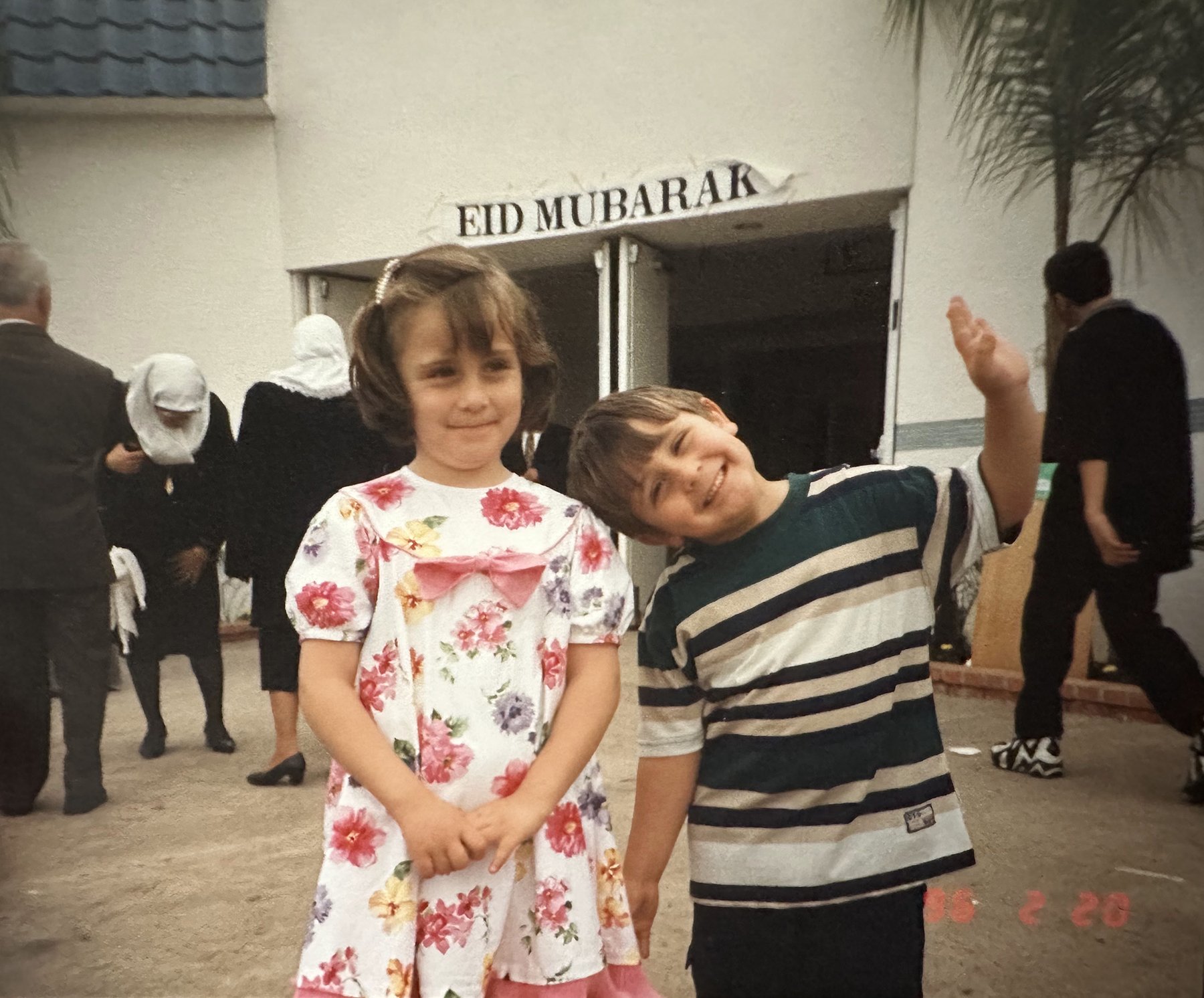
The author and his sister, 1996
San Diego’s Muslims are not strangers to vigilante violence. In the days, first, then the months and years after September 11, 2001, the mosque attacked today was attacked repeatedly, its students and worshippers victims of perennial threats and abuse. On September 14, paintballs were shot at the mosque; the next day, live ammunition. On the 16th, a cherry bomb detonated on the sidewalk outside the mosque led to its evacuation. More than once, California mosques have been victims of drive-by porkings (bacon-addled Islamophobes seem to think that the Islamic relationship to pork is like Superman’s with kryptonite). While the pace of attacks has slowed, they have never abated. The archipelago of spectacular violence against Muslim institutions in North America now stretches from the Islamic Cultural Centre of Quebec City to the Islamic Center of San Diego.
I grew up in the Islamic Center’s catchment. My earliest memories are squeezing into the tightly packed rows of the prayer hall and stacking chairs after communal meals in the multipurpose room (and trading Pokémon cards in the mosque’s shadow and playing soccer in the adjacent city park, too). Its raucous parking-lot Eid carnivals and stoic Saturday school Quran lessons are fixtures of San Diego Muslim memory. As American imperialism waxed across the globe at the fin-de-siècle and nations were displaced in turn, San Diego’s Muslim population swelled. Long overshadowed by Los Angeles and Orange County’s denser concentrations of Muslims and West Asians, by the 2010s San Diego’s Muslim community no longer trekked up the 5 to Anaheim for grocery stores, Arabic bookstores, and bridal boutiques. Around the Islamic Center, and in refugee hubs like the neighborhood of City Heights and city of El Cajon, the social and commercial infrastructure of San Diego Muslim life flourished in the wake of imperial war.
San Diego is girdled by military bases. To the north lies the massive Marine Corps Base Camp Pendleton, named for Major General Joseph Henry Pendleton, of America’s wars on the Philippines and Cuba. The base stretches some seventeen miles north along the Pacific and another seventeen inland east into the Santa Ana Mountains. Contained in its 200 square miles are bombing ranges, barracks, training camps (including mock “Afghan” villages), a golf course, and even a herd of protected bison. Naval Base San Diego, home of the formidable Pacific Fleet, forms the city’s western edge. And to the east lie the rolling hills of Marine Corps Air Station Miramar. The considerable air power contained at these sites has been mythologized and immortalized in Top Gun (1986) and Top Gun: Maverick (2022)—late, and later, imperial comedies. Much of this infrastructure was built to wage the Cold War’s hot wars, but already in 1931 Edmund Wilson had observed the follies of imperial San Diego: “You seem to see the last blind feeble futile effervescence of the great burst of the American adventure. . . .where the gray battleships and cruisers of the government guard the limits of their enormous nation—already reaching out in the eighties for the sugar plantations of Honolulu.”
Muslim life in San Diego is conditioned by this geography of war-making. “As a militarized city as well the largest refugee-receiving county in the state of California,” Maxamed Abumaye writes in Black Muslim Refugee: Militarism, Policing, and Somali American Resistance to State Violence (2025), “San Diego embodies the relationship between militarism and refugees.” If Muslims are subjects of violence in San Diego, they’ve often arrived there already having been subjected to American violence abroad. The irony, of course, is that violence is produced by the same source. “Indeed,” Abumaye continues, “three of the largest refugee groups in San Diego—Vietnamese, Somalis, and Iraqis—were displaced by US wars in their respective countries.”
If San Diego’s bases to the west, east, and north were built to wage war on Afro-Asia, the city’s southern border is the Monroe Doctrine’s front line. This orientation toward the frontier has long made San Diego a hotbed of jingoist attitudes and activities, official and extracurricular. The Border Patrol's imperial regime of racialized policing originated in white vigilantism, as the historian Kelly Lytle Hernández has detailed. And white vigilantism continues to nourish the Border Patrol’s cause in word and deed. Mike Davis was the city’s greatest chronicler, drawing out the marriages of convenience that brought together California’s fledgling government aiming to exterminate its native population, robber barons eager to make ever greater profits, and armed militias out for blood. “There is extraordinary consistency in white prejudice over the last 150 years of California history,” Davis wrote in his genealogy of California vigilantism, “The wrath of nativists and vigilantes has always been focused on the poorest, most powerless, and hardest-working segment of the population: recent arrivals from Donegal, Guangdong, Hokkaido, Luzon, Oklahoma and now Oaxaca.” The latter day Minutemen who volunteered to patrol the border in their store-bought tactical gear could be found regularly roaming San Diego neighborhoods and Home Depot parking lots in the early 2000s, camcorders in hand. One-time Grand Dragon of the Ku Klux Klan’s California chapter, Tom Metzger, himself dwelled in the hinterlands of San Diego County. (The eastern San Diego city of Santee has long been known by the sobriquet “Klantee”.) American flags and Gadsden flags are as ubiquitous in some neighborhoods as Mexican flags are in others. Despite the Treaty of Guadalupe Hidalgo, which drew today’s border after the Mexican-American War in 1848, the battle over San Diego’s territory, transnationally Kumeyaay in the first instance, continues.
We can draw a straight line from genocide in nineteenth-century California to genocide in twenty-first century Palestine, two proverbial “holy lands.” Trump and Hegseth’s current crusade in Iran draws upon the language of Bush and Rumsfeld’s crusade in Iraq, which itself drew upon a whole repertoire of crusading ideas and practices at the core of western modernity, as Suleiman Hodali has recently identified. His own body emblazoned like a Crusader battle flag, Hegseth has enthusiastically adopted the War on Terror crusade as his own, fittingly, of course, since he was one of its soldiers. Indeed, in his 2020 manifesto American Crusade: Our Fight to Stay Free, Hegseth repeatedly draws on his oriental career to authorize his conclusions (including candid discussions with his Afghan interpreter “Esmat”). Less ecclesiastical in his locution, Trump—usually so matter-of-fact—has nevertheless turned decidedly toward the transhistorical as his Israeli war on Iran continues to falter, announcing, once, that “a whole civilization will die tonight.”
Finally, we must draw a straight line from the murder of Muslims as Muslims in San Diego today to America's war on Muslims yesterday. San Diego is not unique. The full catalog of attacks on Muslims within the United States is only dwarfed by US imperialism’s library of brutality against Muslims, which begins with chattel slavery and is reinvigorated continuously through war. San Diego is symptomatic. The murders of Amin Abdullah, Nader Awad, and Mansour Kaziha (Abu al-‘Iz), the three men killed in Monday’s attack on the Islamic Center of San Diego, will be added to the register of names, kept in at least a dozen languages, of those martyred by the forces of US imperialism. Many will be eager to separate these murders from these conditions, but in the San Diego from which the USS Abraham Lincoln sets off to stalk the Arabian Sea, that trick is impossible.