
Stones Are the First Words We Speak
Anti-Zionism as Praxis
nasser abourahme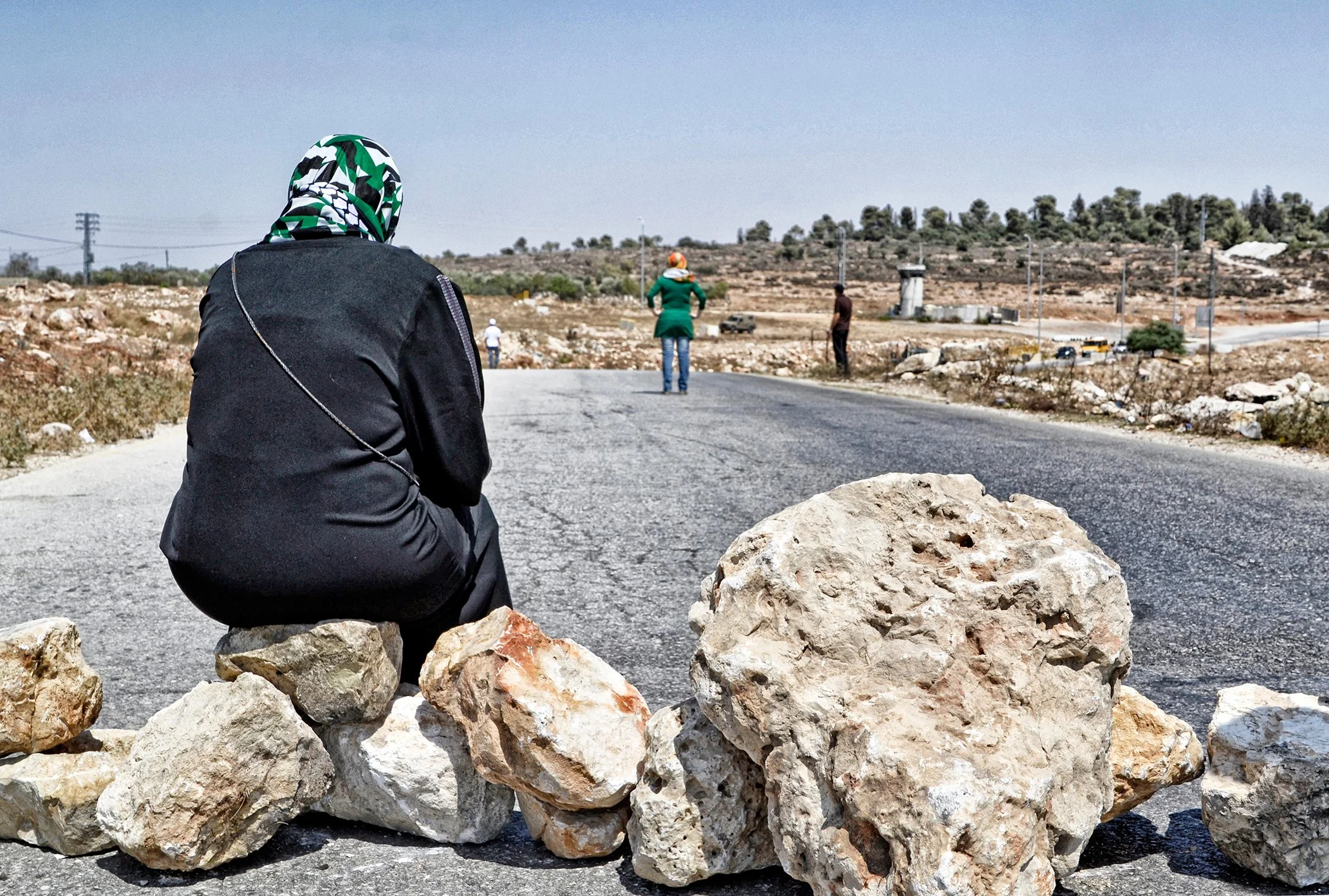
What is anti-Zionism today? What traditions does it draw on? What are its political and epistemic starting points? And to whom or what is it answerable?
Before these questions, there is the question of timing: Why pose this now? We’ve been here before. Anti-Zionism is, of course, as old as Zionism itself, so why is this a question to which we still need answers? The most obvious reply is that anti-Zionism is again a matter of urgent political concern, an urgency that appears in direct relation to the crisis of the Zionist project and as a direct effect of the resistant forces that have produced this crisis. Israel’s turn to open, limitless, exterminatory violence has quite simply plunged ideological Zionism into what is most likely a terminal crisis, an abyss from which it may never exit. An ideology that in the West was once, in the full sense of the word, hegemonic is today badly flailing. And yet the ideological defeat of Zionism does not equal, by any stretch, its political defeat. Quite the contrary. In correlation with its waning as ideology, Zionism as a disciplinary repressive tool has only expanded.
One aspect of anti-Zionism’s urgency, then, is the repression it elicits. Anti-Zionism becomes a pressing question as expressions of it are increasingly rendered out of bounds as inadmissible speech. But the absurd definition of anti-Zionism as a form of antisemitism is little more than a rearguard and desperate attempt at censure and repression by institutional Zionism and an increasingly unbalanced ruling class in the West. These responses only mark the ideological collapse of Zionism. On their own they’re hardly worth bothering with.
Instead, my immediate starting point here is anti-Zionism on the left, where it has been today in certain places subject to a kind of disarming that empties it of its political and negational force, one that deregionalizes and dehistoricizes anti-Zionism, removing it from the traditions and broader worlds of anticolonialism, anti-imperialism, and left internationalism. In a certain sense, in these cases, what is invoked as anti-Zionism begins increasingly to look a lot like what used to be called post-Zionism or non-Zionism (both largely meaningless terms today, I think). One could go further and say that arguably we’re at a stage where the death of liberal Zionism might be replaced in some contexts with a liberal anti-Zionism, in which the Euro-American imperial structures that have been, at least since the 1970s, co-constituted with and through Zionism are salvaged even as the Israeli state project is disavowed.
To begin, then, a proposition: there is no anti-Zionist idea, there is only anti-Zionist praxis. This praxis must be drawn from the lifeworlds of the Palestinian anticolonial tradition and is both the condition and effect of the anticolonial subject.
In the first instance, this means that any meaningful critique or knowledge of Zionism can only ever be a part of, and indeed can only ever emerge from, the concrete struggle to defeat Zionism. A struggle not limited to the defeat of the Israeli state project, since Zionism exceeds that project by some distance, but extends to a full contestation of the racially and imperially ordered Euro-American world. If anti-Zionism is a politics of decolonization, it is because decolonization has always been about the world itself. Another proposition follows: There can be no anti-Zionism that is not also anti-imperialist and, today, there is no anti-imperialism worthy of the name that is not also anti-Zionist.
Much like the knowledge we produce about the contemporary carceral system or the border regime, anti-Zionist knowledge can only ever be abolitional. And just as abolitional thought begins with anti-carceral and anti-border struggles, with the material worlds of the incarcerated and encamped, so too must anti-Zionism begin with the terrain of struggle on colonized ground. Abolitional thought shows us the possibility of another world made visible in the cracks of this one; anti-Zionist praxis likewise incites a world just beyond the horizon of ours. It should be clear that “praxis” here is not opposed to theory, but, in a broadly Marxian sense, refers to forms of action that both inform and are informed by theory. What I’m emphasizing, through a notion of praxis, is that anti-Zionist thought has to be immanent to the actually existing concrete forces of struggle and combat: immanent to the prisons of the occupation, to the hospitals and their insurgent doctors, to the forms of refusal in everyday life, to the fields of armed resistance, to social movements and their committed intellectuals. It is from this world that the conceptual tools and the grammar must be drawn.
i: against relational ethicsAnti-Zionism cannot begin from Zionism’s own genealogies or its intellectual history. Ideology critique that stays on Zionism’s terms invariably produces knowledge limited by Zionism’s own omissions and exceptionalism. Take, for example, Jacqueline Rose’s The Question of Zion, in which all of Zionism’s key dynamics and structures of feelings—its catastrophism, tragedy, and so on—emerge from its own immanent contradictions. They are either drawn from Jewish millenarian-messianic traditions or else forged in the historical crucible of European antisemitism and racial nationalism. Palestine and the Palestinians are almost mere background in Rose’s account. Rose writes an entire psychoanalytic book on catastrophe, trauma, and memory in Zionist political subjectivity and does not name the Nakba once. Ideology critique of this kind not only often fails to really come to terms with the thing itself—the zero-sum struggle with native Palestinian life—but also continuously risks our ensnarement in Europe’s or the West’s political and epistemic worlds.
In turn, counter to much of the enduring theoretical and philosophical trends, anti-Zionism need not—indeed must not—begin with Europe’s Jewish question or with the tragic melodrama of the figures of the Arab and the Jew. In other words, anti-Zionism need not revolve, as is often suggested, around an ethics of the Other. Work invested in this kind of relational ethics as the substance or method of a critique of Zionism not only typically begins with continental philosophy and the ethical failures of its canonical figures (e.g., Levinas, Derrida, Sartre, and Habermas, who all infamously failed to recognize Palestinians as victims—and that’s really all they were ever being asked to do) but also reproduces the problem of implicit epistemic capture. This is the effective insistence that the Palestinian question cannot actually be thought of independently or even to the side of the Jewish question but must be thought in direct relationship to it. In this capture, the Palestinian question cannot think itself.
In a review of Zahi Zalloua’s book[WL1] Continental Philosophy and the Palestinian Question: Beyond the Jew and the Greek, Gil Hochberg resists the separation of the Jewish and Palestinian questions by leaning on Edward Said, attributing to him, in her words, “a line of flight towards the Palestinian question, but through the ‘figure of the Jew.’” If continental philosophy must choose between a universalist “Greek” pole that calls for a Paulinian turn away from the fetishization of difference and identity (“neither Arab nor Jew”) and a deconstructionist “Jewish” pole that turns to difference and the other as the means of disrupting identity as such, then Hochberg emphatically favors the latter. But neither pole is capable, she argues, of dealing with the “ethical obligation that bonds to a specific other based on one’s particular identity.” That is, neither pole knows what to do not with the figures of the Arab and the Jew, but with actual Arabs and Jews in particular at this point in history. Where Zalloua wants eventually to move theory past the philosophical phantasms of both “Jew” and “Greek” altogether, Hochberg wants to shift gears to insist on staying with the “politically charged ethical commitments” based on the particular self-identifications of Israeli Jew and Palestinian Arab.
And yet Hochberg’s turn to particularity doesn’t move us beyond the familiar claims of ethical entanglements and the mutual recognitions of histories of suffering and trauma as the basis of an ethics that might begin to exceed Zionism. For Hochberg, rethinking the relationship of the figures of “the Jew” and “the Arab” “beyond the figure of the enemy” is in itself taken to be a generative political step. “Such a rethinking,” she argues, “should open spaces of co-existence based on psychic identification, historical continuation, and ethical obligation, all of which do not do away with either Arab or Jew, but rather affirm such differences while reminding both sides that ‘each is the other.’” We’re back in relational ethics, back on the terrain of “co-existence” and psycho-historical dramas and entanglements that, for all their claims to particularity, never even come close to the terms of a settler colonial contradiction now taking full exterminatory form. A contradiction that, precisely in its very particularity, and from a revolutionary Palestinian perspective, has next to nothing to do with the “Arab” and “Jew” as figures and everything to do with the settler and native.
What the Palestinians think or don’t think about the Jewish question, or even the Holocaust, is immaterial to the question of historical injustice—they are neither its perpetrators nor its beneficiaries. What Jewish Israelis think or don’t about the Nakba is entirely material—they are both its ongoing perpetrators and beneficiaries.
One iteration of relational ethics today is the move to think of the Holocaust and the Nakba side by side, as the entangled, foundational pasts and traumas of two seemingly colliding collective national identities. We see this in Bashir Bashir and Amos Goldberg’s edited collection The Holocaust and the Nakba: A New Grammar of Trauma and History, which, despite many merits, struggles to overcome a historical and structural asymmetry that is all but unsurpassable in the current terms of order. In its search for a common grammar, the book heaves under the sheer weight of this imbalance. In the very first pages, the editors declare, “Each side is convinced that it is history’s ultimate victim, while denying or downplaying the suffering of the other side in order to validate its own claim.” They go on to write that “In this context, many Jews, in Israel and abroad, employ various strategies to deny the Palestinian catastrophe” and “[m]any Palestinians also find it hard to recognize the Holocaust and the suffering experienced by the Jews.” Whether this is actually true is irrelevant; the obvious hole in this neat little mirror is that insisting on mutual recognition risks displacing the actual terms of responsibility: Zionist Jews and their Euro-American imperial backers are the architects of the Nakba; Palestinians have nothing to do with the Holocaust. The authors know this, of course, but swim against the tide of this asymmetry in their search for a shared grammar that might become the basis of reconciliation.
Yet it is not at all clear that a contrived historical equivalence provides the terms on which a shared grammar can or should be sought. What the Palestinians think or don’t think about the Jewish question, or even the Holocaust, is immaterial to the question of historical injustice—they are neither its perpetrators nor its beneficiaries. What Jewish Israelis think or don’t about the Nakba is entirely material—they are both its ongoing perpetrators and beneficiaries. This incommensurability is compounded by the fact that the Holocaust continues to be instrumentalized to render all Zionist violence—up to and including genocide itself—as always already exceptional, as by definition always defensive and salvational.
*
What exactly then is this “interconnectedness of the two histories and the tight weave of the two traumatic memories” that Bashir and Goldberg make so much of? If we reject—as we must—the fiction that this interconnectedness is just two colliding foundational national narratives duking it out over the same piece of territory, where does that leave a relational ethics? If the story is, as Palestinian anticolonial knowledge has always insisted, one of settler colonial conquest, the question becomes this: What obligation does one owe the historical traumas or identity constructs of one’s colonizer? What responsibility, for example, did Black South Africans have to recognize the collective historical trauma of the Boer nation in the Great Trek or their mass internment in concentration camps at the hands of the British? And how would this recognition have changed the redress of the historical injustice of colonization? When posed like this, the question reveals its own irony: There already exists a grammar that connects the Holocaust and the Nakba, and it is the grammar of the anticolonial tradition that has long pointed to the continuities of racial supremacisms and the enduring politics of colonial exterminability in the modern liberal world. But to recognize and share that grammar would demand moving precisely beyond the exceptionalism and sacralization of the Holocaust as the starting point. An anticolonial grammar would eschew the divinity of origins entirely and look instead at genealogies of racial-colonial violence and their filial logics as they move between the Americas, Africa, and Asia. From this perspective, the twentieth century would no longer be split into two neat halves defined by liberal redemption but might instead look like a long and discontinuous arc that begins with German extermination in South West Africa, “returns” this extermination to Europe in the Holocaust, and closes out with the Zionist extermination campaign in Gaza.
This, then, is the trap of theory that seeks a way out of the genocidal present via the supposed entanglement of the Jewish and Palestinian questions: Even as they construct a seemingly independent conjunction (Israel and Palestine, Arab and Jew, the Holocaust and the Nakba) they invariably get stuck at the epistemic limits of Zionism’s or Euro-America’s self-image. In her review of Bashir and Goldberg’s book, Nadia Abu El-Haj identifies this with precision: “Put simply, one cannot begin with ‘the Holocaust and the Nakba’ as foundational tragedies. In that ‘and’ a constitutive slippage is elided: one actually begins with the Holocaust.” As such, one not only never begins with, but also never really arrives at, the actual terms of colonial contradiction that are the question of Palestine.
This premise is an entirely dead end for anti-Zionism. It presents Palestinian liberation with an almost impossible set of symbolic demands: You have to be versed in the intricacies of Europe’s Jewish question and in the long shadow of Western Christian antisemitism before you can even begin to refuse and resist your own extermination. At the end of this road, the best you get is the ethical space of appearance for the Palestinian Other or righteous victim; at best, we get what was denied and refused us by people like Levinas, Derrida, Sartre, and Habermas, which counts for nothing today. Plus, these relational ethics don’t really take us an inch past the moral economy of sentiments proper to humanitarianism—compassion, tragedy, empathy—that are no longer merely complicit in liberal violence, but today totally defunct in the face of the Western-mandated post-humanitarian exterminatory destruction that is the Gaza genocide. But perhaps even more consequentially than all this, in taking us back to Europe’s privileged figures of alterity as the origin, relational ethics keeps all of us ensnared in Europe/the West as the historic and epistemic center of even those forms of thought that seek finally to leave it.
Unless we refuse and discard this straitjacket, we remain trapped in the self-referential and narcissistic world of Europe and its Zionism where the entirety of Palestinian existence is at its core only ever really a reference to the Jewish question. This is a world in which, as Mary Turfah had it, “Insofar as Palestinians exist, they are about Israel.”[i] By contrast, and following the lesson of Fred Moten, we need a refusal of the refusal: a refusal of the righteous victimhood and humanity which was refused us by the high priests of European ethics. What is needed for anti-Zionism is precisely a radical forgetting of Europe. That our colonizers happen to be Europe’s Jews is and must remain at some level irrelevant to us. This has to include the refusal of the Holocaust as the ethical and historical starting point of a line of flight. In Abu El-Haj’s words, “In order to imagine a radically ‘otherwise’ political future, I want to suggest, rather than think the Holocaust and the Nakba together, the question of the Holocaust, and its grammar in its entirety, needs to be set aside.”
None of this is to foreclose the potential of anti-Zionism as a form of address capable of reaching Israeli Jewish society, nor is it to forget the long and rich history of Jewish anti-Zionism or to ignore the value of contemporary Jewish anti-Zionism and what it might draw from histories of Jewish resistance and struggle in Europe. It is, rather, to refuse the demand of reading our struggle through the prism of the Jewish question and, in turn, to resist the conclusion of Raef Zreik, for example, who tells us that it is the Palestinians’ “fate and destiny to deal with” the Jewish question.[i] Says who? This is not only an impossible burden but fundamentally a displacement that effectively lets Europe off the hook. Houria Bouteldja might be right when she says, “Anti-Zionism is that territory in which the two primary victims of the Israeli project come to light: the Palestinians and the Jews. It is also where its primary beneficiary appears: the West.”[ii]But there’s no chance of anti-Zionism being this common territory if it is bound to the very terms of the West’s historical displacement and extension of its racial and imperial structures.
In the displacement of the terms of the colonial contradiction into Europe’s figures of alterity—Arab and Jew—we lose the actual or particular relations of struggle. These relations are not so much between particular Arabs and Jews (as with Hochberg), or even Palestinians and Israelis, but between native and settler. These conjunctural pairings are neither synonymous nor interchangeable. The first—Arab and Jew—is a pair of overdetermined mirrored figurations that cannot but index Europe’s privileged racial foils and its displaced historical antisemitism. This is a pairing that is, as Joseph Massad once showed, not just internal to Europe’s modern identitarian ideology but located precisely at the intersection of Orientalism and antisemitism and bound by the racial foil that is Europe’s or Aryanism’s Semite—a figure that both binds and (after Zionism) separates figurations of Arab and Jew. Settler and native, by contrast, are mutually constituted subject positions that only emerge in and from the colonial contradiction—subject positions that amount to a binary that can only be undone with the defeat of the settler colonial project and its racial taxonomy. Insofar as settler and native subject positions are entangled, they are entangled only in combat; they are not mirrored or echoed and are substantively incommensurate. For Zionism, the figure of the Palestinian Arab, as the racial discard of necropolitical sovereign control, is the phobic object that holds Zionist subjectivity together. The reverse is not true at all; for Palestinian political subjectivity, both sovereignty and the figure of the Jew are marginal. The foil is not the Jew, it’s the settler. And the settler has no content, needs no content, other than settlerness. The contradiction, and in turn the terms of praxis, is the colonial relation itself. Neither the Jewish question nor even Zionism itself are of much value to the struggle at all; Palestinian anticolonial thought has produced plenty of critiques of Zionism, but only ever as “knowledge of the enemy” (marifat al-‘adu) and as part of a politics of liberation.
This underscores the need for anti-Zionism to hew closely to the existing terms of Palestinian struggle and its political subjectivities. Whether or not continental philosophy heeds the calls of Alain Badiou to jettison philosemitism and the fetishization of difference and victimhood or whether, as Zalloua urges, it moves past both “Jew” and “Greek” altogether is not really what’s at stake here. These might be lines of flight for continental philosophy, but they are still not the grounds of a useful anti-Zionism. If anti-Zionism is to move us, as Zalloua elsewhere compellingly urges, from a humanitarian reason and its “traps of empathy” to an anti-colonial reason that is a “radical unsettling” of supremacist sovereignty, then it is with what we might call the cosmopolitical world of Palestinian resistance that we must begin.
It’s worth remembering here, as Samera Esmeir has noted, that Arabic does not really have an equivalent term for anti-Zionism. We might point to the fact that Arabic lacks a clear equivalent to the negational prefix anti, but this is usually solved in the use of the verbal nouns, munahada or mu’ada. Yet the term munahadat al-sahyuniyya (“opposition to Zionism”) isn’t really vernacular in any meaningful way. The more substantive explanation for this is not linguistic but conceptual: whatever content we hold in English under the term anti-Zionism is already located in the Palestinian tradition under the Arabic term tahrir, liberation. And that’s because the content of the politics does not begin from what Zionism is in its own discursive universe. What anti-Zionism ultimately amounts to here is a liberation of land and people that is indifferent to Zionism’s self-image. As such, it does not demand a relational ethics; it demands a liberatory praxis.
ii: liberatory praxisThe best resource for thinking about this, to my mind, comes from Ghassan Kanafani’s 1969 novel Returning to Haifa, precisely because it’s so widely read and celebrated as a deeply humanistic rendition of the encounter between Palestinian and Israeli. These readings, however, often entirely miss the political thrust of the novel. The plot of the novel is quite simple. In the weeks after the 1967 War expanded the effective boundaries of the Israeli state, a Palestinian refugee couple, Said S and Safiyya, make a journey back to the Haifa home from which they were expelled in 1948. In that expulsion and in the panic that ensued in the city’s conquest, Said and Safiyya had left their infant baby Khaldun in the house as they were expelled to the West Bank. A Jewish couple, Miriam and Iphrat, are then given the house by the Israeli state on the condition that they adopt the seemingly orphaned baby. The novel revolves around Said and Safiyya’s return to their home and their encounter with Miriam and their son Khaldun, now named Dov, who enters during the middle of the novel in his Israeli military uniform and, in disdainfully rejecting his biological parents, brings the novel to its dramatic denouement.
The novel has been praised, and I think correctly, for its rich picture of “the enemy,” for having fully formed and complex Israeli Jewish subjects, and indeed Kanafani presents an empathetic and rounded picture of Miriam, the central Israeli Jewish character in the book, a Holocaust survivor and a reluctant participant in the colonial project who consistently displays forms of doubt and empathy. But the book is not a story of intersubjectivity, that, as one well-known reading had it, “shows how the Israeli and Palestinian narratives of exile and return become interlinked to the point of collapse”; neither is it an appeal for a recognition of entangled pasts and traumas that have to be revisited and mutually accounted for so as to find a way forward. What the novel mediates above all is the imperative of anti-colonial praxis as both the immanent ground for thought and self-realization and the opening of futures not shackled by the past.
At the dramatic crescendo of the novel is a long and fragmented monologue that Said delivers after his and Safiyya’s disastrous encounter with their biological son Khaldun/Dov. This monologue, which is also the staging of a failed dialogue, and which begins with Said bursting into a kind of “explosive laughter,” is the moment in which Said begins to see the concrete conditions of his historical predicament for the first time. Spurned by the lost son, who stands in allegorically for an occupied Palestine, he realizes it was a mistake to return to Haifa now. They have not in fact returned home; they have not in fact found Palestine. Not yet, at least. The past can’t be restored, and Palestine can’t be recovered, in an individual act or as an object of memory. Said tells Safiyya, in some of the most memorable lines in the book, “I’m looking for the true Palestine, the Palestine that is more than memories, more than peacock feathers, more than a son, more than pencil scribbles on the stairwell. . . . We searched for something beneath the dust of memories, and what did we find beneath that dust? More dust.” At this point, Samera Esmeir tells us, Kanafani is making clear that the turn to look back at a past, at Palestine as an object of memory, only produces more loss: “In other words, Palestine as an object of memory is itself the work of the colonial present.” This is what Said now realizes: The homeland is not a past, it’s a future yet to be made. The insight here—as almost always with Kanafani—is that it is only in the turn to action and struggle that the future might be opened. Or as Said repeatedly tells Safiyya, “Didn’t I tell you from the beginning that we shouldn’t come…that this is something that will take a war?”
For Said, this subjective becoming—and its expression in speech—is premised on an end to the failed dialogue with Miriam and Dov/Khaldun, an end to the kind of dialogue Kanafani elsewhere famously dubbed the “conversation between the neck and the sword.” By contrast, it’s both Miriam and Dov/Khaldun who constantly implore a return to dialogue and civility. As Said becomes animated and stands up to speak, Dov/Khaldun chides him by saying “We need to talk like civilized people.” In the final pages, just as Said and Saffiya are leaving, Miriam beseeches them: “You can’t leave like this. We haven’t talked about it enough.” To which Said replies, “There’s nothing left to say.” When he reaches the door, he turns to look at Dov/Khaldun and Miriam a last time and says: “You two can remain temporarily in our house, it’ll take a war to resolve that.”
This is not simply a celebration of armed struggle and the figure of the militant; rather, it is an understanding of struggle—armed or otherwise—as part of the unavoidable condition for the very possibility of becoming Palestinian in the world. What Kanafani understood then, and what his legacy still bespeaks today, is that it is only in struggle, only in the revolutionary ruptural act, that a Palestinian subject—as the speaking subject of thought or the idea—might emerge.
This is borne out most clearly through Said and Safiyya’s other son, Khalid, whom we never actually meet in the novel. What we do know is that a week prior to the couple’s return to Haifa, Khalid wanted to join the armed revolution only for Said to forbid it and threaten to disown him. Now, in the novel’s denouement, in that dramatic encounter, as Said is completely overwhelmed by the rejection and contempt of his biological son, the Israeli soldier, he invokes Khalid and pretends that Khalid has already joined the revolutionaries, to tell Dov: you two might meet on the battlefield. It’s Khalid that is the key for Said’s becoming. Khalid, he turns to tell a distraught and collapsing Safiyya, doesn’t know the house or Khaldun, or Haifa; he has no memories of this place, and yet Palestine is a cause for which he is willing to bear arms and die: “Khalid knew it before we did . . . Oh Safiyya . . .”
The stakes become clear in the following moment of Said’s introspection, which Kanafani complicitly lets us into. In more lyrical passages that interrupt the realism of the novel, Said thinks to himself, “[w]hat a strange world”; a week ago he had tried to stop Khalid from joining the revolution and yet, in that moment, Kanafani tells us, “Said could find no way to defend himself in the face of this tall young man’s disavowal other than by boasting of his fatherhood of Khalid,” the revolutionary-to-be. As he teeters between subjective collapse and dissolution—on the edge of a kind of psychic death—it is only his son’s participation in the revolution that allows him to carry on and gather himself as a speaking subject.
*
What Kanafani gives us, then, is the anticolonial subject as neither essence (the human) nor a metaphysical universal (memory, longing, love of homeland), but as the effect of a practice or an act—or, more precisely, the effect of the opening made by the act. In this Palestinian revolutionary tradition, the subject is only ever immanent to that fight, to the hole or crack made in the order of the given. Khalid Odetallah says that for Kanafani, the Palestinian is neither memory nor identity, but always trial or test. It’s only in the trial (imtihan or mihna) that a subject emerges.
“This is anti-Zionism: the revolutionary negation of the negation that is also the very possibility of a subject.”
What Kanafani opens up, then, in the staging of this encounter in Returning to Haifa, is neither the entanglement of competing or overlapping pasts and historical injuries (the Holocaust and the Nakba, the Arab and the Jew), nor the possibility of an idyllic return to a restored pre-Nakba past, but the imperative of a dialectical overcoming of the present through revolution. In other words, to use Marxist terms that Kanafani no doubt would have known, he gives us the imperative to negate the negation. “It will take a war”—the single most repeated refrain in the novel. This is anti-Zionism: the revolutionary negation of the negation that is also the very possibility of a subject.
In turn, the anti-Zionist “idea” that figures in study, thought, and speech can only emerge from this praxis. In the conditions of eliminatory and now exterminatory violence that constitute contemporary Zionism—in the systematic negation of the very possibility of collective existence—the “idea” needs the rupture; it needs the crack or the hole in the order of the given that only the act can give it. The political subject is only ever the effect of this act; it only ever emerges from an immanent break with the colonial situation, and only within the space opened up by what Badiou would call an event. When we participate in or witness events, we are compelled to decide a new way of being; we must decide whether to be faithful to or disavow their truth. But events are exceptional and rare, and it’s hard to be faithful to them. They emerge only from the impossibility of a particular situation, from its void—the emptiness which structures a situation’s systematic entirety.
“Palestine” as that which must be constantly negated, disavowed, disappeared, made nameless just so the situation can persist, is Zionism’s void. It’s only “Palestine” as a native claim to equality that allows us to think through the situation of Zionism as a whole. In every colonial situation, the void is consistent with the impossibility of the full being of the colonized, with the space of their non-being. This is an order of separation that needs constant upkeep. “The first thing colonialism does,” wrote the revolutionary intellectual Basil al-‘Araj, “is define the possible and impossible for the oppressed.” Fanon understood this well. “The work of the colonist,” he wrote, “is to make even dreams of liberty impossible for the colonized. The work of the colonized is to imagine every possible method for annihilating the colonist.” To make even dreams of liberty impossible, colonialism must settle in the very center of the subject and undertake what Fanon elsewhere called “a sustained work of cleanup, of expulsion of self, of rationally pursued mutilation.” Even breath is occupied, itself a site of struggle: “Under these conditions, the individual’s breathing is an observed, an occupied breathing. It is a combat breathing.”
Kanafani’s insight was that in these situations only the resistant act or event could exceed the objectifying or depersonalizing effects of colonial domination and enable the possibility of subjective becoming. Only by punching a hole in the order of the given, only in the event might we become something new, something we did not know we were capable of. For Said in Returning to Haifa, the event is the armed insurrection of the Palestinian Revolution and the possibility that his son Khalid had joined the revolution. His subjective becoming, his appearance as a speaking subject, is his decision—on the edge of collapse—to be faithful to that event, to be a militant of its cause. He’s interpellated by it, he changes, he finds language and voice; Safiyya is temporarily taken aback: “What happened to you, Said?”
This was not Kanafani’s insight alone, of course. We see a similar insight in the 1973 memoir of his comrade in the Popular Front for the Liberation of Palestine, Leila Khaled. In My People Shall Live, Khaled recounts her rebellious childhood and path into revolutionary militancy in an acerbic, irreverent, and fierce text, brimming with her own brand of counter-modernist refusal of every social hierarchy around her: patriarchy, obscurantism, eurocentrism, individuality, bureaucracy. One of her turning points comes in 1968 during a conversation with a young American woman, Jane, hosted at Khaled’s family home in exile in Lebanon. The armed revolution had begun tentatively in 1965 and though it had many “defects and problems,” “[i]ts supreme virtue was incontestable: it was a fighting organisation in a time when others only talked about theories of war.” It hailed Palestinians to take up armed struggle; though she was active in the Arab Nationalist Movement, Khaled was not yet one of those who responded to the call: “Some did. I was not yet ready.”
It’s in conversation with Jane, the pacificist, liberal, color-blind missionary, “a typical Yankee do-gooder” as Khaled has it, that something shifts. Jane declares her desire for peace among “the semitic brothers” and lectures Khaled on the necessity of using analytical language and avoiding emotional and hyperbolic responses. Khaled flies into argument, insisting on “the legitimacy of revolutionary violence” and American complicity in arming the Israeli state. But then Jane points to the apartment Khaled and her family live in and asks whether Khaled expects to live in Palestine “more luxuriously than you are living here.” When Khaled responds that this isn’t important, Jane replies, “It is very important because you wouldn’t give up what you have here and you’re not doing anything personally to reach your goals.” Khaled is stumped. “Jane stunned me. My mind went blank.” She has to walk out onto the balcony to recompose herself. When she returns, she tells her younger brothers, also incensed at Jane, that they should all thank the American lady “for helping us expose ourselves to ourselves. We must act, not just talk and memorise the arguments against Zionism.”[i] She turns to risk, action, wager, fidelity to the revolutionary call—the complete reworking of the ordinary way of living the situation. Then and there Khaled resolves to join the Popular Front.
*
These insights of the revolutionary tradition are very much still with us in various forms of the contemporary struggle. We see this insistence on the event, for example, in the work of Khalid Odetallah. Anticolonial uprisings, Odetallah tells us, are revolutions regardless of their outcomes, because they contain the possibility of the recovery of the human as subject in an age of technical determinism. “For revolutions,” he goes on, “are open historical processes inaugurated by a ruptural (khariq) foundational event, and then wagered on the struggle between those that declare their belonging (intima’) to the event and commit themselves to circulating its truth to every field of struggle, and those that attempt to nip it in the bud.” The striking resonances with Badiou are ultimately beside the point; these are insights already present in this tradition.
The same insistence on the primacy of the ruptural act as the condition of subjectivity is there in a last will attributed to Yahya Sinwar but almost certainly written by someone else. This last will circulated quickly and widely in late 2024. It too starts with a scene of becoming, this time as part of a childhood in occupied Gaza’s Khan Yunis Camp: “My will to you starts here from that child who threw the first stone at the occupier, who learned that stones are the first words we speak in the face of a world that stands silent before our wounds.” In this phrase—“learned that stones are the first words we speak”—is something much more than metaphor. It is also, again, the insight that the resistant act (the throwing of the stone) is the very condition of thought and speech; it’s not simply that stones are words, but that the stone enables the revolutionary word to be spoken. In turn, the stone enables not theory of the world, but theory in the world of struggle. This is, Stephen Sheehi tells us, precisely its challenge: Starting and staying with the scandalized image of Edward Said throwing a stone at Israeli border fortifications in southern Lebanon, Sheehi points out that it was precisely the sense of Said’s engagement, the notion that his thought might be part of political praxis, that was at the heart of the ensuing controversy.
This insight, I think, is also there in contemporary Palestinian prison literature. It’s there, for example, in the work of the martyred Walid Daqqa, a political prisoner and intellectual who served the best part of the last four decades of his life in Israeli jails. For Daqqa, the prison was a name for the political logic that defines Zionism and becomes constitutive of the Palestinian condition. You can be an inmate of “the small prison” that is an actual carceral site, or an inmate of “the large prison” that is occupied land. The logic of the carceral defines both, and that logic is not simply confinement, it’s objectification; or, what he calls the molding of docile and defeated bodies.
In his 2010 book, Molding Consciousness, Daqqa tells us that task of confronting the prison logic begins with refusal. As prisoner you have only two choices: “[E]ither you give up on your subjective being and are transformed entirely into the object of your jailer, or you transform yourself into an object of study so as to redefine your suffering and its causes.” This transformation of yourself into an object of study, into what Daqqa called “both the examining and the examined self,” is a part of praxis; it both depends on and produces events and truths that constitute a break or a hole in the given. Armed struggle is one means for making this hole, but it is not the only one. It might be the smuggling of sperm beyond the prison walls to create a child—the act Daqqa undertook and for which he likely paid with his life. Or it might be using a spoon and some pan lids to dig a literal hole and tunnel to crawl outside those same prison walls—the event that came to be known as the 2021 Freedom Tunnel prison break, in which six Palestinian revolutionaries crawled out of the same Gilboa Prison where Daqqa had clandestinely written his 2010 book. All six were caught, but the event remained. In the Israeli court in which they were re-sentenced, one of the six, Mahmud al-‘Arda, understood the meaning of the event: “We wanted to tell the world that this monster is nothing but an illusion made of dust.” The prison guards too seemed to understand the meaning; as soon as he said these words, they descended on him in a beating caught on camera.
“The issue, in short, is the intolerability of the world—“a world that stands silent before our wounds”—and the imperative of fashioning the forms of action that might do something about it.”
The issue at stake in thinking about anti-Zionism as praxis isn’t the uncritical primacy of armed struggle. This is not what beginning with the political grammar of the Palestinian struggle means. The issue, rather, is the condition to which this struggle rises. The issue, in short, is the intolerability of the world—“a world that stands silent before our wounds”—and the imperative of fashioning the forms of action that might do something about it.
This arc from Kanafani to Daqqa is the clearest rendition of the way the Palestinian revolutionary tradition has staked itself—like many traditions in the anticolonial key—on its capacity to constitute a subject in almost impossible conditions. The impossibility of these conditions isn’t only the nearly insurmountable asymmetries or the terrible odds of liberation. It’s not only that you face the total military, financial, technological superiority of your enemy. It’s also that you have to act from the midst of colonialism’s systematic negation; you have to fashion a speaking political subject from the most radical of voids. That’s the anticolonial challenge.
Here the challenge is doubled. If Zionism has been integral since the second half of the twentieth century to the very construction of the object that calls itself “Western civilization,” if it has been integral, that is, to the imperial control of geography in West Asia, and even more so to the West’s own postwar liberal and philosemitic arcs of civilizational redemption, then the challenge becomes clear: you’re up against the order of the world itself. To be the Palestinian subject, the subject of the refusal of Zionism and its imperial sponsors, is to oppose this world. Impossibility upon impossibility.
To challenge the world itself, to practice anti-Zionism, we cannot, then, begin with Europe’s figures of alterity, or with relational ethics, but rather with the world of Palestinian struggle and its emergent political subject. If anti-Zionism is to become the indictment of colonial modernity that it should be, it must be entirely indifferent to the totems of an incorrigibly imperial “Western civilization” and its contemporary racial regimes; it must begin with the void or “the outside” that is the cosmopolitical world of Palestinian struggle. It’s from this world, which is also a condition of worldlessness—a world with no place in the world—that we might learn what it means to rebel against the intolerability of the world today. It’s from here that we might glean how the child faces a tank with stones in their hand, if only to learn how to speak.