
Stranger than Faction
Masud Khan’s Rewriting of Psychoanalysis
Noor Asif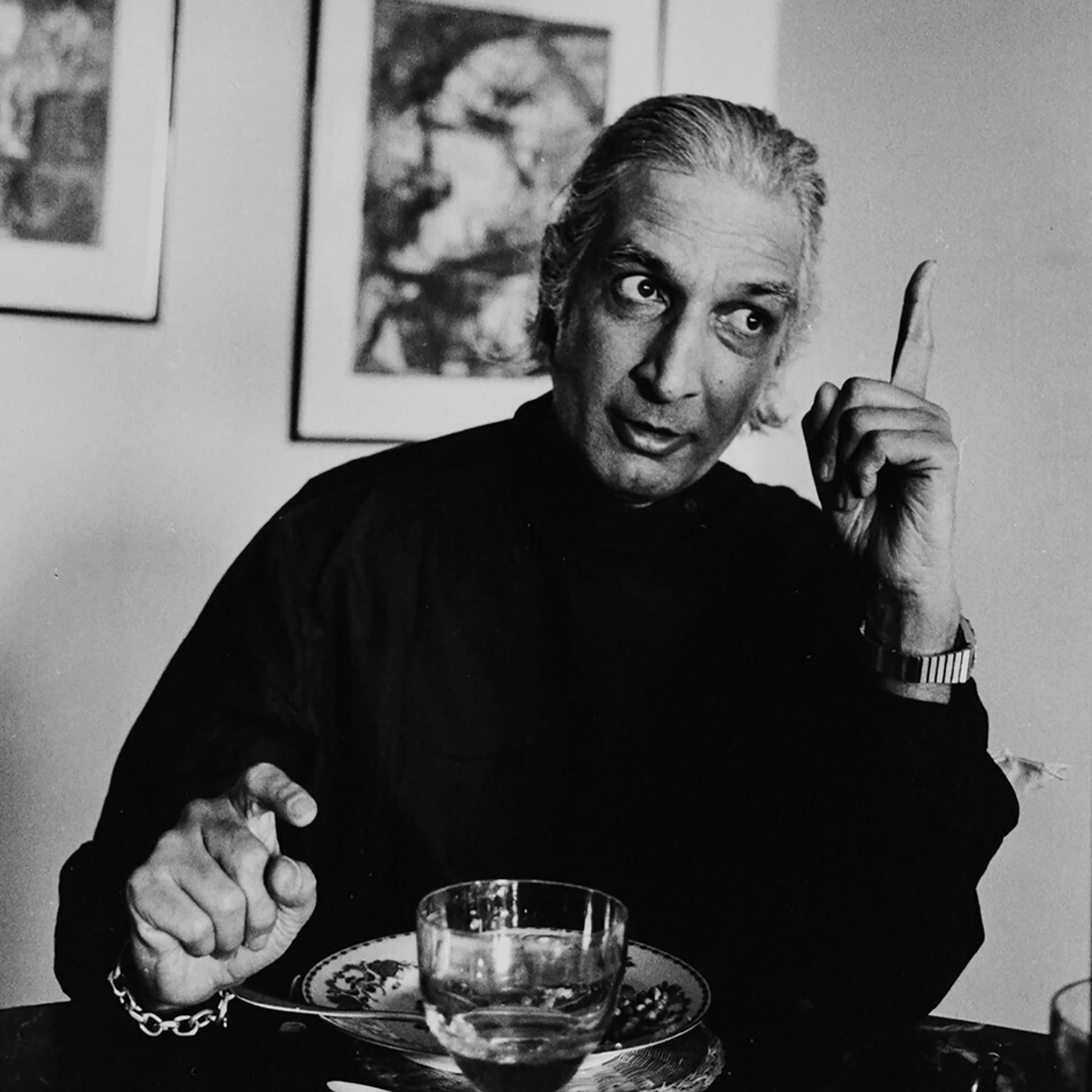
Henri Cartier-Bresson, Masud Khan, 1980
In an August 1968 entry from one of his Work Books, a body of texts somewhere between an intellectual record and a personal diary slyly intended for an audience, the psychoanalyst Masud Khan laments, three years before the beginning of a long psychotic breakdown, the idolization of love. The Work Books, written between 1967 and 1980, occupy thirty-nine volumes; in 2022, the first fourteen were edited by Linda Hopkins and Steven Kuchuck and published under the title Diary of a Fallen Psychoanalyst: The Workbooks of Masud Khan 1967–1972. In this entry, Khan writes that it is, in fact, “hate that has led to all true expansions, conquests, social institutions and individual progress.” He asks, “Why has hate become an ugly condemned word and emotion, when it alone has mobilized and initiated some of the most creative ventures of human effort and enterprise as well as achievement?” Finally, he argues that only “a true understanding of the creative role of HATE alone would lead to a firm and solid establishment of human and humane order: social and individual.”
Khan’s entry is curious, given his immersion in British psychoanalysis and among prominent theorists of hate, like D. W. Winnicott, who was his training analyst, colleague, and intimate friend. Khan was also briefly supervised by Melanie Klein and mentored by Anna Freud, who considered him one of her father’s best readers.
The timing of Khan’s entry is striking. A few months prior, British politician Enoch Powell had given his infamously hateful “Rivers of Blood” speech to the Conservative Political Centre, in which he derided increasing immigration rates from former colonies and suggested that, among other things, migrants were stealing the jobs of the white working-class and posed a violent, sexual threat to society. Notably, Powell declared, “We must be mad, literally mad, as a nation to be permitting the annual inflow of some 50,000 dependents, who are for the most part the material of the future growth of the immigrant-descended population. It is like watching a nation busily engaged in heaping up its own funeral pyre.” This speech contributed to an atmosphere of hatred and suspicion between the “whites” (self-explanatory) and “blacks” (immigrants from former colonies, including those in South Asia and the West Indies). That Khan would promote the creative functions of hate during such a time demands a closer analysis of what his call for hate might have actually meant in the context of the intellectual and clinical lineage in which he participated, as well as in his sociocultural milieu.
Hate plays a fundamental role in Freud’s theory of the subject. When the seemingly self-sufficient psychic apparatus of the reality-ego encounters alterity, it seeks to incorporate pleasurable stimuli and expel unpleasurable stimuli. But this neat division is a fiction, because there will always be, as Massimo Recalcati writes, “unpleasurable stimuli with endogenous sources, unpleasurable stimuli that cannot be exteriorized completely.” This internal remainder of an alterity which the ego cannot metabolize gives way to the pleasure-ego, which constantly seeks to spit out the unpleasurable in order to reinstate this fiction of the internal as pleasure and external as unpleasure. This act of expelling that which is unpleasurable and resides in one’s self, forever marking one’s own Otherness, encompasses the movement of hating through which the “human emerges.” Hate provides the conditions for the emergence of the subject and its boundaries. Hating is an originary act of self-creation. Hate gives the subject form.
In Melanie Klein’s work, hate manifests in the infant’s unconscious phantasies of destroying the breast, which haunt and urge the individual to seek out relationships in which to do the work of reparation. Here, hate provides the conditions for future instances of love. In his 1949 essay “Hate in the Counter-Transference,” Winnicott argues that in order to love, the infant must learn to hate, which it grasps through the mother’s own inevitable hate toward it. The mother, meanwhile, must tolerate her hatred toward her infant and take care not to express it overtly. Hate must be acknowledged and used, but not indulged. In his own example as an analyst, and without seeming to register his sadism, Winnicott recounts how he took in a boy whom he would put outside for misbehaving, there being a “special bell he could ring” to be “readmitted”; he would tell the boy that “what had happened had made me hate him” and surmised that the words were significant not only for stimulating psychic growth within the boy, but also for “enabling” Winnicott himself to “tolerate the situation without [. . .] losing my temper and every now and again murdering him.” The admission of the analyst’s hate becomes vital to the analysis.
The dynamics of hate—projection, splitting—make analysis and transference possible. Without these dynamics, which help to maintain boundaries, analyst and patient would be at risk of dissolving into one another. Yet unlike Winnicott, who put the boy outside, Khan kept his hated objects close and confronted them with his own hate, which would become the grounds for a mutually creative transformation.
*
Masud Khan was born in Jhelum, Punjab in 1924 to a British loyalist father and a young nautch-girl (dancing-girl) mother. A little less than a year before the partition of India, in 1946, at the age of twenty-two, Khan moved to the British metropole. At a time when many other young South Asians were agitating for the end of colonial rule, Khan sought to study the Modern Greats at Oxford. How he fell into psychoanalysis remains a muddy story. In Roger Willoughby’s biography, Khan, having seen an analyst in Lahore, covertly applied to train as an analyst at the Institute of Psychoanalysis; his family was under the impression that he planned to become a barrister-in-law with plans to return back home. Meanwhile, in Linda Hopkins’ account, before arriving at Oxford he corresponded with John Bowlby, then the Training Secretary of the Institute, about seeking out analysis; Bowlby misunderstood his request and thought he was applying for training analysis instead. Regardless of how Khan ended up becoming an analyst, what remains indisputable is how quickly he became the golden boy of British psychoanalysis, using not only his brilliance but what many have heedlessly described as his exotic charm and good looks on analysts, patients, lovers, friends, and enemies alike, to move forward in the field. Anna Freud, D. W. Winnicott, Melanie Klein, Pearl King, Marion Milner, Michael Balint, and even Julie Andrews appear numerous times as friends and interlocutors throughout his autobiographical writing. He also maintained an important position as the editor-inchief of the International Psychoanalytic Library for nearly a decade, during which he edited works by Milner, Winnicott, and others, and headed the library and archives at the Society for twenty years.
In 1971, Khan suffered major losses. He was devastated by the deaths of both Winnicott and his mother. Having descended from a proud landowning family, he was forced to sell more than half of the land comprising his family’s estate and paid a settlement to seven people who claimed they already owned parts of the land he sold. All the while, his relationship with his second wife was tragically failing, until finally they divorced. Prior to these events, Khan was already known for his belligerence, but afterwards he fell into a despair that intensified his behaviors. He indulged even more in alcohol and began to suffer from delusions. For a brief period, he believed he lived in the crazed world of Dostoevsky’s The Idiot and alternately identified with the holy fool Prince Myshkin and the murderous nihilist Rogozhin. (He went so far as to reenact Rogozhin’s attack on Nastasia Fillipovna by violently stabbing a lover’s couch with a knife; the lover remained unharmed.) Most of the time, he was just very rude; sometimes, he was violent. Despite his madness, he seduced his patients, slept with several of them, and continued to awe his colleagues despite his kindling rage toward the hand that had fed him all those years—that of the psychoanalytic world itself.
*
In his clinical practice, Khan understood the fiction of hatred as one of individuation and the necessity with which one must continue to strive toward it even if seduced by regression into dependency. He also understood, from personal experience, the way that fantasy and fiction threaten to push their way into reality. This is especially apparent in his often literary and unconventional case histories. In one case history from his last and most controversial book, published in 1988 in the UK as When Spring Comes, and in the US in 1989 as The Long Wait, Khan writes that for one patient “most facts, offered as facts, are factions, both fictive and true, and paradoxically so at the same time. In fact, [my patient] tells more through her factions than those miserable creatures, the neurotics, addicted to being analysed.”
Rather than overtly alluding to something like sectarian violence or the seemingly irreparable division between self and other, “faction” here becomes a symbol of a porous affinity between fact and fiction. But this mixture of fact and fiction also enacts the role of a conventional faction, antagonizing the analyst, or reader, with its rough edges and deceptiveness.
In its quotidian usage, the term “factions” indicates rifts produced by hostile parties with differences that cannot be reconciled. The word also evokes the specific factions that led to infighting within psychoanalytic institutions. British psychoanalysis, like its American counterpart, emerged via the instigation of feuds and animosity between groups that became increasingly regulated and exclusive and remained largely white and European. In Britain’s broader history as a locus of empire, we must not forget the factions that it carved out of and into South Asia, the site of Khan’s origins, cleaving India from East and West Pakistan, which later led to more bloodshed and gave rise to the Bangladesh War of Independence in 1971. Partition itself is one of recent history’s most significant examples of factions in the making. Further, the London in which Khan lived, as we will see, became an especially charged site of conflict between formerly colonized people and white Britons in the aftermath of empire. It would be a clinical and intellectual disservice to ignore how these histories might be embedded, perhaps unconsciously, in Khan’s own preoccupation with factions, which he uses to describe his patients’ tendency to congeal fact and fiction in their self-narration. Rather than overtly alluding to something like sectarian violence or the seemingly irreparable division between self and other, “faction” here becomes a symbol of a porous affinity between fact and fiction. But this mixture of fact and fiction also enacts the role of a conventional faction, antagonizing the analyst, or reader, with its rough edges and deceptiveness.
Khan wrote When Spring Comes while dying of cancer and estranged from colleagues. According to his close friend Robert Stoller, the case histories are only “daydreams,” raising questions about Khan’s professionalism and sanity. We might approach them as psychodramatic factions—texts that prickle us with their unstable mixture of the imagined and the real. In one case history, Khan treats a patient seeking an abortion by breaking the analytic frame, relying on what he calls “unprogrammed and non-bounded relating” by allowing, with her consent, correspondence between himself and her gynecologist, family, and friends to enter into the analysis. But his explanation arouses discomfort in the reader. He writes, “I was freeing myself of the rigid Yiddish shackles of the so-called psychoanalysis [. . .] [T]he impact of the Judaic-Yiddish-Jewish bias of psychoanalysis was neither small nor light on me. If it undoubtedly nurtured me, it has also cramped my personal and ethnic styles. It was an ego-alien ferment, as well as an increment, in my totality of experiences [. . .] Time to be my own person.” I take the curious phrase “ego-alien ferment” to mean the fermentation of behaviors dissonant with the needs of the ego and the individual’s ideal self-image.
Prior to writing this case history, Khan, who was Muslim, typically expressed genuine interest in Judaism. In 1970, he writes, “I will never align myself with political factions” (there’s that word again) “and specially anti-semitic ones.” His subsequent antagonism in When Spring Comes thus shocked colleagues, especially the way he seemed to see psychoanalysis as shaped by both its Jewishness and by fascism’s narrative of Jewishness, which “cramped” his own Indo-Muslim inheritance.
We find more of this in the case history that caused the British Psychoanalytic Society to vote to revoke his membership. Titled “A Dismaying Homosexual,” it follows Khan’s treatment of a suicidal Russian American and Jewish gay man named Mr. Luis. Khan refuses to treat Mr. Luis, who pleads, “Is it because I am a Jew?” In response, Khan writes that he has “little use and less praise for self-made Jews who pretend to be artists, atheists, writers or dancers.” Using derogatory slang, he says that Jews “certainly know how to climb up. My profession is no exception. [. . .] You would not be the first Jew I would be treating,” so the reason for his refusal is “not that.”
When Mr. Luis presses him further on why he refuses to analyze him, Khan says it is because of Mr. Luis’ lack of privacy, or self-implemented boundary, without which Khan cannot relate to him. In a statement that buys into the fiction of divisions, Khan adds, “I am further handicapped by the fact that I am all things you are not, and you are many things I could never be,” and shamelessly lists physical, class, social, and ethnic attributes he obviously feels pride in, including the fact that he lives “in a style of my own making. Am a Muslim from Pakistan. My roots are sunk deep and spread wide across three cultures, from the Punjab of Northern India, Rajput Indian, and Shia Persian. So where do you, and I, Mr Luis, meet?”
Later, when Mr. Luis makes a jab at Khan’s wife, Khan gives voice to the unforgivable, calling him an “accursed nobody Jew,” whose “people [. . .] drift around,” making flippant references to the Holocaust and Hitler, saying that Mr. Luis will “like the rest of [his] species [. . .] survive and continue to harass others, and lament, and bewail [themselves].” He ends the tirade by saying, “Do you hear me, Mr. Luis? It is not that difficult to splurge obscenities and outrageousness. Now, is it? I can be a deft hand with it at times, when provoked. But what will be the point of that, with you? Playing your dirty games your way.”
Why in the world would Khan spew antisemitic hate in a book he wrote while he was dying? Is this a dirty game? A kind of perverse play or some kind of revenge? How did Khan get here? The last two decades of his life were filled with what Khan perceived as betrayals—most significantly, Winnicott’s papers were left to Winnicott’s wife, rather than to Khan, and because of his alcoholism and general state of mind and behavior, he began to lose rapport with the psychoanalytic society to which he had been so devoted. He lost his once bright status in the field because of boundary violations and angry outbursts and began to spin more lies about his upbringing, which fed into and exacerbated his own paranoid delusions.
Meanwhile, beyond the analytic room, and beyond Khan’s own account of the sociopolitical situation in which he lived, a broader betrayal was taking place: the streets of London became increasingly hostile, especially toward “Pakis” like Khan himself. Yet, without referring to Powell, the riots, or the uptick in racist sentiments that followed, Khan abandoned his former devotion to English culture and indulged in racial and colonial fantasies that exaggerated his difference instead. Rather than lying low, and almost as though he lived in an alternative timeline, he claimed to be one of the last living relics of an Indian feudal royalty that preceded colonial rule and, in a newfound pride about his centuries-old Rajput blood (“Rajput” is an umbrella term for North Indian clans historically associated with warriorhood), demanded to be called “Prince” or “Raja.” He traded in his expertly tailored European suits for traditional, sometimes luxurious, sometimes sagely, South Asian clothes and began to perform, everywhere from dinner parties to the analytic room itself, the racialized, exoticized tropes of the aggressively provocative Indo-Muslim holy man or haughty royal instead. Pictures from this era show him to be tall and gaunt in loose-fitting kurtas or kaftans, sometimes wrapped in colorful shawls, occasionally adorning himself with necklaces. He was well-practiced in these characters, founded on what appeared to be an intense disavowal of reality, by the time he wrote When Spring Comes. While many are quick to dismiss the late-stage Khan as a psychotic or an antisemite beyond the purview of analysis, I suggest that we read his final text as a psychodrama revealing the enmeshment of histories of colonization and British race-relations with problems of race within psychoanalytic institutions themselves.
Yet for Janet Malcolm and many other critics, When Spring Comes was a shameless act of revenge against the profession that abandoned him. Malcolm argued in The New York Times that the book was proof that Khan had “reverted to the snobbery, arrogance and anti-Semitism that are his birthright.” In other words, antisemitism is inherently Indo-Muslim. Regardless of Khan’s egregious behavior, her criticism opens a window onto the broader sociocultural environment that gave rise to Khan’s own racial essentialism: a shared Anglo-American psychoanalytic milieu hostile to racial difference and quick to ascribe the misbehavior of one racial Other to all.
But, as we keep reading Khan’s case history, something curious starts to happen. Despite Khan’s hate, Mr. Luis keeps coming back, and Khan begins to analyze him. I’m less interested in whether this is a true description of the case or a self-serving daydream and more invested in reading this as a psychodrama made up of factions. For Mr. Luis also takes a stab at Khan by accusing him of having his partner Dave “wrapped round your Muslim Mongol feudal little finger.” Reflecting on this, Khan writes, “Hatred is so addictive [. . .] Now Mr. Luis and I are trapped in hating and loathing of each other. A strange therapeutic alliance.”
Midway through the analysis, there is a shift. Khan writes, “So far I had worked by putting up negative hostile barriers. They had served their purpose. Now a new way of relating was needed and necessary: a mutual way of relating, trusting and working together.” This mutuality unfolds into a blurring of boundaries as Khan remarks on aspects of Mr. Luis’s character that feel, to a reader familiar with Khan, oddly like Khan’s own.
We see hints of this even in the earlier “negative hostile barriers”: Khan’s statement that his “roots are sunk deep” compared to Mr. Luis, who “drift[s] around,” reads as a defensive ego inflation to hide his envy of what he sees as Mr. Luis’ ability to assimilate—not to stick out and be fetishized, romanticized, or villainized for one’s race or ethnicity as Khan, a postcolonial subject in England, was. This is a faction—for Mr. Luis, like Khan, surely also faced hostility as a Jew, and yet the friction that Khan has staged between himself and his patient is a necessary creative device that masks Khan’s envy, if only to draw out the desire for intimacy and connection tethered to it.
The leakage between analyst and patient becomes more evident toward the end of the case history. Khan writes that Mr. Luis is prone to outrageous monologs, which he calls “his ‘texts.’” Khan writes that the texts are “bizarre, lewd, and very personal” and yet also “impersonal to Mr. Luis.” We might read Mr. Luis’ texts as evoking Khan’s own tendency to conjure groundless versions of himself through texts of his own.
In Mr. Luis’s painful mourning and fear of having wasted his loved ones, as described in the case study, one can detect the various stages of Khan’s own life and sorrows in relation to others, exhibited in his Work Book entries. Mr. Luis’ realization that he has been nothing but a “collage of imprintings”—residues of his parents, those he grew up with, others around him—parallels analyses of Khan’s own psyche, as explored by his psychoanalytically oriented biographers, like Hopkins and Willoughby. As his Work Book entries and biographies reveal, Khan was heavily influenced by his father, a British loyalist, and put under immense pressure by his expectations. He was also overwhelmed by his mother’s attachment to him. He often felt lost inside himself, striving toward an authenticity that always seemed to be just out of reach.
Even Mr. Luis’ decision to start wearing “gaudy clothes” to hide his feeling of being “colorless” evokes Khan’s own increasingly outrageous wardrobe toward the end of his life, when he was growing colorless, too, and desperate to reverse his waning health. Khan writes, “Mr Luis had taught me something: the role of clothes, not as decoration and fineries, as in my culture, but as skin.” Throughout Khan’s life, we can see performance and reality merging into one faction.
Factions, we might say, are almost synonymous with hate, in that both pose necessary yet fictive divisions through which the self, or the way one knows the self in relation to others, emerges.
In the case history, Mr. Luis also exposes Khan to American literature, particularly Henry James’ What Maisie Knew, as well as the work of Walt Whitman, Edgar Allen Poe, and Emily Dickinson, even though Khan himself was already widely read. Indeed, though Khan was deeply immersed in psychoanalytic literature, it was apparent that his real passion was fiction—his autobiographical writings and his biographers’ are strewn with accounts of how he fondly read Woolf as an adolescent in Lahore, how he adored Russian literature, and how he obsessively watched Laurence Olivier’s King Lear twenty-seven nights in a row when he first arrived in London in 1946.
Khan ends the chapter by writing that it was “important to show how much I had learned, after all, from Mr. Luis’s treatment.” Analyst and patient appear to have switched places, or even to have become each other. From hate to mutual relating to perhaps a kind of identification on the verge of blur: What might we make of this? Is this a narrative of individuation or of fusion?
To return to Khan’s use of the phrase “ego-alien ferment” to describe what he saw as a Jewish influence in psychoanalysis, it is striking that he chose the word “alien,” given the time and place in which he was writing. While he used the phrase to describe the imposition of a culture onto his psyche, a culture allegedly at odds with his own upbringing and mode of being, the word “alien” also echoes the disparaging term used against migrants in the hostile atmosphere of Britain following Powell’s speech. In the late 1960s, Britain witnessed a shift in the far right’s hate from the Jew to the migrant; by the time Khan wrote this text, Powell’s speech had helped reinforce this displacement by focusing its criticism on the threats posed by migrants from the Caribbean and the Indian subcontinent, including Muslims, instead of Jews. This is certainly not to say that antisemitism disappeared, but that during the Powellian 1970s and 1980s, the figure of the migrant, the black, the Paki, was imagined as a central antagonist to British society. No longer just an exotic, Khan might have experienced the weight of this racist animosity on the streets and perhaps even in the psychoanalytic institutions he worked in. We might, then, read Khan’s use of “alien” as unconsciously entwined with his society’s use of “alien” to describe not only people like him—foreign, unwanted, threatening—but also, as in earlier decades, Jews. By doing so, the Jew and the migrant—in this case, the IndoMuslim—find themselves caught in a difficult knot. As Jews increasingly began to pass as white and migrants like Khan fit more firmly into the category of the despised racial Other, this knot came violently undone. In Khan’s account of Mr. Luis, we see an attempt to re-suture this bond, albeit through use of hate and factions.
I suggest that we read the hate in When Spring Comes as a tool of fiction that reorients analysis, the space of transference, to become a space of co-creation involving both analyst and patient. The division between them cannot negate the remnants of the Other that reside within each. Analysis is a method of turning what Khan calls the “chatter” of the unconscious into the narrative of “faction”—that ambiguous mixture of fact and fiction—which is also an antagonistic and agonistic narrative. Factions, we might say, are almost synonymous with hate, in that both pose necessary yet fictive divisions through which the self, or the way one knows the self in relation to others, emerges. They stimulate the need to enforce a boundary between analyst and patient, between reader and text, but this boundary does not necessarily hold. In the analysis of Mr. Luis, this boundary starts to dissolve as the transference and countertransference go on until both participants reciprocate and share the responsibility of transforming the blur into a shared story. In Khan’s psychodrama, we see how a productive antagonism of factions enacts an individuation away from traditional psychoanalytic practice and toward an embodied method of collaborative storytelling that incorporates the messiness of difference and hate to forge new, rather unconventional, ways of relating.
By situating his account of the analysis of Mr. Luis in the larger context of British immigration politics, we can more fully appreciate Khan’s racialized position in psychoanalytic history and theory. The factions on which Khan placed so much importance, and which he produced himself, recall more formative divisive structures he was raised within. They index the nascent projects of India and Pakistan, the friction of which continued to affect his sense of self through his material and cultural possessions, their loss, and his eventual efforts to resuscitate some version of them in his life in Britain, in the context of increasingly fraught race relations. Clearly symptomatic of Khan’s personal problems as much as those of his sociopolitical environment, it would be an error not to listen to what this faction about Mr. Luis, with all its ugliness, gives voice: the persistent entanglements of psychoanalysis, racism, migration, and Islamophobia, and a longing for relation despite and through it all.