
The Happy Trail to Heaven
Finding America in the Cowboy Church
Bex Heimbrock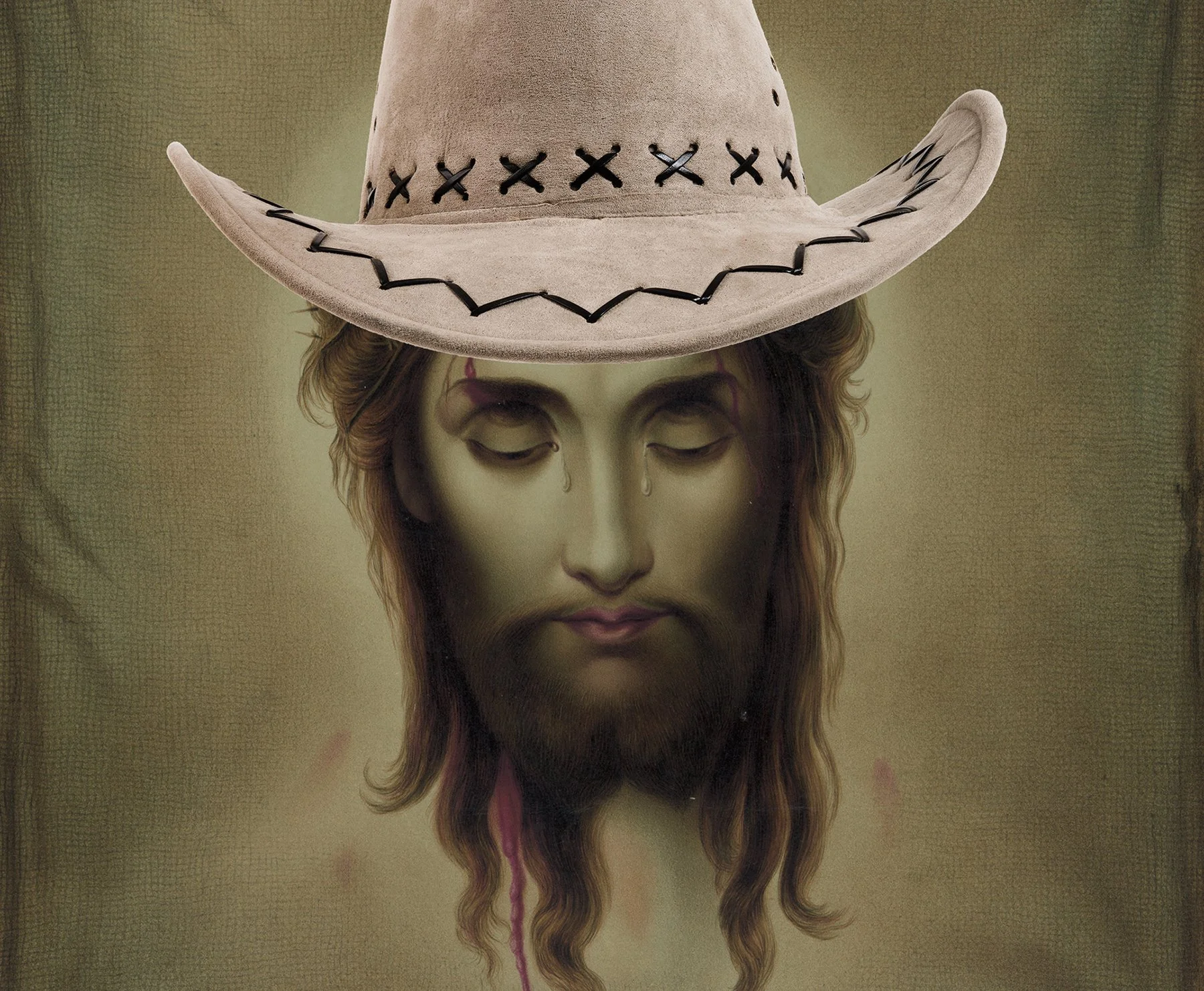
In a low pole building tucked against the foothills of Eastern Washington, where tumbleweeds blow onto the roads and the land feels unbelievably vast, some two hundred people have gathered. Wearing cowboy hats and muddy boots, they settle into seats facing a rugged wooden pulpit. There, TV screens show a picture of a tattered American flag displaying a simple message: “As we look toward the election . . . Pray that God remove those who might try to unjustly & illegally change the outcome of the voting.” The mood is jovial. On this Sunday in October, just a few weeks from the 2024 presidential election, a tall, bearded man with a cowboy hat and bolo tie takes to the stage. With his hand resting on a leather-fringed Bible, Pastor Ron Alexander—or “PR,” as his congregation affectionately calls him—calls the congregation to a special prayer for the upcoming election and for President Trump. PR is a Cowboy Pastor, and his church is a Cowboy Church, where what the church calls “western heritage culture” meets the word of the Lord.
The Walla Walla Valley Cowboy Church (WWVCC) is one institution in a growing movement that reanimates the mythic world of the Wild West to craft the politics of shared grievance that has helped mobilize America’s right-wing populist movement. As America nears its 250th anniversary, cowboys remain decidedly in vogue as signifiers for both American prosperity and anxiety. A recent ICE recruitment ad on Instagram used the figure of a cowboy bucking a horse to expose anxieties about America’s future, asking, “ARE YOU GOING TO COWBOY UP OR JUST LAY THERE AND BLEED?” Before beginning her post as Secretary of Homeland Security, Kristi Noem asked her Instagram followers to vote on their favorite of a series of paintings depicting her as a horse-mounted cowgirl “for the official Governor’s portrait to hang in the South Dakota State Capitol.” During the January 6th insurrection, a Cowboy Pastor from New Mexico led a prayer from the grounds of the Capitol Building, ten-gallon hat and all.
The proliferation of cowboy imagery allows anyone from so-called moderates to full-blown Christian nationalists to identify with a “heritage culture” that, strictly speaking, may have little relation to any individual’s actual background. Claiming proximity to these cowboy motifs often has nothing to do with whether one owns a ranch or whether one’s ancestors were part of this idealized cowboy past. The contemporary image of a gun-slinging, Jesus-loving cowboy exists only in relation to, and as a reaction against, those who might threaten the fantasy of its existence. Cowboy Christians take up shared aesthetic signifiers but come from many different backgrounds. In PR’s Walla Walla congregation, some church attendees have traveled the world, while others have never left the country. Still, they come together under a group identification with cowboy culture and evangelical Christianity. Writing of the libidinal ties that help form and maintain such religious groups, Freud claims that “the mechanism is that of identification based upon the possibility or desire of putting oneself in the same situation.” Identification, in this case, is not only with the nostalgic concept of a cowboy and a simplified “love thy neighbor” message of Christianity, but also with Trump, whose projection of a fully liberated libido allows him to embody the cowboy figure. In Trump’s persona, two figures named in Group Psychology are activated and merged: Christ and a military commander-in-chief. These figures, Freud argues, provide the illusory support by which groups are organized. “It is to be noticed,” Freud writes, “that in these two artificial groups each individual is bound by libidinal ties on the one hand to the leader and on the other hand to the other members of the group.”
For those who are drawn to charismatic Christianity or simply to a sense of shared “heritage” and patriotism, the ornaments and aesthetics of Cowboy Christianity are deeply appealing. The Cowboy Christian get-up is a straightforward look, easy to accessorize. Indexed by overdetermined signifiers such as Pastor Ron’s leather-fringed Bible, cowboy boots, and blue jeans, the Cowboy Christian look is available whether or not one works on a ranch or rides horses. The WWVCC has its own merchandise line for sale, ranging from bumper stickers to t-shirts and trucker hats. Attendees of the church’s annual Rodeo Bible Camp, where Christian youth learn both the Bible and rodeo skills, wear custom hoodies with an image of a cowboy on horseback leading a second unruly horse to the cross. This scene of cowboy salvation, which riffs on the process of breaking in a horse, is set against the backdrop of Walla Walla’s Blue Mountains. In the external identification with this tokenized scenery, the body meets a mythic landscape and is ecstatically redefined by it.
“To enter into the Cowboy Church is to enter a realm of pure fantasy where undeserving Others—immigrants, queer people, and other constitutive outsiders—wholly enjoy the promises and freedoms of America through diversity, equity, and inclusion programs…”
In the Cowboy Church, the act of worship encounters and reinforces an antagonistic relationship to Others whose embodied difference threatens the borders of the Church’s carefully crafted identity. To enter into the Cowboy Church is to enter a realm of pure fantasy where undeserving Others—immigrants, queer people, and other constitutive outsiders—wholly enjoy the promises and freedoms of America through diversity, equity, and inclusion programs that directly exclude Cowboy Christians from enjoying what they imagine was once promised to them. The Cowboy Christian’s fantasy of America includes economic mobility (many WWVCC members work blue-collar jobs in the Walla Walla Valley’s large agriculture industry) but also the ability to speak freely and experience a return to a state of normalcy that never really existed. Fueled in part by the group’s shared libidinal identification with Trump, Cowboy Christians formalize the latter part of this fantasy in the image of the myth of Manifest Destiny and the cowboy’s way of life, which reflects their desire to release American culture from the chains of wokeness by harkening back to a time when people were fully liberated to do and say what they wanted. It is only through active faith—in Jesus, God, and Trump—that this selective reality might make a comeback.
Todd McGowan writes of fantasy’s role in political struggle, “[t]he enjoyment in the fantasy derives from the tortured path to the object, not from the object itself.” The object or aim of fantasy is, in other words, never the point. The structure of the Cowboy Christian’s fantasy—and that of the fantasies deployed in the ICE ad and in Kristi Noem’s portrait—promises access to America’s glory days, which always remain on the horizon and can only be approached phantasmatically through prayer.
Pastor Ron and his wife Pam founded the WWVCC in 2010. At their church, cowboy-adjacent objects are everywhere, framing sermons where images of Others come to life and proliferate. Saddles, rotary phones, and framed photos of nondescript Western landscapes transport the Cowboy Christian into a space where cowboys are still real and the West can still be claimed in a prayer-fueled future. As PR led his congregation in prayer on that Sunday in October, he stated, “I love America and I don’t want to see it go down the toilet!” Repeating Trump’s famous post-assassination-attempt words, a member of the audience shouted out in return, “Fight! Fight! Fight!” “There is no doubt that the tie which unites each individual with Christ is also the cause of the tie which unites them with one another,” Freud writes in Group Psychology and the Analysis of the Ego. In this case, the cowboy serves as a uniting figure that translates the love of Christ into a familiar ideological realm. PR and his congregation love America. So does the cowboy, and so does Christ.
*
I am sitting in Hot Mama’s, a firefighter-themed café with daily specials like the “Ladder Truck Latte” (a 16-oz. caramel latte, hot or iced) and “Two Alarm Mocha” (a 16-oz. mocha). As I wait to meet Jody, a longtime Cowboy Church member, I find myself staring at a mural that takes up an entire wall of the shop: “WE WILL NEVER FORGET 9-11,” the letters each cut out from the diamond-plate metal used for fire truck tread plates, hangs above a painting depicting firefighters responding to the 9/11 attacks. A list of those who died is also painted on the wall. Like the WWVCC, Hot Mama’s is a third space where individuals can renegotiate their vision of America and seamlessly reintegrate themselves within it.
When Jody arrives, she tells me that she comes here all the time. A member of the church for twelve years, Jody’s first introduction to Cowboy Christianity was through the WWVCC’s equestrian drill team. Since childhood, Jody told me, she had always wanted a black-and-white American Paint Horse, a breed with a black coat interrupted by dramatic splashes of white. Jody’s dream came true after she married her husband; the pair found a plot of land big enough for horses and put up a manufactured home. Her first horse was an Appaloosa and her second was the coveted black-and-white Paint. When she and her husband gave up their home to move into town as the couple aged, they also gave up Jody’s beloved horse. To work through this loss, Jody began to look for ways to remain “involved in horses.”
“In my mind I thought, well, if I’m gonna be on this church drill team, I feel like I should be part of the Church,” said Jody. The WWVCC is the first, and only, church that Jody has been a member of.
Here, the church serves as its own sort of third space, substituting ideological and theological kinship for family. This alternative bond proved to be of importance to Jody, whose difficult childhood ultimately led her to religion.
“My stepmom was not a nice person. Any time I went to church and told her about it, I got punished. So when I [would spend] the night with one girlfriend, they would take me to church and I really enjoyed it, but I wasn’t allowed to keep going,” Jody recalled. It was through this friend that Jody was introduced to religion and developed a love for horses.
“The girlfriend I stayed the night with, she lived out in the country and she had a horse. And she let me ride it and, and she knew Jesus, and she helped me invite Jesus into my heart.” But, as Jody explains, because her visits to church were sporadic, “it never really sank in.” Now, at the WWVCC, Jody has found her family. “You get up and you don’t think about anything on a Sunday other than going to church . . . it’s like going home for Thanksgiving or something, you know?”
Commandments to “take America back” and exclamations like “Fight! Fight! Fight!” are common in the WWVCC, as are positive affirmations like “happy trails,” which the congregation repeats at the end of most sermons. This juxtaposition creates a curious effect. Within this holy space, where borders between bodies and objects blur, each reaffirming and reshaping the other, the synchronized echoing of clichéd nationalist sentiments constructs a group identity charged by a shared belief in the ideological and literal borders of this country. The path to “happy trails” is the same one through which they will “take America back.” One constitutes the other; their causal relationship is circular. You must follow the happy trail to take America back; by taking America back, you’ll finally have access to the happy trail.
To ground this idealized vision of a future that is always already the past, an Other emerges. A phantasmatic Other sets the coordinates through which cowboys establish their own legitimacy, through which they organize and frame their own lives. The Other does not belong in America; the cowboy does. Like the specter of whiteness, the figure of the cowboy can only become intelligible through what it negates. For example, when the cowboy enacts violence upon Native bodies, he ultimately positions himself as the true native of the country. By disavowing poor immigrants and other Others, the Cowboy Christian figures herself as the one who truly belongs. McGowan succinctly describes the logic at play in the Trumpian and Cowboy Christian psyche:
I’m working hard for a pittance; the other receives money from the government for not working. I’m obeying the law while the other is circumventing it by entering the country illegally. I give up my old ways of speaking, and the other creates and enjoys an ever-increasing number of identities that I have to respect.
In the same way, the white body is intelligible only through a constant act of recreation in fantasy, as whiteness itself is forged in a phantasmatic register. Fanon elucidated this with the simple formulation “[t]he white man slaves to reach a human level”; the white subject is constantly striving for an unachievable status to conceal or shirk his constitutive lack. It is this state of precarity that ultimately fuels the Cowboy Christian’s nationalist anger.
“The libidinal ties of the cowboy complicate the pair Freud identifies in Christianity—to Christ and to each other. There are instead ties to multiple figures: to God and to each other, but also to Trump, to the cowboy, and to western heritage culture.”
Here, America’s frontier becomes the promised land through which the Cowboy Christian may finally achieve intelligibility. But the frontier has changed. Greg Grandin observes that the “national metaphor” of the frontier has been irrevocably altered. The first step in a long national downfall, Grandin argues, is President Donald Trump’s June 16th, 2015, candidacy announcement, in which he stated, “I will build a great wall.” Free trade, a policy that encouraged a seemingly endless expansion of America’s frontier, was among his targets when he said, “We have to stop doing things for some people . . . [I]t’s destroying our country. We have to stop, and it has to stop now.” The new frontier is in the fight to reclaim what America once was.
The Cowboy Church’s problem with competing proximities—the proximity to undesirable or even monstrous Others versus the yearned-for proximity to nationalist symbols like cowboys, firefighters, and landscape panoramas—reveals the phantasmatic nature of the whole endeavor and creates a new problem: how to define the cowboy. The libidinal ties of the cowboy complicate the pair Freud identifies in Christianity—to Christ and to each other. There are instead ties to multiple figures: to God and to each other, but also to Trump, to the cowboy, and to western heritage culture. To understand how the Cowboy Church movement took off, we need to look, perhaps predictably, to Texas.
*
In 1972, Glenn Smith abandoned his career as a professional rodeo clown to spread the word of God. Smith’s ministry of bull riding and rodeo circuits combined what one University of Connecticut student journalist termed “traditional western activities” and Christian evangelism. He was part of a zeitgeist: Smith launched his Rodeo Cowboys Ministry just two years after rodeo athletes formed Cowboys for Christ and two years before the Fellowship of Christian Cowboys launched as a chapter of the Fellowship of Christian Athletes. A 2014 Texas Monthly article by Maurice Chammah asks, “Where Have All the Cowboy Churches Come From?” The answer, according to story subject Jeff Copenhaver, world-champion tie-down roper, minister, and author, is that the movement’s spread from these origins was “like a wildfire.”
From the ’70s onward, the movement spread consistently. Chammah highlights two tipping points. First, in 1985, Copenhaver, hired after he held the first-ever church service at the National Finals Rodeo in Las Vegas, started regularly preaching sermons at Billy Bob’s Texas, the self-proclaimed “World’s Largest Honky Tonk!” and a massive venue for bull-riding, live music, and private events. Here, the world’s first “stationary” cowboy church was born. Then, in 2000, a Baptist General Convention of Texas “church planter” founded the Cowboy Church of Ellis County. The Baptists’ reach and infrastructure allowed the church to grow quickly, and another boom was upon Cowboy Christians. Ultimately, Chammah concludes, “In a rapidly urbanizing Texas, these churches allow one to aspire while looking backward, to the rural lifestyle that gave birth to the self-image so many Texans hold dear.”
While this article provides some insight into the development of cowboy churches in Texas, the phenomenon is considerably more expansive. Marie W. Dallam’s 2018 Cowboy Christians marks the first booklength history of Cowboy Christianity. Dallam estimates that “in the United States today there are more than five hundred [cowboy] churches, and possibly close to one thousand.” This number does not include international cowboy churches, which Dallam notes do exist but are beyond the scope of her book. The loose, grassroots nature of the churches make it difficult to accurately tally up just how many there are. For example, the Walla Walla Valley Cowboy Church is not marked on the American Fellowship of Cowboy Churches’ “Find A Cowboy Church” map. In fact, entire swaths of the country are marked as having zero churches by the AFCC, when a Google search tells a different story. The state of North Carolina, for example, has twenty-three Cowboy Churches on Google Maps, but the AFCC lists none of them on its official site.
A 2008 strategy document published by the Church of the Nazarene, of which the WWVCC is an official member, defines the mission and vision of the Nazarene Cowboy Church Network. The mission is condensed to eight simple words: “Making Christ-like disciples in the western heritage culture.” Section II of the document, titled “Who is in Western Heritage Culture,” provides more clarity as to who, exactly, makes up the church’s target audience:
WORKING COWBOYS— makes all or part of their living on horseback, they represent a small part of this population and they may be the hardest to reach.
PROFESSIONAL RODEO COWBOYS— make all or a part of their living on the rodeo circuit and again are very few in number.
ARENA COWBOYS & COWGIRLS— makes his or her living somewhere other than the ranch or rodeo but they love arena activities such as team roping, barrel racing, team penning, ranch rodeo, sorting, cutting, play day etc.
CATTLE PEOPLE— these may be large ranchers with hundreds or thousands of head or people who own a few cows or even one FFA steer. They may or may not use horses.
HORSE PEOPLE— these people love horses, they may trail ride, western pleasure, show horses, raise horses, race horses or just have a few nags in the pasture and they may or may not care anything about a cow.
COWBOYS AT HEART— people who just love the cowboy and what he stands for. They wear boots, jeans and a cowboy hat, they listen to country music, have all of John Wayne’s movies on DVD and Capt. Augustus McCrae and Capt. Woodrow F. Call are their heroes.
COWBOY MENTALITY PEOPLE— these folks may be linked to the culture through their past, parents or family, they are people who live by a code, your word is your bond, a honest days word for an honest days pay, they may be electricians, carpenters, law enforcement officers, firefighters, business men, working folks, country folks, people who love the land, farmers, hunters and fishermen. Even to the extent as one put it, those who have ever watched a western.
*
“We are not horse people.” This is one of the first things John and Linda Smith said to me when we met at a Starbucks (Hot Mama’s, their first choice, was closed) to talk about the WWVCC. When we spoke, the Smiths had only been members of the church for a year, but they have always considered themselves religious. Linda accepted the Lord at the age of nine and first met John at a non-Cowboy Christian church.
For the Smiths, who live an hour away from the church and commute every Sunday, their involvement with Cowboy Christianity began when their children attended WWVCC’s annual Rodeo Bible Camp. “ I watched when my kids had changed in a positive way,” said Linda. “I’m like, okay, something’s happening here because the kids that go are coming to that church who don’t even have parents that go to church.”
As for their ties to cowboy- and cowgirl-hood, John says he “[dresses] western, but I’m not a cowboy.” Linda is stymied by her bad luck with horses. “Me and horses don’t get along,” she says. “The horses are always trying to throw me off.” The Smiths fall directly into the group that the Church of the Nazarene calls “cowboy mentality people,” but their love of the church goes beyond their affinity for western culture.
It is also Pastor Ron’s leadership that members of the church find so compelling. “ I’ve never seen a pastor actually be real. [They] usually do their sermons and act like they’re all put together. And I thought, he’s just real. He’s a real guy with a real family and he’s not pretending to be something [that] he’s not,” said Linda. “And I just like the way he teaches. I can apply what he teaches to my life.” And, crucially for Linda, “even the Pastor’s wife—[she’s] not a cowgirl.”
Other Cowboy and Cowgirl Christians agree with this sentiment. Piper, who has been with the church “from Day One,” says the culture of Cowboy Church is what separates it from other churches that are too formal. Per Piper,
That’s our vision. I mean, that’s why we are focused on that culture is because you do have that commonality and that bond and you can relate to struggles. Like you can go and ask, “So how’s calving going? How’s harvest?” And I mean, somebody from the city wouldn’t have any clue about that, but people knowing that you can commiserate with what they’re going through and everything, it really, I mean, that’s in all relationships . . . and that’s what you get with Cowboy Church.
On Sunday, February 9th, a little under eighty people have gathered at the church for the weekly service. From the parking lot, soft country music plays, which seems to emanate from the church itself (speakers mounted near the roof of the building are neatly camouflaged). Greeters open the glass doors for congregants. In the Great Room, TVs play looping slide shows with announcements for financial classes and a dinner auction. PR ambles in, making his way to the wooden platform at the front of the Hall. The sermon begins, and the crowd becomes quiet in anticipation.
PR begins, like most small talk does, with a comment about the weather: Today there’s freezing fog and the wheat fields are covered in snow. This quickly segues, however, into a broader statement about the landscape of Walla Walla and, it seems, the West in general. PR says it’s “just beautiful” here. He muses that “rather than living in Southern California,” where people have to mow their lawns all year, Walla Walla is a “very fertile mission field.” PR continues, “there’s lots of people who need to know Jesus.”
As cowboys and cowgirls sit in these chairs during the service, their collective gaze is drawn to a large object mounted on the wall above the wooden pulpit. A metal mural depicts a cowboy wrangling a horse and riding toward a cross rising from a hill, the same vignette that appears on the church’s Bible Camp shirts and sweatshirts. In the background of this mural are the Walla Walla Blue Mountains. Notably, the cowboy is facing away from the cross and toward a seemingly reluctant horse he is guiding toward the cross. Here, the cross becomes almost secondary. The drama of the scene is in the pious cowboy’s ability to bring the wild horse just one step further. This echoes the named goal of the church, available on their website: “At Walla Walla Valley Cowboy Church, our desire is to make Christ-like disciples. As one ol’ cowboy said when describing a true believer, ‘Believin’ the way they does makes ’em the way they is.’”
WWVCC services follow a familiar pattern. By 9 a.m., everyone has filed into the Great Hall to find their places. If you’re a newcomer, many people will come up to you and introduce themselves. Some will even invite you to sit with them. Then, PR will make his way up to the podium, where a band of roughly four people are already standing and playing country music. Here, PR makes introductory remarks, cracks a few jokes, and leads the room in prayer. This introductory prayer is often jubilant. During one prayer in the fall, PR exclaimed, “Shout to the Lord!” to which the congregation loudly responded, “Hallelujah!” These remarks, and the ensuing prayer, effectively set the tone for the next roughly two hours of worship. If PR is elated and exalting the Lord, so is his audience. If, however, PR begins on a somber note—as he did one Sunday in October while reflecting on his cancer diagnosis—a hush will fall over the crowd, and a sense of communal sadness will quickly become palpable.
“The humility required to relinquish control and stop stressing over ‘woke stuff and DEI stuff’ is also part of the mythic humility found in the figure of the cowboy.”
Whether exuberant or muted, once this introductory prayer has finished, PR leaves the stage and invites the band to play a medley of hymns with a distinctive cowboy twist. The band, composed of both men and women, typically features two guitar players (who alternate between acoustic guitar, electric guitar, mandolin, and ukulele), a bass player, and a drummer with a full drum kit. Songs played by the band include contemporary tunes like Bill Gaither’s “I Believe in a Hill Called Mount Calvary” and “My Savior’s Love,” by popular Christian bluegrass singer/songwriter Kevin Williams, as well as recognizable classics like “Amazing Grace.” Whatever the song, the band faithfully performs each rendition with thick Southern twang, and the congregation follows along with the help of lyrics displayed on two wall-mounted TVs. Song lyrics, in western-style font, are superimposed over stock photos of horses and wheat harvests. When the music ends, PR dismisses the congregation for a short break to enjoy coffee, pastries, and other refreshments. “When you hear the cowbell,” as PR says, often while brandishing a large cowbell, that’s when you know the break is over.
The second stage of the sermon begins with the distinctive gong of PR’s cowbell. Cowboy Christians file back into their seats, and PR returns to the front of the room. PR flips open his leather-fringed Bible and begins to read. Typically, three to four readings are offered from various parts of the Hebrew Bible and New Testament. In a more traditional Protestant church, attendees would be able to read alongside the pastor with Bibles placed in pews. At Cowboy Church, however, congregants bring their own Bibles. Many of the Cowboy Christians I sat next to had well-worn, earmarked Bibles. Some, like PR’s, sported custom western-themed decorations. PR’s main sermon moves smoothly and with a familiar, nostalgic cadence. Nearly every reading from the Bible is followed by an anecdote that translates dense passages into life lessons. If you happen to be there on the first Sunday of the month, you’ll receive Communion: a wafer and single-serving plastic cup of wine, passed out on wooden trays with horse-shoe handles.
Two members I spoke with work in the wheat industry, and another grew up on an isolated ranch. I spoke with one churchgoer who described her family as a “firefighter family,” an identity based on the hardship and chaos of having a firefighter as the patriarchal head of household. Another, who works as a paramedic, eagerly showed me his shoes during one church sermon, pointing out the specks of vomit that remained from one of the previous night’s patients. What connects them all is the idealized figure of the Cowboy Christian. In the twenty-first-century Cowboy Church movement, the cowboy is a rugged man who isn’t afraid to speak his mind. He works hard and spends time with his nuclear family. The twenty-first-century cowboy probably isn’t actually engaged in herding cattle across vast expanses of land. Rather, he’s an honest man who works a blue-collar job and submits himself to the Lord. But, and this is crucial, the cowboy has been forgotten: He’s a well-meaning man trying to find his place in the new frontier of social media, liberalism, and expensive coffee. The cowboy represents the lost American way. Cowboy Christians feel the cowboy is unwelcome in traditional churches, to say nothing of mainstream American culture. The Cowboy Church provides a safe space for down-to-earth people who don’t feel comfortable in fancy clothes and who prefer their preachers to focus on a more godly message. Church members I spoke with often called out what they perceived as too-liberal interpretations of Scripture in mainstream churches, encouraging sin.
*
Ask a Cowboy Christian “Why cowboys” and their answers vary in specifics, but they all paint a picture of the cowboy leading an idealized existence—once the norm but now increasingly difficult to access beyond Cowboy Christianity. For Stefani, “ people were a little bit more simple.” For Piper, “there’s just that down-to-earth connection.” Piper means “down-to-earth” literally, explaining that to be a Cowboy Christian is to have “some kind of agriculture touch.” For DeeDee, it’s about heritage: “You have to have grown up here to really get it, I guess.” For Jody, becoming a Cowboy Christian has revealed a new sense of profundity in the mundane. Jody now feels God everywhere: “I feel God everywhere. On your drive to work, you see the beautiful [sunrise] in the morning when you’re walking. You see, you know, God’s creatures everywhere. You feel God. Feel His warmth in the music that you listen to or the people that you talk to that are Christian believers and just thankful for all the things that He’s given us, and all the things that He does for us.”
The church has also provided a space that is both aesthetically and functionally different from an outside world that has “gone off the edge,” in Jody’s words:
Because all this woke stuff and DEI stuff, it’s just not Biblical. As stressful as the last four years has been for me, at the end of the day, I have to remind myself, you know, there isn’t any need to worry about this. I’m not in control of this. He is. And He is going to do what He is going to do and I—so I can’t get angry about it. I can’t stress over it. I can’t worry about it because He’s in control. You know about the Rapture and the Book of Revelations that He’s coming back? Yeah. And so, I mean, that is our hope that He will, He will come back and He will take those of us that believe. And so we can’t fear, we can’t be afraid. We just have to pray and what happens, happens.
When Jody spoke with me, Trump was poised to take office once more, his role as the idealized and uncastrated leader guarding against invasive Others reaffirmed. There is, once more, hope. When Jody says “He” is coming back she, of course, means Jesus. But we can also imagine these comments in the context of her libidinal ties to Trump: Trump is in control, Trump will come back. Here, one might recall that passage from Group Psychology: “[T]he mechanism is that of identification based upon the possibility or desire of putting oneself in the same situation.” Jody’s jouissance originates from her libidinal investment in the figure of Trump, activated through the exercise of relinquishing control to God, incarnated in Trump. The humility required to relinquish control and stop stressing over “woke stuff and DEI stuff” is also part of the mythic humility found in the figure of the cowboy.
As for the explicitly political references in the sermons and the Trump paraphernalia worn by some of the congregants, John Smith describes the environment as one in which people care deeply about pressing moral issues: “It might be something that’s talked about in the Congress or wherever, but to us it’s more like a moral issue. Is this right or wrong?” The world, John and Linda pointed out, has changed. Who defines the rules? Why do we abide by them? “Everybody thinks that murdering somebody is wrong, but why? . . . if there’s no God, if it’s just the rules, if we were just here by accident because we evolved, then what makes that wrong? . . . [I]f you believe in God and that God made the rules of what’s right and wrong, then we need to talk about those rules,” John stressed. The polarity of “right and wrong” maps comfortably to normal and abnormal. As John explained, “My hope is that we will come back to some kind of normalcy where boys are boys and girls are girls and that’s the way it’s recognized. And boys play in boys’ sports and girls play in girls’ sports and, you know, we teach the Constitution, not the history of, you know, LBGTQ what - ever.”
When Trump promises to “take America back,” it is clear which image of America he draws from. It is the same phantasmatic image on which the Cowboy Church is founded. We should be careful to note that it was not these particular cowboys who participated in the January 6th insurrection. Still, the white Christian nationalist ideology of Cowboy Christianity is part and parcel of the daily functions of the WWVCC. The members that I have spoken with typically don’t consider themselves to be political. Instead, they see themselves as self-fashioned, commonsense Americans who want to point out the obvious and return to normal.
The logic of normalcy is, in many ways, a racial logic. The figure of the beloved American Cowboy is steeped in violence against racialized Others, yet his image is made pure in the world of the Cowboy Church. Here, whiteness is the already-given goodness imbued upon its subjects with as much Biblical significance as Eve’s betrayal of Adam or Ham’s betrayal of Noah. As Biko Mandela Gray writes, “white people have become agents and beneficiaries of divine benevolence, and anything—anything—that challenges this benevolence will be dismissed, denigrated, diminished, or denied.” A viral TikTok video from January 2021 is another indicator of Gray’s “theodicy.” In it, a woman is crying as she films herself saying “President Trump, if you see this, please save us. I don’t even see our American flag anymore. Biden’s talking with some kind of crazy flag. This is America. This is our land.” The American flag—metonymically flying for the very idea of America—is at risk. Trump, as the divine savior, must save it.
In the lead-up to the election, the WWVCC prayed that God remove those who might influence the election—an obvious nod to conspiracy theories about rigged elections promulgated by Trump. The Sunday after Trump’s victory, the church hosted the Liberty Quartet, a Boise-based touring Gospel group. Though the visit had been planned far in advance, there was an unmistakably exuberant atmosphere in the church. PR, introducing and welcoming the group, expressed his thankfulness for the “good news” of the election. The quartet, composed of four white men, crooned traditional hymns and a newer entry into the canon, Gospel songwriter Dianne Wilkinson’s “Master Builder,” written in 1986. The chorus goes, in part, “Jesus is the Master Builder / He built His church upon a rock / He built it upon a firm foundation / And the work is never gonna stop.”
The future of the Walla Walla Valley Cowboy Church is uncertain. In the spring of 2025, when my time observing the church concluded, PR was still searching for his successor as his cancer progressed. He often remarked during sermons that he was “not counting out a miracle.” With Donald Trump’s reelection, the Cowboy Church shifted from its politically charged sermons to the day-to-day lives of these suburban and rural cowboys. On January 22, 2026, Pastor Ron Alexander passed away after battling his cancer for nearly two years. PR’s obituary, published in the Walla Walla Union-Bulletin, reads in part, “Ron was a skilled woodcarver & enjoyed playing the Native flutes that he made; he also enjoyed playing the harmonica, attending rodeos, & being involved in the western heritage culture.” Despite PR’s absence, as the WWVCC grows, the refrain “the work is never gonna stop” rings true. This work is political, religious, and personal.
The work of Cowboy Christians depends on the continued existence of ungodly Others against whom they can define themselves or whom they might even attempt to rescue with the rope of dogma. This fantasy exists and perpetuates itself despite its basis on a shared belief in triumphant return to, and arrival at, the promised land. The cowboys, in short, are destined to wander on, searching for souls to save while simultaneously and paradoxically relying on the continuation of the very system—liberal, DEI, whatever one might call it—that they insist subjugated them in the first place. As Linda puts it, “Stuff is going on, whether you’re on this side or that side, you can’t stick your head in the sand and say, ‘Well, it doesn’t concern me.’ Because it does.”