
The Colonial Spatial Uncanny
Ido Nahari and Ralph Tharayil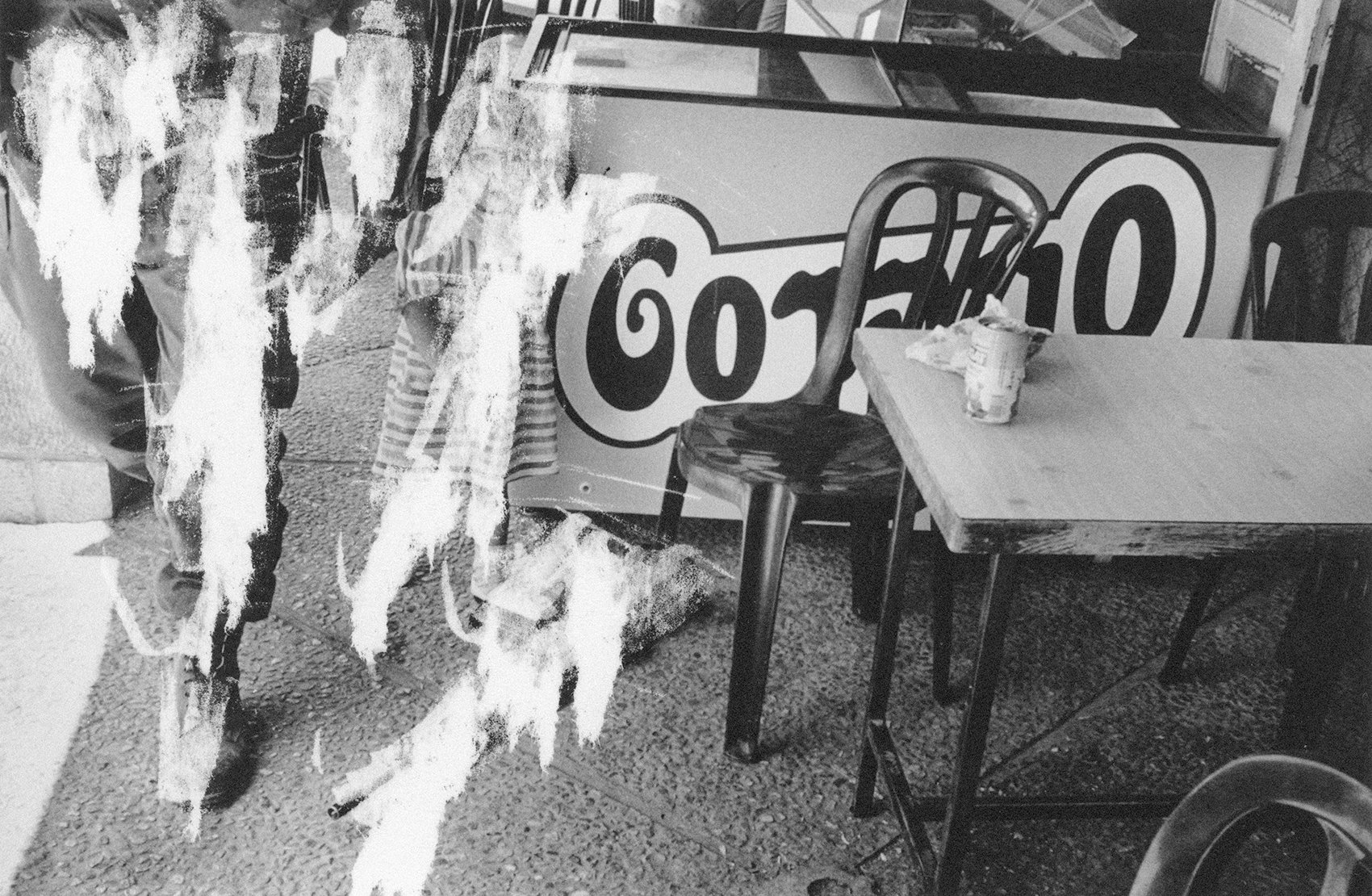
Israeli soldier and settler girl, Hebron, 1994
Making a new home is never simple. Moving demands turning an unrecognizable setting into an inviting one, subordinating the unknown to the recognizable. Breaking the domestic into a kaleidoscope of spaces, Clara Brockmann left behind her native Germany in favor of South West Africa in 1907. Knowing quite a bit about the emotional limbo homemaking creates, Brockmann decided to share her experiences from the new abode in a series of public letters. Uncertainties produced a series of small misunderstandings. Without the immediate guidance of parents or landmarks, home became a chimera: the innocent charm of relocation fragmented all that she once knew into all that could not be anticipated.
Taking parts of the past into the present, Brockmann recommended in her Letters from a German Girl from the Southwest (1912) that all those who would make a comparable move take “all kinds of tasteful furniture” with them. She advocated bringing small items to decorate new surroundings, “such as pictures, silk cushions, and lampshades,” that would “make a room feel homey and cozy.” Just like home, there was a bakehouse that served apple strudel with a dollop of whipped cream. Just like home, Brockmann could swim outdoors and be surrounded by “thousands of splendid flowers standing in the field” that were “like our German garden flowers.” Just like home, one could, in the words one German colonial official offered to Brockmann, “live here like the ancients did in the times of Schiller and Goethe.”
Merging the familiar with the unknown is a demanding task; Brockmann herself admitted that. She missed and longed for her “German fatherland,” and it angered her “that there are people here who forget and renounce its grace.” But when all was said and done, Brockmann’s new home, “with its eternal summer and solitude, is also a beautiful land.” Because while German South West Africa was “harsh, rugged, unspoiled,” all those who had ever experienced the colonial homeland “in all its grand, silent allurement will love it until their end.”
Published just four winters after the end of the Herero and Nama genocide, Brockmann’s letters recount the graceful experiences of homesteading next to the concentration camp that had exterminated tens of thousands. Writing from Lüderitz, a German settlement of roughly one thousand inhabitants, Brockmann lived and thrived next to the Shark Island internment camp. Brockmann knew “that prisoners of war are transported there to fall victim to the mortal maritime climate,” but that catalog of human miseries was absent in her accounts. “Politics and war know no forgiveness,” and, Brockmann wrote, “why should they, given that these murderers have never shown us any mercy?”
The balance sheet was obvious. Given that land is constitutionally racial, Brockmann’s move into a genocidal homesteading project first required the removal of the native Herero and Nama. While indigenous homes were destroyed, the would-be German pioneers erected theirs. Brockmann shared how efforts were made
to promote German culture, and the newly opened Homeland House (Heimathaus), for which donations are being received from all over the Fatherland, will be an effective support for this. In this Homeland House, young girls are taught all aspects of housekeeping; a sewing, washing, and cooking department has been set up, along with a small livestock and chicken farm.”[1]
This environment, which Brockmann and other settlers have perceived as welcoming, could be said to be heimlich. Writing at the end of the decade in which Brockmann shared her homemaking insights, Sigmund Freud observes in his work on “The Uncanny” (1919) that the German word heimlich is to the house all that is “familiar, tame, intimate.”[2] Heimlich arouses “a sense of peaceful pleasure and security as in one within the four walls of [a] home.” Naturally, the heimlich could be applied to individuals too. Consider Clara Brockmann herself: a woman who made her own colonial home next to the extermination site so homey and cozy.
*
In Freud’s etymological research, each German woman in the Heimathaus would be considered “a careful housewife, who knows how to make a pleasing Heimlichkeit (Häuslichkeit) out of the smallest means.” Heimlich derives from the German word for home, Heim, with the suffix -lich to make it a descriptor. While it might present itself as a net positive, the term connotes a bubbling deceit. Freud notes that to do something heimlich is to act “behind someone’s back”—to admire flowers on the other side of barbed wire, to devour whipped cream while others starve, or, simply, “to look on with heimlich pleasure at someone’s discomfiture,” as Brockmann did with the Herero and Nama trapped by German settler expansion. The confidence of Brockmann and the people of Lüderitz is striking. Her writing bears witness to hubris of mythical proportions. Homeland was an absolute protector of the private home, a foreclosed outlook described by Brockmann as a “love for the Fatherland, which never disappoints,” one that brings “comfort and peace.” This admiration of the Heimat (homeland) shared by the German settlers was just as heimlich. Like most German words, heim serves as a building block for other related terms. Heimweh means “homesickness”; heimtückisch, tellingly, translates as “insidious”; Heimat construes the homeland. Geheim means “secret,” and geheimnisvoll stands for the “mysterious,” which is how Brockmann glosses over the neighboring slaughterhouse: “The vast, shimmering diamond fields, the white moonlit night, sweetly and mysteriously whispering over the silver lagoons of the sea and the immeasurable sand dunes of Namibia. Where has this stuff gone? It was a dream.” All such denominations of heim blend into the revulsion we now feel upon inspecting the home Brockmann and other members of Lüderitz and its ilk constructed. But how does that work? What is the psychological process that renders the uncomfortable as comfortable and disquiet as quiet?
“In contrast to the uncanny, which remains circumscribed within a primarily psychological register, unsettling gestures directly toward the political and materialist grammar of dispossession: land seizure, expropriation, and systematic erasure of infrastructure.”
Freud argues that the two opposite categories are, in fact, one and the same. “What interests us most,” he writes, “is to find that among its different shades of meaning the word heimlich exhibits one which is identical with its opposite, unheimlich.” Collapsing semantic barriers would reveal that “[w]hat is heimlich thus comes to be unheimlich.” When Freud wrote his work on the etymological basis of domestic terror, he focused on how it is both a psychological condition and a narrative device. Yet this translation of the term is limited. It is usually translated into English as the “uncanny,” or that which is beyond the realm of knowledge and recognition, though uncanny also misses the mark. If we are to consider the richness and alarm embedded within the original term, then the role of unheimlich in English should be realized as “unsettling”: all that is uprooting and disruptive in the most literal sense, and quite disturbing, too. Its twin, “settling,” denotes positive, hospitable experiences, whether baked goods or splendid gardens, think of “settling down and relaxing” or “settling into” a place and making it a home. Grasping just how universal this understanding is, one must only recall that declaring a matter as “settled” marks the definitive, the end, the absolute. But “settling” also connotes the nefarious, a structure of tormenting many for the sake of comforting the few: settler colonialism. In this case, “unsettling” reverberates with the histories of settlement—the very violence that facilitated Brockman’s experience of feeling at home. In contrast to the uncanny, which remains circumscribed within a primarily psychological register, unsettling gestures directly toward the political and materialist grammar of dispossession: land seizure, expropriation, and systematic erasure of infrastructure.
Freud observes that in everyday use, unsettling things are understood to produce “uneasy, eerie, bloodcurdling” sensations. The unsettling also happens when we take comfort in discomfort, when we find pleasure in distress. The unsettling is not new or unfamiliar, but rather “familiar and old—established in the mind that has been estranged only by the process of repression,” just as Brockmann’s must have been when disregarding the miseries at the adjacent concentration camp. In that sense, it should not come as a surprise that genocides unfolding around the corner do not stifle appetites; burning corpses do not stop one from tanning outside; faint shrieks accommodate laughter. The closer one gets, the more one negates that proximity. When considering the colony as a racialized spatial setting, the other is registered as a psychologically unknown threat as well as a negation of indigenous personhood.
Freud, who also quotes the Deutsches Wörterbuch (1854) in considering the origins of the two words heimlich and unheimlich, remarks that the Brothers Grimm denote the uncomfortable term as a feeling of being “free from fear,” as well as the ominous sensation of “that which is obscure, inaccessible to knowledge” or of knowing that something is out of place, be it admiring animals while men are put in chains, relishing an evening swim next to the shores of a concentration camp, or sewing a dress while skins are carved with knives around the corner. As in the Brothers’ recountings of “Hansel and Gretel,” “Little Red Riding Hood,” and the “Three Little Pigs,” the home becomes the scene of distress, an operative trope and narrative locus across traditions of horror.
Bastardizing the pleasant and gracing the horrible, the unsettling could be applied to other atrocities. Three decades after Brockmann shared her experiences from Namibia, the Höss household was settling into their new habitat behind Auschwitz I. Bringing his wife and children with him, Rudolf Höss, the Schutzstaffel Kommandant of Auschwitz, made a reassuring environment right around the barbed wire and watchtowers beckoning from the other side of his garden wall that none of his beloveds could witness. Present and absent, the unsettling for Freud is that which petrifies us precisely because it “leads back to something long known to us, once very familiar” but that is now repressed. Freud notes that philosopher Friedrich Wilhelm Joseph Schelling defines the unsettling as the name for all places, affairs, and conditions “that ought to have remained . . . hidden and secret” but have “become visible.” In that sense, we could suggest the following hyperbole that showcases just how the psychological rubrics of settler colonialism operate. In the case of the Holocaust, both Villa Höss and the neighboring Auschwitz appear unsettling to the other side—each site is the open secret and hidden truth the other seeks to contain. In his study of horror films, the German scholar S.S. Prawer observes that what interests both Freud and Schelling is the “un-secret”: the category of “that which should have remained hidden but has somehow failed to do so.” It is of little surprise that the German expression “ein unheimliches Haus,” like the colonial home itself, also connotes “a haunted house.” Since the foreground and the background are withheld from one another—“concealed, kept from sight,” and removed from the reach of others—settler colonialism expresses the binary collapse between the settling and unsettling that Freud described. Auschwitz is not apparent to the pioneering Germans expanding to Poland via Generalplan Ost; Shark Island is absent from the minds of the strudel-eating settlers. But since Villa Höss, like Lüderitz and all settler colonies, appears as a fortress rather than an inviting setting, the architectural notion of the unsettling can operate in such violent spaces on several spatial levels.[3]
*
Unsettling is not just a German issue. A home once erected must also be afforded. Both in the case of Namibia and Poland, homemaking becomes a middle-class desire. One imagines the home as one’s own: private and secluded. Here, the notion of the protected and harbored home becomes a fortress in the guise of another infrastructure that bears the unsettling within: proto-suburbia. The idea that settler colonial violence happens only in segregated and racialized settings such as plantations or camps is misleading. Many of the same logics foundationalized by the spatial logic of the plantation—forced displacement, restricted movement, regulated access, surveillance—also operate in suburban compounds, outposts, and gated estates. The notion of “looking after someone” becomes a sign of both care and eerie control. As Aidan Forth’s Barbed-Wire Imperialism makes clear, during the Indian famines of the late nineteenth century, barbed wire and camps were used not only for confinement but also for the spatial and medical discipline of populations in famine relief camps. Much like the German pioneers in Namibia and, later, in Eastern Europe, these British infrastructures foreshadow entrenchments of control that reemerge in domestic and suburban forms. The proto-suburban emerges when settlers build housing developments that are meant to be permanent, normative, commodified. This requires infrastructure—roads, street lighting, gates, fences, all of which serve the critical function of demarcating who belongs inside and who belongs outside. These are not temporary “zones of interest,” as Jonathan Glazer’s 2023 film depicts, but ongoing formations of domestic normality. Despite, and perhaps because of their violence against native and indigenous people, colonizers depend on mass-producing the sensation of comfort within the colony so as to depoliticize its space. In that sense, the most successful colonies are the ones that are not perceived as such. Whether in Australia, the United States, Argentina, or Israel, a hostile environment must be rendered welcoming so as to be legitimized.
Suburbia has long been narrated as the apotheosis of domestic stability: neat houses, manicured lawns, and cul-de-sacs arranged to quiet the noise of the city. Yet beneath the suburb’s promise of tranquility lies a sedimented history. The very forms of suburbia—its fences, zoning laws, and racialized geographies—embed the logic of settlement into domestic architecture. In this sense, suburbia is a spatial manifestation of settled unsettling: It enshrines the dream of comfort while encoding the exclusions and displacements that make rarefied comfort possible, obscuring the unsettling within the appearance of hominess.
This landscape is affectively charged because it is never set on neutral ground. Suburbia is a place where repressed violence seeps into the everyday, often through banal details. In the US context, the suburb is inseparable from the racialized practices of redlining and white flight, mechanisms that converted financial instruments and housing policies into tools of racial and socioeconomic segregation. If we look at settler colonial contexts, like the United States, Australia, or Canada, that thrived on stealing and excluding, suburban sprawl translates into the encroachment upon Indigenous land, legitimized through the ordinary architecture of cul-de-sacs, playgrounds, and community centers. The façade of safe neighborhood planning conceals a cartography of dispossession that unites the carceral techniques of barbed wire, facial recognition utilities, and gated enclaves.
“The very technologies of enclosure—gates, fences, raced and classed surveillance—become harbingers of their undoing.”
Literature has been particularly adept at exposing the affective contradictions of suburbia in the United States. In Richard Yates’ 1961 novel Revolutionary Road, the manicured surfaces of postwar American suburbia conceal deep reservoirs of despair, suffocation, and violence, which culminate in tragedy within the supposedly safe domestic sphere. Similarly, John Cheever’s short stories chronicle the malaise of suburban life, where cocktail hours and backyard pools barely veil existential emptiness and marital conflict. These narratives testify to what suburbia structurally suppresses: Its violence is not external but internal, woven into the very architecture of its repetition and conformity. In a different register, Octavia Butler’s Parable of the Sower (1993) imagines suburban gated communities in near-future California as fortresses of fragility; Walls, guards, and communal discipline cannot prevent their collapse under economic and ecological stress. Here, suburbia appears not as a site of stability but as a tenuous enclave haunted by the violence it requires to sustain itself. The very technologies of enclosure—gates, fences, raced and classed surveillance—become harbingers of their undoing.
The unsettling affect of suburbia lies precisely in this contradiction. It stages itself as the locus of safety, family, stability, and non-violence, while the suppressed violent conditions of its existence—racial segregation, land expropriation, militarized exclusion—are out of view, surfacing only as anxiety or discomfort; homes become fortresses. Setha Low has pointed to the relation between gated suburban communities in the US and the notion of dread. Low notes that both the narrative and psychological preoccupation with criminals and fear of crime have increased in such communities even in the face of statistical decreases in crime. If the architecture of suburbia is a condensation of violence rather than a bulwark against it, suburbia is not merely a derivative of settlement but one of its most perfected forms: a structure where repressive violence is converted into a feeling of security on the inside and a sense of looming threat from the outside all at once.
This is exemplified by the phenomenon of closed condominiums, gated communities, and so-called compounds all across the globe. For instance, in Brazil, they are coined condomínio fechado; in the UAE, Secure Residential Developments. Wealthy residential clusters are surrounded by walls or fences, controlled gates, surveillance systems, and security services. Their design is premised upon exclusion as much as protection. These enclaves do not simply sit in privileged neighborhoods; they altogether reshape the urban fabric through a securitarian partnership with state power that reinforces inequality. It appears as though the unsettling could be considered more than just a narrative device: Unsettling is the material realization of a political project. Within this terrible dialectic, some are deprived of settling or making a home, while others erect settlements on their homelands or force them into geographic alterity. These are coterminous regions, forming adjacently or concentrically: spaces that are simultaneously inside and outside, spaces that juxtapose incompatible logics of order and control. Michel Foucault would call them “heterotopias.”
Perhaps the heterotopia par excellence, produced through Israeli surveillance infrastructures, is Hebron’s Old City: Homes are transformed into hybrid zones of domesticity and occupation, simultaneously private and public. Cameras affixed to rooftops, servers and wires running through bedrooms, and the routine intrusion of soldiers for “maintenance” convert the dwelling into an unsettling scene of surveillance that displaces homeliness with the architecture of dispossession. Ethnographic accounts collected by Sophia Goodfriend show how this insidious intrusion is lived at the most intimate scale, where mental repression leads to spatial repression. Samira, a lifelong resident of Hebron, described how Israeli soldiers regularly entered her home without warning to access and reboot the cameras installed on her roof. What had once been a place of intimate homemaking was reclassified as infrastructural territory, a conduit for surveillance data, rather than a site of family life. The Palestinian home becomes porous, a frontier zone of interest where the military gaze is literally wired into the walls and ceilings: The very notion of home becomes an abstruse perversion. Amahl, another resident, recalled how soldiers cut down a tree shielding her living room windows and replaced it with a surveillance post directed at her front door. When her son complained, the army declared, “It’s our business.” When he tried to obscure the camera’s view with a tarp, the army removed it the very next day.[4] The prohibition of Palestinians’ installation of their own protective infrastructures, such as domestic cameras, exposes the structural asymmetry of surveillance. The “permission” of the occupier is always for the visibility of the surveilled, never for their self-defense. In their article “We Stopped Taking Photos,” Ariel Goldberg and Yazan Khalili describe how
[t]he CCTV that Palestinians install to monitor their homes against theft has become another set of eyes for the Israeli Demolition Forces (IDF) that surveil the streets of Palestinian cities and neighborhoods. One story goes that the IDF arrested a man for not having his CCTV working when they wanted to check an event of resistance. They accused him of hiding information from them. Now every CCTV camera that isn’t working is a camera hiding information, and every working one is an informant for the IDF.
What is mandated is exposure, not the protective understanding of a sheltering home, giving leeway for scornful dichotomies like civilized-uncivilized, human-animal, worthy of living-condemned to die.[5] During his tenure as Israel’s prime minster, Ehud Barak memorably echoed this sentiment when he remarked that he regarded his nation-state as a “villa in the jungle.” In 2022, Josep Borrell, then the High Representative of the European Union for Foreign Affairs and Security Policy, shared the sentiment when he said that he regarded his continent as a garden, whereas “most of the rest of the world is a jungle” that could invade it at any moment. Here, Freud’s notion of the repressed offers a strikingly architectural resonance. In psychoanalytic theory, the repressed is forced down, only to return in distorted forms. But Freud’s concept of the repressed is not simply psychological: It names any denied element under prevailing power—what is made invisible or illegible. In settler state surveillance, the ability of Palestinians to maintain a domestic gaze—to see and protect their own premises—is strategically repressed, as is the autonomy of sight. Palestinians are forced to inhabit roles of passive visibility, constantly subjected to the occupier’s gaze while denied reciprocal sight. But, as Freud insists, repression never succeeds absolutely. What is repressed inevitably returns as disturbance, as disruption, as a presence that unsettles the very structures designed to exclude it.
This return is architecturally legible in Israeli infrastructures of surveillance: The wires running through Palestinian homes, the cameras affixed to their rooftops, and the fences bisecting their courtyards are meant to guarantee settler state security by rendering Palestinians perpetually visible. Palestinians’ repressed desire for autonomy and protection does not vanish; on the contrary, it resurfaces in the experience of being simultaneously “at home” and dispossessed of that home. It is here that the uncanny folds into the unsettling. The home, which should be a site of interiority and privacy, becomes a heterotopic outpost that disciplines not through enclosure, as in the camp, but through infrastructural saturation that erases the boundary between home and occupation.
In this instance, language discloses precisely what it strives to obscure. The figures of the un/settling designate ruptures through which the repressed violence of settlement becomes legible. The prefix un- does not operate as a simple negation but as a symptom: It signals that the act of settling can never occur without mechanisms of exclusion, and that every settlement bears traces of its own unsettling from its inception.
These Palestinian homes become unhomely because the devices that fabricate their integrity enforce an asymmetric visibility powered by Israeli supremacy. The occupier’s survival is secured by detailed knowledge, the mapping of visibility, fences and facial recognition, and portable biometric databases; the occupied have no equivalent infrastructure. They cannot surveil the surveillers and they cannot fully defend their own intimate homemade spaces like rooftops, window sills, or entrances. As Goodfriend notes, cameras not only gaze outward but peer inward—into children’s play, into family meals, even into bedrooms—rendering every action potentially visible to surveillant authorities. Looking back and confronting the gaze becomes a threat to the un/settling order.
In her September 2023 Edward W. Said Memorial Lecture, Isabella Hammad reintroduced Aristotle’s concept of anagnorisis, a turning point of recognition, as a critical tool for understanding the narrative frame imposed upon Palestine. She describes moments in which observers, often strangers to Palestine or the Israeli occupation, move from “apparent blindness” to “staggering realization” of lived oppression: checkpoints, barbed wire, surveillance cameras, and persistent physical intrusions.
In her lecture, Hammad turns to Ghassan Kanafani’s novel Returning to Haifa to show how the scene of recognition unsettles, rather than consoles. She recounts the story of Said and Safiyya, who, after Haganah attacks had forced them to flee in 1948, go back to their home in Haifa twenty years later. Having left their son Khaldun behind, they return to find him adopted by a Jewish couple, Holocaust survivors who took over their former home. Hammad emphasizes that this reunion does not culminate in kinship or relief. In Freudian terms, Kahldun, who has been renamed Dov, explicitly represses the significance of blood ties, only to reproach his biological parents moments later for not having fought to reclaim him. For Hammad, the scene echoes the Oedipal paradigm but deliberately destabilizes its logic. Recognition here is not the revelation of the stranger as kin, with all the tragic weight that usually entails. Instead, it is a refusal: an unsettling that exposes the insufficiency of lineage alone. “Now I know, better than anyone, that man is a cause,” Said tells his son, “not flesh and blood.” Recognition, Hammad argues, is thus redirected from the biological to the political—from inheritance to intention and will. This narrative turning point of recognition (and the lack of catharsis that comes with it) can be transposed to what we have described as the structural asymmetry of surveillance. The occupied are persistently recorded, intruded upon, surveilled; they are constantly seen, but not recognized. What Hammad adds is that recognition isn’t just about passive sight, but about seeing humanity, subjectivity, and vulnerability.
In this way, Hammad’s anagnoristic moment is bound up with the return of the repressed as geopolitical as well as psychological. The obstructed sight of visitors to Palestine (who miss the occupation’s material reality) is itself repressed; the scene of recognition is staged when repressed infrastructures of suppression can no longer be ignored or rationalized away. These material violences return in the imagination, in literature, and in individual realizations. They become visible in works of narrative and in political testimonies alike. Placing Hammad and Goodfriend side by side illuminates a stark contrast. For the outsider, recognition comes as a dramatic revelation through a rupturing of perception, but for the occupied, recognition is structurally withheld. Surveillance technologies render the occupied visible as objects of control, not as subjects with rights to privacy, intimacy, or protection. The suddenness that qualifies Hammad’s scene of recognition is, in Goodfriend’s accounts, a daily condition: a life lived under what might be called the repression of recognition itself.
This is where the concept of the un/settling becomes indispensable. Surveillance infrastructures, like those in Hebron, altogether unsettle the possibility of homeliness. In Freudian terms, this enforced exposure is repression at an infrastructural scale—what is denied (the right to self-defense, to recognition) returns as the un/settling unhomeliness within one’s own four walls.
“Were Freudian psychoanalysis to offer a theoretical framework to genocide and even postcolonial studies, it would be a sociological and historical reading of the unsettling and its reversal. Inspecting tamed environments that provoke a recoil, examining all pioneers who make homes atop torn limbs and debris, lavish estates right by cotton fields, and colonies erected from rubbled bodies.”
Freud quotes the psychiatrist Ernst Jentsch, who supposed that, paused in its limbo, the unsettling stirs doubt as to “whether an apparently animate being is really alive; or conversely, whether a lifeless object might not be in fact animate.” Jentsch evokes the settler colonial insistence, expressed by Brockmann and so many like her, that there are “peoples, who to this day live like animals.” Unlike humans, who construct homes and hold a cultivated taste for the comfortable, animals are unable to value such accomplishments. What beasts have is shelter that migrates from place to place. When the Israeli defense minister stated immediately after October 7 that his nation was “fighting against human animals,” he reduced human beings to creatures that neither require nor possess any sense of settling, thus permitting the obliteration of their homes. “In telling a story,” Jentsch writes, “one of the most successful devices for easily creating uncanny effects” is to leave audiences in a state of uncertainty as to “whether a particular figure in the story is a human being” or not. Political propaganda in conditions of dehumanization operates this way: Victims of atrocities are often regarded as helpless, passive things.
The return of the repressed translates here into an architectural fact: The home itself becomes a site where the repression of self-defense resurfaces as the uncanny un/settling. The paradox is that the very attempt to suppress autonomy produces spaces that continually remind residents of what has been denied. Foucault’s heterotopia allows us to conceptualize this paradox: Palestinian homes, as with all homes of colonized people, are forced into an architectural condition where the very possibility of feeling “at home” is annihilated. The infrastructures of surveillance do not simply secure territory; they reorganize lived space into constellations where the domestic is inseparable from the structure-process of un/settling.
Settler colonialism steers the unsettling as a never fully acknowledged terror, while stressing the obliviousness that is demanded in homemaking. In short, we are presented with those who ignore their ignorance, those who negate a negation. People are described as unsettling, Freud writes, “when we ascribe evil motives” to them. But Freud determines that there is also more to it: “[W]e must not only credit him with bad intentions but must attribute to these intentions [a] capacity to achieve their aim in virtue of certain special powers.” The internal psychic operation is made permissible and materialized through external machinations, whether in the form of full backing by a state apparatus, a lubricated war machine, or organized supremacist intent. Perhaps it is this precise semantic connotation that must be unsettled at once. How else could we square the fact that to unsettle is both the sociopolitical ambition of decolonial struggles as well as what evokes the sinister and unnerving? Were Freudian psychoanalysis to offer a theoretical framework to genocide and even postcolonial studies, it would be a sociological and historical reading of the unsettling and its reversal. Inspecting tamed environments that provoke a recoil, examining all pioneers who make homes atop torn limbs and debris, lavish estates right by cotton fields, and colonies erected from rubbled bodies.
The unsettling, still, is not an event that concludes with the end of formal empire. It is a structure that endures, reverberating through the spatial and symbolic orders that colonial settlement leaves behind. In Namibia, the German colonial project did not simply vanish with the defeat of the empire in 1915. Its spatial logic persisted—through the League of Nations, which assigned and administered control of German South West Africa to the Union of South Africa after the Treaty of Versailles, through the illegal continuation of apartheid rule after the mandate was revoked in 1966, until its independence in 1990, and even into the present. What remained of the colonial settling was not only the memory of violence, but the architecture of the settlement itself—racialized land distribution, segregated spatial arrangements, timber-framed houses typical of Mitteleuropa, and the inscriptions of imperial presence that continue to mark the landscape. Even today, colonial street names such as Bismarck and Göring quietly mark Lüderitz: the memory of colonial authority embedded into the grammar of urban navigation. People now live and are housed in the locus that once rejected them. Seen from this perspective, the un/settling does not belong exclusively to a singular trajectory of genocidal violence, nor does it require the framework of exceptionalism to be legible. Rather, it reveals white supremacy as the vehicle through which settlement travels across colonial contexts within a grammar of violent homemaking. Namibia and Palestine appear not in a hierarchy of historical causality, but alongside one another as parallel formations of a colonial spatial order. In both places, the promise of settlement rests on an ongoing estrangement of Indigenous life. If settlement seeks permanence, the un/settling marks its afterlife—an enduring tension between presence-absence and dispossession, between the desire for home and the infrastructures that continue to unsettle it.
[1] With all its grand intentions, the colony can never produce its own ideals. According to one ethnographic survey conducted in German South West Africa, the proportion of German women in the colonies “was generally low.” Ergo, “a large number of German men had relationships with African women” and even married them. While the German Empire regarded mixed marriage (Mischehen) as undesirable, data pulled from the Women’s Association of the German Colonial Society (FDKG) indicated that in 1909, “there were six men for every white woman.”
[2] This essay uses Alix Strachey’s 1925 translation. Here and in the two paragraphs that follow, Freud is quoting from “a long extract” of the entry for Heimlich in Daniel Sanders’ 1860 Wörterbuch der deutschen Sprache (Dictionary of the German language).
[3] For those interested in historical continuities and intergenerational heritage, it would not be all that surprising to note that Hermann Göring, one of the most dominant figures in the National Socialist regime and who regarded concentration camps a requirement to eliminate opposition, was the son of Heinrich Ernst Göring—the colonial governor of German South West Africa from 1885–1890.
[4] For more such testimonies, see Sophia Goodfriend, “Algorithmic State Violence: Automated Surveillance and Palestinian Dispossession in Hebron’s Old City,” International Journal of Middle East Studies 55, no. 3 (2023), doi.org/10.1017/S0020743823000879.
[5] For centuries, Europeans relished in the construction of ethnographic villages—human zoos. Indigenous people from around the world were kidnapped from their actual homes and shoved into make-believe ones that made caricatures of their habitats. The French city of Rouen set the stage for the first recorded human zoo, built to honor King Henry II’s royal entry there in 1550. Named the Brazilian Village, it was populated by fifty native Tupinambá and Tabajara people who were trafficked across the ocean as a testimony of growing imperial muscle flexing in absolutist France. King Henry II, intoxicated by the unsettling nature of the theatricalities, decreed them to participate in mock naval battles for all to see. When Catherine d’Medici entered the village the next day, the battles were repeated for her. We know this dynamic by heart; unsettling others makes others unsettling.