
Following the Line
On Tracing Susan
Akshi Singh
When I started my formal psychoanalytic training, I found that I couldn’t read most psychoanalytic writing, except with great and grudging effort. I had spent the past four years reading and writing about psychoanalysis for my doctoral studies, and I think I was tired and in need of something else, but I didn’t know what. The only exception was the British psychoanalyst Marion Milner, whose writing I was inclined to consider literature rather than psychoanalysis, because Milner writes in an experimental and questing manner, doesn’t shy away from autobiography, and most of all is a pleasure to read. I was tired of the academic emphasis on knowing and proving things and, much as I respected and valued this rigorous approach to knowledge, I was also trying to feel my way toward other modes of relating to topics and objects that interested me.
Perhaps it was no accident that I found Milner a helpful companion during this time. I think she is the writer and theorist par excellence of creative blocks and impediments—one of her best known books is called On Not Being Able to Paint—and a thinker who consistently calls into question ideas of success, failure, and productivity. When she writes about clinical work, she doesn’t cast herself as the knowing and clever psychoanalyst who makes people better, and she’s always tentative about what better might mean. In many ways, Milner’s writing was the perfect note on which to start the psychoanalytic training, because it encouraged me to be curious rather than frightened, and it made me notice the ways in which knowledge, certainty, and authority could also be postures of defensiveness.
In particular, it was her book length case study, The Hands of the Living God, that really became a touchstone as I embarked on clinical work myself. The book describes Milner’s work with Susan, her patient of over twenty years. When Susan came to her, Milner was just at the start of her psychoanalytic practice, and the Second World War was raging around them. Susan was a young working-class woman who had been hospitalized after a breakdown and then given electro - convulsive therapy twice as part of her psychiatric treatment. Inasmuch as it narrates the trajectory of Susan’s analysis, the book also depicts Milner’s evolution as a psychoanalyst and the development of her analytic idiom. Susan herself is one of the great patients of psychoanalysis, like Anna O. or Dora or The Piggle, in that she remains enigmatic—to the reader, but also to the author of the case study. Compelling as a narrative and reflection on psychoanalysis, and a valuable historical document, the book raises as many questions as it answers.
Central to the book are drawings made by Susan, which Milner interprets and organizes into sections, through which we learn about the questions and problems that Susan was trying to get to grips with in her analysis. Chief among these was the question of the boundaries between herself and the world. When Marion Milner wrote about art and what it might mean to be creative, most notably in her book On Not Being Able to Paint, she was concerned with questions around connection and separation, questions which are also refracted in Hands. For this reason, it is possible and rewarding to read her account of creative life as a way of thinking about what it means to exist in an intimate relation with someone else. After all, her own thinking about creativity was itself shaped by one such relationship—with Susan, who, especially in her drawings and paintings, was a great theorist and artist of the vicissitudes of differentiation and merging.
Some months after reading The Hands of the Living God, I visited New York en route to an academic conference. I knew Milner had spent time in the city, and written about it in her first book, A Life of One’s Own, published under the pen name Joanna Field. Partly because I hadn’t planned much for my time in New York, partly because I was so steeped in Milner’s writing at the time, I entertained the idea of going and looking at paintings as she might have done. So I walked from Harlem, where I was staying, through Central Park, until I reached the Museum of Modern Art. It was my first visit and, as I took it in, floor after floor, I wondered if Milner had visited the museum during her time in America, wondering to myself how the galleries would have altered since. I walked through the museum as though doubled, looking out of my own eyes, trying to look out of Milner’s. What I didn’t register or recall in my wish to follow in Milner’s footsteps was that the Museum of Modern Art didn’t even exist when Milner was in America—it was established in 1929, and Milner left just before it opened. I had walked myself into a parapraxis, one that persisted until I was revising a draft of this essay.
My initial response to a parapraxis is inevitably a feeling of embarrassment and an excruciatingly cellular registration of my stupidity. Even if I didn’t know then that Milner couldn’t have visited the museum, shouldn’t I have worked it out later, in all the years since? Why had the error persisted? Psychoanalysis contends that the parapraxis is its own form of revelation and communication and, having become conscious of my mistake, I was struck by how it offered a condensation of the preoccupations and anxieties that gave shape to this essay. But first, let us return to MoMA, and to the moment where I was still fully within my error.
I walked into a room where I saw some astonishing stone and brass sculptures. I looked at them for a long time, reading the captions and information plaques, captivated by their presence. They evoked a feeling of repose and containment that was so inviting I felt it in my body. This display of sculpture by Constantin Brâncuși included Mlle Pognany (version I, 1913) a bronze bust resting on a base of limestone. Mademoiselle Pognany, as depicted by Brâncuși, is leaning her head on her folded hands, and her large eyes appear to be closed in rest or reflection. I had never seen any work by Brâncuși before, and I was surprised by this sculpture, because it reminded me powerfully of a drawing made by Stella Coomber, the Susan of Milner’s book The Hands of the Living God.
Brâncuși’s sculptures brought to mind a drawing by Susan that Milner titled “The Sleeping Goddess.” It shows a resting face with closed eyes. The drawing is made almost entirely of highly stylized whorls and spiraling lines; though the lines all suggest movement, the effect is one of stillness, as though a point of suspension has been found amid a vortex of activity. In the Brâncuși exhibit, I felt a wish forming. I wanted to write about Susan’s drawings in relation to the sculptures I had just seen. I bought a postcard of Mlle Pognany, or maybe it was an image I cut out of an information booklet? Whatever it was, I stuck it on the wall next to my desk in the shared office of the London university where I was a postdoctoral scholar. Years passed, and when I moved out of the office, I discarded all the bits of paper I had stuck to the wall. The subject—Brâncuși’s sculptures and Susan’s drawings—felt out of reach, though I wouldn’t have been able to say why.
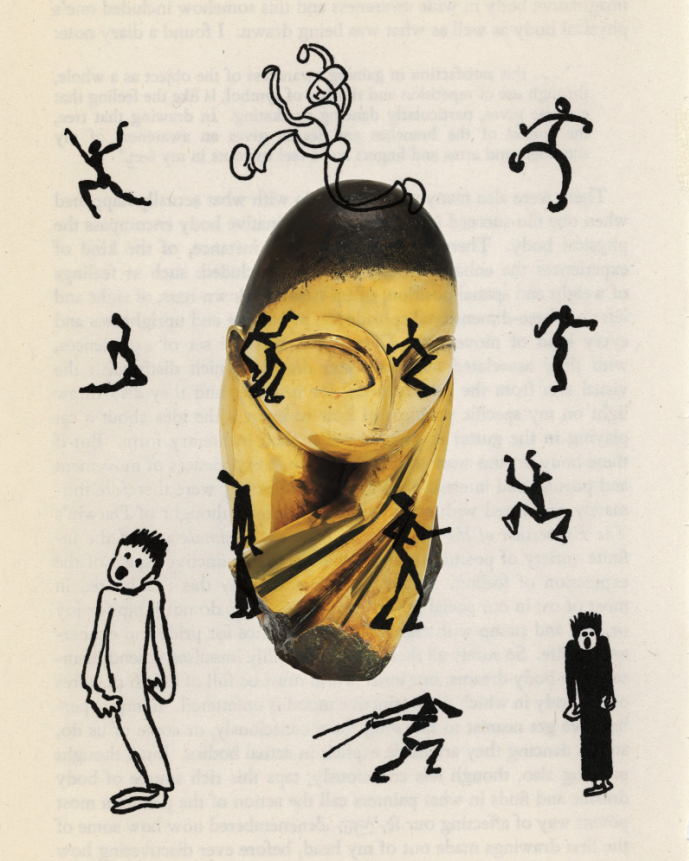
Marion Milner, Body Postures, 1957 / Constantin Brâncuși, Mlle Pogany, Version I, 1913
Six years after that first visit to MoMA, I visited New York again, this time with my partner. We were just some months into seeing each other and couldn’t quite believe that we’d made it together all the way to New York. My partner had never visited the city and had long dreamt of doing so— he knew it well already from film and music. I was moved by his enthusiasm for paintings long familiar to him from the pages of books and digital reproductions. He met the paintings as though reunited with someone long loved at a distance, with excitement, but also with the need to ascertain if it really was the same person, were they as you remembered them, or were they altered.
In the presence of this joy, I found myself becoming melancholy, which later that night turned into a torrent of inarticulate grief and tears. The only explanation that I could find for this outpouring of sorrow was the feeling that my partner had so long denied himself a visit to a place that was full of significance for him, where he could see the things he loved, studied, and attended to so carefully in his writing and teaching. He had felt unable to make the claim, represented by such a journey, to his own time, to his work and interests. It struck me, in the midst of my sorrow, that the greatest love I had ever felt had also left me completely open and porous to the losses and griefs of my beloved.
On this second visit to the museum, I found myself wanting to write about Susan and Brâncuși again, though I did not see Mlle Pognany on display. Some months later, back in London, when I sat down with three heavy books on Brâncuși borrowed from my partner, I felt dull and uninspired, with no idea how to link these two things that felt connected but which, when I tried to write about them, seemed entirely separate.
*
While looking through Marion Milner’s archive to prepare this portfolio, Marianne Brooker and I were shown an envelope of tracings by Milner.[1] They were her reproductions of those drawings and paintings made by Susan which are reproduced in The Hands of the Living God. We were initially confused—had we somehow missed the fact that the images in the book are in fact tracings by Milner, not Susan’s original drawings? At this point, Ewan O’Neill, the archivist, brought us a copy of Milner’s book from the library upstairs, and we held the tracings next to the grainy reproductions in the book. Soon we began to note differences between Susan’s lines and Milner’s. Expressing anger, exuberance, and so much else in their movement on the page, Susan’s lines were in stark contrast to those of Milner’s tracings, which were hesitating and careful in their attempt to stay close to the original. In her diligent attempt to reproduce Susan’s drawings faithfully, Milner’s lines show a considered caution that is precisely what sets them apart from Susan’s expressive flourishes.
“Milner was perhaps trying to feel her way into her patient’s drawings, trying to access a form of insight or familiarity that was facilitated by knowing and observing something not by sight, but through touch and movement.”
Milner was well aware of the effects of tracing on the line. Her book On Not Being Able to Paint (1950) included tracings of her own drawings originally made in “chalk, charcoal, water-colour, pen and ink, pencil.” Milner noted that “exactness of reproduction” had to be sacrificed for “ease of reproduction,” presumably to manage printing costs. In a note published in the second edition of the book, Milner notes that “the tracing process obliterates those subtleties of line upon which the vitality of a drawing depends.” But this was not a problem as far as her drawings were concerned, she observes somewhat disingenuously, since her drawings weren’t “put forward as works of art,” but rather as illustrations of “the gradual discovery both of ways by which the creative process is freed and of the content of unconscious ideas that interfere with that freedom.”
Puzzled by the tracings we were looking at in the archive, Marianne and I wondered what they were for. Nineteen years after the publication of On Not Being Able to Paint, the tracings were no longer a necessary measure for keeping printing costs down. In one instance, Milner had traced Susan’s original, which had an identifying place name written into it, and altered the name. An accompanying note to her publisher suggested that the book use the tracing instead of the original or use the original with the place name blurred out (the book shows the latter). Even so, the tracings cannot all be explained by this conscientious attention to confidentiality. Did Milner make them so she could handle the drawings repeatedly without damaging them? Then why not make photocopies? I wonder if Milner was trying to understand something about Susan’s drawings by copying them. Imitating the movement of her hands, Milner was perhaps trying to feel her way into her patient’s drawings, trying to access a form of insight or familiarity that was facilitated by knowing and observing something not by sight, but through touch and movement.
In looking at the tracings I felt a mounting sense of discomfort. Hands is an account of how Susan and Milner get all mixed up, get under each other’s skin. They experience and recreate thoughts, feelings, and states of body and mind that Milner connected to very early infancy, going back to intrauterine states. I found that it was one thing to learn this through the book, and quite another to encounter the material artifacts of this proximity in the form of the tracings. Especially because, as a reader of psychoanalytic texts, I found it no problem at all to learn of the ways in which the patient was merged with the analyst but hadn’t quite taken full note of just how close the analyst was to the patient in question.
Milner understands the creative process as a cyclic oscillation between a lost dreamy state where the boundaries of the self are suspended (or lost or surrendered) and a state of separateness and organization. This particular understanding of creative states was articulated through her work with Susan as much as it was through her own experiments with drawing, painting, and writing. It was in some drawings by Susan, which oscillate between showing two faces in profile or a full face, that Milner found a visual representation of what she wanted to say about the creative process and its rhythmic movement, which she thought absolutely essential to the experience of creativity: “having once achieved the sense of separate existence, it is then necessary to be continually undoing it again, in a cyclic oscillation, if psychic sterility is to be avoided.”
In Milner’s writing, love appears as a variety of the creative act. Her account of creativity draws upon the sexual—when trying to think of the experience of undifferentiation she often thinks of the infant at the mother’s breast or held securely in the arms of the person looking after it, but she also thinks of orgasm, a willed letting go where a sense of the body’s boundaries is dissolved. A state of self-forgetting and merging with the Other (who may be a memory, or idea, not just someone present), this state must at some point move into something that feels quite different—a reboundarying of the body and psyche. Moving between these two states is no easy task; in fact, it is in the struggle that is part of this oscillation that a creative impulse or romantic relationship takes shape and is expressed. The artist’s struggle is also what lovers must contend with—how to come together, how to separate in an ongoing rhythm.
There isn’t such a thing as too close for Milner—the creative process involves “an undoing of that split into subject and object”—and it is in the undoing of this split that the creative artist and, we might add, the lovers, come into contact with something mysterious and renewing, something that eludes understanding and explication. Just because it is resistant to elaboration in the language of conscious thought, in the everyday language of means and ends, or right and wrong, doesn’t mean it isn’t important, or indeed that it can’t be trusted— after, all, as Milner writes, “reason possesses a life both deeper and less conscious than its articulate logical life.” Still, there can be a resistance to such merging, because it brings with it risks—will the dissolved self ever be found or reconstituted again? There is the risk too of the inevitable mourning that must follow from such blissful union—the reality of lack, limits, and solitude. The movements of union and surrender, of mourning and separation, are the rhythms of love and creativity.
Thinking of all the hours outside the analytic session that Milner spent poring over Susan’s drawings, tracing line after painstaking line, I am left with an impression of devotion and, equally, of obsession. And yet Milner is careful to preserve a kind of barrier between her line and Susan’s, the tracing paper always present as a thin but undeniable distinction. Indeed, the material— tracing paper—that allows Milner to get so close to Susan is the very thing that also keeps them separate. It strikes me that the envelope of tracings in Milner’s archive is a condensed expression of the volatile dialectic of separation and merging that shaped Milner’s relationship with Susan—and that forms the basis for her account of creativity and love.
*
I now think that Brâncuși’s works, both Mlle Pognany and the rounded, plump fullness of Young Bird, evoked, by their forms and by the feeling of rest they conveyed to me, the state of undifferentiation that Milner writes about—and that Susan sometimes experienced, at other times longed for, and repeatedly sought to understand.
“It strikes me that the envelope of tracings in Milner’s archive is a condensed expression of the volatile dialectic of separation and merging that shaped Milner’s relationship with Susan—and that forms the basis for her account of creativity and love.”
In addition to the lines on tracing paper in the archive, there is another kind of line at work in Hands. This is the line of Milner’s narrative and text, which fixes both Susan’s drawings and her life within a frame of interpretation. As such, Milner’s lines make Susan available, and visible, to a reader, but they also leave her obscured. We encounter Susan’s lines—her drawings and speech—within Milner’s lines. Milner’s book preserved Susan’s drawings and made them available to a wide readership, but with the consequence that readers and viewers would always encounter Susan’s work within the context of her material and psychic difficulties. Like so much art that exists in the world, Susan’s came out of the complexities of her psychic and material circumstances, but this should be no reason for it to be read solely in these terms. Like something I see in a gallery or on a postcard, sometimes I wish to encounter Susan’s paintings outside of Milner’s framing text, so that they are freed into evoking associations and thoughts in the viewer that are not pinned down by the circumstances of Susan’s life.
I don’t know how, or, indeed, if this is possible. The paintings and drawings included in Hands are reproductions in black and white. Seeing some of the paintings in the archive, in their color and texture, was a revelation—I was absorbed by what Susan was doing with colors and shapes. But the archive only has a few of Susan’s drawings and paintings. Milner did show Susan’s paintings to other analysts and art teachers, reproducing their anonymized responses in an essay published in 1955. Though many of the viewers read Susan’s paintings as an expression of her psychic needs and difficulties, some also comment on the formal qualities of the work, noting their admiration of her style.
This brings me to an absence in Milner’s account of creative life, in that it does not reckon with the politics of what is designated art, what is seen and circulated and under which circumstances, and the ways in which gender, disability, and class circumscribe the scope of interpretation and circulation. Milner’s romance of creative life—one that I find enriching and inspiring—comes up against a powerful blockage here. However democratic Milner’s vision of creative life, and for her creative life is something available to everyone who seeks after it because it is enacted on a daily basis in any medium of choice, it nonetheless skips over questions of whose work is seen and recognized, and thereby offered the conditions in which it can prosper.
*
Holding the tracings Milner had made in my hand, I was reminded of my time in school and the excitement of using tracing paper on a large table with an atlas underneath. Tracing paper was a special supply, reserved for certain important projects. I was most likely preparing a portfolio for my geography exam. Not skilled at drawing, the tracing paper conferred on me a whole new kind of alien competency, and I would marvel at the neatness and precision of my lines. I prized the ideal outline. While writing this essay I felt stuck, unable to access what I wanted to say about Susan and Brâncuși. One morning Marianne and I tried out some of the free writing exercises that Milner describes in A Life of One’s Own. In conversation with Marianne afterwards I realized I had had some kind of ideal version of the essay in my mind that was preventing anything from finding actual expression. I felt under pressure to write in what I imagined to be a serious art historical style, for which I have inadequate training and knowledge. This takes me back to the parapraxis with which I began my essay.
To imagine Milner walking through MoMA, I had to forget which years she was in the United States. This allowed me to construct a false possibility of her past presence at MoMA. When I visited the museum, I was alone and intimidated by the famous art and grand building. I think I felt uncertain about whether I was entitled to be there or whether I had the requisite knowledge to appreciate what I saw. Imagining Milner offered reassurance, gave my interest and presence a justification. Without this feeling of being accompanied, I would probably not have made a connection between Brâncuși’s sculptures and Susan’s drawings, and my experience of these sculptures and the museum itself would in many ways have been reduced and impoverished.
My wish to summon Milner also obscured something factual and incontestable about her circumstances; it left me unable to apprehend her life in its reality. The parapraxis and its consequences contained within them a form of ambivalence about proximity to the desired object—the creative possibilities of this kind of closeness and the risk of a loss of identity and reality as a consequence of this kind of merging. As such, it restaged questions raised by Milner’s tracings of Susan’s drawings which, like the case study itself, reveal and obscure in the same gesture. All the ways in which things don’t work or work out, the blocked and bungled, the mistaken and messy—these are at the heart of Milner’s account of creative life and essential to her account of psychoanalysis, not least in her own relationship with Susan. Writing this essay, I concluded that perhaps what I had to say about Susan and Brâncuși would only emerge sideways, through not being able to write about it.
Accompanied by my love instead of a false impression of Milner’s past presence, my second visit to MoMA took me back to the wishes and questions produced by the first. Once again, I saw through my own eyes and someone else’s. Anxieties and risks pertaining to proximity and merging are never resolved in Milner’s account of creative life. On that second visit I was beginning to learn that they are never settled in romantic relationships either. Much like my schoolgirl wish for an ideal outline, I can often find myself craving an ideal solution to the difficulties of creativity and love—a perfect point of resolution and balance, an answer. But Milner’s great romance of creative life is, in fact, a joyous romance of failure, animated by frustration and misunderstanding. And it is through the magic of love and creative endeavor that such failure becomes the heart’s unending desire.
[1] Envelope containing a “Complete duplicate set of drawings” from the book, Marion Milner Collection, Archives of the British Psychoanalytical Society, GB BPASA P01-A-E-1.