
Preserving What One Loves
On Marion Milner’s First Collage
MarianNe Brooker
Asked whether she still paints in a 1990 interview with Deborah Anna Luepnitz, Marion Milner replied irreverently, “I do collages, using my old paintings. I cut them up; I’m recycling myself!” Collages are charged with all the force of things to be done and undone: creative acts of destruction, preservation and renewal. This activity relies on but exceeds painting, allowing Milner to work through her urge to take a thing apart and put it back together in a new and fractured form. Cutting up and reassembling her “old paintings,” Milner makes a found object of herself and finds herself transformed, a discovery that’s closely tied to her ideas about love and its limits.
Milner made her first collage in the 1960s. Or that’s what’s suggested on the reverse side of its frame: once, in a caption written directly onto the cork backing, the fine-tip pen barely visible over flecks of brown; and again, in the same hand but this time written on a white label just next to the original note. Both announce “M. MILNER’S FIRST COLLAGE (1960’s) ‘SMALL PORGY’ (KIPLING).” Neither caption is in Milner’s hand, but the repetition—once quiet, once clear—is emphatic.
Encountering the collage for the first time at the Institute of Psychoanalysis in London, I had mixed feelings. I’d never seen one of Milner’s paintings in the flesh and perhaps I still haven’t. This picture is partly composed of scraps cut from different paintings, reassembled in a new work. Part of my interest arose from the object itself and part from the sense that it could show me something of Milner that I couldn’t glean from her writing alone: What does collage do that painting doesn’t, or can’t? Why am I so drawn to this practice and these reconstituted works that, until now, I’d only read about or seen in reproduction? For all my excitement about the shapes and paints and first-ness, I bristled when I read the label: Why Kipling? Anyone but Kipling.
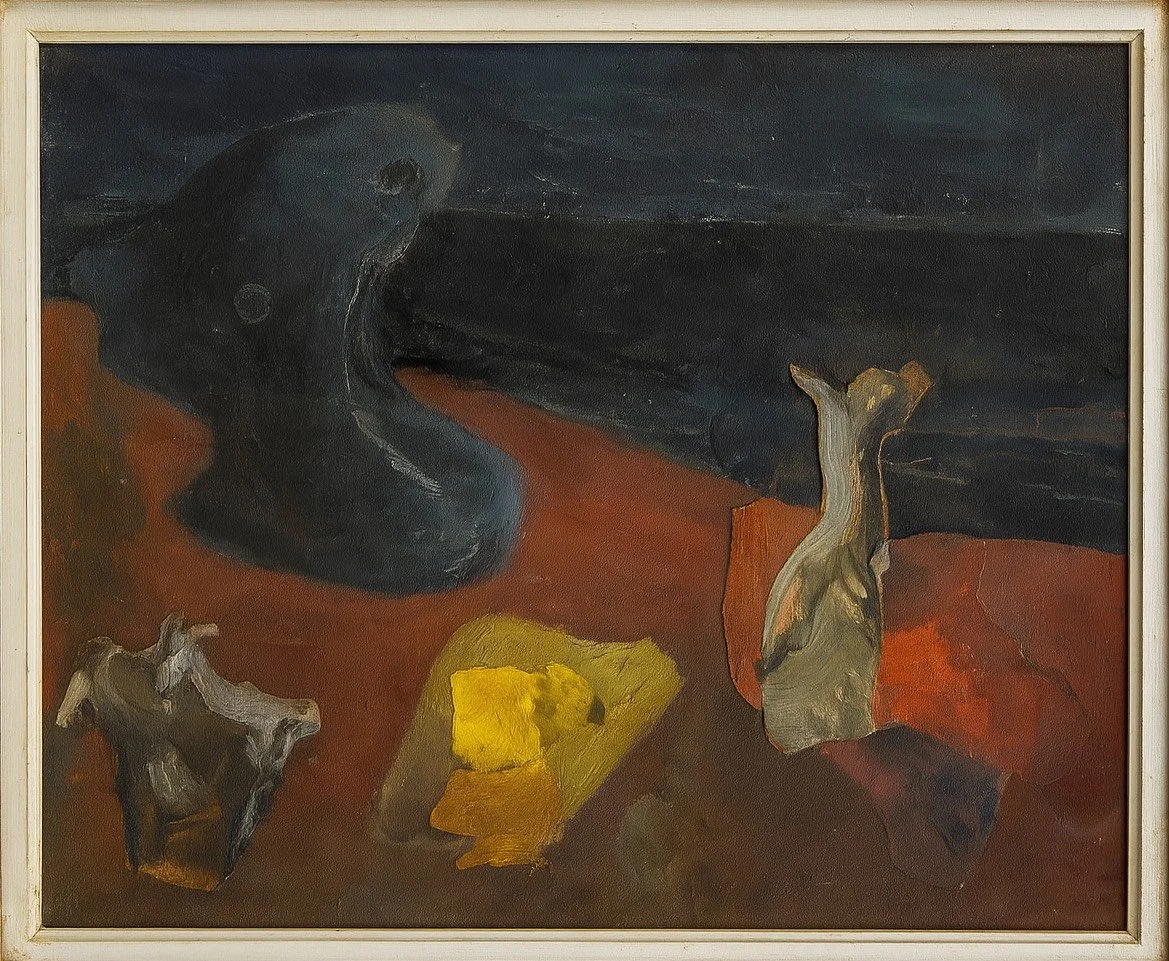
“Small Porgy” (Kipling) by Marion Milner, 1968. Marion Milner Collection, The British Psychoanalytic Society Archive.
Rudyard Kipling was an English writer born in Bombay, then under England’s colonial rule, in 1865. Infamously, he’s the author of “The White Man’s Burden,” a long poem that propagandizes for imperialism and encourages the colonization of the Philippines by the United States. The “Small Porgy” of Milner’s first collage seems likely to be a misremembering of Small Porgies, the sea creature in Kipling’s short story “The Butterfly that Stamped” (1902). In the story, Small Porgies is the smallest of thirty thousand brothers that live at the bottom of the sea. When the “Most Wise Sovereign Suleiman-bin-Daoud—Solomon the Son of David” boasts that he has gathered enough food to feed all the animals in the world, Small Porgies rises up and guzzles everything down in three cautionary mouthfuls. As the caption illustration describes: “He ate up all those boxes and packets and bales and things that had been got ready for all the animals, without ever once taking off the lids or untying the strings, and it did not hurt him at all.” Solomon, just out of the frame of Kipling’s original illustration, is left astonished and ashamed that he showed off. The tale proper begins from there.
Kipling’s story is an orientalist’s lesson in submission, all the more unsettling for its register, written as it is for children. It’s magical (a butterfly conspiring with a king), but its whimsy is underpinned by a racist trope (Suleiman-bin-Daoud has 999 quarrelling wives). The women quickly learn that they must please their husband or else, with one stamp of his foot, their entire world will disappear, leaving them in total darkness. There is no love in the story, only the kind of power that a husband and a king can hold over a wife and a subject. And so the “Queens of Egypt and Ethiopia and Abyssinia and Persia and India and China” alike learn their place in a social order that figures their subjection as comedy.
In Kipling’s own illustration, the boxes devoured by Small Porgies include figs from Syria, leeks from Egypt, “Special Slave grown” sugar cane, and much more besides. Looking at his depiction of towering food parcels, ships, and cranes, my first thought is of the perilous aid centers in Gaza and packages on parachutes hurtling down to beaches full of starving Palestinians. There doesn’t seem to be much distance between the world now and the world then.
How, then, to look at Milner’s collage? She didn’t begin with a blank page, but with a bundle of works to be taken apart; scraps in uncertain relation; multiple possibilities for arrangement; a contingent holding. Notably, she doesn’t appear to have made collages from ephemera or photographs—there’s no Dadaist scrapbook of the outside world, no newspapers. Instead, she turns back to her own work. If there’s meaning to be found, it’s necessarily mixed up, arising as it does from association and accident. So, I follow my first thought.
Milner visited Jerusalem in 1975 but didn’t mention Palestine in her brief description of the trip in Eternity’s Sunrise (1987). Of everything Milner sees on her visit to a kibbutz near the Sea of Galilee, the image that stays with her is of a Bedouin tent, which she came to associate with the cocoon she wraps around herself, “turning inwards [. . .] away from concern with outer possessions.” Milner’s visit came less than a decade after the Six-Day War, during which Israel raided the Gaza strip, seized control of the West Bank and Jerusalem, and forcibly displaced over 430,000 Palestinians. Milner, “dazed with history,” is indeed turning away.
After seeing the Bedouin tent and visiting Yad Vashem, Israel’s Holocaust museum and memorial, Milner sits down to paint with her fingers: white gesso on black card. Contemplating her picture the following day, she sees a face contorted with “unimaginable horror,” “as if one had oneself dropped the bomb on Hiroshima and is having a first inkling of what one has done.” The realization of violence is at the tips of Milner’s fingers, even as she fails (or refuses) to fully grasp it. Painting expands—if only slightly—“the limits of [Milner’s] imagining.” In a few seconds of apparently random movements, the paint gives form to something she hadn’t previously been able to articulate, reminding her that what appears to be a kind of child’s play “can be intensely serious.”
How then can I take Milner’s collage seriously, swerving as I am (and as Milner did) between associations and histories, longings and frustrations? The collage arrives in the reading room as if one of Suleiman-bin-Daoud’s “boxes and packets and bales” itself: taped in a huge sheet of bubble wrap and bundled in a large cardboard box (am I Small Porgies, guzzling papers indiscriminately?). Its large wooden frame—scratched, heavy, held together with bent pins only half hammered in—solicits a particular kind of attention. There’s something ritualistic about the scene: a campfire at night, a spell. But unlike Kipling’s illustration, the emphasis is on the encounter between bodies, strokes of paint, and torn edges. The large form, presumably Small Porgies, doesn’t rise from the black sea but from the land, suggesting perhaps that she didn’t set out to represent the scene as it appears in the original story, but made the association afterwards.
I look in two directions at once. First, toward the image: the boundary between red land and black sea; the circle of bodies (apparently human, animal, and spectral). Next, toward this practice which seems so distinct from painting: cutting, gluing, and reassembling. Thick ridges of excess paint create a sense of movement and density; the edges of each scrap peel slightly upwards, announcing their separateness from the canvas and casting slithers of shadow across the scene; my eyes are drawn to the bright stack of yellow scraps at the center of a circle.
Eternity’s Sunrise was published when Milner was in her late eighties and reevaluating concepts that had been central to her earlier work. Toward the end of the book, she notes a thought that’s been “nibbling away at some misgiving” about the cocoon as an “appropriate image” for self-experience. For Milner, a cocoon signifies the way in which a person has been slowly fashioned out of good and bad experiences, all enclosed in the limited space of a body. But this image won’t do, not anymore. Collages refuse cocoons: they are the unwrapping, unmaking, and recombination that’s central to a new kind of relation. Milner realizes that the kind of self-awareness she’s interested in is “not a fixed thing, not something rigid which can be emerged from and discarded, a torn relic, as a cocoon is.” Instead, she has come to understand a person as “infinitely expandable,” a shapeshifter. One’s “imaginative body” can—“like fitting a tracing exactly on top of a drawing”— closely follow the contours of an actual body, but it can also resist the pattern.[1]
“For Milner, our imaginative bodies are the means by which we think and feel outside of ourselves, as and with others, encompassing opposites. Milner notes that this capacity—to exceed, expand—is so often curtailed, even mutilated, in the notional pursuit of safety. But in fact, our psychic realities are always already ‘torn, ravelled.’”
For Milner, this realization about the imaginative body is “the ground and necessary condition of all true loving one’s neighbour as oneself.” Milner’s realization serves as a corrective to Freud’s frustration at the impossibility of neighborly love in Civilization and its Discontents: such a love is, for Freud, an impossible idealization predicated on sacrifice, obligation, and a sense that love is too finite, too discerning to bestow on a stranger, as if there were no stranger inside oneself to love, or as if love were free from contradiction. For Milner, our imaginative bodies are the means by which we think and feel outside of ourselves, as and with others, encompassing opposites. Milner notes that this capacity—to exceed and expand—is so often curtailed, even mutilated, in the notional pursuit of safety. But in fact, our psychic realities are always already “torn, ravelled.” It’s this realization that enables Milner, in the penultimate page of Eternity’s Sunrise, to return to her memory of the Bedouin tent and question whether it is in fact an empty cocoon. Revisiting the image, Milner still falls well short of making the connection with Palestinian struggle, but she does connect the memory to the context in which she wrote her earlier book, An Experiment in Leisure, namely “the houses and lives of the poor.” Together, the memory of the tent and of the 1930s hunger marches point to “the problem of how to share the world’s resources.” Before one can love one’s neighbor, one has to see and accept that there is a person living next door: the tent isn’t empty. A gap remains between the world as it was (and is) and how Milner saw it during her trip—but over the course of the book, the gap narrows a little.
Collage materializes the “imaginative body”: torn, gathered, and recomposed from “infinitely expandable” paintings. Its ethics are at once defensive (a guard against failure), aggressive (tearing), and reparative (making a new picture). Perhaps this is what Small Porgies signifies—its curved, featureless form eating an impossible quantity of food and taking it back down the ocean depths, content and infinite. In this version, my version, Small Porgies exists in opposition to, and not in aid of, the colonizing force on land. But it would be too easy and too sanitizing a romance to say that the Small Porgies of Milner’s collage represents the condition of possibility for “loving one’s neighbour as oneself.” Milner had long understood a problem in the old saying about neighborly love: “supposing in fact one did not love oneself at all but hated and feared it.” The collage suggests both a capacity for love (reassembling one’s paintings) and for hate (destroying them in the first place). And so, when I look at it, hating Kipling and loving Milner, I realize that these feelings are inseparable, that they trouble one another.
The interplay of love and destruction is central to Milner’s psychoanalytic practice. In Eternity’s Sunrise, she describes driving home as the cat on her lap affectionately dug his claws into her bare knee. She held the cat’s paws gently and delightedly in her hands, his “little spears safely sheathed.” The cat reared and rubbed then curled up asleep. “There’s this feeling of wanting to hug someone so closely that they merge into you. Even the cat. Or especially the cat,” Milner writes. The cat’s loving scratches repeat a primal love, like rubbing at his mother’s belly for milk. Watching the cat luxuriate in these daily rituals of eating, napping, licking, and scratching, Milner longs for his kind of “total being, his total relaxation.” Being close to the cat brings her close to their shared desire to be fed and to be one with the feeder. In the same passage, she describes waking and her own cat-like stretch as she turns her electric kettle on from bed: “the flow into [her] fingers, it felt like love, a kind of love affair. That hymn we had to sing every day at the little private school I first went to: ‘New every morning is the love / Our waking and uprising prove.’” In the early light, loved and loving, Milner’s contentment, like the cat’s, is evidence of the care she has received, of being fed and sheltered, and of her scratches or unwieldy desires being met with gentle holding.
Milner describes this revelation about loving and destroying as the “central thing [she had] learned from psychoanalysis.” Her learning is twofold: first, “that it’s bad to hurt, spoil, harm what one loves,” and second, that we do it anyway. We try to escape this fate—harming and being harmed—by “splitting off the bits that do the hurting” through denial and defense: it’s not me, it’s you. Recycling herself, the painter-turned-collage maker’s creativity is necessarily tied to her capacity for destruction. I imagine a discarded painting at Milner’s feet, a hole in its center where two goats once grazed. “Again and again,” Milner observes this pattern through her psychoanalytic work with patients. She watches people attack something in another person that represents the “bad bit” of themselves. She sees it in herself, too; behind her self-image as someone “gentle and considerate and preserving what one loves” there lurks a shadow, a “violent self-aggrandizing ruthless gangster self,” who, like Agave, tears what she loves to pieces. Tearing and reassembling her old paintings in the later years of her life, Milner was taking the “bad bits” of herself and giving them a second chance, remaking her work and herself in the process. She was working through the “haunting question” she asked in Eternity’s Sunrise: “do I love or do I hate, do I save or do I destroy?”
*
Milner used collage to rework her experience, transforming it from something disconnected to something harmonious. Returning to a work that didn’t work helps her to get unstuck. So much is clear from a scene of failure and recomposition that Milner relates earlier in Eternity’s Sunrise.
Looking out to sea from a Grecian port in 1967, Milner had made a “fairly accurate” drawing of two sailing ships in ink and oil chalks. Despite her initial delight in the boats and fishing nets, she was “deeply discontented” with the result. Though charmed, Milner was out of place in the landscape and couldn’t find what she “really wanted to draw”—until she happened upon a “solitary chapel built between the sea and a grove of unbelievably ancient olive trees.” She turned to face the horizon, “feeling [her] breathing and listening to the silence” and “emerged from the stillness” knowing “what [she] wanted to draw, a little white goat”: “I drew it with the sharpened end of a twig dipped in a pot of Indian ink and only added watercolour when I got back to the hotel.” Somehow, through searching and stillness and fashioning a paintbrush from a branch, Milner becomes part of the landscape, an extension of the ancient trees and lapping sea.
A few days later, sitting up in bed, Milner “played, using scissors and paste and oil chalks, with the idea of the flat brown nets of Thassos.” She cut up her earlier drawing of the quayside, “dismembered it and reassembled the bits in a tiny collage, its shapes only determined by the formal qualities of the rhythms of colour and line.” She introduces pinks and sea greens to the scene and is “enormously pleased, as though some barrier had been broken through.” Her pleasure radiates outwards until she feels the “sheer delight of the sensation of walking, the rhythmic contact of [her] feet upon the ground and of [her] weight spreading upwards from the earth, like the pink pole [in the collage].” The simple act of cutting and pasting produces movement, bringing the piece-of-pieces (and Milner) to life.
Over the following years, Milner added to the tiny collage of harbor drawings until it became a “full-sized picture” with its own gravity: “[I]t took to itself bits torn from an old failed picture of [Milner’s] which now seemed to be asking to have themselves used as the background.” She added more and more for balance and texture, cutting and pasting at the behest of her former failures, as if the picture itself were a creature from the deep, drawing everything into its compass.
These reconstituted failures serve as reminders to the version of Milner who stopped to look out to the horizon and focus on her breath, at odds with her landscape. A scrap of green, for example, symbolizes both Mary Magdalene and a green frog, spotted during Milner’s travels. Collage’s composite symbolism roots the divine in the everyday. Why a frog? Because frogs jump and to jump is “to be willing to risk letting go the solid ground, willing to leap into the unknown.” The collage-maker takes a frog’s-eye view of the world. She takes a risk in cutting up her paintings, lets go of solid ground and starts again.
*
Collages announce the occasion of their making, each piece a reverie. There are scarce but brilliant moments elsewhere in Milner’s books where she describes her collage-making, its roots in failed paintings, and the feelings that this practice creates for her. As Masud Khan notes, describing Milner’s bags full of drawings and loose writings: “Each scrap of paper was an EVENT in itself.”
Milner’s grandson Giles recalls “the table covered in bits of chopped up paintings” and a couple of evenings during which they “sat moving pieces around the collage telling stories, discussing what the story might be.” Collage-making was a tabletop game, as insightful as it was intimate. In Bothered By Alligators, Milner’s last book, which remained unfinished at her death in 1998, she describes her enjoyment in cutting up failed paintings “and then picking out the bits of colour or shapes that [she] particularly liked, putting them in a heap on a tray, and letting [her] wandering eye, often only out of its corner, select any of them that caught [her] attention.” Meaning dances in Milner’s peripheral—and, by then, failing—vision. Like free drawing, collage requires a wide attention and allows materials to speak for and even arrange themselves. Milner’s practice is shaped by continual reconstitution: memories into diaries, diaries into books, symbols into paintings into scraps into collage into memory into books. In this, nothing is wasted, no failure permanent.
Only one rule governed Milner’s collage play: she wouldn’t create abstract pictures, but “represent some sort of human (or animal) encounter.” Sometimes this encounter extended beyond the collage itself. Despite their origins in perceived failure, Milner must have been proud of her collages. She had “twenty or so” hanging in her studio “so that they could talk to [her] or to any of [her] friends who might have ideas about what they are saying.” As with drawings, these symbolic encounters spark lively interaction outside the frame. The artist Desy Safán-Gerard notes that Milner was “more interested in showing me her recent collages and sculptures than discussing her ideas about art and psychoanalysis.”
Some of the collages were persistent, even nagging. Milner recalls how she “kept putting off listening to” one of them, which “call[ed] itself ‘Woebegone,’”until a friend pointed out the faint figure of a face. What Milner once interpreted in the picture as hidden woe is transformed, slowly, over many days of looking, into an “expression full of peace.” Painted fragments, fixed in place, transform over time, their meanings shifting through repeated encounters.
“I wonder with her, could the collage be a similar kind of madness: Milner’s self dispersed across scraps; asking something of a painting and listening for an answer; the therapeutic work of remembering and working-through?”
Another collage “called itself ‘The Listeners.’” Milner describes each moment in its construction in Bothered by Alligators: how she cut the figures from an old painting, then utilized “a two-figure-shaped hole in the original failed painting.” Choosing its title, she recalls a poem by Walter de la Mare, about a lonely traveler, an empty house, and the answering strangeness the speaker hears when he knocks at its door. For Milner, the phantoms in the house “are almost like a self that has had to get disembodied and disperse itself, perhaps out of panic.” “Could it then be a poem about madness,” she wonders. And, I wonder with her, could the collage be a similar kind of madness: Milner’s self dispersed across scraps; asking something of a painting and listening for an answer; the therapeutic work of remembering and working-through?
*
One listens, but it can take a while to hear. Small Porgies had spoken to Milner at least a decade before the collage. She includes a drawing titled “Small Porgies” in On Not Being Able to Paint (1950). If the collage depicts an encounter between forms, the drawing depicts a rush of motion— rising, feeling, swallowing—just before the creature’s jaws clamp down. In the collage, the animal is featureless, with sweeping, even serene curves. In this earlier drawing, he is more like a crocodile, “the things he is swallowing look like seeds and he has got no eyes or features, only teeth and those hair-like feelers which seem to be guiding the prey into his mouth.” Kipling’s neatly labeled boxes of slave-grown cargo are nowhere to be seen. Milner’s creature swallows seeds—possibilities.
Painting, for Milner, enacts a primitive wish: to find a thing to love and to envelop that thing within ourselves (a kitten nosing its mother’s belly or clawing at Milner’s lap). But Milner is deeply concerned with the painful realization that we must be and remain separate from those we love, despite our yearnings, because if we deny what we love its own separate identity, we destroy it. Kipling’s Small Porgies dramatizes this fearsome wish fulfilment: it consumes everything and, implicitly, it destroys everything.
Painting takes Milner back in time: not only “restoring and re-creating externally what one had loved and internally hurt or destroyed,” but going “back to the stage before one had found a love to lose.” In this, painting has a reparative quality that isn’t contingent on possession. Milner quotes Jan Gordon, from whom she learned about the imaginative body: “In painting one of the prime sources of inspiration is the queer feeling that the subject is ‘yours.’” But Milner is frustrated and knows this to be a tempting denial of a basic fact of life. “[W]hy did it not always work?” she asks, as if shaking her book for answers: why can’t we have what we love? The idea of a painter spiritually or imaginatively enveloping her subject might be enriching, even exhilarating, but for Milner it “contained a denial of the basic fact of one’s bodily life.” We can’t transcend our limits. As eating proves, we absorb and we excrete, but we don’t possess or become those things we take within ourselves. Milner rises with her lofty sources before quickly rushing back to earth.
It is at this exact moment when the painter realizes the limits of her body and the impossibility of transcendence; just when she touches brush to paper, “all the anxieties about separation and losing what one loved could come flooding in.” If this is the painter’s anxious realization, it is the collagemaker’s condition of possibility. Collage is the rough, sticky stuff of matter—bits and pieces—expressing symbols through touch, tearing, and assemblage. Not transcendence, but transformation. Collage retains something of the integrity of separate forms, expressed through visible edges and the necessity of glue, yet allows those forms their encounter as separate things. Indeed, it insists upon it.
Possession, by contrast, is a temporary transcendence. In a gentle corrective, Milner admits that “the things one saw were not really one’s own, one’s self was still really bounded with one’s skin.” This is surely a political point as much as it is an aesthetic and psychoanalytic one. If Kipling’s story models two kinds of conspicuous consumption—either meticulous expropriation and hoarding for the notional benefit of others or the rapacious gobbling up of everything in one’s sights— Milner is grappling with the lie at the heart of both. Her collage expresses an aspirational kind of love: parts combining in something new; scraps just touching, with subtle differences in texture and hue, a slight space between them; edges.
But this admission still leaves Milner hungry. Painting cyclamen, she wants to protract the glimpse of timelessness that art affords: “I want to taste it continually, swallow it, become merged with it.” She wants to eat the landscape and feel its expanse within her own body, somehow infinite. “That’s partly why I want to paint, in order to preserve.” Her wish may be more about space than taste. She dreams of a world within that can hold the world without. Collage is one way in which Milner takes failure—the painting that doesn’t work, the lie that doesn’t hold—and remakes it in paradoxical destruction-as-preservation. In doing so, she acknowledges her limits, yet resists enclosure.
In On Not Being Able to Paint, Milner describes how she mobilized her will against itself, setting out to abandon conscious planning and embrace spontaneity. Yet she still found many of her free drawings were “bogus and demanded to be torn up as soon as made.” The problem with these maligned attempts was their eager organization into form: “a scribble turned into a recognizable object too soon,” an indication that Milner couldn’t bear the chaos of indeterminacy, or couldn’t jump, frog-like, into the unknown. The stakes of this failure were strikingly high. Such eagerness exhibited “a sense of false certainty, a compulsive and deceptive sanity, a tyrannical victory of the common sense view which always sees objects as objects.” Collage was Milner’s way of giving her tyrannical false starts a second chance. Hasty paintings could be torn apart, recombined, and pasted into new scenes yet to be determined; they could beckon other scraps into the frame and even insist on a name.
Milner needed a second chance herself. Just before her description of the “bogus” drawings, she describes visiting a Picasso exhibition, “arriving ‘all-to-bits’ from the struggle of living.” Despite looking like a whole, puttogether person, she felt “full of conflicting wishes and chaotic standards, one’s self can be nothing but a caddisworm shell of bits and pieces, picked up anywhere and stuck on anyhow.” The pictures on show “lifted [her] right out of” this feeling by permitting her a life of “inner chaos,” contradiction and fissure, free from the deception of wholeness, uncocooned. Milner’s animal metaphor is typically precise: A caddis-worm is the larva of a caddis fly, typically used as fishing bait. In reclaiming her life of bits and pieces, and in tearing-up and repurposing her failures, Milner’s larva-self grows into the moth and takes flight. Eat or be eaten.
[1] Milner takes the idea of an “imaginative body” from Jan Gordon’s A Stepladder to Painting, as she describes in On Not Being Able to Paint (1950), discussed below.