
Mother, Death Becomes You
On the Interior Life of Grief
Moon Charania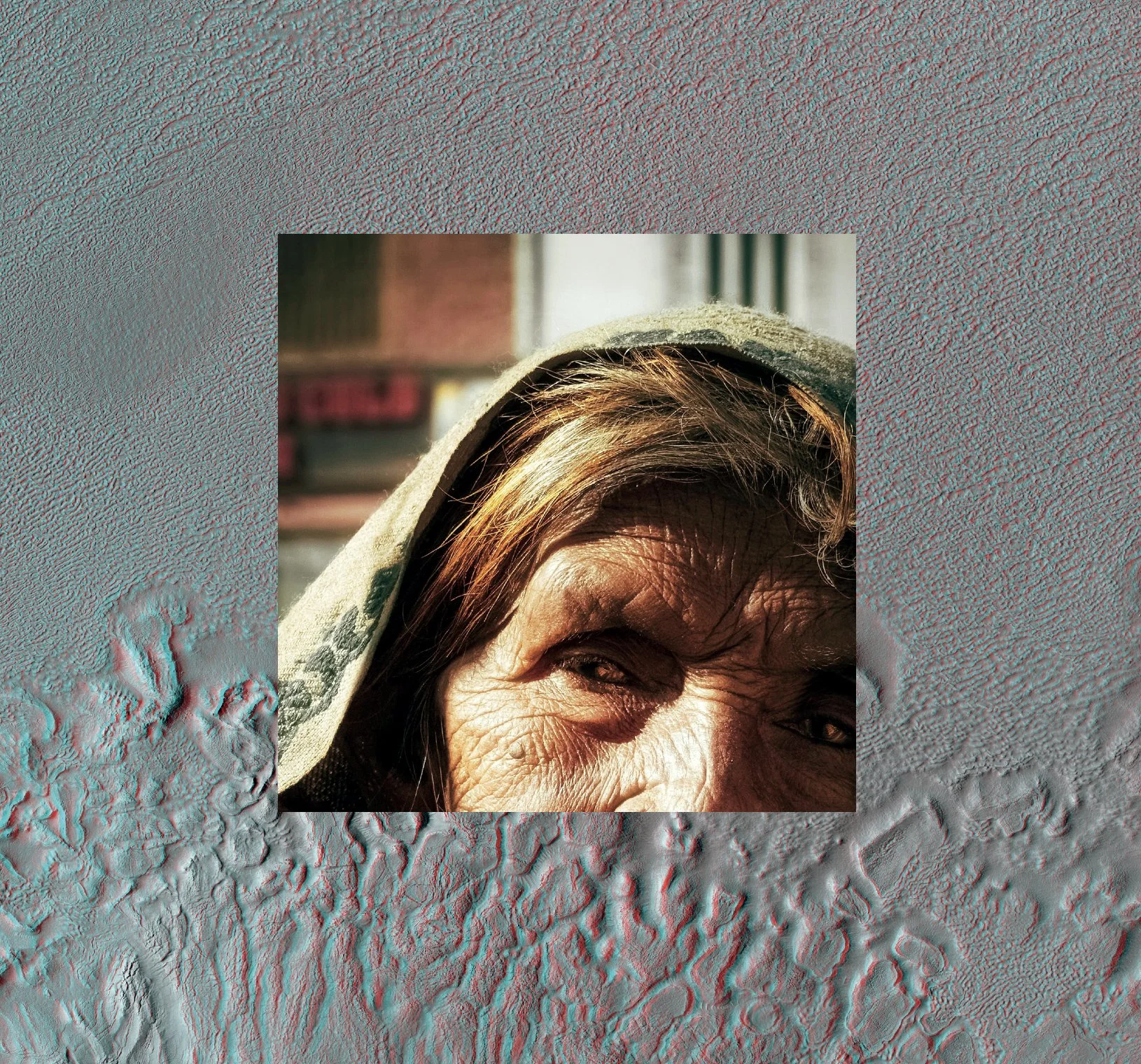
Photo (inset) by Shakir Ajmal
What kind of lover have you made me, mother
who drew me into bed with you at six/at sixteen [. . .]
lifting up the blanket with one arm
lining out the space for my body with the other
as if our bodies still beat
inside the same skin
as if you never noticed
when they cut me
out
from you.
— Cherrie Moraga, “La Dulce Culpa”
After she died, my mother came in my mouth. As an abscess. An infection. Or maybe just a sore. It made sense. My mother had terrible teeth. Not a good one in her mouth. No sense of dental hygiene. Discolored. Gray gums. By the end of her life, most of her teeth had fallen out. According to her dentist, she had eight remaining on the top row of her mouth, five of which were actual teeth and the rest just roots, residual dental matter which allowed her to chew on harder objects. All, he recommended, should be removed and dentures put in for the small cost of $7,000. Her bottom teeth were entirely gone. She never wore her bottom dentures. She found them uncomfortable, a nuisance. She ate mostly soft food, so found those unnecessary.
In April, when I left to deliver a talk at Rutgers University and she went to stay at my brother’s for a week, they both called me to tell me that my mother’s front tooth had fallen out. No blood. No discomfort. Just fell right into her hand while she was nibbling on her evening tea and toast. She had laughed into the phone as she told me about her tooth. But my heart broke for that broken tooth, and I felt the worry behind her laugh. My attachment to that fallen tooth kept me up all night. I thought about how my mother liked to keep her toast just a little crispy, even if it meant struggling with every bite.
Every morning, I watched her. She liked the crunch of her toast, so she never fully dipped it into the tea to keep it from getting too soft, and that fallen tooth was key to that crunchy delight. That fallen tooth also allowed her to eat breadsticks and a Personal Pan cheese pizza from Pizza Hut, two things she often asked me to order for her. Of course, both were terrible for her, a diabetic woman with congenital heart disease and a pacemaker. But I still did it. When I hesitated or tried to convince her otherwise my partner would quietly order it, winking at my mother. No matter all the gourmet, artisanal, gastronomic, or just healthier pizzas now around; for my mother, there was only one pizza: Pizza Hut.
I mean, I completely understood it, even as I was both repelled by it and secretly snuck in a few quick bites. Pizza Hut was intimately tied to our 1980s immigrant landscape. It was where our entire Pakistani family went after Friday night mosque prayers, pushing together small rectangular tables for our multiple extended families, dousing our pizzas and garlic bread with piles of red chili flakes and downing it all with pitchers of Coca-Cola. Pizza Hut is also where my mother’s three brothers first invested in American real estate in the 1970s. They worked as servers, then managers, then they bought a franchise, then another, and another in Dallas, then Los Angeles, and then Alaska, only to become Pizza Hut Kings by the early 1990s. My mother boasted that her brothers owned “all the Pizza Huts”—an oversized and discordant statement that never quite benefited her, since her surviving brothers are misogynists who dismissed all three sisters as afterthoughts. It wasn’t until the death of her husband, my father, eighteen months before her own death, that my mother began to abandon her deep fraternal romance, finding it, as with all men, both Machiavellian and cumbersome. The transition from wife to widow led my mother to new preoccupations, but she still loved Pizza Hut. So when that front tooth fell and I was up north, all I could think about was how difficult it would be for her to eat that little Personal Pan Pizza. Another disappeared pleasure. Another site of decay. Another desire out of reach. Her death drive, pushing to its way through the unconscious.
I thought I was done writing about my mother. I had just recently published my second book, Archive of Tongues: An Intimate History of Brownness, in which I ruminate on my mother, brown maternal memory, brown feminine care, care labors, and modes of world-making to argue that for the dispossessed, the archive is always bound to the body, to the flesh as a repository of transgenerational diasporic violence, and to intimate feminized space and time. But then, at perhaps the most inopportune time, when I was deeply ensconced in the tight balance of caretaking and academic work, trying to elude, evade, escape my mother’s unflinching romance with death, I was invited to write about romance. The irony was piercing. But such is perhaps the psychoanalytic burden, as our training—at least feminist psychoanalytic training—always involves meandering, twisting, snaking, coiling, a word play, a word fuck that allows involves a widening of language, or a collapsing, a constant reinvention of our tongues, at least in Kristevan terms. For Kristeva, the poetics of interpretation bear witness to a syntactical alchemy, by which she means there is poetic immanence in analysis. For Kristeva, interpretation is a passion, open to self-analysis and to history, into which the timelessness of the conscious erupts. If analysts forget this, they fail to address psychic life.
What, then, do I imagine into the aperture of my mother’s romance with death, a romance that slowly ruined me for life, for love, for my lover? Hers is an old romance, one that started in the whispers of the women who raised her; in the secondhand ganja she inhaled around her grandmother, who puffed it in her clay pipe after aborting the fetuses of women raped during and after the 1947 India-Pakistan Partition; in the abject and sensual sonic scape of 1950s Lata Mangeshkar songs that my mother would listen to over and over again; in the ocular residue of all the domestic obscenity she had witnessed.[1] My mother, as I had written previously in Archive of Tongues, was a woman who, “Yes, knew too many things firsthand, secondhand, third removed. Yes, she had learned along the way not to fight. Yes, she was easy to defeat. Yes, she joined them in her own demise. But who fails to recognize such a figure? Who doesn’t know this story?” If I searched and searched, there were too many roots to her death drive. Like a rhizome, it had no singular home; it was a creeping, continuous contagion—upwards, backwards, sideways, circular.
Did she ever have a romance with life? Death courted her, watched her, lurking in the corner of her life, teasing and toying and tormenting. She learned to court death—watched it like it watched her, with a coyness and a laugh. The closer it got, the more she stood still in anticipation. She had watched many women die, in moments of profound unmaking and in the most quotidian, most ordinary ways. She was in a dance with death, waiting for it to close her in its embrace. Her was an erotic cathexis, with a peculiar indifference, a romance like none I had ever seen before. I think about how romance has its own dimensions of unexplorability—its wretchedness, its torment, its ethics. Like other affective attachments, romance involves a whole complex dialectic of idealization and devalorization of self and other, life and death. Subsequently, for my mother, identification-overidentification with death through introjection-projection-incorporation of death into life was an ongoing, persistent entanglement of the life and death drives.
It was after the death of her husband in November 2023 that my mother went into a deep melancholia. Stunned that she outlived him, a charismatic and larger than life patriarch, every one of her doctors diagnosed her with “prolonged grief disorder,” meaning she was grieving too long (definitionally longer than six months). I found myself at each one of her doctor’s appointments filling out short questionnaires on whether my mother “still had an interest in life,” “was preoccupied with thoughts of death,” the extent to which she “felt life had no meaning” or “the future held no purpose,” and so on and so forth. I lied on all these forms as melancholia weighed on my mom’s fragile body, tore at her mind, and disordered her cognition. I thought about how absurd it is to have a diagnosis that essentially means grieving too long, thinking about the past in excess. Six months is arbitrary, tied to a biopolitics of time, to placid grief, to the notion that time heals. One thing I did know was that my mother’s melancholia and death drive would have brought Freud’s pen to a halt (if he actually took notes during the clinical session). At the least, Freud would have deemed my mother a failed mourner.
In Freud’s 1917 renowned essay, “Mourning and Melancholia,” he defines mourning as the process by which libidinal attachment to a lost object is withdrawn bit by bit, with eventual declaration/acceptance that the object is gone. In Freudian parlance, successful mourning in part necessitates a certain degree of forgetting, letting go, getting over, moving on—affective resolutions intrinsic to the regeneration of (biopolitical) life. So, while mourning may temporarily disturb the boundaries of life, it is nonetheless an affective field that keeps us moving toward life. (The arbitrary time of six months for the resolution of grief came later, with the publication of the ICD-11).[2] Conversely, melancholia is the inability to resolve grief, the stubborn rejection of closure, an enduring refusal. For Freud, mourning exteriorizes loss (the world is what is empty now because the object is lost); melancholia interiorizes loss (the ego is empty, diminished, even self-abnegating). While mourning is finite, melancholia keeps dragging along. Freud diagnosed melancholia as failed mourning and the melancholic subject as a failed subject.
“Such readings of melancholia—as a mood, as a disposition toward the world that understands how weighted it is by loss—shaped my everyday listening and observing of my mother’s circuitous death talk, her romancing of death, her pulling me away from life.”
Within the psychoanalytic mandate, my mother was this estranged subject, unrecognizable often even to herself, spinning, spinning, spinning away from all biopolitical attempts to reproduce life. Her life drive not just temporarily paused but depleted, abnegated, abjured. However, was there something to her death drive that could be recuperated, even productive? Melanie Klein opened up Freud’s interpretation of melancholia, focusing on the anxiety produced by the paranoid-schizoid position as one that might actually be productive for the self. For Klein, the insight of the melancholic is holding onto the devalued object (in Kleinian terms—the bad object; in Butlerian terms—all subject formation is based on losses).[3] Lauren Berlant, drawing on Melanie Klein’s “depressive position,” offered the condition of “depressive realism,” whereby one attempts to sit “around a thing” for a while instead of moving beyond it, and in so doing, may actually bind oneself to the social in new ways, with the possibility of creating new, less cruel, attachments. Walter Benjamin also reopened a reading of Freud’s melancholic’s “stubborn” fixations, pointing to the ways melancholia cuts the essential tone of biopolitical affect—of possibility, of lessons learned, of futurity—and subsequently produces a different, wayward temporality. Feminist psychoanalytic scholar Ranjanna Khanna has interestingly proposed that rather than seeing melancholy as a disabling affect (as per Freud), we might think of it as an affective residue, a remainder of a critical force, an agency of sorts, an aperture that is otherwise not possible.
While all her doctors saw my mother’s inability to move past grief as a depressive condition, I couldn’t help but wonder about these possible insights into my mother’s melancholia, no matter how much it dragged me down with her. In “Mourning and Melancholia,” Freud used the phrase “and so on” as a nod to the (sub)consciousness of the melancholic, subsequently interpreting the “and so on” as the narcissistic circuitousness of the melancholic. However, David Eng and David Kazanjian, in their canonical edited collection Loss, in which melancholia takes center stage to examine global losses, reinterpret this Freudian phrase as a gesture that gives us a way to take up global loss.
Taking a similar interpretive liberty, I read Freud’s “and so on” through the lens of a feminist daughter, observing the “and so on” of the melancholic’s ability to dwell in multiple losses at once, even if partially, perversely, shamelessly in what remains unsaid about the brown diasporic maternal and her situations of grief. My mother’s unassimilable, unruly grief was the cumulative result of her refusal to forget, her different interface with history, her excess subjectivation all through which she was now reviewing her life—her children, her debilitated body, and her repetitive, anxiogenic, mishmash, mnemonic landscape preoccupied with the most abject. Such readings of melancholia—as a mood, as a disposition toward the world that understands how weighted it is by loss—shaped my everyday listening and observing of my mother’s circuitous death talk, her romancing of death, her pulling me away from life. It was a grief in which she unleashed all of herself—her cynicism, her edginess, her eccentricity, her generosity, her genius, her ruthlessness, and her radical death drive.
*
A year after my father’s death, my mother began rapidly declining. I had left for a fellowship in American Studies at Princeton University that fall, and my mother went to stay with my sister, her eldest daughter. However, I had flown back several times during my fellowship because, regardless of the fact that she was a successful physician and the apple of my mother’s eye, my sister’s disposition leaned toward coldness, bordering on a kind of medical sadism. But upwardly mobile immigrant families love nothing more than doctor-daughters, and my family is no different in this regard; it is a sign of the good immigrant life, now modernized to robust individualism and gendered freedom. So my sister’s sadism hid well behind my parents’ attachment to that ensemble of desires called the American Dream. Ironically, as infatuated as they were by her medical degrees, both of my parents agreed that she had an appalling bedside manner. And it was during her caretaking of our father, who had died of gastrointestinal cancer a year earlier, that my sister’s anger began to shape her (medical) care.
My father, unlike my mother, had a profound love for life, and my sister was instrumental in my father outliving his cancer prognosis by two months—just as she, too, was a key player in his ongoing abject humiliation during his months on home hospice. In his desperate desire to hold onto life, my father gave my sister carte blanche control over his body. What she said went, and along with that authority came all sorts of bodily mistreatment, debasement, condescension, aggression, and contemptuousness, followed suddenly by a miraculous tendering of care that gave my father a week of boundless energy and liveliness. Well trained in Western medicine’s ideological structures, medical gaslighting was my sister’s specialty. There was no turning her medical hubris into humility. It was how she got her emotional dividends paid. In response, we all settled into a practice of psychic avoidance, as familial kinship positions us as silent bearers of witness to violence, infantilizing us to a role, to a dynamic, to a hierarchy, to a collective fantasy in which we all take part, passively or actively. What we could not bear to speak, to know, to register, we avoided. My sister revealed not just our family dynamic, but how notions of kin, gender, power, and violence all falter at its limits. The protective fiction holds until it cannot.
Subsequently, in that first week of December, when I received a cryptic text from my sister saying my mother had fallen, I immediately flew back. My partner had retrieved my mother from my sister’s house and had also urged me to return to Atlanta. My fellowship was almost over. I threw clothes in a suitcase, left my faculty apartment in shambles, shot out rushed emails to Princeton colleagues who were expecting me at various academic events that week, and headed for the Newark airport, terrified that I was returning to Atlanta to bury my mother. My sister’s history of medical sadism made me enormously suspicious of her. Filial obligation to maternal care, as previously with paternal care, produced my sister as the repulsed daughter with a tendency toward rage. My thoughts drifted to Mary Lamb, an English writer who, in 1796, described as fatigued from the punishing routine of caregiving, stabbed her paralyzed mother to death. As a feminist and queer writer on violence against women, I have always been struck by how close care and violence are, how inside of care is violence and inside of violence is care, and how the collusion of care and total uncaring can pierce the psyche. I have also been struck by how, despite the voluminous vocabulary we have developed to analyze male violence, we have done precisely the opposite to understand women’s violence against each other. Throughout my life, I have been unable to untether the practices of violence from the practices of care in my family, with the few exceptions of the feminine and feminist practices I learned from my mother.
For ten days, my mother lay in bed at our house, recovering from this mysterious fall that left no visible bruises or scratches. She spoke little. When she tried, she barely released a whisper. When we asked what happened, she couldn’t or wouldn’t tell us. She said she didn’t know or couldn’t remember. She ate little. Spoke even less. When she finally began speaking, she simply expressed how much she had missed me. She would say, As long as I am alive, don’t leave. Atlanta is not Atlanta without you.
It took weeks for her to regain strength and a semblance of an appetite. Her daily rituals of prayer and conversation had diminished, and her sociality had lost its amorousness, even with me. She was keeping something from me. I suspected that something had happened, something she would dare not expose. Did she actually fall? Had she been hurt? My repeated probing was useless. She was an old-school woman from head to foot, loyal to the bone. Trapped by a capacious notion of maternal forgiveness, she had an infuriating affinity to the bloodline. Freud’s phrase in Studies in Hysteria, the “blindness of the seeing eye,” seems apt: the unknown and the troubled air of secrets thrived in my mother’s cathexis, shaping, molding her maternal abjection.
“My mother’s desire for coherence (her firstborn daughter as her little girl) worked against her observation of her daughter as her perverse carer/taker and yet, no matter the cost to her, she was unwilling to relinquish this fantasy. It is why she fell silent.”
At seventy-eight, she had exhausted all means of self-defense. She was now more than ever anxious to hasten her own extinction. It was as if she had survived this long, outlived her patriarch, only to witness the cruelty of her firstborn turn into her (phallic) master. My mother’s desire for coherence (her firstborn daughter as her little girl) worked against her observation of her daughter as her perverse carer/taker and yet, no matter the cost to her, she was unwilling to relinquish this fantasy. It is why she fell silent. This was a perversity for which she could find no language, and language had always been her object, her way of sense-making, her way of world-making.[4] This perversion left her mute and tongueless. When she spoke, she spoke about death—its arrival, its inevitability, its welcome, its timing, its logistics, its ease, and so on. I thought about my mother’s intimacy with death and domination and God, that she was always at home with violence, even when the terms of engagements shifted, even when the characters changed, even when bits and pieces felt surprising and caught her off guard, even when her hands shook and her voice collapsed and a whisper couldn’t escape the folds of her tongue. My thinking takes me nowhere except to the abyss of an id from which I cannot find my way back.
By January, we had moved into the slowness of life and care. Care work is slow work, mundane and redundant; it slows one’s life down tremendously, no matter how much one tries to keep up with the outside world of fast life. I watched as my mother moved into exile, severing her relations with most everyone but me. I tried to stop her, but to no avail. All relations had become futile. Even her grandchildren brought little joy. Too loud. Too full of life. Their mouths too full of English. Each of her kids had a dim and disparaging approach to her that they tried to hide, some of us better than others. I sedulously encouraged her toward food and activity but mostly failed. I took her to Patel Brothers so she could walk around, but she had lost interest in looking at seasonal vegetables and fruits, previously a favorite pastime. My brother tried to make her laugh, sometimes successfully. My sister, on occasion, invited her back to her home, and my mother, driven by a lifetime of masochism, always went eagerly back. In those months, I witnessed how her face-to-face meetings with her doctors took on a particular character, how she now saw them impatiently as roadblocks to death.
The daily turn to death was gutting, draining. Sometimes it was banal, merely bureaucratic—about a piece of jewelry or a shawl or a phone call to make. These were the simple conversations. But my mother was not a simple woman, even if she lived a simple life in her old age. She was a deeply philosophical woman. Most of our conversations moved through her mnemonic landscape, graphically retelling gendered pains of her deeply gendered life. Rare was a story that didn’t end on a morose note. I now think that perhaps she needed to shed each thought, each memory, each story before she died so she took nothing with her, leaving all the unbearable sadness here where it happened.
My mother’s cognitive decline was intense—the in/voluntary derangement of the senses, the in/voluntary derangement of sense. Psychoanalytically, we might understand this as a form of traumatized language. The repetition was hard and heavy. But I had become more and more interested in her linguistic unreason and disorder, even as I, too, was becoming deranged with her. We were two deranged women encircling each other, her stories more and more unmoored, my understanding of her collapsing, disassembling. My mother moved closer to death while I tried to stay present in life. We were at an impossible impasse.
My mother’s death drive had an enigma, an unintelligibility; something had pierced her psyche but, try as I might, I could not decode it, I could not reorganize it, signify it back to her, back to me; it left me with a series of dark fantasies and representations that were too unstable, too intense, revitalizing an id with which I could not contend. It crept up on me on a daily basis—with my morning coffee, while I was cooking, when I walked toward her room, when I turned the knob of her bedroom door. With each daily banality, I found myself thinking of death, her death: hurting for it, damning it, fearing it, worrying it would come, worrying it wouldn’t. She sought death with such a fierceness that it collapsed any remainder of hope I’d had that maybe, just maybe, my mother could have loved life with me, could have found a new way (a feminist way) to live with me. Her death drive made others so uncomfortable that they quickly jumped off the phone or, looking at her with pity, left visits hastily. But my mother didn’t wince. For her, it was a way to disobey the terms of life, the life drive, and most interestingly, the attachment people have to the life drive. Her death drive was a technique of self-abnegation, vertiginously disobedient, immersed in a sustaining cycle of cynicism, irony, negativity, and submission.
I think about how Freud theorized death but wanted desperately to live (he had thirty-four jaw surgeries in the course of sixteen years due to oral cancer). His life drive was so powerful, his orientation so far away from death. For Freud, death anxiety is analogous to castration anxiety, a pivot for all losses of the object, behind which, as Nicholas Royle writes, “no deeper secret would be hidden.” My father’s life drive was like this. In hindsight, perhaps my sister’s rituals of medical humiliation were a form of castration in which she wanted us all to participate. Freud’s work on death was remarkably incomplete and remarkably anxious, shaped by his own neuroses, the cause of migraines, sleeplessness, and intestinal disorders. Conversely, Frantz Fanon theorized the possibility of life for the colonized through the death of the colonizer, but perhaps knew that when the CIA brought him to Bethesda, MD, his days were tightly numbered and death was around the corner. Fanon was dead at the tender age of thirty-six. The misery of dying and death comes for us all. My mother was a rare woman who welcomed it with a coy smile and small laugh.
In 1952, Wilhelm Reich posed his famous question of ontological misery to Freud’s oeuvre, asking: “Where does that misery come from?”[5] As feminists, we know this question of misery, as with the question of ontology, is fundamentally about who and where and how one is (seen) in the world. Of course, neither Reich nor Freud took questions of race, femininity, and sexuality seriously and therefore neither of them thought about the psychosexual/psychosocial being through iterative, layered, or diasporic dispossession. For Reich, misery came from the external world, while for Freud, misery emerged from the world of psychic angst. The radical ambiguity between inside and outside is, of course, collapsed or ignored by the very framing of the question. What justice or freedom remains is perhaps the biggest (and most rhetorical) question of them all.
In many ways, my mother understood freedom better than anyone else I have ever encountered, but she had no romantic attachment to freedom as an idea, as a concept. For her, freedom was someone she could be with, laugh with, loosen her tongue with, with whom her speech was free, capacious; someone she could eat with (eating was a private, intimate act, and my mother did not eat with just anyone); someone with whom her body moved freely, someone with whom her legs could spread apart, her knees wide, her thighs loose; someone from whom she did not have to avert her gaze or look down or away or constantly say sorry or “okay, okay, you’re right, I’m wrong”—that is, someone with whom fear, power, anxiety, apprehension, and hierarchy were far, far away. Freedom was a relation; freedom was created in relation. On the other hand, my mother was a deeply unfree woman. Her relations bound her, bonded her. They contained her. She was sharp enough to know that love, as she lived it, was a pedestrian sentiment. That it lacked acuity. Yet she committed herself to that love relation, always suspicious of ideals of independence. Perhaps more than any other moment, watching my mother die, I began to take seriously Gayatri Spivak’s question: “Isn’t it autonomy that is suspect?”
How do you free an unfree woman? Or free a woman so free in her unfreeness? How can any of us be free in an unfree world? I thought about my mother’s misery and my mother’s un/freedom every day I cared for her. It was a question that haunted me in every practice, every act, every minute of domestic grunt work. Only at night would I try to reckon with the everyday dying of my mother, the grief that accompanied that dying, and all the unrecorded states of mind, of being, of speech, of care, of perversion of thought.
“When my mother died, all I could think about were the failures, the rejections, the dejections, the lack. I was stuck in this maternal curse/wound/s/lash/gash.”
Caring for my mother drastically changed my life. Drastically changed my writing. Drastically changed my health. Drastically changed my looks. Drastically changed my relation to femininity, to my femme self. I didn’t want this to be the case. I wanted to rise above this. I wanted to be able to compartmentalize, as I had done so well for the first several decades of my life. But every day, for seven and half months, I watched my mother transition, her body and mind slowly deteriorating. Caretaking for my mother suffused and infused every aspect, every pore, every crevice of my selfhood, diminishing and diminutizing my old self, literally. As more and more of me shrank, I felt myself disappearing: my subjectivity and my femme excess gathering as shards on the floor of different rooms in different homes, in different institutions, in different cities. Her unfreedom coagulated with all my feminist notions of freedom, collapsing, eroding, and corroding all my freedom theorizing. Her presence absented my life. I was grieving her before she died, while she was dying, not knowing she was dying—just knowing she wanted to die desperately.
My mother walks to the kitchen. Walks to the bedroom. Walks to the bathroom. Walks to the front porch. Each walk wears her out. Each walk quiet, resigned, dispassionate. It is now hard to appreciate the difficulty this entailed and to realize the impact caring for her had on me. Grief and maternal love floated over and through me every minute of every day. No matter how much I attempted to look at my attachments, their subtle and crude manifestations, they invaded the deepest recesses of my psyche immeasurably. The sameness of everyday. My gaze on her closed door. My ear listening for a sound, a rustle, a heavy breath, the gentle call of my name, a strange quiet. Her preoccupation with death had become my preoccupation with death. Shame runs in me like a broken, busted faucet. I fantasized about cradling her in my arms. She was so small that the fantasy was actually a possibility. The image was hard, so hard that it swells like a mass in my throat. It won’t hold. I won’t let it. Better to turn back to the familiarity of her death drive. Or my trained intellectual syntax. It is romance that is abject. Wretched.
*
So seasoned was I in her death drive that I thought that when death finally came for her, I would surrender to it. But when it came, it destroyed me.
It was the week of Eid and my daughter’s college graduation. Family and friends had flown in for one event but were now gathering at our home for another. I quickly went from doing something frivolous, like wrapping my sari for my daughter’s college graduation, or something tender, like oiling my mother’s hair, to working in service of death, toward death: each one of us began to work for death, her death, to make dying easy, seamless, as though she had already stepped over to the other side, as though she was already gone. It all happened within eight days. No illness, no hospitals—just what the doctors told us over the phone, “failure to thrive.” Medically, she was dying of heart failure. Of course, I thought; it would be her heart that would fail, that would break. Within twenty-four hours, home hospice was initiated, morphine arrived, along with Ativan, a battery of hospice pharmaceuticals that we never used, and a line of tender hospice workers.
My mother mostly slept. I mostly sat next to her on her bed. Five days into “failing to thrive,” a flood of strange memories began cascading off her tongue—nonsensical, garbled memories of almost eight decades on this earth, mashed together in her frontal lobe like succotash. The deep interior residue of her psyche communicated symbolically important psychological truths through the construction of strange nonfictional half-narratives. The set of unconscious conversations during the last twenty-four hours before she fell completely silent fascinated and devastated me.
Like the dream, the end-of-life hallucination metabolized her deranged thoughts through the displaced words she offered, hinting at the drama of her life. She called out the name of the woman who helped raise her in Karachi. She recalled how much her own mother slept before she died. She told yet another fragmented story of her violent brother-in-law, warning us not to let him in the house (he lives in Mumbai and hasn’t stepped foot in the States in over two decades). She remembered something about her heart being ripped open. And then she mentioned a Pizza Hut competition.
Her language followed a syntax of splits and ruptures—the utter openness of the hallucination. If I listened closely enough, every memory and every warning opened up a series of faults, a terrain of relations, breaking the grammar of censorship. Even at a primitive level, the level of something spontaneously produced in the unconscious, there seems to be a way in which the human mind is tethered to worry in order to tell a story, to string together a memory. I strove to listen to her hallucinations as Bion advised in his papers on technique: without memory, without desire. But I felt immobilized by the words coming out of my mother’s mouth, by how even at the end she was inured to her powerlessness. As death dwarfed life, defining my mother, I wanted to believe that her self was not irretrievably lost, that even dying, she was offering me slow, fractured idioms, warnings, metaphors, mother tongues. “Ma, hear me now, tell me your story, again and again,” Nellie Wong writes in her poem “From a Heart of Rice Straw.”
Still, I felt unsure as quiet fell over the house. I listened to my mother’s gentle breathing. Was she simply sleeping? Or was my mother dying? All I could think about, all I longed for her, was for her death to be sweet, the very opposite of the material conditions of her life—bitter, acerbic, punishing. She deserved a death that felt like a long, gentle nap, so when my daughter and I first started administering the morphine, we would slip a small piece of chocolate under her tongue, letting it slowly melt to assuage the bitter taste of the drug. I would watch for several minutes as that small sliver of dark chocolate melted in my mother’s mouth, sweetening the insides of her mouth. I could tell she liked the sweetness because a small smile stretched at the corners of her mouth. My mother’s signature small smile. “‘Was it hard? I hope she didn’t die hard.’ Sethe shook her head. ‘Soft as cream. Being alive was the hard part,’” wrote Toni Morrison in Beloved.
*
The night she died, my partner, daughter and I went out for pizza. Everyone had left, the funeral handlers had removed my mom’s tiny body, and the three of us just stood in the kitchen staring at one another in dead stillness. The silence pressed on my throat, strangulating my senses. A moan was fighting its way through my mouth. Pizza, my daughter said, suggesting it was one way to honor nani (maternal grandmother in Urdu). Grief swirled. We ate Mom’s coveted pizza. I drank two dangerous glasses of wine, numbingly prepared to get a migraine that night. I have a history of migraines for which I am on a number of psychopharmaceuticals, and over the last eighteen months these medications have caused a slurry of wild side effects, including spinning sensations, ongoing metallic taste, daily nausea, suppressed appetite, a rare form of tardive dyskinesia which causes an intense desire to swallow my tongue, and pica, a condition in which I consistently crave dirt or ice or frost. Instead, I got an abscess. Mom. For three and half lovely weeks, my mouth was in physical agony. I rinsed with warm saltwater. I dabbed my abscess with homemade turmeric paste. I ate soft foods like Mom, tilted my mouth to chew only on the non-abscess side. Four days later, we buried my mother.
On day five, I sat in my mother’s room, in her chair, looking out her window. I lay on her mattress, in the space where she died. I wanted to burn that mattress. Both my mother and father died on that mattress, in my home. My father was already gone when I went in to check on him. My mother was taking her last breaths as I held her hand and whispered her favorite Islamic prayer until she stopped breathing. I fantasized about watching the mattress go up in flames. Instead, I donated it to my mother’s care worker—a working-class, undocumented Pakistani woman who tells me she and her husband sleep on two shitty twin mattresses their landlord pushed together for them in a room they rent in a small apartment next to the mosque. I told her Both my parents have died on this mattress; it’s bad luck, no? But she was not superstitious and began to arrange delivery as my pyromaniacal dreams withered into the background of good will and gratitude.
By day ten, everyone was telling me to go to the dentist. I hate doctors, dentists even more. I responded with this and also said that turmeric is a miracle worker. But really I am convinced that the abscess was mom. She was with me, in my mouth. She was my agony, literally. And I inherited my mother’s masochism. The abscess made it real. I could touch it. I could touch her. She was in my mouth. I could tongue her. My mother tongue. Tongue my mother. Oh, the delight. Oh, the pain. Later that day, I let my butch fuck me, with her tongue and her dildo, until grief and pain and pleasure overwhelmed my senses. After, I let my mind drift to Audre Lorde in Zami fantasizing about wanting to fuck her mother, as she writes: “our touching and caressing each other’s most secret places.” Lorde’s fantasy of her mother flows from a desire to fuck her mother to a desire for her own body as she pounds spices with a mortar and pestle, “back and forth, round, up and down, back, forth, round, round . . .” feeling the strength, the eroticism, the richness of this complicated mother-daughter rhythm run through her body. After the publication of Archive of Tongues, many readers approached me about the book, describing it as “delicious” and “a validation of lesbian love of the mother that they had never seen before.” Reader upon reader specifically referred to a passage in which I offer varying delineations of queerness, ending with a queerness that refuses “the hegemonic disassociation from the mother, the feminine, and the femme and instead lingers with and makes love to the eggs, the breasts, the vulvas, and the tongues of the mother.” What does it mean to come/cum through the mother?
On day twelve, I put my downstairs bar back in place, the one I had removed so my mother wouldn’t have to look at a bottle of whiskey every time she walked out of her room, because it reminded her of her drunken father-in-law who used to incentivize the seventeenyear-old house maid to sleep with him and her abusive brothers-in-law who were notorious for violating women and girls. It didn’t matter that the bottle I had sitting on our bar tray wasn’t the deadly bootleg stuff these men used to finish off before noon, but an aged bourbon to be sipped slowly in the company of writers and artists. I comforted myself with a class habitus that fancied itself far outside of that archive of racialized violent masculinity. Education equals distance from abjection. I romanced this equation with all its cruel attachments. But the visual acuity with which my mother saw abject femininity etched into every crystal whiskey decanter she walked by haunted me. So when she moved in with us, I moved every bottle of wine and whiskey out of her sight. After she died, I stared into the intricate, geometrically shaped crystals and realized with utter mundanity that we could go back to sipping bourbon sin incognito.
“I opened my mouth and searched for my mother. She was gone. The abscess had healed.”
Raven Leilani writes, “[b]ereavement makes a mockery of borders and by extension narrative.” In grief, I felt each aspect of my body eroded, my border mocked, battered, beaten. I felt disordered cognitively. Intellectually ruined. “I open my mouth in my own life and I want to distort, rearrange, mispronounce the available vocabulary,” writes Renee Gladman. Like Gladman, I wanted to bathe in this ruin, in this distortion, in all the mispronunciations I worked my whole life to avoid. I thought of Lisel Mueller’s poem in which she describes turning to poetry after the death of her mother: “[I] placed my grief / in the mouth of language, / the only thing that would grieve with me.” Language, my mother’s object of disobedience, her gift to me, my feminist inheritance, collapsed around me in moans.
The swirl of grief. Dizzying. An altered condition of life. Complete temporal disorientation. Nothing I say feels intelligible. In grief, I was stuttering, stubborn, hysterical. My pathos repetitive and boring. My mind short-circuited. My epistemological propositions were essentialist, and I insisted on their defense. Reality looked like the flat, propositional object of a single verb, shivering in its threadbare simplicity. No negotiation of complexity could complexify my epistemological terrain. I was deep in my own epistemological fixations, with all their paralyzing preoccupations, accusatory projections, and elaborated, moralizing refusals that kept me from entering any complex practice and the will to know.
I look in the mirror and I see my mother. “The precursor of the mirror is the mother’s face,” argued Winnicott. I look in my mouth and see my mother. I think about the opacity and imperviousness of this maternal mirroring twenty days after I bury my mother, trapped in a solipsistic condemnation. I return to my mother’s death drive. French psychoanalyst André Green argued that the death drive and life drive must remain in equilibrium, as a dialectic, to govern our psychic life. If the death drive prevails, self-destruction, impoverishment, deadness takes over. There is no beauty in grief.
When my mother died, all I could think about were the failures, the rejections, the dejections, the lack. I was stuck in this maternal curse/wound/s/lash/gash. I was stunned at how even at the end of her life, she was controlled by the weight of violence, the imposition of (maternal) shame. Care wasn’t, as Saidiya Hartman has said, the (only) antidote to violence. I couldn’t, no matter how much I tried, take it away, lighten the burden. My care was incomplete. This deep failure of mine. I felt it every minute after she died. I wanted to think about her as I had written about her, as I had previously theorized her, and also as I had understood her throughout my life, as a woman who had developed a complex set of refusals, disobediences, a set of feminine abundances, and had passed those on to me as trans-generational feminist inheritances. But in grief, I felt myself doing a different math—a negative arithmetic of counting lack, of bearing negation, of doing violence to my inner self. A mathematics of loss and interminability, of a life split by death. A math in which I counted my every absence, every deficiency, every error, every oversight, every failure, dividing by my varying acts of neglect, subtracting by my cowardice, minusing my ineptitude, minusing my months away, minusing the times I was too governed by a migraine, minusing selfishness, minusing tiredness, minusing frustrations, minusing irritability, minusing, minusing, minusing . . .
“These my two hands / quick to slap my face / before others could slap it” —Gloria Anzaldua
On day twenty-one, I went to the cemetery where my mother was freshly buried. Everyone thought it was a terrible idea. But I wanted to see her grave before I left for France for a month. I was running away like many writers before me, desperate to grieve outside of everyday life. In Islamic tradition, women do not shoulder the burden of burial or participate in the sunnah (which is when the dead are put into the ground). So I had this urge to see the burial site, see where my mother was buried. I hadn’t gone to my father’s after he died, and I am generally not attached to cemeteries. But I remember accompanying my mother in her healthier days to the cemetery, where she would put flowers and incense on her mother’s grave, so a part of me wanted to reproduce this matrilineal ritual. My brother warned me that the headstone hadn’t arrived, that it was too soon, the dirt still fresh. “You won’t feel good,” he warned. But we all went—my brother, his sixteen-year-old son, my partner, my daughter, and me. We silently drove through Floral Hills, a Christian funeral home and a beautifully manicured cemetery deep in the suburbs of Atlanta, now saturated with Shiite Muslim bodies.
When we pulled up, there were three unmarked but clearly fresh graves packed down with Georgia red clay. Two of the burial sites were covered with green grass mats, but one was just red dirt and a pot of not-yet-dead flowers at the head. The freshest of all the graves. Mom. I dropped to my knees. I touched the dirt under which she laid. Caressing it as though I was caressing her. I burned two incense sticks. I cried. I prayed. Everyone stood around me in silence. My partner began arranging the fresh flowers we had brought with the not-yet-dead flowers. I burned two more incense sticks. Cry. Pray. Burn. Cry. I had an intense desire to take the dirt from my hand, put it in my mouth, and crunch on it. My mind turned to Tiffany Lethabo King’s beautiful and disturbing essay, “Geophagia: The Pull of the Earth,” where she writes of Black practices of geophagia, opening with her momentary intense desire, after her own mother’s death, to rub her mother’s ashes over her gums. King notes that mothers pass the condition of geophagia—the addictive desire to eat dirt—onto their children in the context of colonial life and dispossession. What was I inheriting from my mother? What does it mean to want to possess the mother?
My daughter hugged me. My brother hugged me. Each in their way consoled my inconsolability. But I didn’t want solace. I wanted my mad, sad, bad grief. Cry. Pray. Burn. But graves and grief are making everyone miserable. So I let my grief float in silence over my mother’s grave, over the dirt that I desperately and disturbingly want/ed to put in my mouth. Is this some kind of residual oral fixation?
My pica had subsided over the last four weeks as two different doctors had put me in the category of “medical suspicion,” ordering a battery of tests and putting me on new meds to curtail my cravings. But now, sitting at the foot of my mother’s grave, all I wanted to do was consume the dirt: lower my mouth and lick the earth that covered my mother. In Memoires for Paul de Man, Derrida writes of the synonymity of mourning and interiorization, an idealizing incorporation, introjection, and consumption of the other. I cannot divorce this interiorization from the erotic consciousness that undergirds it, cannot forget how mourning, sexuality, ambivalence, subjectivity and sublimation are all connected (“as if our bodies still beat / inside the same skin,” writes Moraga). Derrida tells us that one of the ways memory in mourning works is that it entails a “movement in which an interiorizing idealization takes in itself or upon itself the body and voice of the other, the other’s visage and person, ideally and quasi-literally devouring them.” My hands remain on my mother’s dirt, rapturously, rhythmically caressing her, aware of my indecent desire. For Freud, the motives for renouncing the mother during the preoedipal phase are listed as oral frustration, jealousy, and prohibition. Over my mother’s buried body, I reclaim her with oral desire, compersion, and promiscuity. I do not want to stop or leave. I look around at the visual markers to remember my mother’s gravesite. I’ll come back alone and then, with my pica surging in me, I will be able to intimately eat (with) my mother.
*
On day twenty-five, I arrived in Paris. I settled into my apartment in the 9th. arrondissement. Like an open wound, I walked around Paris, to the markets, the boulangeries, the patisseries. I ate the delicious pastries. I chewed them symmetrically. I felt strangely painless. I returned to my apartment and looked in the mirror. I opened my mouth and searched for my mother. She was gone. The abscess had healed. What does it mean to be dispossessed of a mother?
On day thirty-nine, I had lunch with a dear friend and fellow queer and feminist scholar who teaches at the Université Paris Cité. We talked about our South Asian communities, our complicities in structures of power, queer secrets, and our mothers. Except, I think, I don’t have a mother anymore. She is dead, buried in dirt I want to eat as long as my appetite stays errant, unruly, uncouth. She is dead, buried in my chest, knocking the wind out of me every time someone mentions their living, breathing, bothersome mother (remember when you had one). She is dead, buried in my mouth, producing an obsessive desire to swallow my tongue. It always comes back to tongues. Mine, my mother’s, her mother’s, her mother’s mother, daughters’, and lovers’. So intimately entangled am I with these tongues that at times it is hard to tell where theirs end and mine begins (“as if you never noticed / when they cut me / out / from you,” writes Moraga).
On day forty, as the Islamic days of mourning came to an end, my mourning snaked itself around me. My brother called me. “It’s mom’s chalisma (40th day of mourning). Go to the mosque in Paris, you’ll feel good,” he advised me. He finds meaning in faith-based community, is a leader in our Atlanta Shiite Ismaili community, well-loved, well-respected. I responded affirmatively, then switched to a maybe, both lies. My lesbian blasphemy finds no meaning in the mosque, in Arabic prayer, except as a nostalgic sonicscape that takes me back to my mother’s funeral. Instead, I think about how what passed between my mother and me resisted relationality, definition, normativity, psychically scaffolding me in hope, defeat, abjection, and love simultaneously. Wrapped in maternal-loss/daughter-wound, I tell myself that my mother’s tongue will become part of my every feminist refrain. But my tongue, drunk on drugs that treat my piercing migraines, winds its way down my throat. M. NourbeSe Philip’s words echo:
I have no mother
tongue
no mother to tongue
no tongue to mother
to mother
tongue
me
I must therefore be
tongue
dumb
dumb-tongued
dub-tongued
damn dumb
tongue
My damn drugged tongue, I think. Nothing ends without coming back, without leaving remains. I am waiting for my mother in my dreams. Behind my eyelids, the dream has not come. Sleep still awaits; there is no rest. Sleep and grief do not go together. Lies and illusions of the conscious do.
[1] There are a number Bollywood songs from the 1950s which capture abject femininity. Indeed, Bollywood is notoriously known for this. My mother, too, was known in her family for listening to these very sad songs on repeat. One such song is Lata Mangeshkar’s 1958 performance of “Aurat Ne Mard ko Janam Diya, Mard nay Aurat Bazaar,” directed by N. Dutta for B. R. Chopra’s film Sadhna. The lyrics translate to “Women gave men life, and men gave women the brothel.” My mother introduced me to this particular song while I was writing Archive of Tongues and insisted that I find a way to incorporate an analysis of the song into the book. I never could. But I was always struck by how drawn my mother was to this song, to this barter of women, even as she lived her whole life, as she called herself, “as nothing but a housewife.” But there was so much I didn’t know about my mother, no matter the stories she told me, no matter the memories I excavated.
[2] Prior to the release of the ICD-11 (the World Health Organization’s International Classification of Diseases, eleventh revision, published in 2018) and the American Psychiatric Association’s DSM-5 (published in 2013), psychiatric diagnosis recognized grief primarily through severe depressive conditions. The DSM-IV applied a so-called bereavement exclusion, stating that depressive symptoms within two months of a death did not warrant a depression diagnosis. In 2013, the DSM-5 shortened the bereavement exclusion to two weeks and named Persistent Complex Bereavement Disorder as a “condition for further study,” though it was not yet a formal diagnosis. In 2018, Prolonged Grief Disorder was added to the ICD-11, with the stipulation that the diagnosis is appropriate six months after a loss. The DSM-5-TR adopted the diagnosis in 2022, but its PGD criterion stipulates that the loss occurred more than twelve months prior to diagnosis for an adult and six months prior to diagnosis for children and adolescents.
[3] Indeed, we might note this—subject formation based on losses—is Butler’s reading of gender formation.
[4] I want to note here that a feminine informed by masculine sadism is part of a longstanding generation of old practices of care, one that my mother recognized. She had seen it throughout her life, and in Archive of Tongues I wrote about this shared historical violence among and between women and the painful legacy of how brown women consumed violence against them to construct violence between them. But there is far more to say, research, analyze, and write than can be done in this short essay on grief.
[5] For a brilliant reading of Reich’s question from a feminist perspective, see Jacqueline Rose, “‘Where Does the Misery Come From?’ Psychoanalysis, Feminism and Event,” in Why War?—Psychoanalysis, Politics, and the Return to Melanie Klein (Blackwell Publishers, 1993).