
Five Contradictions in Group Life
hannah baer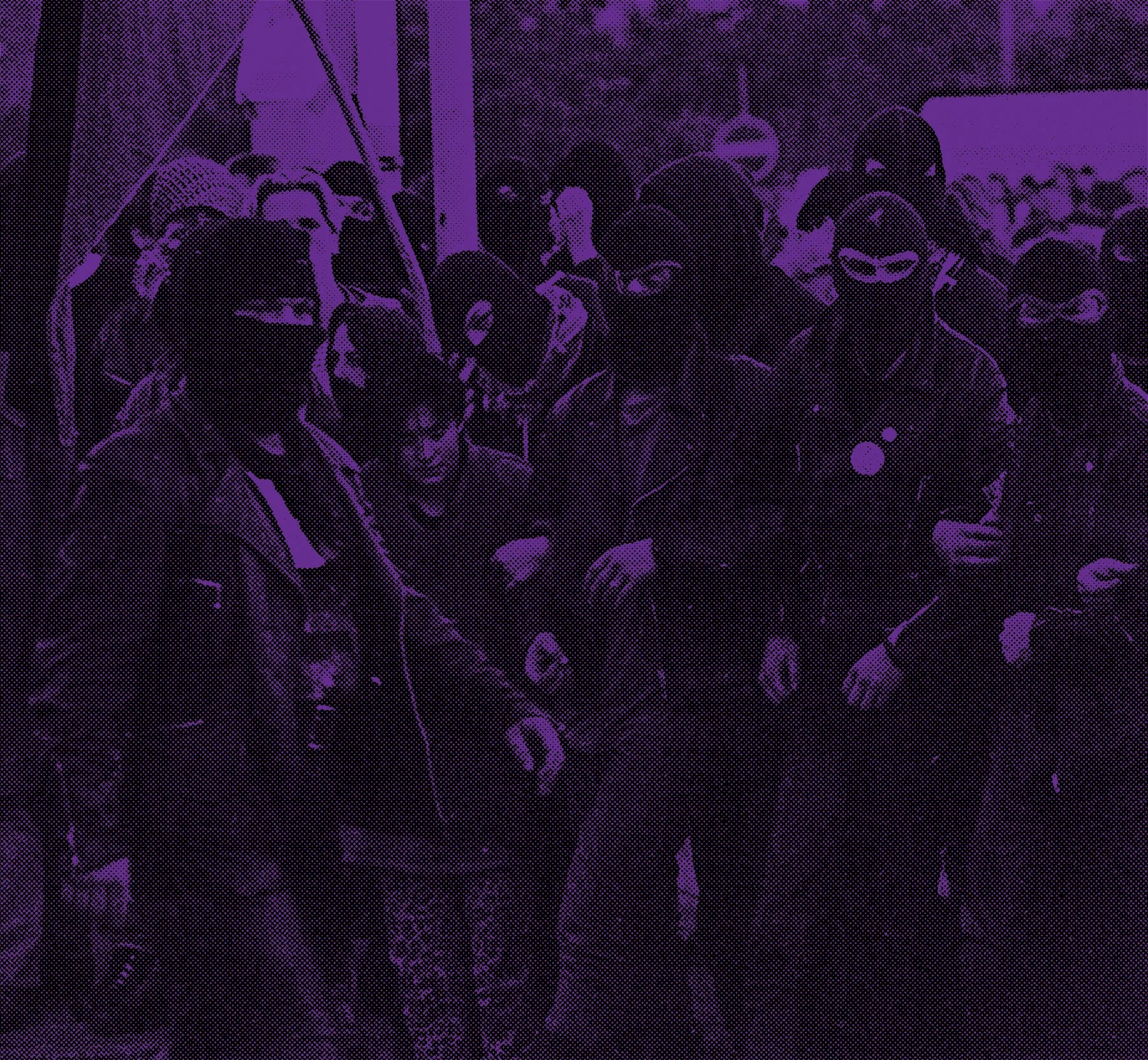
Black Bloc, Berlin, 1990
Psychoanalysis and capitalism are full of twinned oppositions: love & hate, cost & benefit, gain & loss, eros & thanatos, growth & decay. The uneasy relation between the two discourses exists perhaps because capitalism, especially in this necrotic late stage, is always trying to get away from the loss, the deficit, the impoverishment. It’s a kind of projective process—if the other loses, you don’t have to bear any loss yourself; if you can project all the feelings of desperation and scarcity onto or into the person, neighborhood, co-worker, company, or country with less than you, you can experience gain, wealth, and abundance, and only the other suffers. In psychoanalysis, and in the psychoanalytic study of the group, a defense like projective identification is understood as just that, a defense against a feeling or an internal state rather than the transcendence of it. I am not sure capitalists understand this.
There is an important analytic idea, variously articulated (and admittedly contested by the free clinic movement), that if you’re not paying for your analysis, there is some pain that is missing. Group therapies are measurably as effective or more effective than individual treatment, but still cost less. There are a number of ways to think about this—most concretely, perhaps, people are less interested in group therapy. Another way to understand it is that in any group, rather than in dyadic treatment, the pain will come, even if there is no fee.
Why does the pain inevitably arrive in the group? There are many ahistorical answers, but perhaps we should answer with regard to the here-and-now. In the neoliberal organization, group life is both attacked and weaponized. Part of how this happens is that the relational is commodified. A friend who works at a big tech company tells me of a performance review process where she and her colleagues evaluate one another several times a year. People are rehired or let go based on their scores in these peer reviews. Since the jobs are competitive, especially as you go up the ladder, she says people are incentivized not to voice any issue or leave any trace of an interpersonal problem, since either of these activities may result in being downvoted by a colleague and losing one’s position. Thus, the relationships between colleagues who spend forty to eighty hours a week communicating are impoverished.
Another friend tells me about an effort to organize a union at a restaurant being met by management with friendly, well-related, union-busting consultants. The thoughtful, conscientious union-busting consultants, my friend said, expertly facilitated a process where the employees met in a group. People really showed up emotionally and earnestly shared their struggles with their workplace. It was a moving experience, she said, in which people felt close and spoke about their challenges and their wishes. Following the circle, the consultants left, and no unionization occurred.
This energetic signature of neoliberal group malady is everywhere. At the psychoanalytic institute where I train, there’s an idea that staff should teach the Tuesday night seminars for candidates uncompensated. Historically this was uncontroversial, but as of late people grumble about it. The seminars are relatively informal (i.e., we do not write papers for them) and are six weeks long. I can imagine a past life of the institute where people often enjoyed teaching them. As a candidate, I co-teach a seminar in part because I think it will be fun, in part in service of my learning, and in part to demonstrate my competency. As I spend my free time reading to plan and prepare for class, I am aware that I am doing uncompensated labor. My supervisors speak lovingly of a time when candidates would all go out for a drink after these seminars on Tuesday nights. The bar where they used to go, across from the institute, of course closed during COVID. And anyway, the candidates in my cohort are too busy to go out for a drink on Tuesday night, myself included. I see a private practice patient in that hour instead of fraternizing with my colleagues. This illustrates the basic dilemma: Group life is withering even as we need it.
“I believe groups—and the things they can teach us and enable us to do—stand between life and death.”
These vaporous problems of group life relate to surrender and affiliation, surrender to affiliation, the modicum of self-erasure required to belong, which we know is pleasurable, intoxicating, and which also becomes burdensome, which we want to shake ourselves free from—for what? So we can have our time back, our privacy back, our curated, bounded personas that are untainted by the ways our group comrades actually know what we’re like, what our problems are. These affective contradictions live at the level of abstraction, theory, metaphor—and then also take place in our hearts, our bodies, in feelings of longing, restlessness, aversion when we are in another fucking meeting or Zoom call or email thread.
I believe groups—and the things they can teach us and enable us to do—stand between life and death. What I mean is plain: The solution to the “loneliness epidemic” is togetherness, and the solution to technofascism is social movements that win, and we need both of these solutions together in a double helix. The path forward involves understanding groups, facing our legitimate fears about them, and understanding what gets in the way of thriving group life. We need lots of groups, more and more of them, and we need to learn how to make better groups so that we can better surrender to them, especially their socioemotional and reproductive aspects, i.e., taking care of each other, so that they can do better work and take better care of their members, reciprocally, back and forth.
*
There are five dilemmas or contradictions related to the life of groups today. I hope you can find yourself and your groups in them.
Reenchant the Catastrophe
We are living in a profoundly dark moment in history in which all aspects of existence seem threatened and potentially threatening; this landscape can affect how we see group life and group work; we can be pulled to see them as worse, more draining, and less useful at the same time. In order to mobilize in this moment, we are actually called on to reenchant the Left through what I think of as reverse fatalism, in the face of the tremendous pull to shut out the world and its possibilities in the current conjuncture.
The Dutch historian (turned progressive activist and motivational speaker) Rutger Bregman wrote a book called Humankind: A Hopeful History, which struck a personal chord with me. His argument, at the risk of being glib, is how huge parts of twentieth-century psychology were kind of click-baity, scientifically flimsy, and not descriptive of human life as it is. This book felt like a special gift to me when I encountered it, partly because I am an American psychologist and so I trained with a lot of people who believed that Philip Zimbardo and Stanley Milgram were the most important political philosophers of the twentieth century. Bregman is not a psychologist nor an avowed leftist exactly, although people on the right hated this book. Humankind traces how, in the twentieth century, through an array of prison experiments, popular narratives like Lord of the Flies, and sensationalist news media, we came to the possibly dubious idea that people, categorically and necessarily, are not merely capable of great brutality but in fact inclined toward it.
He then challenges this hypothesis through a kaleidoscope of examples, including a real-life Lord of the Flies scenario where a group of teens stranded on an island developed a subsistence commune and lived together happily for over a year with no supplies or contact with the outside. He goes on to share biographical information about William Golding, the author of Lord of the Flies, describing him as an abusive, alcoholic, deeply unhappy person. He retells the story of the murder of Kitty Genovese—a canonical citation in social psychology 101 syllabi as an example of how bystanders don’t intervene—documenting how her neighbors actually did respond to her cries and corrects the historical narrative (she died in the arms of her friends who came to her rescue). He retells the story of the Stanford Prison Experiment, demonstrating that the narrative of unbearable horrors taking place was largely sensationalized. In particular, the heavily documented and televised “mental break” of one of the participants was actually a student who reported later he was bored and annoyed by the charade and wanted to leave so he could do his homework, resulting in him pretending to “go crazy.” Lastly, he talks about how Robert Martinson, a sociologist who popularized the idea that the rehabilitation of incarcerated people wasn’t possible, recanted this idea. When the world took little notice of Martinson’s about-face regarding a lurid and damning idea about human nature, Martinson took his own life.
Bregman’s tapestry of arguments doesn’t refute the reality of genocide (but genocide is one false proof frequently offered for the idea of an inclination toward evil in the twentieth century), nor the reality of private prisons and detention centers in the US and abroad, nor the various for-profit wars being waged by America and its various imperialist tentacles. But part of what it does do is explain how the mythology of evil upholds these mechanisms. We saw this when the texts from J.D. Vance and Pete Hegseth concerning an attack on Yemen leaked in April 2025—our leaders are clearly warmongering and profiteering, and yet they also believe themselves to be waging good in the face of evil. Perhaps one could only justify drone bombing villages or abducting young parents if one felt in some way that these people were dangerous and harmful, and it is this idea of neutralizing some kind of threat that animates wars, broken windows policing, border security, and, perhaps, sadly, radical organizers who can’t collaborate because they are playing what Claude Steiner in 1971 called “Lefter Than Thou” games.
Group relations posits a largely Kleinian and twentieth-century view of group life, where competition and envy and destructiveness wait relentlessly in the wings. Bregman makes it quite clear that the Hobbesian view of the world is both historically and materially constructed, as well as elective. To deelect it is in part to imagine other historical and material conditions, ones which would produce overwhelming evidence of radical possibility.[1] Of course, these are not our conditions. We are being devoured, like Saturn’s sons in the Goya painting, by the roving whims of the owning class and the withering husk of an imperial military project. Especially as we face greater resource scarcity and rolling shocks and crises, I think the ideological bedrock of resistance is enchantment with the human capacity to thrive, not in some abstract fantasy, but in real examples in real life, right now. To surrender to our groups and to believe in their work and their ability to protect us and empower us in the face of what is, in this time, is also to believe in the possibility of their goodness, and therein to believe that the pocket of goodness that a group can foment can be turned inside out to form a sail.
For me, all of this amounts to an injunction to study perpetual peace, study collaboration, study what works. What doesn’t work is everywhere, we will learn about it just by trying to make a group or have a meeting. To incant reverse fatalism, this sense of possibility or promise, is incredibly important and also very painful in this moment in history. It’s also not everyone’s predisposition, but I think searching for, investing in, and taking seriously stories where the group prevails—in the face of, rather than in denial of, the horrifying current conjuncture—is one part of the equation.
2. The Eye of the Scapegoat Is Like the Eye of the Guru; It Reflects the World
The people we disagree with the most and find to be the worst exemplars of both our own and other tendencies are also some of our best teachers about the unconscious lives of our own groups, especially as relates to aversion.
Gary Gemmill, a management professor who, as far as I know, was not a particularly politicized person, but worked in the group relations tradition, wrote, “As [Muktananda] stated: ‘There is a great mirror in the Guru’s eyes, in which everything is reflected.’ What is true for the guru is true for the scapegoat. There is a great mirror in the eyes of the scapegoat in which the intrapsychic conflicts of the group membership at large are interpersonally reflected.” One way that the world, with its real threats of contamination, domination, fracture, and attack, affects a given group has to do with scapegoating. We can find ourselves safer— in our group, in an unsafe world—if we find and excise bad members.
In the decidedly un-PC 1973 existential romp The Denial of Death, Ernest Becker talks at length about “fetishization.” Following the work of Otto Rank, Becker describes fetishization as the adaptive ability to narrow down the scope of experience in the world in order to only take in some things, rather than attempting to take in the whole totality of things, a process Becker believes is a tool for sanity. Failure to fetishize, or to contract the lens of one’s experience, leads to neurosis. Because a neurotic can’t fetishize, they attempt to face the totality of the world and their tiny place in it, a kind of boggling experience that afflicts the too-open-minded among us. One can hear in the words of a depressed friend who feels unable to act due to feelings of painful insignificance—as well as in the expressions of someone inflated with grandiosity who feels they were put on the earth to re-make everything—the failure to fetishize.
“Struggling to take in the whole of the world, tortured by our smallness in the face of injustice, people who are leftists are also neurotic, burdened by the weight of sheer everythingness, and, in particular, everything wrong.”
Rank and Becker argue that one way neurotics try to address the terror of everything that comes with failure to fetishize is by making art. “The creative person is too full both of himself and of the world,” Becker says, showing how artistic practice, as a solution, comes with its own perils. Encountering these words, I was struck by the echo between the creative’s efforts to address their neurotic dilemmas through a grandiose undertaking and the at-times bizarre-seeming psychology of the political radical. Struggling to take in the whole of the world, tortured by our smallness in the face of injustice, people who are leftists are also neurotic, burdened by the weight of sheer everythingness, and, in particular, everything wrong. Our moderate siblings and classmates are better able to tolerate the vanilla mundane, not be angry at the teacher, the administrator, the police, the military. We leftists can’t do this.
Perhaps we do fetishize, however, in our groups, and I think we do this in particular by scapegoating those adjacent to and within our groups—those outside of our tendency, the people who would be our peers or collaborators if we didn’t find them to be reminiscent of ourselves. If the eyes of the scapegoat reflect everything in our group, we prefer not to look them in the eyes and instead chase them out of town.
I once consulted for a group of white anarchists who ran a prison education program. They were upset because they had been accused of being too white by—you guessed it—other white anarchists. I remember a meeting where one of them said, “They’re treating us like we’re the Red Cross or something.” This was in 2016, so it was not unheard of for an anarchist group to not want to be seen as too white. When I think about it now, in retrospect, I think about it psychologically, I wonder about the granular reasons the anarchist group members would have given for not wanting to be identified with the Red Cross. Perhaps because they were horrified at the possibility of being seen as establishment, coopted, linked to the military, perhaps too organized, too corporate, etc. You can listen for this in your group each time this kind of projection gets voiced. We identify or disidentify, fetishize or narrow the scope of our lens, by locating ourselves in relation to another group. When this happens, it’s a tiny lesson about what we think we’re doing, what we’re afraid we might be doing, and how we’re managing to scrape together an identity in the face of totality. Really clocking what’s in the eye of the scapegoat is a kind of surrender, a kind of reality confrontation, and I think it’s courageous to try to do it.[2]
In Rituality and Social (Dis)order, a book about medieval carnivals, Alessandro Testa writes about literal scapegoating:
[I]n European popular culture, it is Carnival itself or its ritual equivalent, the zoomorphic figure, that is the bearer of the negativity in need to be collectively atoned for and ritualised; it is the Carnival of the feral animal-man which brings the guilt in the cultural space of the city, the town, the piazza; it is him who is guilty of a variety of disparate crimes duly reported in the sources (amongst which are gluttony, theft, beastly acts, bad weather, infertility, and many others) for he must be punished[.]
Testa contrasts this with another kind of scapegoat, perhaps more familiar:
[T]he poor goat of the biblical tale was obviously not guilty of anything; it was just the (innocent) carrier of the collective sin, which was literally (according to the scripture) put upon it. In fewer words, the carnival scapegoat brings the guilt into the community and is punished for that, whereas the innocent biblical scapegoat carries the sin out of the community.
Groups use scapegoats in both these ways—to try to mark something that’s internal and contaminating and to push something outside that’s different. I do it all the time, and you may find that you do it, too. My point is not that it’s wrong to do this, but, after Gemmill, if we can understand what we are doing when we do it, we can learn a lot about our unspoken assumptions and ideas. Maybe we can even be a little less neurotic and destructive in our groups, even if we need to ask someone to leave or differentiate ourselves from a sibling organization.
3. Asking for More Because We’re Getting Less
In the neoliberal diffusion of institutions, organizations and groups provide less and ask more, depleting individuals and leaving people needing more from groups that provide less. This contradiction is counterposed with another, namely that we likely need left organizations that are more disciplined and demanding. Part of this entails having groups that can make deliberate choices about which needs of members will or won’t be addressed by the group.
Since Marx, at least, people like to use metaphors of vampirism and parasitism to talk about the kind of torturous qualities that emerge in relationships that aren’t working that well, where it feels like something is being taken without reciprocity, a kind of lack of just exchange.[3] The idea suggested by these metaphors is that if something could be given back, the parasitic could be restored to symbiosis; the feeling is that we’re not getting enough. In Attention and Interpretation, Bion talks about the different ways a container can hold the contained: symbiotic, commensal, or parasitic.
I’ve written about how a feeling of being drained of one’s vitality by authority systems and infrastructure is one of the central dimensions of the world in this time, and there’s a specific way this occurs in groups.4 Sometimes it can feel like a who-extracted-from-whom anxiety that leaves people feeling like groups are stealing their time or energy or leaves groups feeling like members are exploiting resources. Underneath this is just a profound reality of material scarcity and psychic precarity (and maybe vice versa, too).
It’s safe to assume that if you form a group with people in it today, they don’t have everything they need in their lives. They are probably facing material lack in some way, and if they have their material needs met, they’re probably alienated. It’s good to know this because it will all bubble into your group in various ways, the things people need from the group and the ways they want it to be.
This is actually not bad/can be beautiful if the group can do some of those things for people, but it’s also hard because groups, too, are under more pressure. I think sometimes it can feel like the “who-extracted-from-whom” angry group is just an intrinsically bad group. However, Kurt Lewin wrote about how we tend to think of other people, and therefore groups, as static entities with intrinsic qualities.[5] Part of the insight of Bionian thinking and group relations is the understanding that we regress when we think of the group as having fixed qualities—for example, imagining that the group has a savior quality or a devouring quality.
“It’s safe to assume that if you form a group with people in it today, they don’t have everything they need in their lives.”
What Lewin pointed out, which is so helpful, is that it’s actually the relationships between parts of the group that matter, rather than the intrinsic qualities of the group (e.g., a vampiric group, a savior group) or even the intrinsic qualities of any one member (e.g., the too-demanding one, the too-withholding one, the perfect one, the vampiric one). Part of working at this dilemma of a world where members of groups ask for more because they’re getting less means both talking really openly about what people need and what the group can and can’t provide and being able to talk openly about relationships between members of the group.
Being able to say something about the vampiric or parasitic feeling is sometimes quite painful or quite intimidating, but if the group members have capacity to bear one another’s feelings and also to understand that the feelings co-arise from broader dynamics, rather than just because one person is a pill, then sometimes it is possible to examine and make use of the feelings, rather than merely acting them out. If members are capable of saying, “We can meet some needs people have, but not all needs” and then clearly set those limits, the group can work at how to be symbiotic enough when the parasitic feelings start to fly.
4. Tolerating Aggression in a Violent World
In a time when violence and fracture threaten to engulf all of sociality, we actually need groups that can tolerate interpersonal aggression, rather than groups that are phobic of it.
I was walking through a parking lot of a grocery co-op in Great Barrington, MA, recently, which, if you don’t know, is a well-to-do hippie town, and I saw a woman with a tote bag printed with, in big letters, a list of the following words:
LOVE
COMPASSION
KINDNESS
EQUITY
JUSTICE
I felt enraged. I was like, “What about being mad? How can you have justice without being mad?” My parents were the type of radicals who would have gone up to the person and given her a hard time in the parking lot, but I am not that type of radical, at least not in GB, at least not in the middle of day. Maybe I would hassle an acquaintance about this, maybe in a more intimate setting. I say this because aggression is important and is part of justice, obviously, but also part of healthy groups.
I will say as a caveat that I am not that comfortable with my own aggression. This is funny to say, because I can happily be quite bitchy when I’m not thinking too hard about it and, in some situations, I can set hard boundaries or express annoyance in a kind of blowing-off-steam way, when I have some steam to blow off. But I often feel guilty afterwards, and at times I avoid situations where I might express something that could lead someone else to feel like I was annoyed, and this generally does not work in my favor. I have worked on this in analysis. I think this is one way analysis, especially group analysis, whether in a process group or a group relations setting, can help people become better revolutionaries, because it helps us become less phobic of aggression.
There are two things I mean when I say aggression. One is probably what people are picturing: getting mad, being mad, saying “That pissed me off,” or “I really disagree and I’m kind of annoyed we even are talking about this,” or maybe just rolling your eyes or turning your camera off, which I would argue are forms of passive aggression.
There is another thing that I think is part of aggression in groups, about which people can also be phobic, but which can really help groups. This other kind of aggression and the capacity to tolerate it is what I want to call, broadly, discipline. In analysis, this kind of aggression can sometimes take the form of holding the frame. In group space, discipline can look like ending the group on time, keeping discussion on topic, or clearly framing the task of a meeting. It is naming when the meeting is off task. It also can be saying “Hey, we’re off task again on this same thing and it makes me feel X.” While this might sound simple and maybe even kind of uncontroversial, I imagine all of us have had moments in groups when this kind of adherence to frame feels like the more hostile kind of aggression.
Anyone who has been loved knows you can be held too much or not enough, and I think there’s a way that discipline provides a kind of holding, even if it is by putting the brakes on there being too much holding. Love is to affiliation as hate is to discipline, and that’s why discipline is important for a group to be healthy. In Plato’s Symposium, Phaedrus talks about the army of lovers:
And I say that a lover who is discov ered doing any dishonorable act, or submitting through cowardice when any dishonor is done to him by another, will be more pained at being discovered by his beloved than at being seen by his father, or by his companions, or by anyone else. The beloved, too, when he is found in any disgraceful situation, has the same feeling about his lover. And if there were only some way of contriving that a state or an army should be made up of lovers and their beloveds, they would be the very best governors of their own city, abstaining from all dishonor, and emulating one another in honor; and when fighting at each other’s side, although a mere handful, they would overcome the world. For what lover would not choose rather to be seen by all mankind than by his beloved, either when abandoning his post or throwing away his arms? He would be ready to die a thousand deaths rather than endure this. Or who would desert his beloved or fail him in the hour of danger? The worst coward would become an inspired hero, equal to the bravest, at such a time. Love would inspire him. That courage which, as Homer says, the god breathes into the souls of some heroes, Love of his own nature infuses into the lover.
The thesis is that the power of love instills discipline in the lover, that to feel love and protect love involves marshaling a kind of disciplinary stance and transforms the character of undisciplined individuals. I don’t think this is actually necessarily true about pairs in groups, but if you think about a kind of affiliative love for the group as a whole as the subject of Phaedrus’s words, you can imagine something of what I believe about the link between affiliation and discipline.
On the other hand, in dyads and at the group level, I think love can sometimes also make people fear the realness required to be in effective groups together. I once worked closely with two people in a couple, and when they disagreed, they collaborated pretty well. I noticed when they started to join with each other around something that they stopped thinking as clearly and became undisciplined. I think if you have a lover in your group, you should practice disagreeing with them, and you should also wonder what work this does on behalf of the group, for the two of you to model being in love and disagreeing. Probably there are also couples whose disagreement is damaging to a group, but I have personally seen this less, and I would wonder about the health of the couple if their disagreements were hurting a group.
In general, if you have a love relationship and you and your lover want to be revolutionaries, learn to say painful things to each other in loving ways to help one another grow. This is what the revolution needs. You can call such a speech “a consultation.” If you are in a group, learning to hear painful things that others say and learning yourself to say lovingly things that are difficult to say and hear are vital developmental tasks. There are lots of great ideas about how to learn to do these things, but I will simply say here that if you are not saying the thing, I hope you do try to say it, gracefully and humbly, some day and in some way, especially in your group, because your group cannot grow and develop if you cannot in some way talk about the thing.
5. Your Character Pathology Makes the Medicine
Anything you believe politically probably says more about you than about the political truth. The question then becomes, in the face of all these other contradictions, how to mobilize what we know about ourselves in order to ride the edges of these dilemmas, rather than be swallowed by them, toward a just world.
How you feel about aggression in groups (both in terms of keeping time and “saying the thing”) probably has something to do with your character, as well as your valence in a given group (i.e., the things that get projected into you by others). Again, this is where knowing something about yourself helps you be a good friend to a group, and having had a life in groups also helps you know yourself. What I specifically want to mark here is that knowing your own liabilities—even if you want to call them pathologies—can help you find your way forward in a group.
“In general, if you have a love relationship and you and your lover want to be revolutionaries, learn to say painful things to each other in loving ways to help one another grow. This is what the revolution needs.”
My partner Early Shinada told me a story about a woman who has an abortion boat that goes to countries where abortion is illegal, picks up women in port, goes out to international waters, performs abortions, and then brings the women home. Early was reading about oppositionality and difficult interpersonal styles at the same time as they were learning about this woman, and they told me they had the feeling of recognizing this activist’s extremely oppositional-to-the-point-of-combative interpersonal style as they learned about the valor and effectiveness of her work. It’s remarkable! they said, explaining that this woman had mobilized her character pathology to do change work.
I brought this story to a supervisor in reference to some of the patients we both work with, and when I said something about mobilizing one’s character pathology in order to make positive change, my supervisor replied, “I think that’s probably the best any of us can hope for in our lives.”
This idea links back to my point above around how radicals are probably neurotic in the Rankian sense of not being able to fetishize or condense reality. There are probably all these other ways in which radicals are neurotic, e.g., we overidentify with oppressed people or get too angry at authority figures or are pathologically drawn to the ways we fantasize the violence of the new era. Or, on the other hand, we are so phobic of aggression in violence that we can’t tolerate the existence of police or a military. I want to be clear that I am not saying we should tolerate the existence of police or militaries, but it’s an interesting psychological question why so many people do tolerate this and we cannot.
Part of the way groups subjugate their members is by asking us to use our character pathology to help the group rather than to harm it, and sometimes this is annoying because it would be easier and more immediate to use it to enact the closer and more available script in a way that hurts the group. I imagine some readers can immediately call something to mind here and others are foggier, and trying to get clear about one’s own patterns in this regard is exceedingly useful.
This particular contradiction about mobilizing character pathology speaks to a dilemma I’ve been having with my own spirituality and politics. I’ve been in full-time psychoanalytic training for the past two and a half years, spending fifty-plus hours a week in a soup of interpretation, the cult of the psyche. This training context has gently disassembled my political and spiritual life. Being a communist or an anarchist, a Buddhist or a Jew, all started to feel sort of holographic and spectral, like transient rays of light refracted off the shifting surfaces of a characterological Rubik’s cube, the real components defined by the domains of early life, personality organization, object relations, and defenses. In other words, some of the things I held dearest as aspects of how I knew myself, especially related to political tendency, started to feel vaporous: less about political reality, more about psyche, and perhaps, if one was lucky enough to belong to a group, whatever the group happened to elicit in you.
Part of the thinking I’ve presented here is an effort to look at the political not just on its own terms, but to invite in the psychoanalytic (despite its perilous sometime-complicity with the status quo) and to describe the specific ways that psychoanalytic thinking can be helpful for group life, especially radical group life. This thinking means to me, personally, that to reclaim my politics from the influence of psychoanalysis involves integrating the analytic lens without neglecting our most radical demands.
I want to end with a rather long quote from Bion about the kinds of problems that arose when he first started experimenting with leaderless groups as a way to run a hospital for men with what were then called “war neuroses” (a term incidentally coined by Ernst Simmel, who was a socialist). Bion is basically describing what happened when they stopped running the hospital like a military unit where everyone was ordered around in highly structured ways and had to clean and march all the time and instead started running it more like a commune, where people could self-organize around tasks like cleaning and recreation and could also just sit around.
Shortly after the new arrangement started, men began to complain to me that patients were taking advantage of the laxity of the organization. “Only 20 per cent,” they said, “of the men are taking part and really working hard; the other 80 per cent are just a lot of shirkers.” They complained that not only was the rest-room [lounge] often filled with people simply loafing, but that some men even cut that. I was already aware of this, but refused, at least outwardly, to have its cure made my responsibility. Instead, I pointed out that, at an Army Bureau of Current Affairs meeting some weeks before, the discussion had at one point centred on just that question—namely, the existence in communities (and the community then under discussion was Soviet Russia) of just such uncooperative individuals as these and the problem presented to society by their existence. Why, then, did they sound so surprised and affronted at discovering that just the same problem afflicted the training wing?
This cool reply did not satisfy the complainants—they wanted such men to be punished, or otherwise dealt with. To this I replied that no doubt the complainants themselves had neurotic symptoms, or they would not be in hospital; why should their disabilities be treated in one way and the disabilities of the 80 per cent be treated in another? After all, the problem of the “80 per cent” was not new; in civil life magistrates, probation officers, social workers, the Church, and statesmen had all attempted to deal with it, some of them by discipline and punishment. The “80 per cent,” however, were still with us; was it not possible that the nature of the problem had not yet been fully elucidated and that they (the complainants) were attempting to rush in with a cure before the disease had been diagnosed? The problem, I said, appeared to be one that not only concerned the training wing, or even the Army alone, but had the widest possible implications for society at large. I suggested that they should study it and come forward with fresh proposals when they felt they were beginning to see daylight.
In the UK more than any other country, recovery programs, from boarding schools for traumatized children (what were called orphanages in the nineteenth century) to programs for people just out of prison or groups for recovering alcoholics, are run on this Bionian model, today called the “therapeutic community,” where people struggle with the 80/20 question and have to study why it is and take each other to task.
By contrast, in the ’90s, the NIH, hoping to make everything cheaper and more efficient, sought to defund these programs and requested hard research demonstrating their effectiveness. The results were staggering; it turns out that being in a democratic community where people have some authority over their situation and are real with each other about how they experience one another contributes to healing and development with significantly more success than many of the other kinds of systems we have for people struggling in these ways, e.g., parole, twelve-step groups, regular orphanages.
The path of reverse fatalism—the invitation to keep at transformation, or at least light off the flare of the possibility, despite all the perils of group life—is a daring one. To make good on that dare, the group is the way.
[1] I am reminded of Eve Sedgwick, who writes in her essay on paranoid and reparative reading, “Because the reader has room to realize that the future may be different from the present, it is also possible for her to entertain such profoundly painful, profoundly relieving, ethically crucial possibilities as that the past, in turn, could have happened differently from the way it actually did.”
[2] I borrow “reality confrontation” from Maxwell Jones in his work in therapeutic communities in UK hospitals.
[3] I draw this from Peter T. Coleman’s beautiful book on systems and conflict, The Five Percent: Finding Solutions to Seemingly Impossible Conflicts.
[4] See “Loving the World on Fire: On Perverse Dependency,” Parapraxis, www.parapraxismagazine.com/articles/loving-the-worldon-fire.
[5] Something the writer Early Shinada recently discussed with me.