
The Clinic’s Counterhistories
Uncovering Disavowal and Recovering the Radical
Ramsey McGlazer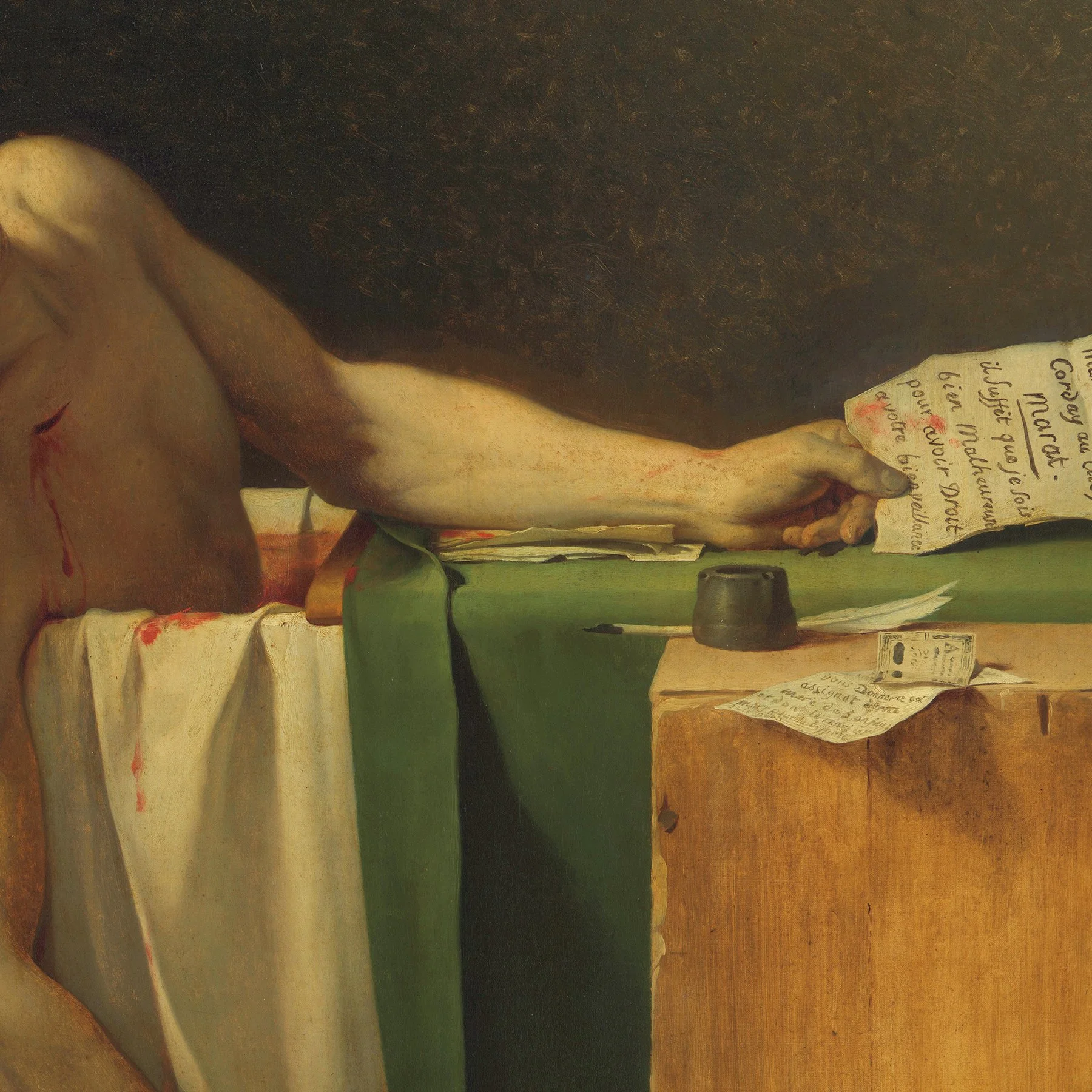
Jacques-Louis David, La Mort de Marat (detail), 1793
In her 1924 essay “The Rôle of the School in the Libidinal Development of the Child,” Melanie Klein tells a story the way only she can, combining confidence, pithiness, and phallic matter-of-factness. In one of several clinical vignettes included in the essay, all drawn from her work with children suffering from academic inhibitions, symptoms, and anxiety, Klein turns to the case of Fritz, a fast learner for whom “the ‘Excellent’ written by a schoolmistress on a good piece of work was a costly possession.” Fritz lives for this kind of praise and loves school for its own sake, and yet current events keep him up at night: “On the occasion of a political murder he showed nocturnal anxiety. He said that assassins might want to attack him just as they had the murdered politician. They had wanted to rob the latter of his medals, and they would rob him of his commendation.” Klein records Fritz’s fear but empties it of political meaning; her interpretation turns sharply away from the scene of political conflict: “The medals as well as commendation and also his report signified for him the penis,” she concludes. For Klein, all of these elements of the dream point to “the potency which the castrating mother (as his schoolmistress appeared to him) returned to him.”
Remarkably, Klein manages to make a “political murder” into a non-event. Or, rather, she purports to follow her patient’s associations as they lead from an assassination back to school. On the one hand, in an essay about the psychic lives of schoolchildren, this move makes intuitive sense. On the other hand, it’s worth asking whether there might be something symptomatic (as well as inadvertently comical) about how quickly and how thoroughly “the murdered politician” is ushered offstage, leaving only, predictably, what signifies the penis.
I can’t be the only reader to have the sense, reading Klein’s response to Fritz’s anxiety, that the young patient may be quite a bit more interested in the assassination than his analyst is. It’s as if Klein were steering Fritz away from his curiosity about the political violence that first causes his sleeplessness. Surely it matters that the boy aligns himself with the politician and not his assassins: “They had wanted to rob . . . his medals, and they would rob him of his commendation.” Can we not see Fritz beginning, if only barely, to reflect on the uneven distribution of precious medals and metals? Couldn’t Fritz be kept awake by the inchoate realization that he’s caught in a system of ruthless competition or by the dawning recognition that he’s in a position to hoard “costly” commendations others can’t have? Couldn’t Fritz’s anxious insomnia, in other words, be a response to at least two kinds of class struggle, one scholastic, the other social?
In The Political Clinic, Carolyn Laubender offers a compelling account of Klein’s career that can help us make sense of this kind of interpretive move, which Laubender calls “depoliticizing.” Challenging Klein’s own characterization of her work as apolitical, Laubender studies the political effects of the analyst’s bracketing of politics and the social implications of her tendency to redirect patients’ attention, leading them away from the social and toward the inner world. Writing about her clinical work during World War II, Klein sings the praises of another child patient, Richard, because he “became capable of feeling sympathy for the destroyed enemy.” Laubender asks us to think about who this enemy is and what, if anything, makes him worthy of a sympathy that Klein sees as inseparable from identification. Because Richard will become a poster child for the benefits of the Kleinian “depressive position,” Laubender is also asking about the limits of what this position makes possible: reparation.
For Klein, this was primarily a psychic, rather than social, concept. Reparation named not a form of economic redress—not a payment made in an effort to right historical wrongs or compensate a nation for wartime damages—but rather a developmental achievement for the individual child. Following without ever fully canceling out the paranoid-schizoid position that precedes it, the depressive position in Klein’s work marks the place where a reckoning with aggressive impulses, destructive desires, and painful ambivalence begins. It is only by confronting these forces that the patient can hope to make up for them, like the child determined “to put back into his mother the good things he had robbed her of in phantasy” or the adult sculptor whose work involves “restoring and re-creating the early loved people, whom he has in phantasy destroyed.” Such reckoning is Kleinian reparation: an unending process of creative world-reconstitution, a work in the rubble left by the infant’s worst fits and the patient’s most violent phantasies.
On the one hand, the capacity to sympathize with an enemy—to see the humanity in an opponent the way the young Richard does—might seem, like Kleinian reparation in general, to be a self-evident ethical good, and so Klein’s praise for Richard’s exercise of this ability might not strike us as at all controversial. On the other hand, Laubender contends in her reading of Richard’s case history, “what [Klein] suggests . . . is nothing less than that Richard’s achievement of the depressive position and his impulse toward reparation are best exemplified by his identification with Nazi Germany at the height of a genocidal extermination.” Because Richard begins his treatment with Klein as a fledgling antifascist, or at least a British patriot, “fervently track[ing] Hitler’s advance” every day as it unfolds, the suggestion of compulsory identification that Laubender identifies in Klein’s interpretation is troubling. It implies, according to Laubender, that what matters most for Klein is the child’s capacity “to position itself as the agent of repair,” to see itself as undertaking the integrative effort to make good. The object of this reparative process, the thing repaired, becomes a matter of indifference.
Laubender argues that in Klein’s work, “reparation is separated from its affiliation with justice and valued only as an ostensibly abstract psychological orientation.” It becomes a matter of feeling that need not find an outlet in speech or action. And even if reparation were to find such an outlet, this speech or action, for Klein, would not need to be antifascist, anticolonial, or egalitarian to be worthy of the name “reparation.” In this way, Laubender concludes, Klein “extends psychoanalysis’s troubling and politically conservative tendency to sever psychological norms and ideals from their social and historical contexts in the name of scientific neutrality and objectivity.”
For Laubender, Klein’s praise of “Richard’s reparative sympathy for Nazi Germany” lets us see this tendency with particular clarity. Indeed, it is hard to imagine an enemy less worthy of sympathy or an object less worthy of repair. This is a strong reading of Klein, though it also arguably runs the risk of exempting Richard’s “patriotism” from critical scrutiny. To be a British nationalist under conditions of empire was not necessarily to be an antifascist in the broad sense, even if it meant, as it did for Richard, opposing Hitler. Still, Laubender’s claim about Klein remains convincing: Repeatedly, Klein rewrites group histories as stories of individual intrapsychic strife.
“Laubender shows that psychoanalysis has always been political, even when and where, as in Klein’s consulting room, it has least wanted to be.”
Klein is only one of the many analysts discussed in Laubender’s study, which shows how this tendency—a drive to depoliticize that in fact serves specific political projects—was sustained and periodically challenged by a range of practitioners working in the United Kingdom and some of its former colonies. All the case studies in The Political Clinic are persuasive, but Laubender’s reading of Klein’s theory of reparation stands out as especially far-reaching in its implications. It will prompt readers to reassess not only key strands of Klein’s thought, but also elements of her reception. To be clear, this need not mean throwing out the Kleinian baby with the conservative bathwater. It can instead mean rereading Klein’s work with more curiosity, more discernment, and an eye to the political questions that she tends to sideline or render strictly psychic—like Fritz’s question about his hard-won good grades and Richard’s about the spread of fascism.
*
The Political Clinic is a capacious history, moving from the work of Anna Freud in interwar Vienna to the efforts of some analysts to address the aftermath of George Floyd’s murder in the United States after 2020. Along the way, Laubender studies a number of approaches and resistances to psychoanalysis and contends with an impressive range of clinical experiments, from Anna Freud’s child analysis, centered on “the judicious embodiment and exercise of authority,” to Wulf Sachs’s effort to practice antiracist psychoanalysis in South Africa in the 1930s and 1940s; from D. W. Winnicott’s way of “making the mother’s reproductive labor central to the recreation of national identity” in postwar Britain to Thomas Main’s reliance on “social and sexual eugenics” in the construction of therapeutic communities; from John Bowlby’s recasting of “the mother as engineer of (national) security” to “ongoing work,” on both sides of the Atlantic, “to reimagine psychological care along more progressive lines.”
Each chapter studies an attempt to set psychoanalysis to work in advancing a social mission, whether implicit or avowed. Many of these clinical efforts run aground and, for Laubender, this happens at least in part because official psychoanalysis tactically denies its own political aspirations and effects, enjoining clinicians to sustain the fiction of neutrality. This injunction leads to what Laubender calls “the spurious separation between practice and politics that has long haunted the Anglophone psychoanalytic tradition, especially.” The Political Clinic seeks to undo this separation even while it explains how it formed. In other words, Laubender shows that psychoanalysis has always been political, even when and where, as in Klein’s consulting room, it has least wanted to be.
In her epilogue, Laubender identifies the process that “mask[s] and mystif[ies]” the political work of psychoanalysis as disavowal. For her, psychoanalysts both can and cannot see, both do and do not know, the inescapably social and political situation they are in. Laubender’s diagnosis also suggests that analysts might draw on their own clinical vocabularies to address the field’s history and its current predicament. “Ironically,” Laubender writes,
psychoanalysis itself is perhaps the best cartographer of the dangers of disavowal since, through the perverse operation of simultaneous knowledge and denial, disavowal has an unparalleled power to bind potential transformation to conscious recognition, refusing change on the basis that knowledge is already both known and unknown and therefore not available for conscious assimilation.
There is something at once virtuosic and frustrating about this sentence, which assigns disavowal—rather than, say, analysis—“unparalleled power.” It’s as if we could never extricate ourselves from the syntax that ties “potential transformation to conscious recognition” and so thwarts radical social change. It is not a mapmaker’s job to locate an exit, only to limn an impasse. But is this analysis? Or rather, is it the best, or the most, that we can hope for from analysis? What other aspirations and itineraries of psychoanalysis fall away in this version of its history? What counterhistories of the clinic might this understanding of disavowal’s intransigence and inevitability prevent us from seeing?
*
As Joan Copjec’s work reminds us, it is a strength and not a weakness—an affordance, not a shortcoming—of psychoanalysis that it puts us in touch with lapsed possibilities, forgotten resources, and still-available alternatives to the historicism that remains hegemonic in so many fields of study today. With its attention to the messages that the unconscious sends; its insistence that, in a world of machines, we address the soul; and its interest in what Freud, defining transference, called the “piece[s] of repetition” that recur in every present, psychoanalysis teaches us that we are not reducible to or ever fully flush with our contexts. A gap separates us from the social world that always shapes and alters us. This gap is the site of the other scene that is the unconscious. And it is unclosable. The psychoanalytic clinic is, among many other things, a place for studying the implications of its openness. In Disavowal, Alenka Zupančič argues that in the clinic and beyond it, we should learn to see that “the other side of the crisis” of the present “is a scene of continuous, ongoing struggle.” Such struggle is, Zupančič argues, what disavowal prevents us from seeing. “When you perceive or learn about something and disavow it,” she writes, “it is because this something has the capacity to change reality for you.” Disavowal lets us preserve a reality that it would be painful to change. For such change would be literal world change, and, as Zupančič takes pains to emphasize, transformation at this scale “can happen only in a collective way.”
“Disavowal lets us preserve a reality that it would be painful to change.”
It is possible to read The Political Clinic as an oblique meditation on the Anglophone analytic tradition’s many missed appointments with collective struggle. To be clear, this is not how Laubender frames the book explicitly, but in various places, as in her readings of Klein’s bracketing of the political or of Bowlby’s engineering of the individual, missing collectives and militant struggles briefly come into view. These are the struggles forcibly displaced by a depoliticizing psychoanalysis that centers the individual and denies the importance of the group even to the point of forgetting that the clinical dyad is itself a collective formation. They reside at the tantalizing margins of Laubender’s work.
*
By contrast, Florent Gabarron-Garcia’s A People’s History of Psychoanalysis, first published in French in 2021 and newly available in an English translation by Shuli Branson, looks squarely at collective movements. Eschewing the positivism of orthodox history and offering in its place “a history of possibilities,” Gabarron-Garcia expressly delivers a call “for another psychoanalysis,” an appeal worthy of a manifesto. His book seeks to offer a corrective to recent psychoanalytic theory and practice: “For decades, psychoanalysis has by and large been deeply and openly reactionary. Lately, the number of its retrograde stances has rapidly increased, reaching new heights of stupidity, ignorance, and bad faith.”
This kind of open, even brash, polemic will not be to everyone’s taste. It is, of course, a far cry from Laubender’s careful self-positioning and scrupulous scholarship. Still, for students of psychoanalysis, A People’s History offers a useful supplement to The Political Clinic, not least because Gabarron-Garcia attends to the long and living history of radical psychoanalytic work happening outside the Anglosphere. Beginning with “Freud’s plea for a free psychoanalysis throughout society,” Gabarron-Garcia proceeds to examine Vera Schmidt’s psychoanalytic pedagogy in early Soviet Russia, Wilhelm Reich’s work with poor patients in Vienna and Berlin, Marie Langer’s travels from Austria to Argentina, Francesc Tosquelles’s clinical career at Saint-Alban and Jean Oury’s work at La Borde, and the formation of the Socialist Patient Collective in Heidelberg. Some of these figures and movements will be familiar to readers of Parapraxis; gathered together in A People’s History, they remind us of the fascinating range and the intercontinental reach of psychoanalysis’s radical history.
Gabarron-Garcia makes an especially impassioned case for Reich’s rehabilitation. The renegade Reich becomes, for him, the bearer of the “revolutionary tradition” within psychoanalysis. Gabarron-Garcia takes aim at “today’s defenders of ‘psychoanalytic neutrality’ and Reich’s detractors,” two sets of people who, he observes, are often one and the same. For Gabarron-Garcia, Reich’s expulsion from the International Psychoanalytic Society (IPA) in 1933 marks a turning point in clinical history. But he does not see this turning point as necessarily a point of no return. According to A People’s History, we are still living in the wreckage of this moment, still paying the price for Reich’s disastrous betrayal by Ernest Jones, still beholden to the “historic period of compromise” that was really an acceptance of institutional complicity: “For the affiliation of the German Psychoanalytic Society with new Nazi Party institutions relied precisely on the argument of psychoanalysis’s neutrality, at the same time that Jews and Reds were driven out of the psychoanalytic institution.”
The stakes of Gabarron-Garcia’s critique of official psychoanalysis are as undeniable as the need for a response to the current crisis. To reproduce uncritically the fiction of neutrality is to collude with fascists—or, at least, to fail to counter them. This claim was already implicit in Laubender’s reading of Klein: The doctrine of analytic neutrality, “the spurious separation between practice and politics” in psychoanalysis, can become a cover for various kinds of collaboration. With enemies like these, there can be no real neutrality. For Gabarron-Garcia, this is the lesson of Reich’s expulsion from the IPA, and it is one that we would do well to relearn under conditions of fascist resurgence. As I write, the US Department of Homeland Security is still occupying parts of Minneapolis and Saint Paul, and recent executions have revived the phrase “political murder.” Keeping us up at night, these killings may align us with Klein’s patient Fritz and put us in touch with his nocturnal anxiety. Some clinicians will still try to disavow them, but they are not only the stuff of nightmares.