
Touching Her Absence
4.48 Psychosis at Twenty-Five
Leah Sidi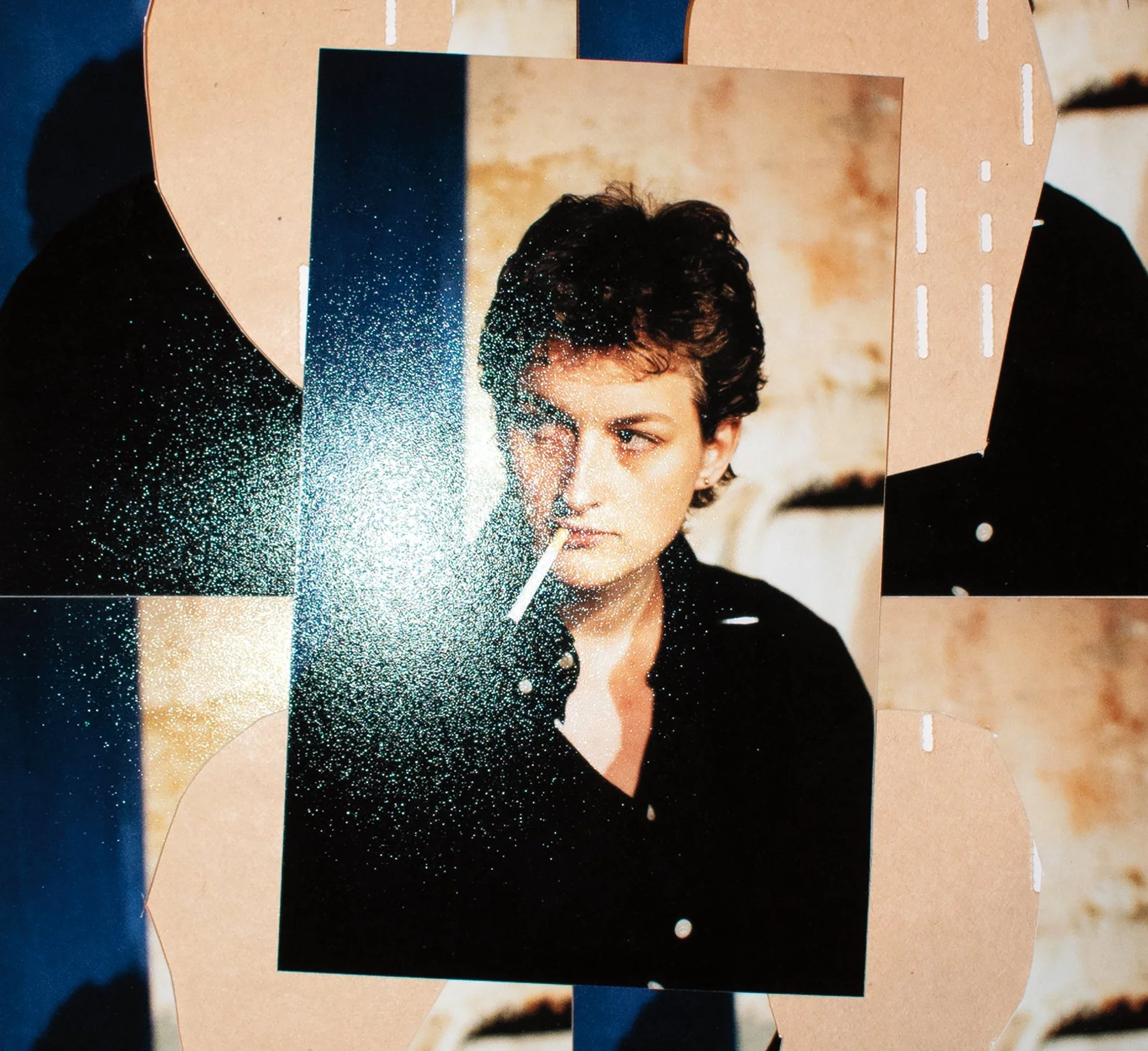
Sarah Kane, 1998, Photo by Marianne Thiele
A funny thing happened that night at the theater. On June 23, 2000, Sarah Kane’s last play, 4.48 Psychosis, premiered at the Royal Court’s Jerwood Theatre Upstairs in London. A controversial and experimental young play - wright, Kane had died by suicide the previous year at age 28. Until her death, Kane had been a talented, if somewhat marginal, figure in British theater. Four of her plays sparked critical debate, some international interest, and high-profile praise (Harold Pinter wrote her a fan letter), but she was not yet a stalwart of the London theater scene. On that night in June, however, this was all about to change.
4.48 Psychosis stages the experience of psychotic suicidality from within, where the boundary between inner and exterior life has broken down. The 2000 production was performed by three young actors, Daniel Evans, Madeleine Potter, and Jo McInnes, who slipped in and out of the roles of patient, psychiatrist, lover, and bystander. Kane finished the playtext the week before her death, having worked on it during her stay at Maudsley, a psychiatric hospital. The script is made up of carefully arranged fragments, does not assign speech, and has no dramatis personae. It weaves together intertextual references to medical and psychiatric texts, Goethe’s Young Werther, and C. S. Lewis, with rich descriptions of psychosis and dry encounters with medical professionals. It is funny, rageful, and unapologetic in its expressions of suffering. It ends with the enigmatic line, “please open the curtains,” which has been differently interpreted as a moment of death or a sign of hope.
Since then, 4.48 Psychosis has been variously staged as a monologue, a dialogue, and by larger casts in varied cultural contexts. In 2017, Julia Wieninger, directed by Katie Mitchell, performed it as a monologue at the Deutsches Schauspielhaus in Hamburg. Wieninger performed the entire play on a treadmill, walking in the rain to a bridge where she would take her life at the end of the performance. Effects, voices, and memories appeared on the screen behind her, on an otherwise dark stage. In contrast, 2016 saw an opera adaptation at the Lyric Hammersmith in London, performed by a six-person female ensemble and twelve musicians. Performances of this work have varied greatly in scale and style, testifying to an openness of the text which resists the notion of a definitive production.
Most recently, in 2025, the Royal Court, in collaboration with the Royal Shakespeare Company, proposed a seemingly identical version of the original production, with the same creative team and cast returning to their roles twenty-five years later. Digital effects such as the projection of a 1990s-style pixelated television screen were old enough to belong in an archive. While the performances of the three original cast members, now in their fifties, lent new avenues to the work, the performance’s loyalty to the original felt at times uncanny and at others, jarringly dated. Not a revival so much as a repetition or reenactment.
Given its rich and varied performance history, the Court’s decision to commemorate the mythmaking first performance so faithfully seemed a little curious. More curious still was the decision to stage the final performance of the run at 4:48 a.m., linking the performance to the time at which Kane supposedly awoke from insomnia during her depression. The final performance, then, might be understood as a form of acting out, which Freud understood as a behavior motivated by an inability to pursue analytic reflection. Tickets sold out within hours of being released. (I have never previously had so much trouble getting tickets to a Kane play.) What is this lure of authenticity, which still hangs over the first production of the last play from the “bad girl of British theatre”?
On that first press night in June of 2000, London’s theatre critics formed a spontaneous, leaderless group, almost uniformly concluding that the play gave them privileged access to the internal life of the playwright at the moment of her death. This presumably unconscious coming together posthumously turned Kane into a legend, a martyr, the Kurt Cobain of British theater, unwittingly making a woman into a myth. In spite of the details of the production, the program notes, and statements from Kane’s family insisting that the play was not autobiographical, this interpretation has hung over the play and Kane’s reputation for a quarter of a century. It points to the uncanny hold the power of the original has over the play’s fans and its status in British theatre history. Here was a performance which seemed to touch something special, something real—the suffering and even the death of Kane herself, the ghost of a ghost.
KANE AND HER CRITICS
During her short career, Kane had developed a complicated relationship with the London theater-reviewing establishment. Her first play, Blasted, caused a scandal when it was first performed at the Royal Court in 1995. The experimental drama stages a sexually violent encounter between a couple in a Leeds hotel room; the experience literally explodes when a mortar bomb goes off on stage and brings the violence of war into a seemingly domestic setting. Several reviewers condemned it in explicit and sensational terms and created a media storm by repeating the violent acts that took place on stage in newspaper headlines. A hate campaign of sorts was launched against Kane. Journalists came to her house and tracked down her parents, and, given that the play, as a Royal Court production, was funded by Arts Council England, tabloids used the controversy to argue for reductions in arts funding.
“Here was a performance which seemed to touch something special, something real—the suffering and even the death of Kane herself, the ghost of a ghost.”
Reviews of Blasted typically comprised a list of the violent or scandalous onstage acts and then speculation as to the sanity of the playwright or theater for staging such a work. Feminist critic Elaine Aston has suggested that the reviews are part of the play’s cultural existence and effect the “fabric” of the play itself. The scandalized reviews of Blasted took away elements of the body of the play (the violent acts) and re-presented them for the reviewer’s own ends, to cast the play as the “sick-making” work of an untalented, young female writer. Aston argues that the reviews thus became a repetition of the violence that Blasted itself performed on the bodies of its characters, reenacting the misogyny of the play’s male protagonist against the play and the playwright herself. Like the protagonists, the reviewers reported being left “soiled” and “weak” after the performance.
Kane retaliated by taking details of her negative reviews and integrating them into her later playtexts. She went so far as to name the villain of her play Cleansed, a torturer running a concentration camp, after the theater critic Jack Tinker, who had called her first play “a disgusting feast of filth.” As we shall see, this relationship with the press made for a deeply conflicted audience on the press night of 4.48 Psychosis, sixteen months after the play - wright’s suicide.
“A 75-MINUTE SUICIDE NOTE”
With 4.48 Psychosis, Kane once again made headlines. The most famous of these, repeated in much Kane scholarship, was Michael Billington’s review in the Guardian, which asked, “How do you judge a 75-minute suicide note?” It is a question which is repeated, in some way or another, in almost every review of the 2000 production in the Royal Court’s archive.
The archive contains a striking paradox: On the one hand, anxiety about the play’s representation of the playwright’s suicide pervades the reviews, while on the other, the quality of the production is widely disputed. Some reviews were raves, some found the performances compelling but flawed, and some judged the entire play to be self-indulgent drivel. Despite these differences, almost all the reviews circulate around the question of the rela - tionship between the work and Kane’s suicide and the unwanted job of parsing the representation from the event, which seems to have been thrust on the theater critic. A cry of protest rises from these reviews when read together. How dare she, they ask, make us have to try to judge this?
To read a suicide note is horrible. Even in a cultural context distant from the event itself, such an object produces a visceral, grief-laden reaction that is hard to explain. I remember once unexpectedly coming across Virginia Woolf’s suicide note displayed in a glass box in a gallery exhibition about modernism and painting—I wanted to vomit, I wanted to leave, I couldn’t look away. It was simply too real to be allowed or aestheticized, lying there among the Vanessa Bell paintings, poetry pamphlets, and first editions of Lytton Strachey. I am therefore not uncompassionate about the bind in which the reviewers of Kane’s last play found themselves. To review a play which teems with suicidal desires, written by a woman who has not only recently died by suicide, but whom you have known professionally and perhaps derided and even bullied in public, is a tall order.
Sarah Hemmings (not one of the bullies) succinctly summarized many of these concerns in the opening of her review in the Financial Times:
4.48 Psychosis is a difficult play to review, because the writer, Sarah Kane, killed herself not long after it was written. Not only does this fact naturally stay your hand a little, it also makes it almost impossible to be objective. I tried, watching it, to imagine how the play would come over if I hadn’t known the author had later committed suicide, but you cannot banish that knowledge. So you find yourself reacting to the piece as a 75-minute suicide note [emphasis mine]. It is a disturbing experience in many ways.
Despite remarks like these, Kane’s play was not a suicide note. She left a suicide note to her family, along with several further letters to her agent, her brother, and others about the management of her literary estate. And yet, the suspicion that the play could be a suicide note cannot be banished. It haunts the reviewers as a form of spectral knowledge with two implications: What if this suffering is all too real, and what if, as a note, it is addressed to me?
Many of the reviews introduce an additional uncanny metaphor: Alongside the suicide note, they imagine the play as prophetic. The reviewer for the Daily Express writes, “There’s been a lot of speculation about [the play’s] contents, how it might predict her suicide. In the event, this chilling, anguished aubade not only foresees her own death at dawn, it announces it” (emphasis mine). The spectral closeness of Kane’s death precipitates a collapse of temporalities in these reviews. It is at once backward-looking (the historical facticity of the note) and forward-looking (prophesying her death before the fact).
Both frames are fundamentally disempowering. They deprive the play of its craft. The metaphor of suicide note turns art into symptom. In the case of prophecy, the autonomy of the playwright to understand and respond to her own distress is itself undermined. If the play is a prophecy, it was put out into the world to predict the playwright’s unwitting demise. The audience and reviewers search for clues to predict a future which has already taken place. The idea that Kane had a life beyond the play, with people with whom she discussed her distress, from whom she sought treatment, and to whom she addressed her actual suicide note is eliminated, and instead reviewers cast themselves into her intimate drama.
“The audience and reviewers search for clues to predict a future which has already taken place.”
This collapse of temporal boundaries in the reviews is couched in an intense anxiety about the collapse of the boundary between LIFE and ART brought about by this performance. Reviewers expressed feeling put-upon by their encounter with Kane’s last play. Their jobs as critics were made impossible by the content of the play, its interrogation of the voyeurism of the audience, and its closeness to Kane’s death. Critics described the play as “beyond review.” “It’s incredibly hard to know how to respond,” writes one reviewer. “There are no words, really, that can do justice to it,” writes another.
How are we to understand this collective critical impasse? Why did this production in particular precipitate a form of critical undoing?
REENACTMENT, ACTING OUT
We might begin to understand this moment of cultural groupthink (or group protest) by considering that on the press night of 4.48 Psychosis, the audience responded to the play’s challenging content by interpreting it as a reenactment of Kane’s suicide itself. These reviews are not traditional forms of biographical criticism: They do not read the play as a mimetic representation of the death of the author. Instead, for the press night audience, the first production precipitated a boundary collapse. It was experienced as a non-mimetic reenactment of the act itself, repeated invasively in the present: not a play but an event. This is best encapsulated in this assessment from The Scotsman:
[W]hen the play—4.48 Psychosis, written in the last months of her life—turns out to be not a play, but a raw, intense, free-form dramatic poem, for an indeterminate number of voices, about the experience of depression and suicide itself—well, then the event begins to smash through all sorts of boundaries, and becomes seriously disturbing.
In thinking about the audience-artwork encounter through the lens of reenactment, I draw on the work of feminist theater scholar Rebecca Schneider. Schneider’s study of historical and artistic reenactment brings together war reenactments, in which laypeople re-perform historical battles on sites of the battlefields, and the re-performance of “original” performance artworks at later dates. In both cases, Schneider suggests that reenactment has its own, unusual temporality, which she calls “syncopated time.”
In the syncopated time of reenactment, where then and now punctuate each other, reenactors . . . romance and/or battle an “other” time and try to bring that time—that prior moment—to the very fingertips of the present.
Temporality in reenactment is curiously reciprocal for Schneider, with the reenactment somehow touching and transforming the status of the original. This transformation takes place in spite of, or perhaps because of, the inaccuracy of the reenacted product—what Schneider calls the “curious inadequacies of the copy, and what inadequacy gets right.”
Reenactment is thus fundamentally distinct from mimetic realism, in which accuracy is key. It involves a kind of flawed redoing of the thing itself, in such a way as to collapse the reassuring distance between past and present. Thinking psychoanalytically, we might consider reenactment as a kind of Freudian acting out: inconveniently repeating a past which cannot be banished in order to refuse its pastness. In a Civil War reenactment, the point isn’t to make the audience believe the soldiers are actually dead. It is to connect, through a redoing of their deaths, with the neverending dying of the original men and women who are being reembodied. Both reenactment and acting out establish a relationship with the past in which the past is not yet complete. It is never closed and, what’s more troubling, never resolved.
In the context of the Kane reviews, the reviewers experienced the play as so imbued with Kane’s death as to feel it was ongoing on stage. In so doing, they cast themselves as witnesses to her suffering, even as they insisted that this was a role for which they were not prepared.
Benedict Nightingale at The Times went so far as to parallel his role as theater critic with reporting on an inquest. He began his review, grotesquely, as follows:
When I was a cub journalist, I sometimes covered inquests in the morning and criticized plays in the evening. I never dreamt of having to do both at the same time. So how am I to review what is an imaginative suicide note, the last work of Sarah Kane, who last year killed herself in a mental hospital?
Here’s the psyche that shocked the world with Blasted and touched it with Crave, exposed at the Royal Court’s Theatre Upstairs as for some post-mortem on a slab.
By casting himself as a witness to Kane’s autopsy, Nightingale’s narrative resists closure. At its most basic level, it does not accept a separation between Kane’s death and her play and does not allow her death to be separate, over, in the past. His framing renders the event of her death present, renders it into his present, repeated in his own theatrical encounter with the play.
This rendering-present, both uncomfortable and traumatic, is imbued with a certain politics. To consider a performance event through the framework of reenactment departs squarely from post-structural or post-dramatic positions which would frame all language or performance as never-ending repetition devoid of meaning. Schneider quotes Elizabeth Freeman to emphasize how this work actually reinstates the power of the original act in the performance encounter: “To reduce all embodied performance to the status of copies without originals [the past as gone] is to ignore the interesting threat that the genuine past-ness of the past sometimes makes to the political present.”
This leads us to some very difficult questions. What politics of memory and presence are raised by this set of reviews? How was the story of Kane’s death and her theatrical legacy shaped in this moment by a handful of powerful storytellers?
On the one hand, the reviewers seem to have come together spontaneously as a group to protest an unreviewable and highly distressing performance event. These people went to see a play for work, in a time before content warnings, and were immersed in a deeply disturbing encounter with a posthumous suicidal mind, which challenged the limits of their roles as professional spectators.
On the other, this fantasized proximity with Kane’s death constitutes the mythology of Sarah Kane. It continues a speculation about Kane’s psyche which began in the condemnation of her first production in the reviews of Blasted and which effectively erased the politics of her first work. In imbuing the first performance of 4.48 Psychosis with the glamor of authentic reenactment, a number of other discourses within the play become erased, and what is prioritized is the reviewer’s own difficult task as witness. Acting out is only one stage in the analytic process, which needs to progress into the more critical position of “working through.” As David Russell summarizes, through acting out, “working through is shortcircuited by a process of literalization, in which an experience that could have remained virtual (neither true nor false, neither good nor bad), and thus available for creative elaboration, is insisted upon as literal.” By acting out encounters with reenactment, these reviews mark an inability to make use of the play’s immediacy as material for something more analytically rich to emerge. Issues of psychiatric violence, gender politics, isolation, and power both within and outside the theater are all deeply important to 4.48 Psychosis but were nowhere to be seen in the reviews. The challenge in reading, viewing, or staging Kane’s play will always be to move beyond this scene of acting out, into a working through of its polyphonic representations of mental suffering.