
What Kind of Group Is a Free Clinic?
Scenes from Our Formation: 2024–2026
ASA MENDELSOHN, DANIEL POLYAK, ERI LINSKER, ETA DEMBY, KAHINA
MEZIANT, KOZ Marcus Hoffman, MENEMSHA THOMPSON (FREE CLINIC NYC) 
The following scenes and commentary were written round-robin style by the members of the Free Clinic NYC Coordinating Committee between October 2025 and January 2026. They are kaleidoscopic and personal recountings of the formation and ongoing development of Free Clinic NYC, a group of therapists and organizers in New York (and beyond) committed to Palestinian liberation, prison abolition, and accessible and liberatory care that seeks to prioritize people whose access to therapy has been systematically denied and to center those facing state repression.
Each author’s individual writing style has been retained in editing.
AUGUST 28, 2025
Daniel’s apartment is the first landscape that comes to mind. Lavish brunch to accompany the first in-the-flesh encounter with some of the smartest, sexiest clinicians I have ever met. This is how we do meetings. We meet in actuality. We meet through deep hugs, deep listening, and deeper stares into each other’s eyes. Sharing an abundance of food, an abundance that speaks of a collective mindset that spreads around the room gracefully, with each succulent bowl and coffee cup passed on. Where is Gaza? The question hangs unspoken between the passing of plates. Each following meeting presents similarly. Abundant food, deep hugs, deep listening, deeper stares. Discussions about practice almost become the backdrop of the stuff that is actually happening in these living rooms. Each living room setting a tone that announces the voluptuous, the unconventional, the warmth of what Free Clinic becomes. The rooms and their artifacts, each detail, the food being served set the scene of what the FC does. I don’t know who they are yet, yet I do know who they are by the lively objects that speak to me through their silence.
SEPTEMBER 9, 2025
It felt so natural to land with a group of clinicians who were politically attuned, analytically sharp, and aesthetically inclined. Not once did I feel like the richness of our gatherings around food created a disconnect from the realities we were convening to confront. And yet we spoke of them only sparingly. At times, I even felt that raising the subject might cast a chill over the room and, to be fair, I often sensed that my occasional interventions did exactly that, even as they were welcomed and appreciated. I felt like the killjoy, pulling us back to identity politics, back to the encampments, back to Palestine.
Still, it never felt like we were at odds politically. Nor did it seem as though we were soothing ourselves into denial of the central issue. In some ways, the feasts, the laughter, the deep hugs were themselves rehearsals of an abundance that should exist everywhere, a glimpse of the collective’s abundant heart. The very act of gathering became the argument. An argument louder than the endless discussions that might have been gratifying but ultimately circular.
And yet, like a refrain, I periodically asked myself what I was doing there. This form of community organizing felt more nourishing and alive than the organizing I had known, where the issue was constantly centered and dissected. The collective felt prefigurative in a way none of my prior experiences had. And that was enough to keep me returning, even as a sense of alienation grew.
Alienation, because I shared the fewest points of reference with anyone in the room. I was not a clinician. I did not identify as queer. I was not American. I had no ties to Judaism. I was not white. English was only the fourth language I had learned. Most importantly, I had no prior connection to anyone before our first Jitsi call. To organize with people who shared a sense of familiarity, while I remained an outsider, around an issue layered and deeply personal due to all our lived identities, was both deeply rewarding and destabilizing, sending me into spirals of legitimacy, oscillating between proving myself and unraveling.
We were doing politics at every turn, politics through care, through abundance, through embodied solidarity and miscommunication. But what are the benefits and the risks of spaces where political alignment is assumed? How does that shape who belongs, and what kinds of thought are nurtured or foreclosed? The ambiguity of what I felt, toward whom, toward what, and the tacit alignment of our politics continues to open new ways of understanding praxis.
SEPTEMBER 12, 2025
A scene between scenes. The way in meme-speak people talk about things living rent-free in their heads. What is “free,” we keep asking each other, and I would add: in this city where it feels like it costs money just to breathe? I have patients who ask me pointedly why it makes any sense to go on during a genocide. I have a partner who reminds me that this genocide is not really a state of exception from the violence baked into our everyday lives. One secret, personal answer is a free clinic. It’s the secret I carry with me to my day jobs where the Free Clinic has stealthily seeped, detourning institutional resources. It’s the psychic imprint of the sumptuous relations that Kahina describes—Kahina with her beauty and her soft but unrelenting fierceness who has too often been in the role of shattering our slide back to more myopic clinical viewpoints. It’s the scenes spread out like a network, a constellation, inside and without me, a kind of safety net, a small but sumptuous breath in a brutal world.
Of course, the group has its own terrors, its own oppressions. Though there’s a frame of sensing we’re committed to confronting these with as much honesty as we can muster, in the context of our evident and deeply felt love. It’s the frame of knowing even conflict and deep discomfort can be sumptuous.
A scene, inspired by a Méret Oppenheim painting: huddle of fat bell peppers dreaming together on a platter above the waves. Europe, 1938. I’m kneeling over a canvas on the low coffee table in the living room. It’s been so many years since I experienced this kind of fugue or spell. The tactility of paint and brush on the rough surface, the calm frenzy of thinning and layering, a circuit of eye and hand that leaves my conscious mind lagging. Bright cream from a tube with the little oil seepage on the plastic palette. Pleasures long suppressed for the sake of being some kind of adult. The pleasure of making something for the group, for the picnic where we will gather. An image that excites libidinally, that throws a drop into the bank of collective dreaming. What is it to paint during a genocide? I think, somehow, we help one another live these contradictions in our bodies.
NOVEMBER 2023
On a weeknight, I meet a friend at a Palestine rally near the UN buildings. When I arrive, the cops are kettling protestors. My friend and I sit to the side of the barricades and share food from a tupperware. We are rejoining the crowd and I am mid-sentence when I pause. My vision blotches dark purple. My words become heavy and hot like something I cannot hold in my mouth. I cannot hold my mouth. A wave crosses from my fingertips as my hand, arm, and chest swell. Each falls away. My friend calls a friend who’s a nurse and we take the bus to the emergency room. At the ER and over the next few months, I try and fail to describe these sensations.
“The very act of gathering became the argument.”
Another night that week: At Eri’s office I feel like a fake therapist and a baby, liquid and without language, next to the therapists sitting in a circle who I do and do not know, who I know to be wiser and more experienced than I am. Between six and ten people in slightly different combinations meet twice. We drink water and eat dried mango in the low, warm light from the lamps clamped to the windowsill and resting on the floor. The objects in Eri’s office are arranged in a way that makes me want to return and maybe also take a nap. We talk about ways that genocide in Palestine is showing up in our therapy practices in New York and about the ways we struggle against the Zionist violence and colonial aphasia of the institutions where we work and study and teach. We begin to talk about what we can do together. We begin listing ideas and suggesting names for our group. We make a group chat on Signal. There is a new and familiar feeling of possibility. There is also dread: of the possibility that the feeling will be formless, that we will think of many names and do nothing.
APRIL 2024
The encampment enlivens the sloped green at City College. Everything is moving and active and full. I meet my classmates and students and their neighbors and children and dogs and take the train for many hours to return. It’s like we’ve never met before and it’s true, we haven’t really. The encampment disrupts the university’s conditions of alienation, the university’s entrenchment in systems of dominance. The encampment holds the psychic and political distance between Harlem and Palestine.
I have felt this before, this bursting into movement, alignment of group formation and function, at other moments of struggle. This is the first time I am feeling it that I am working as a therapist. What does that change? I have learned more about my conscious and unconscious wish to be useful. Other times I don’t know.
Another weeknight, I am driving in circles with a friend and classmate in the passenger seat. The cops are raiding the encampment at Columbia, where encampment participants have taken Hind’s Hall. We have heard the cops are getting ready to raid City College. There is a tense, unstable relationship between the live updates my friend reads aloud from multiple group chats and what is happening outside, sixteen or seventeen blocks uptown. I keep my eyes on the windshield, which fills with red and blue lights from cop cars. We have supplies in the car to distribute. We distribute the supplies, but it’s not what’s really needed. We leave after we know the plans of everyone we know who’s inside. Things are moving quickly and it’s unclear what it means then to know.
Four months later and ten blocks away, we sit in tented shade and color in and out of the lines with a seven-year-old at an event organized by Uptown4Palestine. We talk to her parent and others about the free clinic through which, by now, we have begun connecting people impacted by state repression with free therapy. I wonder: What would the encampment look like as a clinic?
SUMMER 2024
When someone’s internet connection on Jitsi is unstable, the grid of video boxes that make up our group call flickers. The video goes in and out. This happens throughout the summer as we return to each other’s faces online. Over a summer of weekly meetings, we stake out the scaffolding for the free clinic. Our images break and go dark and then bright again. We keep using Jitsi because it’s supposed to be more secure from surveillance than Zoom. That the video connection often sucks feels like proof.
This becomes a group process, a rhythm: long, thoughtful reflections and detailed notetaking interrupted by the blips and blinks of the Jitsi call. In between our careful notetaking and our fucked-up video connections, our personal lives move in and out of the frame. 11am Sunday, 9:15pm Tuesday: Hi hi hi hi hi hi hi.
The conversations are long and sometimes tedious as we talk through, for instance, the details of an email we might send. Or as we try to imagine what it might feel like to be a person seeking support through the free clinic, the clinic that does not exist yet, the non-clinic, the clinic that we are endeavoring to bring into existence—we are trying to imagine what it might be like to ask for support and to be sent a Cryptform and asked your name—as we also recognize that we cannot know. We ask around and return to the question again.
SUMMER 2024
After several months of meeting on Jitsi we gave form and substance to Free Clinic NYC. Following these months of exclusively virtual interaction, seven of us met in person at A’s place in summer 2024. What happens when a group of psychoanalytically-oriented leftist therapists introduce themselves? The introductions become everything, the whole meeting. I felt saturated by content, feeling both connected and disconnected from how people introduced themselves and what they said. Organizing traumas were shared, family histories were considered alongside systemic forces, and the roots of political commitments were woven into the stories of traumas and histories. We sat for many hours, we ate, we drank seltzer. We realized that we didn’t get into any of the deeper questions about the Free Clinic: how could we offer ongoing therapeutic support without the exchange of money? Could this be sustainable? What did it mean to be free? Free for whom? For everyone? Toward the end of several hours of being together, a tension arose connected to these questions. Conflict. What was political about being free? Would the politics of the clinic be compromised if we began to consider how some people seeking support through the free clinic (e.g. , white, wealthy, employed, stably housed) were materially positioned in such a way where some form of payment for treatment made sense? And what about the labor of therapists? What were the clinical implications of removing money from the therapeutic frame? Does free therapy foreclose contact with the unconscious? These questions swirled around in this meeting and many others held after on Jitsi. The group was divided. At times this tension felt insurmountable. I worried about the Free Clinic surviving. As a materialist, I didn’t think we could sustain the initiative without thoughtfully considering political economy. As a psychoanalyst, I was concerned about what could be clinically destructive about disavowing material realities. I worried about our push to recruit more therapists of color and then ask them to offer free ongoing therapy. Therapists of color were and are in high demand by people seeking support, but not to compensate a therapist of color for their labor—if not by the person seeking support, then through some other redistributive frame—felt politically suspect to me. This is one instance of how complex this tension has been and continues to be in the formation of Free Clinic NYC.
MAY 2025
We are meeting at my place, in person, with a baby bouncing around on her play mat, with delicious bread I begrudgingly purchased from my new favorite gentrification bakery on my block, with a variety of toppings I put together for the complicated bread. We are discussing the question of free. We are laughing about the idea of renaming the Free Clinic, F(r)ee Clinic, where the r falls away or is suspended. We have moved from some of the tension around free to consider working toward a redistributive economy of time and money in which those who can afford to pay and/or have insurance help fund therapy for those who can’t. We don’t know how to put this into practice, but as we are talking about it, we are beginning to put into words something that has been difficult to talk about. This movement is incremental. We are still unsure about how to put this idea into practice, but we keep talking about it, each of us trusting the group process. We are all invested in this group work.
“I am compelled by a hopeless desire or a hopeful despair I can’t don’t won’t understand.”
MAY 4, 2024
I am on the front deck at my grandma’s, my iPad on my lap atop a plastic box that reads MAIL. We are on Jitsi, our first time together since meeting in person months ago in Eri’s office. Asa, Eri, Eta, and I are there. I know this because I took a surreptitious screenshot, an attempt to touch what I sensed we might become. The call for free therapeutic support we’d received informs today’s shape, providing a direction we welcome. Someone asks how I am doing. My beloved grandma is dying, and we’re all surprised I’m joining, but I am compelled by a hopeless desire or a hopeful despair I can’t don’t won’t understand. Other photos: my dad and my grandma touching foreheads and holding hands, my family’s noses in profile, screenshots from an article about the relationship between the production of antisemitic acts and willingness to endorse violence.
JULY 5, 2025
It is summer and two of us who’d gone on dates and kissed until we didn’t are late to meet the rest of us at Daniel’s parents’ place in Westchester. I drive us and our partners, yapping to keep myself more awake than I feel after the purportedly antifascist dance party we’d all been at the night before into that morning. We arrive, I apologize, and we begin meeting about meeting. Where do we start, how long will we allot to this and to that, do we have time to swim, what pizza will we order? We decide to talk about the logo we’ve asked my partner, who is also a Free Clinic therapist, to create. What if the horizon was on fire?! is the clearest feedback we can conjure. I go inside toward the bathroom but am thwarted by something wet and slippery coating my heel. Daniel and his parents insist it was Asa’s puppy, because Daniel’s dog doesn’t do that, and Asa apologizes. Daniel’s dad escorts me back through the porch and out to the yard, stopping abruptly so we nearly collide as he exclaims, “We have a rose! We have a rose! We would not have known without this shit!”
We eat pizza and okroshka, the partners who are present leave, and we return to the porch, another circle. We spend hours reciting the Request for Support (RFS) form aloud, dreaming up new language and making edits. This new language potentiates where we might go, stretching toward our horizon of offering free ongoing therapy via a redistributive model.
Someone says the Free Clinic is for those who can’t, won’t, don’t, leading to jokes about merch, starting with pink halter tops.
OCTOBER 2024
Have you ever started falling in love in a Jitsi? Have you ever started falling in love in a free clinic? Have you ever kept falling, but it wasn’t falling, because the group held the field, against the couple form? What kind of group is a free clinic?, Asa asks. A group where questions are repeated ’til they communize themselves. A group where, like the commune, you can fall in love against the couple form.
I was already falling in love with Free Clinic peer supervision. It was a time and place where time and place became a blur because a session—a vignette—a moment in the field of Free Clinic therapist and person seeking support became so clear, because the falling in that field could be held in the group. In comes someone so clear it was a blur in body it was a pulse through the screen my body, the body, a body, was. In comes someone refusing their person seeking support, again and again, when this person was pushing for the frame (the frame as horizon, it was called in the first peer supervision meeting a couple months before) to change in a way that could have been retraumatizing, when refusal was kindness. What’s hotter than holding the horizon as frame? What’s hotter than holding open the commune someone, in a clinic of consent not to be a single being, is? Especially when such refusal must—as it must if it’s to be felt—pass through the body, a body, again and again, with presence and presence in the midst of fear and fear, dread and dread, where dread is the mood signal of fusion.
Hotter still, it was up to me, in my role as cofacilitator, to refuse that the sharing of the group around this vignette go on beyond the frame, the time limit. The group was so involved in the clarity, who we were to each other as therapists—and I think as comrades—was growing clearer in the heat of the sharing— who we were as therapists and who we were as comrades was, I think, blurring even as—because—the horizon as frame held and burned without falling but grew in a flame, a love in the group, of the group, for one another, not for one or the other, for nothing, for the negation the commune is, the negating the commune does, as Joshua Clover, who died last April, right before the April Free Clinic peer supervision meeting, shared.
It is questions of love and death the peer supervision meetings, at their most molten, for a moment, go through. Somehow without much grandiosity, where the somehow is that grandiosity belongs to individuals and at their most molten these meetings are not of individuals but of what Joshua’s comrade Fred Moten shares is more and less than one, the blur.
Of course we don’t get anywhere. An hour and a half, no time at all, once a month, hardly at all, ends only to restart a month later, amid the alien Jitsi. Thank goddess we don’t get anywhere but sustain lack, condition of love and death, love and death’s condition, insurrection’s conditions.
SUMMER 2024
It is our first session together. She’s confident, a straight shooter. We build rapport quickly.
She contacted me through the Free Clinic because I’m a therapist and she needs support. She’s a student organizer for the Gaza Solidarity Encampments. We relate first and foremost as accomplices, speaking in clumsy euphemisms as if somebody is listening. This is our frame.
Adrenaline animates her gestures as she speaks. I imagine her as an organizer; her warm candor illuminates the cold blue video chat.
I am in my third trimester of pregnancy and have stopped attending protests. She beams when I thank her for her organizing. We are giddy, a reaction formation to the seriousness of the moment. Neither one of us speaks of genocide.
We talk about her time in jail and how it made her think of her bio mom. She shares about taking direct action with an amorphous group of strangers, and how difficult it has been to navigate dynamics after the arrests. The action was far less coordinated than she had expected, and the group now lacks relational coherence. Since the arrests, some had become targets of doxxing, and all had their phones or laptops confiscated by the NYPD. She’s having a hard time sleeping from anxiety and asks if I think EMDR might help.
Growing paranoia within the group makes it nearly impossible to organize a strong legal defense. She is scared, and rightly so. Her charges are serious. Still, she manages to keep a sense of humor. She throws a coy side-eye when I offer to facilitate group therapy for the arrestees. She thinks quietly to herself and with a halfsmile, playfully retorts, “And who would I say you are?” I understand what she means. Her irony turns to sincerity, and she starts taking notes as I try, in earnest, to tell her who I am. I am distracted as I consider the function of paranoia in liberation struggles. We discuss co-facilitating an informal group session for the arrestees.
She has been in therapy for years and self-interprets as she talks. I listen and try to deduce what kind of support she needs. I consciously relax my body so I can listen better. I decide she just needs a sounding board from someone with similar politics.
She already has a therapist, but she isn’t sure her therapist could meet the moment. They are clearly very close, and we discuss their relationship and her fears of abandonment. She thinks she’s ready for a new therapist and I can tell she has mixed feelings. I ask if she’s considered psychoanalysis. For the first time, she trips over her words.
We close by agreeing to meet at the same time next week. She thanks me for my time and I thank her for hers.
OCTOBER 2024 – OCTOBER 2025
How do I know what I want if it’s not happening? How do I know what I want before it happens? How can I will it to happen? Will it happen? Will I still be fighting then?
How do I know when it will hit me, the grief I hold and how angry I am? How does it settle? How many days can you go without sleep? How do you know you’re awake and on fire?
How do you speak with your parents? How do you speak with the people who sell watches outside? How do you kill time? When you’re together, who holds the camera? When you’re together, do you pray the same? What kind of drone? What kind of gun?
How do I write a poem inside my mind? How could I write it down when all the paper is burning?
How did you know you were on fire? How do you breathe in this heat?
What made me cry that time? What makes me cry when I speak about it later? How do I know that the words I say are the same words in my mind, the same words that you hear, the words on the burning paper? When we’re together, who holds the gun?
Have you seen that movie where everyone’s memories are erased? You remember how it ends? You heard Assata died?
OCTOBER 14, 2025
All evidence erased, but some memories of those days on the CCNY encampment remain. After Mahmoud Khalil was abducted off the streets in 2025, just a few weeks before Eid and a trip back home I was looking forward to taking, countless invitations from all the different support groups I was orbiting around came in: “Travel advice for non-citizenship holders,” “How to respond if ICE comes to your house.” My choices suddenly weren’t mine anymore. I began the journey of deleting everything off my phone. Every small piece of information that could lead one to get a sense of my political allegiance and beliefs. It was better not to leave the country than risk not being able to come back. So I have nothing left. The texts I was writing to my friends at the encampment, the texts asking if any more food was needed as I was on my way uptown from Brooklyn. The texts to my family, to tell them how overwhelming this all was, and how fucking lonely I felt. The sense of agency to take a trip home and return . . . home.
Mahmoud’s abduction triggered in me the same panic I had felt during the 2024 encampments, that paralyzing fear that had never really left, only gone dormant. Now it was back, stronger, undeniable. I only remember those encampment days when I conjure the images of some key moments. The pressure in my chest I felt for days on end, the crippling fear that had me freeze as I lay awake staring at the ceiling at five in the morning every day. Memories are artifacts, even when there is no replicable physical evidence of them.
I, for one, was among the least susceptible to being deported. I have no social media presence, barely anything I do is public, and I have a second passport, burgundy, the very artifact that symbolizes my family’s attempt at escaping the grip of ongoing colonial violence. A permit to be and stay on the imperial side of the world order. Nevertheless, I was freaking out and my bodymind was reminding me of it every living minute.
On the encampments, I remember feeling out of place. Like I was so fearful of police violence targeting what I experienced as a collective body that I was alienated from. I remember the first Friday prayer. I was dying to get in, and instead, I froze, feeling less legitimate than all the students who were confidently going in there. I watched out for any threatening police moves instead. And later sat down on the edge of the campground, by myself, wondering how the hell I could find a way to belong, despite feeling like this was my battle, more than ever.
This double consciousness triggered my impulse to create a “CUNY recovery” group chat. At a time when group chats were opening constantly to cover all kinds of needs and actions. Mine was one that I envisioned as a space to protect our bodyminds from too much damage, as I could feel already unfolding in me. A space for collective healing, collective grieving, some form of releasing. Perhaps somewhere we could support one another with the help of professionals.
Perhaps this was all projection. Perhaps the call would not land, I thought, and the emergency of the situation didn’t call for such a reflexive perspective. Perhaps this would be seen as too individualizing at a moment of collective urging.
I was already grieving. I was grieving the innocence of what had brought me to America. I was grieving the sense of belonging a city like New York offers that I could not experience. I was grieving the trust I had placed in an institution erected for the public good, for the uplifting out of the most dreadful situations of a population that has endured the worst. I was grieving the fun times I was hoping to have that spring and summer. I was grieving my ability to feel at home somewhere that was in practice opening its arms to me. I was grieving my lost eroticism, in the sense of how Audre Lorde describes it.
Meanwhile, the collective body kept resisting. And somehow, my call for a recovery space was heard. A bunch of angels coming down the blue NYC skies of that spring made me feel like these demands were legitimate. They were all analysts, rooted in the city in ways I could never be. They had networks of practitioners, the ability to make things happen, to get things off the ground in ways I couldn’t. Not only that, but they had more of that eroticism I lacked. They had more comfort, more grounding, more glam, more wit than I’d ever manufactured by myself in that moment. I felt relieved and excited that this ask found resonance among such great people.
Yet I also could not get over my own limitedness, which very quickly had me step back. A feeling of inadequation that had roots in the fact that I knew my time in the country was contingent on a visa that felt increasingly precarious. A fear of letting myself get attached to life and people to a point where leaving would be too hard, in the face of the impossibility of staying. I’d converse with friends who were more active at the encampments about connecting students targeted by police violence to therapists willing to offer support. The offer was so welcome. But here too, I failed, by not proactively making these connections happen. By letting others step in.
Day after day, as I sank deeper and deeper into a looming depression, I observed the free clinic become something wonderful, and something I had not imagined. Not the thing I wanted for us, not the space for collective grief and somatic release I had envisioned, but something else entirely. Something that existed without me.
OCTOBER 4, 2025
i don’t remember because i don’t remember, i don’t remember but i can’t forget we were there, or you were where you were and i was where i was and we were approaching something together, dotted lines
who is this for and can i be here and what can i say to make it feel okay?
and what about money? how do i make it and what do i pay?
how do i pay off all i’ve been given? what do i have to give to get?
did i know you before? why are you here? thank you. thank you.
there’s so much more i could be doing, i need rest but my need is nothing compared
there is no record beyond our bodies and their leakage
detritus, remains
“Meanwhile, the collective body kept resisting.”
OCTOBER 15, 2025
I begin meeting with a person seeking support through the Free Clinic in summer 2024. In most ways, this initial consultation feels like the beginning of any treatment. I ask them what brings them to therapy at this time and we move from there, seeing where the conversation goes, seeing if it’s possible for the two of us to speak with each other, noticing if there is a connection. In the string of their initial associations, they begin to speak about their relationship to political organizing. There is a pause, they look a bit surprised and say, “I’ve never been able to speak about my organizing with a therapist before.” I feel a rush of emotion, a kind of welling up, I feel tearful. What am I feeling? Heartbreak. Anger. Resonance. Although at this point I do not know anything about the how, what, why, or when of political organizing for this person, it is clear to me that organizing has been a significant aspect of their life. They tell me that they’ve seen a number of therapists throughout their life, some helpful, some harmful, all seemingly building a bastion around speaking of political action. I am angry at all the therapists that failed at their practice. I judge them. And I wonder how I will likely fail this person who is about to begin treatment with me. Three months into our work they arrive and ask me if we can turn our phones off and put them somewhere else for the duration of the session. I say yes and offer the bathroom as a safe enough place for our devices. We walk to the bathroom together, something I’ve never done with any other patient, and we leave our phones on the windowsill. I wonder how these accommodations for speaking about political action will impact the transferential field. After the session I retrieve my phone and consider the other times I’ve turned off and stored my phone with political comrades, and now with a patient, who is also, in an explicit way through the Free Clinic, a political comrade. Six months later they arrive and tell me they baked and brought some cookies. They ask if it’s ok to give me a cookie. I say yes, after the session they can give me a cookie. At the end of the session we step outside my office into the kitchen and they open up a tupperware container of cookies. I pick one and put it on a plate. In my mind I am having a field day of associations: cookie, transaction, no money has been exchanged in this treatment, they offer me food, a sweet treat, I offer them food in the form of an environment where they can speak about political activity, alongside love, alongside loss, alongside dissociation.
OCTOBER 27, 2025
I am silently struck many times in our sessions by the similarities (though not exactly commensurable) in our backgrounds. Two Jews from US metropolitan areas, both raised in the same kind of Zionist Jewish communities, both now involved in the same kind of anti-Zionist organizing. She’s going through something I went through at a similar age, not that it ever really stops, how to speak and be from this privilege in spaces and groups with people who are not. A painful rupture has occurred for her, she is questioning so much about the ways she has been. These similarities induce the quiet veil of associations and countertransferential feelings I hold when we talk, that I dip into and consider as critically and objectively as I can before every word I utter during treatment.
“I want to pay, when I can,” is one of the first things she says. And money turns out to be at the core of our work together. Where does money come from? What strings does it come with? Lineaments of power and expected allegiance mean that money is never free. She is freeing herself, in a way, as much as possible, from the expensive institution that suspended her, and from the family.
NOVEMBER 10, 2025
We circulate a Free Clinic NYC therapist guidelines document to new therapists and share it with them again any time we refer a person seeking support. It’s a manual that we add to and adjust as we learn more about the frame of the work we’re doing, as we learn more about what works, and the questions therapists have as they get started. The document instructs Free Clinic therapists to avoid taking notes: “In particular, avoid taking notes that describe someone’s life circumstances. But the less you write down the better, so consider not taking notes at all. Limiting written documentation limits intrusion by courts and cops.”
We’ve taken data security seriously since the beginning, and the more time that passes, the more people seem to get why. In the first year and a half of the Free Clinic, many electronic health record systems used by therapy practices and state-regulated clinics have integrated AI into their software. In contrast, we use encrypted documents for clinic choreography and do not ask for the government names of people seeking support. Like doing therapy with people in prison over the phone: Assume everything is surveilled. That you are surveilled becomes part of your language.
“They will find another way to get angry. You will find another way to fail them.”
JANUARY 4, 2026
The material remains present when currency isn’t.
Humphrey Morris believes the analyst’s offer, which makes psychoanalytic work possible, requires the creation of circumstances that disavow certain potentials. This enables the work to become hyper-real, realer than real—the real that is birthed in the space between reach and grasp.
How does this offer change when there is no exchange of money for some part of the treatment or all? Are we disavowing disavowal, power, material reality? Are we resisting? I and we have more questions than answers, which settles me.
What does money symbolize in each of these scenes, for each person seeking support, as we call them, and each clinician? What does an exchange about money, whether or not that particular currency is used, tell us about desire and lack, love and hate? Money is insistent here—slithering through scenes, announcing an atmosphere. Beginnings fill with distress about deservedness and wishes to pay. Questions about individuation enter, about freedom and labor, love and hate.
Money shapes these free treatments in the form of a cookie, is gestured to as lack, desire, guilt, or shame. Who is in debt to whom for what? I wonder as I return to the words again. And what might this guilt motivate if it’s the depressive (Kleinian) kind? What if the currency in circulation is sustaining organizing work, like Chloe suggested.
Of course, unconscious process is present even when currency is not! I remind myself when I falter. They will find another way to get angry. You will find another way to fail them. Your hate, your love, their hate, their love. All will find a novel form en route to and through mutual seduction. This is where we enter Morris’s “realer than real.” Through the alchemical swirl that unfurls in each treatment around money, whether present or absent, and all the rest.
JANUARY 4, 2026
Bion says that the patient is our best colleague. These scenes say, The person seeking support is our best comrade. No best. Is our comrade. What is it to practice psychoanalysis with a comrade, where the comradely link is explicit? To go into the bathroom with them to store your turned off phones (Daniel)? To go into the kitchen with them to eat a cookie they brought you (Daniel)? To relax one’s body consciously so one can listen better (Menemsha), into “the voluptuous of what fc becomes becomes” (Kahina), to conspire consciously, to practice consciously unconsciousness-raising, unconsciousness-earthing, “to see / the earth before the end of the world” (Ed Roberson) you’re working toward, to see, in a flash, the earth as the end of the world, to, then, be the luckiest person on earth? No luckiest. No person. Bion says detritus remains, surrounds the patient in a ring of chaos. The scenes say, detritus, remains (Koz) to be used, to be used by, to ring, to sound, anarchy, to leave no record for the state and its supporters to dox, to remember we leak because we’re differentiated against individuation. What is it not to practice psychoanalysis with a comrade, where the comradely link is explicit? May we only practice with comrades.
JANUARY 12, 2026
“The decision I have reached is that I cannot continue to bear a responsibility at no matter what cost, on the false pretext that there is nothing to be done.”
When Frantz Fanon realized, while working at BlidaJoinville, that Algerians weren’t being “impossible patients,” but that it was the system of settler-colonialism reproduced through Western psychiatric practice that rendered them psychotic in the clinical gaze, he resigned. The institution, he understood, could not be reformed from within when its foundations were designed to pathologize the colonized.
I have been thinking about my own psychiatrist, Algerian herself, who also fled the 1990s war, just like my family and I did. She told me that our people would never be able to access happiness in the same way that Europeans do. I burst into tears. I had come hoping for a six-month prescription for Prozac 20mg as a single intervention. Instead, I found myself returned to a question I cannot seem to escape: the impossibility of disentangling my own psychic life from the ongoing struggle for liberation, in Palestine and everywhere. It feels selfish and unjust to center myself, and yet I am pulled, in the most unconscious ways, back to the colonization of Algeria, to the few stories of occupation and war told by both my parents. And, more than anything, to their silences. Psychoanalysis felt familiar precisely because of those silences, the known absence of words that lets so much slip through. I have had to make sense of so many things out of what was never said.
Organizing as part of the Free Clinic felt, at times, like being trapped within the four walls of an institution. There were moments when I struggled to parse the overflow of words, when I could not locate my usefulness within the group, when I lost track of what our mission even was. An act of holding on and letting go, successively, that left me feeling both inside and outside. Belonging and alienation, as always. Organizing does that. And organizing around therapeutic support surfaces intersectionalities in ways that one-on-one camaraderie (or care) can sidestep. The group setting demands that we name what individual exchanges (or sessions) allow us to avoid. Or is it the other way around?
Reading over my scenes now, recalling the many discussions I had about the Free Clinic with studentfriends who took part in the encampment and even faculty colleagues, I am reminded that there was nothing self-evident about the merit of such an effort. I remember my mentor telling me, “I think psychological support is not the first line of support needed at the moment.” I felt foolish. And that is it, really. I often wonder whether I am projecting my own needs onto others or whether the history of oppression and internalized illegitimacy that runs through me also runs through others who are simply choosing different modes of resistance as a response.
With the benefit of hindsight, I see that I wasn’t an impossible organizer so much as a resistant one. Not participating in the same way as my comrades was, perhaps, my way of insisting that in this struggle, and in this moment, we are not equal. I may have had the desire to organize, may have held a vision of something I hoped would come to life, but I quickly found myself self-censoring, because of my own overwhelm, and because without the ground of permanent residency or stable work, I simply lacked the room to learn at the pace the moment demanded. And the show did go on. I have since had to leave the country, and my position on the margins remains, though now with stronger friendships and a clearer sense of what I believe is necessary. What Fanon modeled: a non-clinical clinic that refuses the Western therapeutic framework, one that attends to the hard questions of sociogeny, citizenship status, visas, double absence (the condition, as Abdelmalek Sayad described it, of being neither fully here nor there, alienated both from the country of origin and the country of arrival), and the impossibility of maintaining boundaries in the way Western models insist is normal for this moment in time.
A Free Clinic beyond the white walls, one that lives in the streets.
“Belonging and alienation, as always. Organizing does that.”
JANUARY 28, 2026
Christopher Bollas writes, “people who suffer a breakdown, which is not transformed at the time into a breakthrough, become what I term broken selves.” I think about the first meeting we had in E’s office, November 2023. We met to begin to talk about what it was like to practice in the midst of genocide and the many kinds of disavowals of it in psychoanalysis and beyond. Perhaps we came together on the verge of breakdown, finding breakthrough in the formation of the group. I keep returning to the question that E recalls, that A asks, what kind of group is a free clinic? The group is the commitment to the avowal of reality in words and action. The scenes weave together the free clinic in formation. The group that begins as eight turns into a network of over 140 therapists and over ninety-five people seeking support. The scenes give shape to the emerging structure and ethos of the Free Clinic.
The first Free Clinic reading group meets in summer 2025 and together we begin to critically examine the history, theory, and practice of free clinics within the psychoanalytic tradition. I search for descriptions of the operations of clinics referenced in our readings; I look for more ways to imagine Free Clinic NYC: Harlem’s Lafargue Clinic, the Berlin Poliklinik, the Vienna Ambulatorium, Saint-Alban, La Borde, the Brazilian free clinics. In one reading, Minozzo and Soreanu discuss the mental health commons in Brazil, situating the spread of free clinics in Brazil in the radical psychoanalytic tradition of free clinics with roots in the Vienna Ambulatorium’s analytic voucher system. A few years after Freud’s 1918 Budapest Congress paper, in which he asserts the social imperative of psychoanalysis, the analytic voucher system began in the Vienna Ambulatorium in 1922. The vouchers replaced cash and were like tickets. A person coming to the clinic would not pay an analyst directly, but by voucher. Each hour of treatment earned the analyst a voucher credit that could be used for various parts of training, including supervision, classes, and use of clinical facilities. Minozzo and Soreanu write, “It was as if the psychoanalytic community had printed its own money and organized its own alternative system of values and redistribution.” The voucher system standardized access to free psychoanalysis for poor and working-class people in Vienna and redistributed psychoanalytic labor. Could Free Clinic NYC create its own currency? Would something like a voucher system support the long-term sustainability of Free Clinic NYC?
I find myself thinking about the clinical dyad and the group. How does the dyad live in the group of the Free Clinic? How does the group impact the dyadic work? Free Clinic therapists practice on their own in a variety of different settings and situations: in private practice, in agencies, in group practices, and in Medicaid clinics. For a therapist, becoming part of the Free Clinic means agreeing to certain political commitments that I think are also clinical commitments. For a person seeking support, becoming part of the Free Clinic means seeking therapeutic support from a therapist who has made and disclosed certain political and clinical commitments. Is a different kind of therapeutic process unfolding in Free Clinic dyads than in the dyadic work therapists are involved in outside of the Free Clinic? Is this even the right question? Is this a meaningful question? Perhaps my desire is for the ethos, the theories, and conversations of and about Free Clinic NYC to inform practice; the process that unfolds in the dyad that is held by the group. Perhaps this would be the kind of lasting breakthrough that Bollas describes.
JANUARY 4, 2026
What kind of a group is a free clinic? Is Free Clinic NYC?
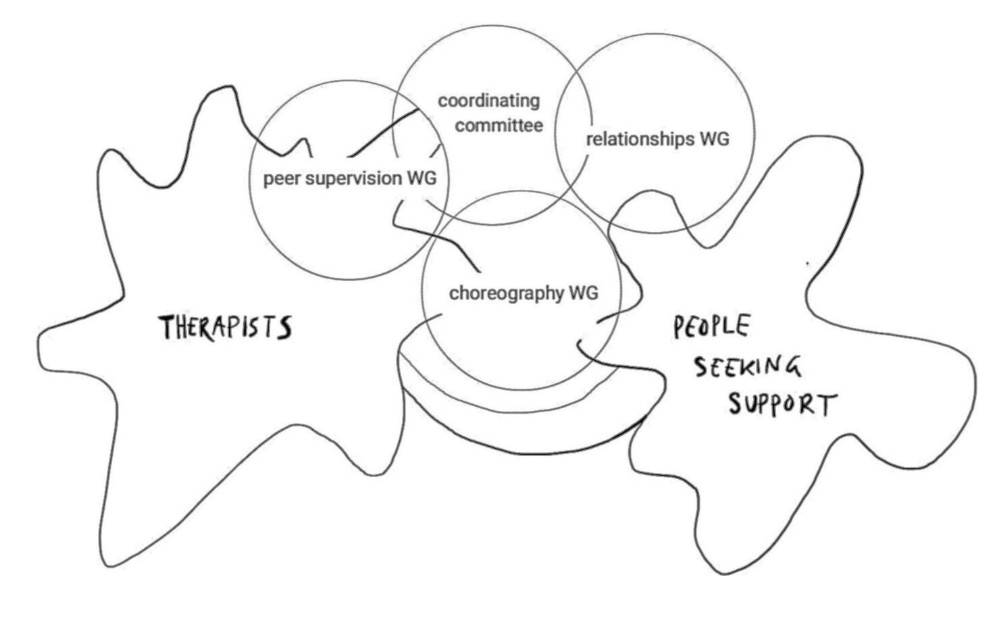
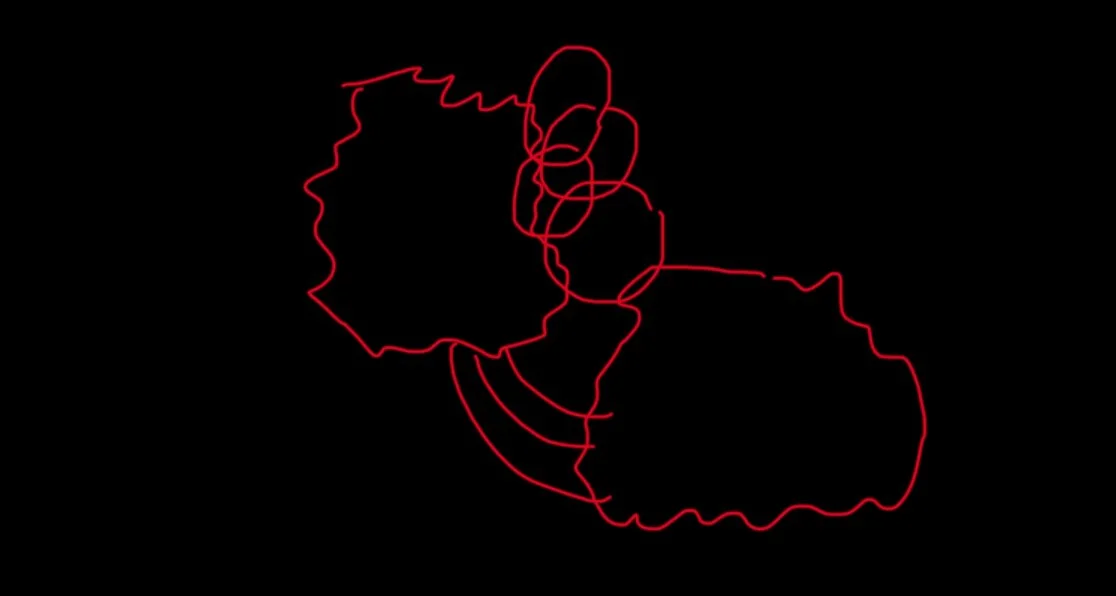
A free clinic is a body, a group of organs and connective parts. In preparation for a daylong event we organize in December, zero and I make a drawing together, passing lines back and forth over Signal chat. We want to visualize the structure of the free clinic to print out on pink paper, to have as a reference when we’re in the room together. At this point, we’ve been building Free Clinic NYC for a year and a half and haven’t yet tried to draw it.
The drawing shows two lungs, frenetic shapes: one for therapists and one for people seeking support. The therapists’ lung and the people-seeking-support lung are connected by working groups, by the relationships we make within and between, as Daniel says, the dyad and the group. Free Clinic NYC is a group made by and connected through the dyad, a dyad that asks what it means to be dis/connected by and within struggle. We make and remake many dyads. We become many groups.
Free Clinic NYC is a group made and structured by subgroups. At present, the Free Clinic organizes within a modified spokescouncil model. The Coordinating Committee shares leadership and stewardship roles and responsibilities, with members acting as co-coordinators of working groups. The eight people who originally got together in May 2024 following the police raid of the Gaza Solidarity Encampment at City College became the initial working group of the Free Clinic, which later became the Coordinating Committee. Additional working groups were developed as our Free Clinic grew later that summer. As of spring 2026, five of the original eight members continue to play active, sustained roles as Coordinating Committee members. At a moment of growth, and as we dig more deeply into questions about how to sustain this formation and collective practice for the long term of political struggle, we embrace questions about how we act as a group. How do we envision the Coordinating Committee changing over time? And what is the relationship between this question and what Free Clinic NYC could become?
The Choreography Working Group devises, rehearses, and maintains the operations of the clinic. Choreography is a body for creating (mostly dyadic) therapeutic relationships. The Relationships Working Group builds and maintains organizing relationships (that may, sometimes, also be or act as therapeutic relationships) with aligned political formations and groups. The Peer Supervision Working Group holds the frame in our relationships with one another as therapists and organizers, offering monthly peer supervision sessions, as well as one-on-one peer support.
What kind of a group is a free clinic? We have wondered whether it’s misleading or aspirational to call our clinic free. We explore questions about what it means to be free—and the relationship between free as in no money exchanged, free as in no cops or prisons, and free as in free association. We are interested in the power and possibility of the therapeutic dyad which meets within the frame and horizon of Free Clinic NYC to determine together what kind of therapeutic relationship is mutually possible, is mutually desired. In many cases of longer-term work, this involves a fee.
Free Clinic NYC is a decentralized group. We have also wondered whether it’s misleading or aspirational to call our free clinic a clinic. We do not have dedicated offices like Harlem’s Larfargue Clinic had the church basement on 133rd Street (Mendes, Duong) or a living space or studio like Saint-Alban had the liberated hospital (Robcis, Nazif ). Like Fanon forged at Blida-Joinville and Oury and Guattari sought to make again at La Borde. We call our group a clinic, a free clinic, thinking of these basements and hospitals, historical models and experiments, thinking of Freud and the Vienna Ambulatorium, thinking of the Freepsy network, of the therapeutic commons of Palestine and in Brazil, comrades working outside of the U.S. who ask us difficult questions about our institutionalized imaginations. Free Clinic NYC therapists practice where they work and sometimes where they don’t. We call our group a clinic and a free clinic to forge a relationship with free, with practices of asking what it means to be free, of asking with others.
JANUARY 4, 2026
I think about how for Lacan one goal of psychoanalysis is to come up with a new way to speak the symbolic coordinates that fix who we are, how we are, for the first time, in the address to the other, with speech working in the future anterior, the speaker always becoming what she will have been in and through the address. Maybe working in the group we collectivize, de-polarize this process. A polyphony of symbolic becoming. But/and the streets are running red with blood. Maybe that’s why I don’t want to write about the group as separate from the organizing work we do. How do we lose ourselves and find ourselves in the group—endure this losing and finding in a group that includes people seeking support who are not therapists and those who are therapists and those who are seeking it in ways that are audible and those whose seeking is inaudible, seeking support in ways that haven’t been spoken yet?